


Imagine yourself in a mathematics class. The teacher is working out a problem on the board, and deftly arrives at an answer and starts explaining it to the class. Even while they were at it, you noticed that a mistake had been committed along the way, thereby arriving at an erroneous answer. Would you raise your hand, stand up, and tell the teacher that they’ve made a mistake?
Doing that – even though it is the right thing – is not easy. We can go so far as to say that it is rather difficult. While good teachers would accept their mistake openly and go on to correct it, the chance of the teacher holding a grudge against a student for pointing out such mistakes is also not unheard of. After all, teachers are also humans, often with their own imperfections.
Imagine then if someone in their late teens or early twenties had to point out the mistakes in calculations of someone considered one of the greatest mathematicians – not just of his age, but all time. Even though German astronomer and mathematician Johannes Kepler had just passed away in the preceding years, it didn’t make the task of pointing out a mistake in his calculations any easier for English astronomer Jeremiah Horrocks.
Dearth of materials
Born in 1618 at Toxteth, 5km from Liverpool, Horrocks was the son of a watchmaker and was largely self taught in his early years. He had a love for studying natural phenomena, but lack of proper books and instruction in mathematics meant that he didn’t have everything he required to take things forward. In 1632, still in his early teenage years, Horrocks therefore set out for Emmanuel College, Cambridge – by foot from Lancashire to Cambridge! He put himself through that journey of over 350 km with the objective of studying the stars.
His limited means meant that Horrocks had to work as a sizar (a student who receives an allowance toward college expenses and who originally acted as a servant to other students in return for this allowance) while studying at Cambridge. This included serving fellow students with their needs, and even emptying their bedpans if need be, to pay his way.
Horrocks left without a degree, and there are rumours that that was because he’d run out of things to read at Cambridge! At 17, he became a tutor at Toxteth and two years later he was appointed curate at Hoole, near Preston.
Poems about telescope
By 1638, Horrocks went further along his dream of studying the stars as he finally possessed a new telescope. Having had to limit his astronomy work with a more primitive instrument, the telescope, which was only decades old at that time, emboldened him to reach for the stars.
A Jeremiah Horrocks memorial at Garston. Notice that it includes a line from one of his poems about the telescope.
| Photo Credit:
Rodhullandemu / Wikimedia Commons
In addition to being an astronomer and mathematician, Horrocks was also a poet. So fascinated was he with his telescope, that he sang its praise in poetic verse:
Divine the hand which to Urania’s power
Triumphant raised the trophy, which on man
Hath first bestowed the wondrous tube by art
Invented, and in noble daring taught
His mortal eyes to scan the furthest heavens.
Progress in lunar theory
One of Horrocks first successes in astronomy came in lunar theory. He was the first to state the ellipticity of the moon’s orbit, and he also stated the reasons for evection (regular variation in the eccentricity of the moon’s orbit around the Earth, caused mainly by the sun’s attraction) and annual equation (an inequality in the moon’s longitudinal motion that shows an annual pattern). Horrocks’ work put a lot of pieces in place for English polymath Isaac Newton when his time came. Newton, on his part, acknowledged many of Horrocks’ observations in his Principia.
Horrocks’ best contribution is easily his observation of the transit of Venus in 1639, which is the first such recorded observation of the astronomical event. Having familiarised himself intimately with the work of Kepler and Polish polymath Nicolaus Copernicus, Horrocks was aware of Kepler’s predictions about the transit of Venus.
Kepler’s prediction
Based on his calculations, Kepler, who died in 1630, had predicted that the next two transits of Venus would occur in 1631 and 1761. While revising the tables that he had in use, Horrocks found out that another transit would actually take place in 1639. The slight errors in Kepler’s tables were probably the reason for him omitting it.
With little time before the event was actually due to take place, Horrocks rushed to inform friend and fellow astronomer William Crabtree, of Manchester. Despite the lack of time, the duo were able to coordinate and observe the transit of Venus in two different locations, thereby providing confirmation and offering crucial measurements and observations.

An art work depicting Jeremiah Horrocks making the first observation of a transit of Venus in 1639.
| Photo Credit:
Eyre Crowe / Wikimedia Commons
On November 24, 1639 – the day the transit took place according to the Julian calendar that was in use then in England, December 4 in the Gregorian calendar we use now – Horrocks had made all the preparations for observing the event. He had made arrangements for the image projected from his telescope to fall on a sheet of white paper. This paper had a circle traced on it with a diameter of six inches, and the circumference was divided into degrees.
Observes through the day
He started at sunrise, watching the sun up until nine in the morning. Following an hour’s break, he resumed his observation, doing it from 10 to 12 noon. With little to show for his efforts so far, he took another break and resumed just after three in the afternoon. You can imagine his joy when he finally found a black spot just within the limb of the sun, at the internal contact. In the next half an hour that followed, he made continuous observations, making it a grand success.
As fate would have it, Horrocks died less than 14 months later, in January 1641. His untimely death at the tender age of 22 meant that he never got a chance to publicise his greatest work, and he never gained the respect and praise that might have been his otherwise.
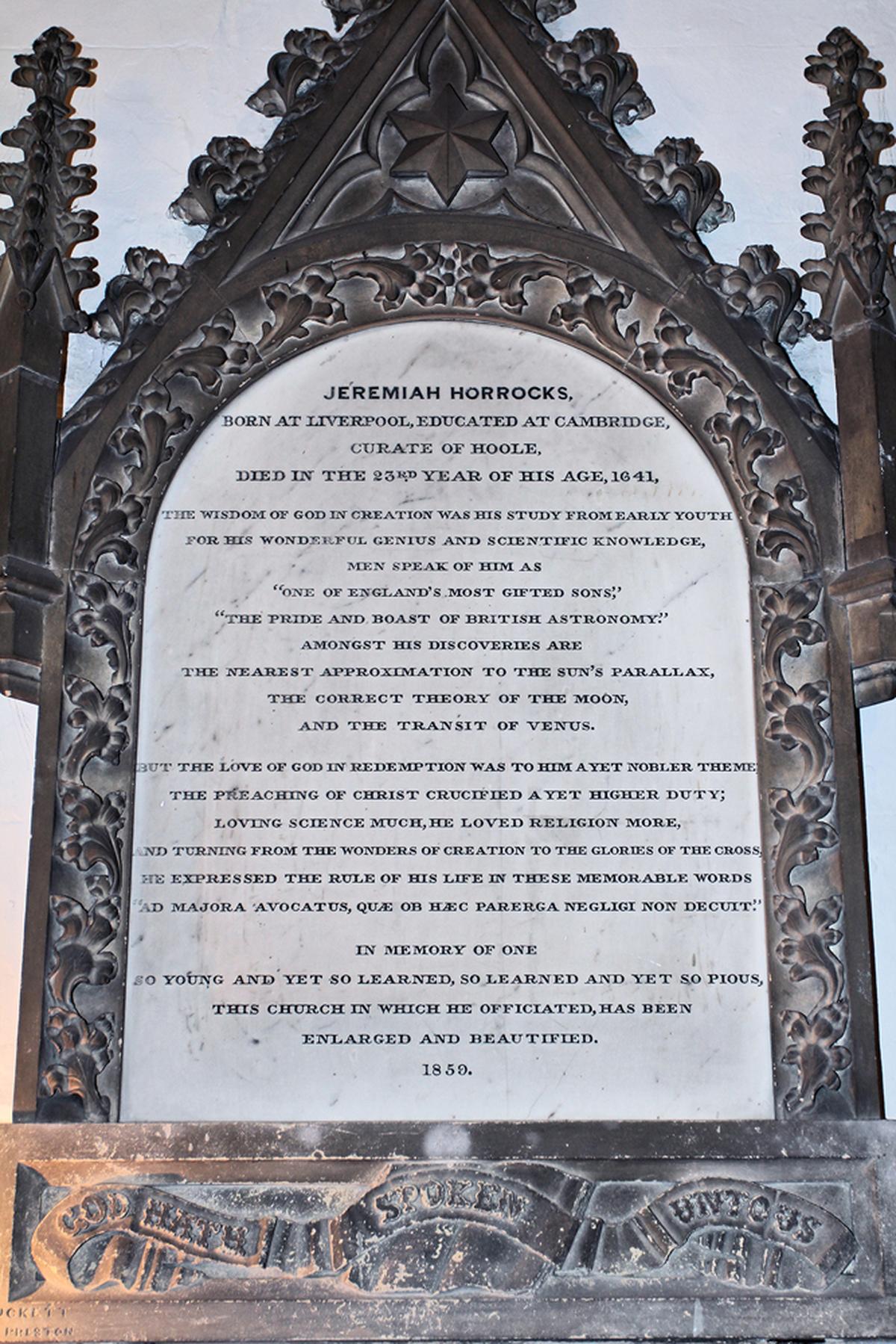
Memorial to Jeremiah Horrocks at a church in Hoole. The inscription talks about his life and his achievements.
| Photo Credit:
Craigthornber / Wikimedia Commons
In fact, his work on the transit of Venus might have been nearly lost forever due to the ravages of the civil war and the Great Fire of London. What survived was a Latin manuscript, which was passed on from one astronomer to another for decades after Horrocks’ death before it was eventually published in 1662.
What is the transit of Venus?
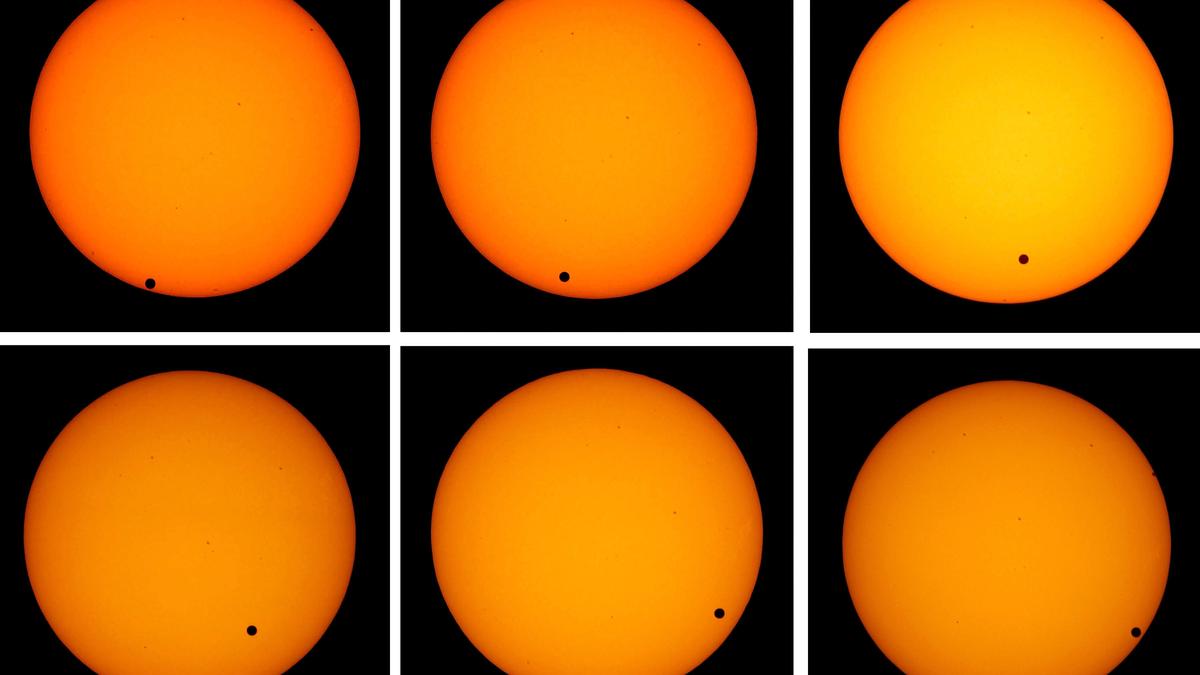
A rare astronomical event, a transit of Venus occurs when Venus passes between the Earth and the sun.
Venus appears as a small black circle that moves across the face of the sun during the transit of Venus.
Even though it is much bigger than our moon, it appears as a dot and doesn’t cause an eclipse like our moon does as it is much farther away from our Earth.
The transit of Venus occurs in pairs periodically. After a pair occurs eight years apart around December, there’s a gap of 121.5 years before the next pair occurs. This pair, which takes place eight years apart around the month of June, is then followed by a gap of 105.5 years, before the pair of Venus transits in December takes place again. The 243-year cycle (8+121.5+8+105.5) keeps repeating itself, with the dates advancing just by a couple of days.
Studying Venus transits helps scientists better understand the atmosphere of our neighbouring planet and also learn more about the elements that layer above its surface.
Published – November 24, 2024 12:55 am IST