


Skip to content
  • Facebook
  • X
  • Linkedin
  • WhatsApp
  • YouTube
  • Associate Journalism
  • About Us
  • Privacy Policy
  • 033-46046046
  • editor@artifex.news
Artifex.News

Artifex.News

Stay Connected. Stay Informed.

  • Breaking News
  • World
  • Nation
  • Sports
  • Business
  • Science
  • Entertainment
  • Lifestyle
  • Toggle search form
  • Who is Susie Wiles, Donald Trump’s new White House chief of staff?
    Who is Susie Wiles, Donald Trump’s new White House chief of staff? World
  • Nagaland’s 1st Medical College Inaugurated By Union Health Minister
    Nagaland’s 1st Medical College Inaugurated By Union Health Minister Nation
  • 26-Year-Old Dental Student Dies By Suicide At Ghaziabad Hostel: Cops
    26-Year-Old Dental Student Dies By Suicide At Ghaziabad Hostel: Cops Nation
  • Access Denied Sports
  • India’s H1 trade with China declines amid slowdown
    India’s H1 trade with China declines amid slowdown Business
  • “Corruptors Are Constantly Looking For A Route”: Outgoing ICC Anti-Corruption Chief’s Big Claim
    “Corruptors Are Constantly Looking For A Route”: Outgoing ICC Anti-Corruption Chief’s Big Claim Sports
  • Bangladesh’s main opposition party plans mass rally as tensions run high ahead of general election
    Bangladesh’s main opposition party plans mass rally as tensions run high ahead of general election World
  • Venezuelan opposition candidate seeks support on regional tour
    Venezuelan opposition candidate seeks support on regional tour World
The INO that wasn’t and the JUNO that is

The INO that wasn’t and the JUNO that is

Posted on November 26, 2025 By admin


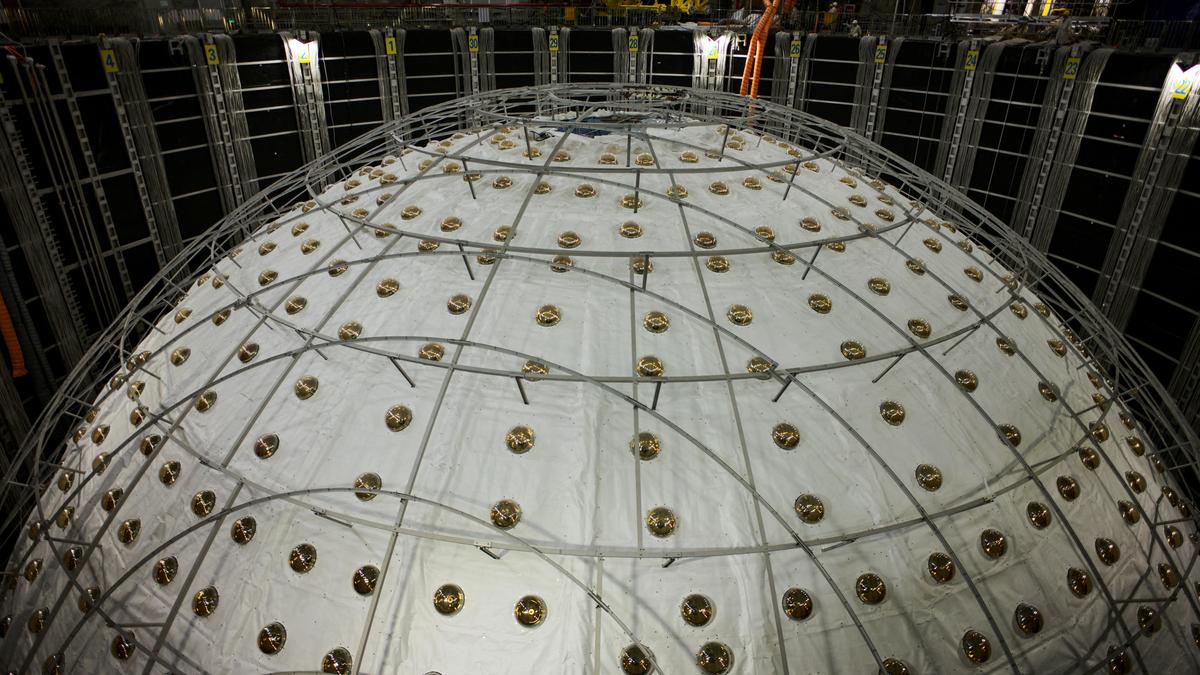
China has finished building its Jiangmen Underground Neutrino Observatory (JUNO), a bittersweet development given that the India-based Neutrino Observatory (INO) has been in limbo for years. Both JUNO and INO were designed to study subatomic particles called neutrinos, which are very hard to catch because they rarely interact with matter. This is why both INO and JUNO are huge: the more matter there is, the more interactions there will be between neutrinos and matter, and thus more opportunities for study.

Progress on JUNO

However, this size was perhaps the original trigger of the INO’s downfall, so to speak, in India. Because the INO detector was so massive (weighing 50 kilotonnes), it could not be operated from inside a lab nor could scientists situate its detector in an existing facility. Instead, the INO collaboration had planned to install the detector inside a mountain in Theni in Tamil Nadu, together with other research facilities. The mountain’s rock was to serve as a natural shield for the detector, obviating the need for a separate structure, which would have been expensive.

However, the scale of the construction activity in the area and the involvement of the Department of Atomic Energy, which was helping fund the project, spooked the locals and spurred local leaders to draw political mileage from that. The INO collaboration also erred (in hindsight) by not following procedure and by not estimating how controversial the project could become, which, if it had done, would have helped it respond to and manage certain public sentiments better.

In the late 2010s, these delays were painful as China moved in leaps to realise JUNO. The ‘pain’ was because the INO collaboration was hoping to secure a limited pool of grants and investments from foreign governments to operate the detector. China expected to complete JUNO by 2020 but that turned out to be five years too soon. If it had said it would aim for 2025, would the INO have had a better chance by no longer having a tight deadline? Maybe not but it wouldn’t have been implausible either.

Today, while the INO remains stalled, JUNO has released its first analyses. The JUNO team uploaded two preprint papers on November 18. One reported the “initial performance results of the JUNO detector”. Its author list reveals the sort of international collaboration India was hoping for, with researchers from Armenia, Belgium, Brazil, Chile, Taiwan, the Czech Republic, Finland, France, Germany, Italy, Pakistan, Russia, Slovakia, Thailand, the U.K., and the U.S. participating.

It is not clear why there are no researchers from India. Journalist Jatan Mehta has documented a similar issue in the space science sphere: researchers from India were conspicuous by their absence in the (first) list of applications to access the rocks China had brought back from the moon on its Chang’e-5 mission in 2020. India has a long history in neutrino physics and analysing lunar samples, and boasts of many excellent scholars in these fields.

The second preprint paper reported the object of INO’s study. Even though neutrinos are so elusive, physicists have discovered that they come in three types, or flavours, and that they can oscillate between these as they travel through space.

Figuring out how the three neutrino masses are ordered is an important open question — and it is related to neutrino oscillations, which are in turn described by three figures called θ-12 (“theta one two”), θ-13, and θ-23. Previous experiments have pinned down θ-13, and JUNO and INO were conceived to use this prior knowledge to determine the neutrino mass ordering. In the second paper, the JUNO collaboration reported that it had measured θ-12 very precisely, in a way broadly consistent with previous findings.

On the back of this, Institute of High Energy Physics scientist and JUNO project manager and spokesperson Yifang Wang had said, “With this level of accuracy, JUNO will soon determine the neutrino mass ordering, test the three-flavour oscillation framework, and search for new physics beyond it.”

Rising bar

While we can debate the way the INO collaboration (at times), bureaucrats, political leaders, and some activists conducted themselves during the saga, one must acknowledge that in this domain, missing the bus on one occasion does not mean you can catch the next one; it means the next one has to be something more sophisticated than a bus for your efforts to mean anything. India had the wherewithal in the previous decade to help crack an important scientific mystery. But if JUNO helps surmount this challenge, India may not have the resources to take a shot at the next big mystery on this front because it will be more specialised and require more sophisticated technologies. Then again, only a fool would bet against the ingenuity and resourcefulness of young scientists to come up with a way.

What grates more is the spectre of “resource constraints” — sometimes all too real, sometimes a bogeyman that administrators invoke to not fund research or, crucially, the skills and materials required to manage its consequences for local communities. Still, there is no room for the notion that India is not ready for a Big Science project. Both the large ground-based telescopes of astronomy and the protected areas of conservation constitute Big Science, and India has many of them. Perhaps the bigger lesson is that we should not attempt such a project solely by whether our scientists alone are ready; we should also check whether the conditions beyond science and on the ground are ready as well.

Published – November 27, 2025 01:37 am IST


Source link

Science Tags:India-based Neutrino Observatory, Jiangmen Underground Neutrino Observatory, Study of neutrinos, Subatomic particles

Post navigation

Previous Post: Access Denied
Next Post: The INO that wasn’t and the JUNO that is

Related Posts

  • The trouble with a Nobel for mRNA COVID vaccines
    The trouble with a Nobel for mRNA COVID vaccines Science
  • Counting calories: a brief history
    Counting calories: a brief history Science
  • Study offers clues to why COVID-19 vaccine protection wanes quickly
    Study offers clues to why COVID-19 vaccine protection wanes quickly Science
  • Panic in the time of cholera: addressing issues critical to managing a resurgence 
    Panic in the time of cholera: addressing issues critical to managing a resurgence  Science
  • Sci-Five | The Hindu Science Quiz: On Indian Institute of Astrophysics
    Sci-Five | The Hindu Science Quiz: On Indian Institute of Astrophysics Science
  • Spin Science: Explaining the Magnus effect
    Spin Science: Explaining the Magnus effect Science

More Related Articles

What does spaceflight do to the human body? | Explained What does spaceflight do to the human body? | Explained Science
370 billion crickets are farmed for food every year; scientists have found they may feel pain 370 billion crickets are farmed for food every year; scientists have found they may feel pain Science
Lab-grown human ‘embryo’ created without eggs or sperm Lab-grown human ‘embryo’ created without eggs or sperm Science
What is Google’s ‘quantum advantage’ leap? | Explained What is Google’s ‘quantum advantage’ leap? | Explained Science
Polaris Dawn: why world’s first private spacewalk wasn’t just a vanity project Polaris Dawn: why world’s first private spacewalk wasn’t just a vanity project Science
Lack of trees causing heat waves, other climate-induced events in Karnataka Lack of trees causing heat waves, other climate-induced events in Karnataka Science
SiteLock

Archives

  • September 2026
  • August 2026
  • July 2026
  • June 2026
  • May 2026
  • April 2026
  • March 2026
  • February 2026
  • January 2026
  • December 2025
  • November 2025
  • October 2025
  • September 2025
  • August 2025
  • July 2025
  • June 2025
  • May 2025
  • April 2025
  • March 2025
  • February 2025
  • January 2025
  • December 2024
  • November 2024
  • October 2024
  • September 2024
  • August 2024
  • July 2024
  • June 2024
  • May 2024
  • April 2024
  • March 2024
  • February 2024
  • January 2024
  • December 2023
  • November 2023
  • October 2023
  • September 2023
  • August 2023
  • July 2023
  • June 2023
  • May 2023
  • April 2023
  • March 2023
  • February 2023
  • January 2023
  • December 2022
  • November 2022
  • October 2022
  • September 2022
  • August 2022
  • July 2022
  • June 2022
  • May 2022

Categories

  • Business
  • Nation
  • Science
  • Sports
  • World

Recent Posts

  • OFC menace persists in Bengaluru as new GBA regulations remain pending
  • Manal bounces back after failing to make it to u-19 WC team
  • Old era of jingoism, equating Nepali nationalism with anti-Indianism, is over: Nepal Finance Minister
  • Parts of Hyderabad receive brief showers on September 20
  • India thrash Indonesia 13-1 in Asian Games men’s hockey opener

Recent Comments

  1. Anthonylop on UP Teacher Who Asked Students To Slap Muslim Classmate
  2. Anthonylop on UP Teacher Who Asked Students To Slap Muslim Classmate
  3. TimmyMEs on UP Teacher Who Asked Students To Slap Muslim Classmate
  4. Josephjab on UP Teacher Who Asked Students To Slap Muslim Classmate
  5. Angelbem on UP Teacher Who Asked Students To Slap Muslim Classmate
  • Car Owner Discovers Cat, 4 Kittens In Engine Cavity After Drive
    Car Owner Discovers Cat, 4 Kittens In Engine Cavity After Drive Nation
  • Silver futures hit new peak of ₹2.32 lakh/kg as global prices cross -mark
    Silver futures hit new peak of ₹2.32 lakh/kg as global prices cross $75-mark Business
  • Access Denied
    Access Denied Nation
  • Starzella, Valiant Stream, Osaka and Flavianus shine
    Starzella, Valiant Stream, Osaka and Flavianus shine Sports
  • Access Denied
    Access Denied Nation
  • When welfare met demographic concerns
    When welfare met demographic concerns Science
  • Access Denied World
  • Iranian TV Journalist Stabbed Outside Home In London
    Iranian TV Journalist Stabbed Outside Home In London World

Editor-in-Chief:
Mohammad Ariff,
MSW, MAJMC, BSW, DTL, CTS, CNM, CCR, CAL, RSL, ASOC.
editor@artifex.news

Associate Editors:
1. Zenellis R. Tuba,
zenelis@artifex.news
2. Haris Daniyel
daniyel@artifex.news

Photograher:
Rohan Das
rohan@artifex.news

Artifex.News offers Online Paid Internships to college students from India and Abroad. Interns will get a PRESS CARD and other online offers.
Send your CV (Subjectline: Paid Internship) to internship@artifex.news

Links:
Associate Journalism
About Us
Privacy Policy

News Links:
Breaking News
World
Nation
Sports
Business
Entertainment
Lifestyle

Registered Office:
72/A, Elliot Road, Kolkata - 700016
Tel: 033-22277777, 033-22172217
Email: office@artifex.news

Editorial Office / News Desk:
No. 13, Mezzanine Floor, Esplanade Metro Rail Station,
12 J. L. Nehru Road, Kolkata - 700069.
(Entry from Gate No. 5)
Tel: 033-46011099, 033-46046046
Email: editor@artifex.news

Copyright © 2023 Artifex.News Newsportal designed by Artifex Infotech.