


Skip to content
  • Facebook
  • X
  • Linkedin
  • WhatsApp
  • YouTube
  • Associate Journalism
  • About Us
  • Privacy Policy
  • 033-46046046
  • editor@artifex.news
Artifex.News

Artifex.News

Stay Connected. Stay Informed.

  • Breaking News
  • World
  • Nation
  • Sports
  • Business
  • Science
  • Entertainment
  • Lifestyle
  • Toggle search form
  • Indian Consulate In Seattle Hosts Business Forum Ahead Of Visit By Trade Mission From Washington State Business
  • Not for Russia to ‘decide’ if West can deploy troops to Ukraine: NATO chief Mark Rutte
    Not for Russia to ‘decide’ if West can deploy troops to Ukraine: NATO chief Mark Rutte World
  • Access Denied Sports
  • Access Denied
    Access Denied Nation
  • To Curb Fraud, Banks May Soon Call You From Numbers Starting With These Digits
    To Curb Fraud, Banks May Soon Call You From Numbers Starting With These Digits Nation
  • Access Denied
    Access Denied Nation
  • Kohli Or Jaiswal? Sourav Ganguly Picks Rohit Sharma’s Opening Partner For T20 WC 2024
    Kohli Or Jaiswal? Sourav Ganguly Picks Rohit Sharma’s Opening Partner For T20 WC 2024 Sports
  • Here’s Why Elon Musk’s SpaceX Steps In To Launch India’s GSAT-N2 Satellite
    Here’s Why Elon Musk’s SpaceX Steps In To Launch India’s GSAT-N2 Satellite World
Clearest black hole merger signal yet allows probe of Hawking’s law

Clearest black hole merger signal yet allows probe of Hawking’s law

Posted on November 5, 2025 By admin


On September 14, 2015, researchers using a pair of giant detectors in the US detected gravitational waves for the first time — a century after Albert Einstein predicted their existence  in his general theory of relativity. For their contributions to building these detectors, called the Laser Interferometer Gravitational-wave Observatories (LIGO), Rainer Weiss, Kip Thorne, and Barry Barish were awarded the Nobel Prize for physics in 2017.

According to the general theory of relativity, when any sufficiently massive object accelerates through spacetime, it will set off ripples of gravitational energy through its fabric. These gravitational waves can travel uninterrupted across billions of lightyears at the speed of light. The louder waves are produced by the most fierce cosmic events, including colliding neutron stars and black holes.

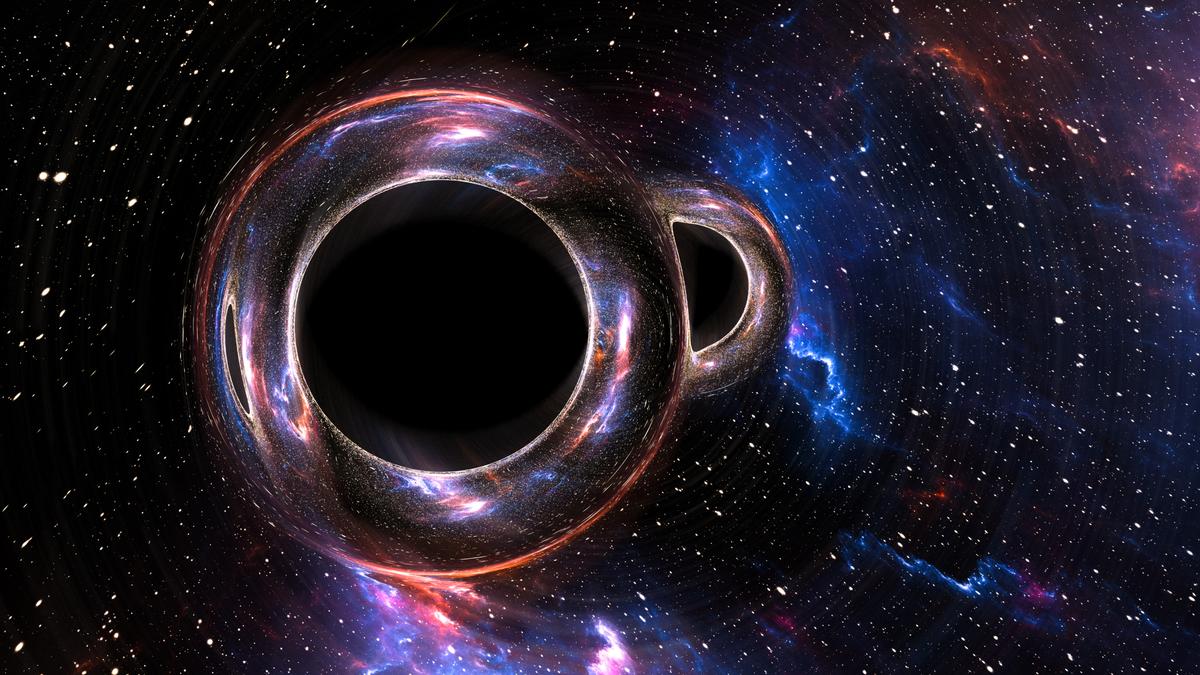
This year, as researchers worldwide celebrated the 10th anniversary of the first detection of gravitational waves, they also announced another groundbreaking discovery. A network of detectors — LIGO in the US, Virgo in Italy, and KAGRA in Japan — had detected a clearer gravitational wave signal from a pair of merging black holes. The event was named GW250114 as it was detected on January 14, 2025.

Notably, the researchers said this was the clearest gravitational wave signal detected to date, allowing them to use it to test some of the more elusive predictions of fundamental physics theories.

Their results were published in Physical Review Letters in September.

Black-hole hunter

The twin LIGO detectors first detected GW250114. Each LIGO consists of two 4-km-long arms arranged in an L-shape. The arms have a vacuum. At the elbow, a highly stable laser beam is split into two beams and sent down  the perpendicular arms, bouncing back and forth between mirrors about 300 times.

When no gravitational wave is passing through the detector, the two beams travel exactly the same distance and cancel each other out when they recombine at a photodetector at the elbow. But when a gravitational wave is passing through, it distorts spacetime there in minute ways, slightly stretching one arm while compressing the other, changing the distance each beam travels by a small fraction. This causes the laser light waves to shift out of phase and produce a measurable flicker of light at the photodetector.

Virgo and KAGRA work on similar principles. When a gravitational wave is detected, the teams operating these three detectors share their data and run joint analyses.

“We look for signals in the data from our detectors with several methods. Some are model-agnostic and others are model-independent,” study coauthor, Virgo team member, and Gran Sasso Science Institute doctoral student Jacopo Tissino said.

Model-agnostic methods try to identify excess energy that appears simultaneously across all detectors, without making any assumptions about the nature of the signal. In contrast, model-dependent methods search  the data specifically for signals that align with theoretical expectations for black-hole mergers.

The GW250114 signal, which came from about 1.3 billion lightyears away, was detected using both methods.

Cosmic bell

The team found that the new signal was similar to the one detected in 2015.

“They are both pairs of nearly identical black holes, with small or no spin, masses just over 30-times that of the sun each, and revolving around each other in an orbit that’s close to a circle,” Mr. Tissino said.

Thanks to advances that increased the detectors’ sensitivity, the new signal was also much clearer. Per Mr. Tissino, these advances include lower laser noise, cleaner mirror surfaces, and lower measurement uncertainty.

As the clearest gravitational signal ever detected, GW250114 allowed the researchers to draw important conclusions about fundamental physics. Notably, they analysed the frequencies of gravitational waves emitted by the merger to present the most compelling observational evidence to date of the black-hole area theorem, which Stephen Hawking proposed in 1971.

The theorem states that the total surface area of black holes should never decrease, referring to the sum of the areas of the event horizons.

To this end, researchers independently analysed the signals from the early stages of the merger, when the black holes were relatively far apart, and from a later post-collision stage, when the merged black holes were settling into a single entity.

“With these two analyses, we could extract the areas of the initial two black holes and of the remnant left after the collision, and directly compare them to confirm that there was an increase as predicted,” Mr. Tissino said.

An aerial view of the LIGO detector site near Livingston, USA.
| Photo Credit:
LIGO Laboratory/Reuters

Growing catalogue

After the merger, the researchers also ‘listened’ to the new black hole’s vibrations and identified two distinct modes of ringing. These frequencies indicated that the resulting black hole behaved like a rotating black hole. Such black holes are expected to emit gravitational waves at specific frequencies and these waves are expected to fade at a certain rate.

As a result, the new study was also able to empirically verify a solution  that New Zealander mathematician Roy Kerr had proposed for rotating black holes in 1963.

Mr. Tissino said that for signals like GW250114, the main sources of error are well-understood and can be controlled. Researchers carefully selected data from different points of time before and after the merger and tested different assumptions, like whether the black holes’ orbits were circular or eccentric. In the process, they checked potential issues in the detectors’ calibration and confirmed they didn’t affect their analyses.

The continuing detection of merging black holes is helping astrophysicists build a steadily growing catalogue that’s helping them fine-tune their understanding of black hole formation and test more and more intricate predictions.

As the authors wrote in their paper, “The gravitational-wave signal GW250114 is a milestone in the decade-long history of gravitational-wave science. … The next decade of gravitational-wave science is bound to enhance our view of these highly dynamical, relativistic systems.”

Shreejaya Karantha is a freelance science writer.

Published – November 05, 2025 04:00 pm IST


Source link

Science

Post navigation

Previous Post: EU strikes last-ditch deal on climate targets as COP30 looms
Next Post: Access Denied

Related Posts

  • ISRO hand-holding start-ups to foster space ecosystem
    ISRO hand-holding start-ups to foster space ecosystem Science
  • Israel Gaza war: what is a famine
    Israel Gaza war: what is a famine Science
  • Song lyrics are getting simpler, more repetitive: study
    Song lyrics are getting simpler, more repetitive: study Science
  • PSLV-C62/EOS-N1 Mission encounters anomaly during end of PS3 stage
    PSLV-C62/EOS-N1 Mission encounters anomaly during end of PS3 stage Science
  • Rush to return humans to the moon could threaten opportunities for astronomy
    Rush to return humans to the moon could threaten opportunities for astronomy Science
  • What is a megamaser?
    What is a megamaser? Science

More Related Articles

New AI method helps identify which dinosaur made which footprints New AI method helps identify which dinosaur made which footprints Science
What are colours and how do people understand them? | Explained What are colours and how do people understand them? | Explained Science
Watch: Explained: All about India’s new nuclear energy bill Watch: Explained: All about India’s new nuclear energy bill Science
Photobiology: speeding up enzyme reactions in microbes using light Photobiology: speeding up enzyme reactions in microbes using light Science
An unlikely mystery: studies shed new light on how genes are made An unlikely mystery: studies shed new light on how genes are made Science
World’s cleanest pigs raised to grow kidneys, hearts for humans World’s cleanest pigs raised to grow kidneys, hearts for humans Science
SiteLock

Archives

  • May 2026
  • April 2026
  • March 2026
  • February 2026
  • January 2026
  • December 2025
  • November 2025
  • October 2025
  • September 2025
  • August 2025
  • July 2025
  • June 2025
  • May 2025
  • April 2025
  • March 2025
  • February 2025
  • January 2025
  • December 2024
  • November 2024
  • October 2024
  • September 2024
  • August 2024
  • July 2024
  • June 2024
  • May 2024
  • April 2024
  • March 2024
  • February 2024
  • January 2024
  • December 2023
  • November 2023
  • October 2023
  • September 2023
  • August 2023
  • July 2023
  • June 2023
  • May 2023
  • April 2023
  • March 2023
  • February 2023
  • January 2023
  • December 2022
  • November 2022
  • October 2022
  • September 2022
  • August 2022
  • July 2022
  • June 2022
  • May 2022

Categories

  • Business
  • Nation
  • Science
  • Sports
  • World

Recent Posts

  • Three-day Mohiniyattam masterclass at Fort Kochi
  • Sri Lanka’s Fisheries Minister urges CM Vijay to ban bottom trawling
  • Tasmac shuts 150 outlets in three days; salesmen face challenges from customers
  • IPL 2026: Tilak keeps his cool at the crunch as MI hands PBKS a fifth straight loss
  • High-flying Royal Challengers feel at home in unfamiliar conditions

Recent Comments

  1. AllanSwexy on UP Teacher Who Asked Students To Slap Muslim Classmate
  2. Davidcag on UP Teacher Who Asked Students To Slap Muslim Classmate
  3. CordellVoice on UP Teacher Who Asked Students To Slap Muslim Classmate
  4. Wesleyunfix on UP Teacher Who Asked Students To Slap Muslim Classmate
  5. JasonDag on UP Teacher Who Asked Students To Slap Muslim Classmate
  • “Raebareli, Amethi Not Just Constituencies, But Our Karmabhoomi”: Rahul Gandhi
    “Raebareli, Amethi Not Just Constituencies, But Our Karmabhoomi”: Rahul Gandhi Nation
  • Ashwin, a modern master with a positive mindset
    Ashwin, a modern master with a positive mindset Sports
  • Access Denied
    Access Denied Nation
  • G-20 members stressed on need to increase climate finance to help farmers take up adaption measures: Agriculture secretary
    G-20 members stressed on need to increase climate finance to help farmers take up adaption measures: Agriculture secretary Business
  • Access Denied Sports
  • Access Denied World
  • Access Denied World
  • Access Denied Sports

Editor-in-Chief:
Mohammad Ariff,
MSW, MAJMC, BSW, DTL, CTS, CNM, CCR, CAL, RSL, ASOC.
editor@artifex.news

Associate Editors:
1. Zenellis R. Tuba,
zenelis@artifex.news
2. Haris Daniyel
daniyel@artifex.news

Photograher:
Rohan Das
rohan@artifex.news

Artifex.News offers Online Paid Internships to college students from India and Abroad. Interns will get a PRESS CARD and other online offers.
Send your CV (Subjectline: Paid Internship) to internship@artifex.news

Links:
Associate Journalism
About Us
Privacy Policy

News Links:
Breaking News
World
Nation
Sports
Business
Entertainment
Lifestyle

Registered Office:
72/A, Elliot Road, Kolkata - 700016
Tel: 033-22277777, 033-22172217
Email: office@artifex.news

Editorial Office / News Desk:
No. 13, Mezzanine Floor, Esplanade Metro Rail Station,
12 J. L. Nehru Road, Kolkata - 700069.
(Entry from Gate No. 5)
Tel: 033-46011099, 033-46046046
Email: editor@artifex.news

Copyright © 2023 Artifex.News Newsportal designed by Artifex Infotech.