





Colour plays an outsized role in the human experience of modern life. It invests both natural and synthetic worlds with beauty and meaning. Colours don’t deny universalism — a red sign will make you stop anywhere on the planet — yet they also make room for human cultures to appropriate them in unique, even discordant, ways. As the human understanding of colour has improved, and continues to do so, this knowledge has also broadened our sense of our place in this world, and the other life-forms with which we share it.
What is colour?
Colour is a type of information our eyes receive and process based on electromagnetic radiation. An object by itself can’t be said to have a colour — but based on which frequencies of visible-light radiation it absorbs, reflects, and/or scatters, we can perceive the object to have a particular colour.
In the human eye, the rod and the cone cells receive information in the light that strikes the eye: the rod cells record brightness while the cone cells record the wavelengths, which the human brain interprets as colour. Human beings have three types of cone cells. Each type is sensitive to light of a different wavelength, and they work together to input colour information to the brain.
The possession of three types of cone cells is why humans are called trichromats. Many birds and reptiles, on the other hand, are tetrachromats (four types of cone cells). Similarly, while human vision is restricted to wavelengths from 400 nm to 700 nm (a.k.a. visible light), honeybees can also ‘see’ ultraviolet light and mosquitoes and some beetles can access information in some wavelengths of infrared radiation. (Humans sense the latter has heat.)
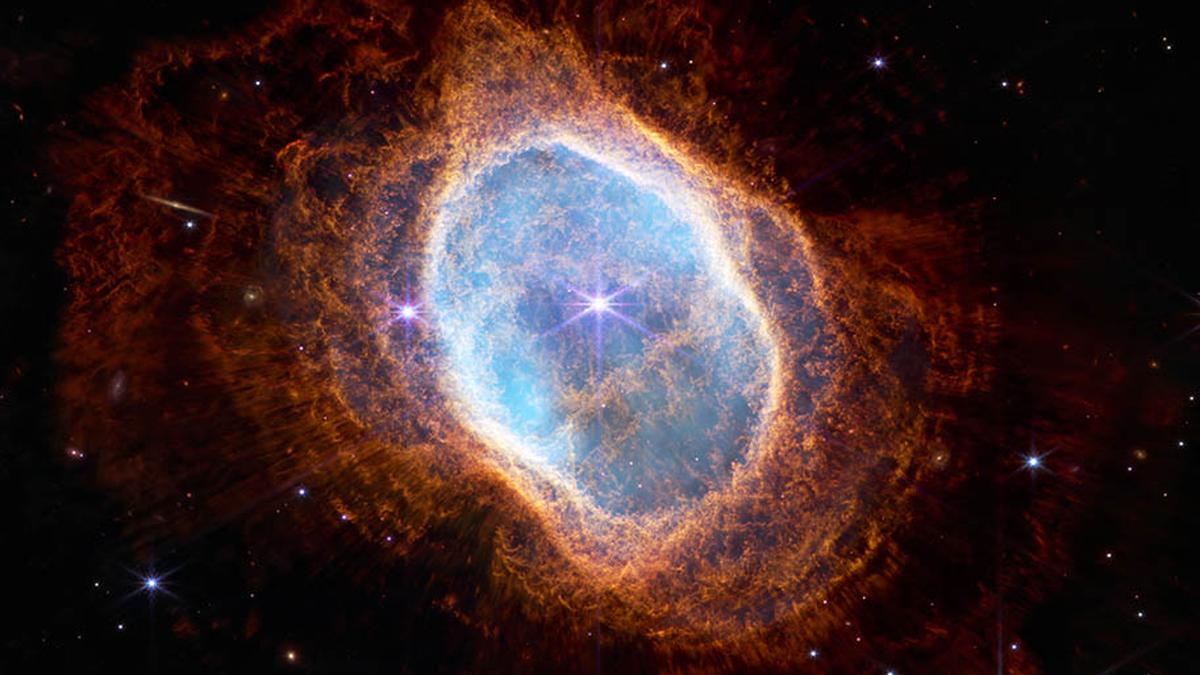
This limitation, such as it is, is why those spectacular images captured by space telescopes of celestial wonders like nebulae need to be false-coloured: to highlight the information secreted in radio waves, X-rays, gamma rays, ultraviolet light, etc. Seen in visible light alone, many of these images will have much less visual detail.

A composite image of the M82 galaxy with X-ray data recorded by the Chandra telescope (blue); infrared light recorded by the Spitzer telescope (red); hydrogen emissions recorded by the Hubble space telescope (orange), and the bluest visible light (yellow-green). Rendered in 2006.
| Photo Credit:
NASA
Is there a science of colours?
There are many ways to produce specific colours. The art of mixing some colours to produce others is rooted in colour theory.
Until the late 19th century, traditional colour theory specified the different ways in which dyes, pigments, and inks could be mixed to make other colours. In this paradigm, there were three primary colours — e.g. red, yellow, and blue — that when combined in different ways could produce all the colours the human eye is capable of seeing.
But modern colour theory, more accurately colour science, rejected the idea of there being three fixed colours. Instead, according to colour science, all the colours that could be produced by combining any three colours in different ways is called the gamut of those three colours. Each colour in a gamut populates a given colour space, and all colour spaces are smaller than the full range of colours the eye can see.
How are colours rendered?
There are two broad ways to render colours: additive and subtractive colouring. In additive colouring, light of different wavelengths is ‘mixed’ to yield light of one combined colour. The colours on your smartphone screens and television sets are produced in this way.
A common colour space associated with additive colouring is the RGB space: where red, green, and blue when added to each other in varying measures produces other colours.
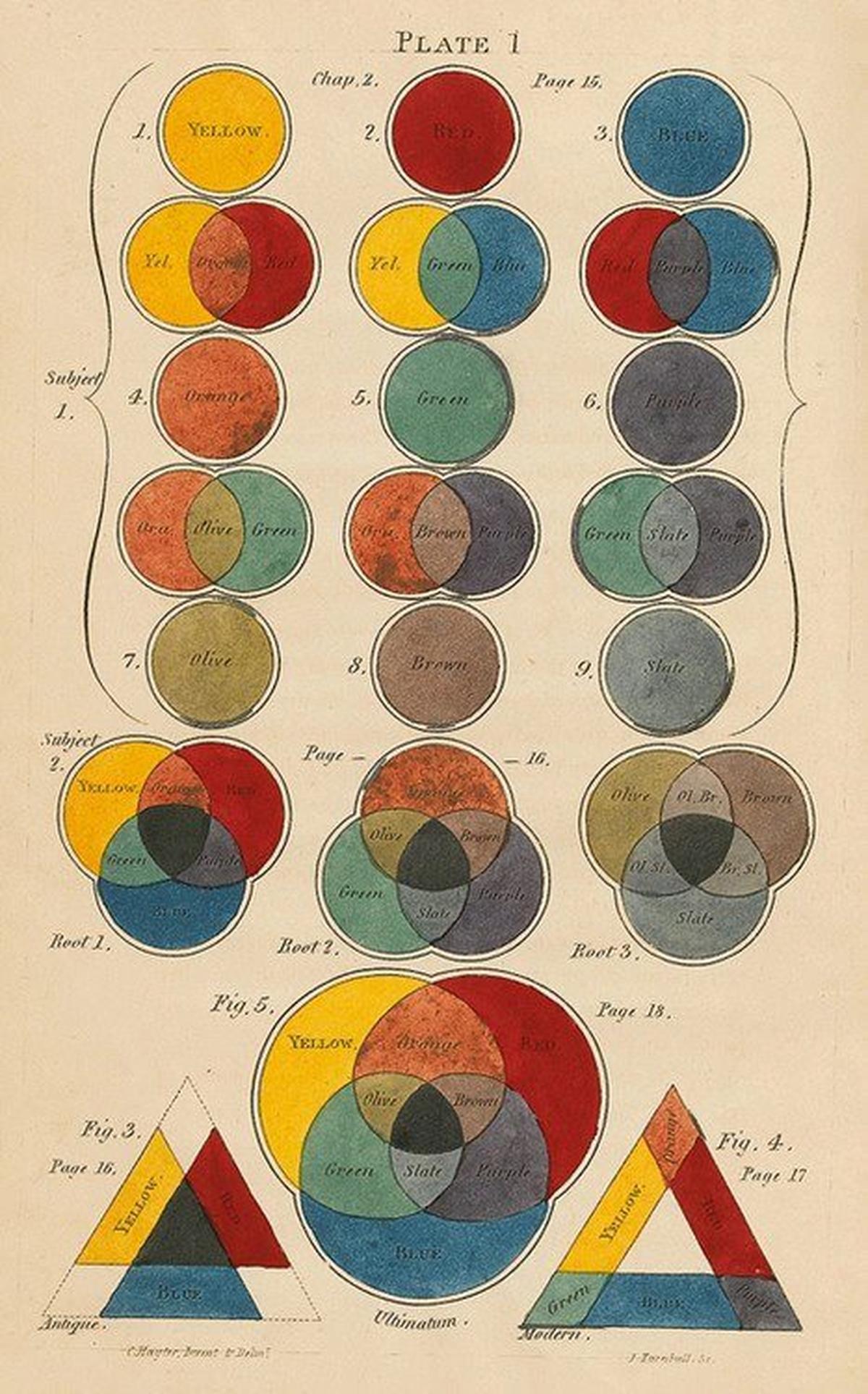
The English painter Charles Hayter produced this “colour diagram” in his 1826 book, showing how multiple colours can be produced by combining three.
| Photo Credit:
Public domain
In subtractive colouring, a colour is rendered by passing white light through a medium that absorbs, or takes away, specific wavelengths of light, leaving the rest to render a particular colour.
The typical examples include dyes, pigments, and inks. A dye is a chemical compound that can absorb certain wavelengths of light. When, say, a cloth is dyed, the dying compound forms chemical bonds with compounds in the cloth and imbues the cloth with the corresponding (subtractive) colour. A pigment does the same thing without forming chemical bonds. An ink is a solution that contains a dye, a pigment or some other colouring substance.

What are the properties of colour?
In colour science, all colours however rendered are said to have a few appearance parameters: hue, brightness, lightness, and chromaticity.
In 2002, a technical committee of the International Commission on Illumination specified the definition of hue to be the degree to which a given (perceived) colour can be said to be “similar to or different from” perceived “red, orange, yellow, green, blue, violet”. Isaac Newton defined complementary colours on the basis of hue: if two colours combine to produce a greyscale colour — i.e. lacking in hue — they are complementary.
Brightness is related to an object’s luminance. The luminance is the power emitted by a source of light per unit area, weighted by wavelength; the eye’s subjective perception of this power in some direction is inferred as the source’s brightness.
Lightness refers to the extent to which a coloured object appears light compared to a white-coloured object that is well lit.
The chromaticity, or chromatic intensity, has to do with the human perception of colour and depends on the colour’s quality irrespective how well it is lit.
How have people related to colour?
The place and roles of colour in human cultures are too wide-ranging and multifaceted to capture in one short article. Colours, and the degrees of freedom associated with them, have made their presence felt in art, the organisation of social classes, natural philosophy, trade, innovation, the expression of cultural symbols, climate change (‘green’ and ‘greenwashing’), politics, and religion — to name a few human endeavours.
Just for three examples:
(i) In the famous painting ‘The Scream of Nature’ by the Norwegian painter Edvard Munch, the sky is rendered in shades of red and orange — a combination Munch himself famously described as “blood red”, to represent an “infinite scream passing through nature”.
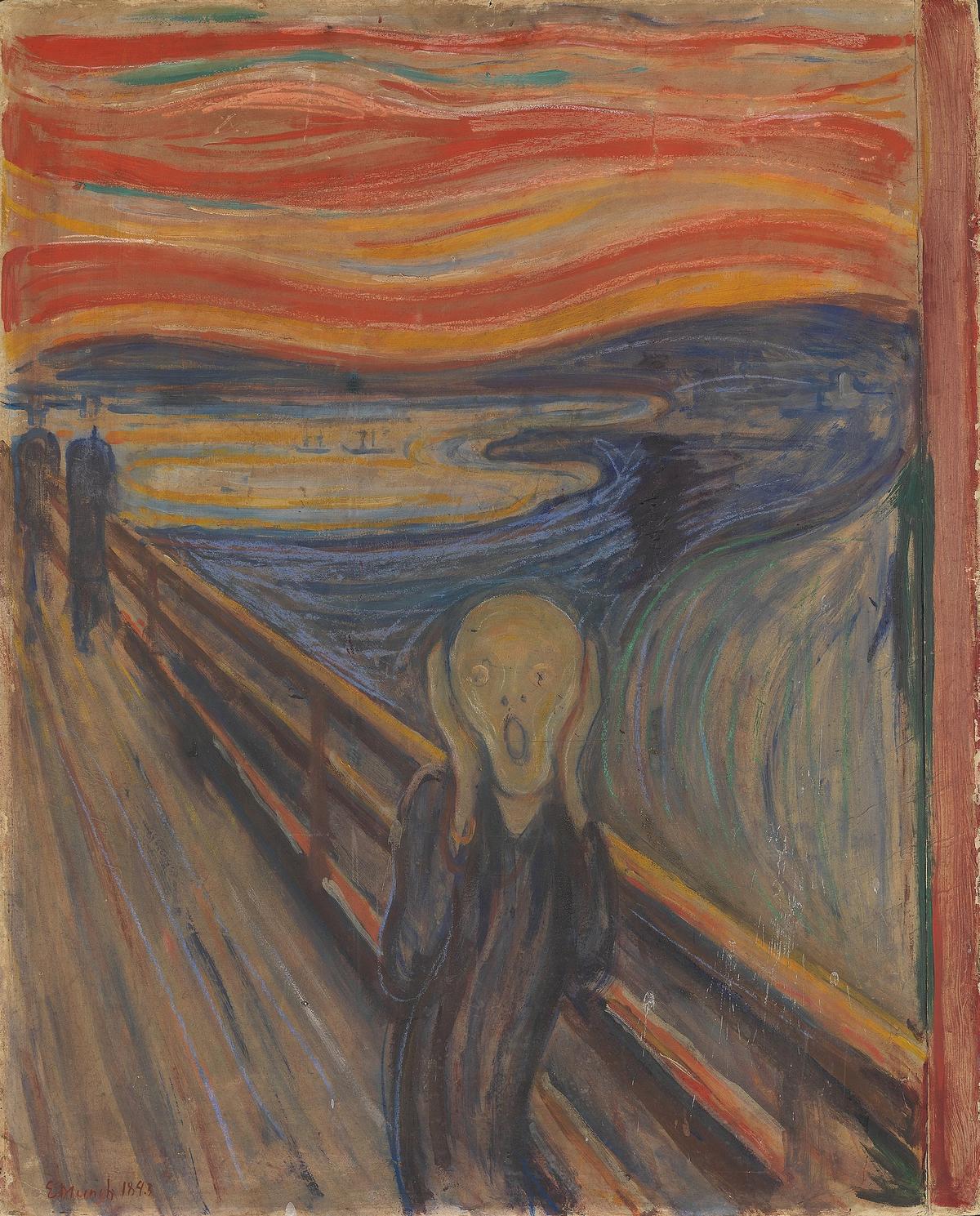
‘The Scream of Nature’ by Edvard Munch, 1893.
| Photo Credit:
Public domain
Why did the sky have such a terrible colour? Some experts have said this could have been the result of the eruption of Krakatoa in Indonesia in 1883. One effect of this devastating event was a tremendous amount of dust in the air for years to come, and dust scatters redder light more, giving the sky the same hues.
(ii) Scientists have dated the use of a pigment called ochre by prehistoric humans to more than 200,000 years ago. This is illuminating because we learn something about how much intelligence these humans had. The use of ochre suggests the ability to make it, and to make ochre, you need to mix ferric oxide, clay, and sand together in the right proportions.
Archaeological records of pigment use, among others, in Africa have also been used to argue against Eurocentrism in the field: manifesting as the belief that, for example, behaviours typical of the ‘modern human’ first turned up around 40,000-50,000 years ago based on excavations in Europe — whereas the African record would suggest these behaviours arose multiple millennia earlier.

(iii) Light-emitting diodes (LEDs) transformed consumer technologies and industrial and household energy consumption in the 21st century — yet the transformation had to wait for the invention of blue LEDs.
LEDs use additive colouring to produce colours. In the 1970s, scientists had found a way to make LEDs that emitted red light and green light — two of the three primary colours in the RGB colour space — but they didn’t have a way to make them emit blue light. Yet they desperately needed a blue LED because combining the three colours would produce white light, which is the most common lighting colour in household and industrial settings, and therefore had tremendous commercial value.
Scientists in Japan finally found a way to make blue LEDs by the late 1980s, and for which they and others had to develop sophisticated techniques to make crystals that went on to transform other industries as well.