


Skip to content
  • Facebook
  • X
  • Linkedin
  • WhatsApp
  • YouTube
  • Associate Journalism
  • About Us
  • Privacy Policy
  • 033-46046046
  • editor@artifex.news
Artifex.News

Artifex.News

Stay Connected. Stay Informed.

  • Breaking News
  • World
  • Nation
  • Sports
  • Business
  • Science
  • Entertainment
  • Lifestyle
  • Toggle search form
  • Uddhav Thackeray May “Hug Hamas” For Power: Eknath Shinde’s Fierce Attack
    Uddhav Thackeray May “Hug Hamas” For Power: Eknath Shinde’s Fierce Attack Nation
  • Man Stabbed To Death By Neighbours After Fight Over Not Flushing Toilet
    Man Stabbed To Death By Neighbours After Fight Over Not Flushing Toilet Nation
  • Internet Approves India’s Cricket World Cup Jersey, That Comes With A Twist. Watch
    Internet Approves India’s Cricket World Cup Jersey, That Comes With A Twist. Watch Sports
  • Bajrang Punia Calls NADA Arrogant, Says He Is Being Targeted
    Bajrang Punia Calls NADA Arrogant, Says He Is Being Targeted Sports
  • Access Denied
    Access Denied Nation
  • Defeated RB Leipzig Lose More Ground On Bayern Munich, Eintracht Frankfurt Go Second
    Defeated RB Leipzig Lose More Ground On Bayern Munich, Eintracht Frankfurt Go Second Sports
  • Access Denied
    Access Denied Nation
  • India vs New Zealand Hourly Weather Update, World Cup 2023: Could Dharamsala Rain Wash Out High-Profile Clash?
    India vs New Zealand Hourly Weather Update, World Cup 2023: Could Dharamsala Rain Wash Out High-Profile Clash? Sports
What helped Vikram lander to soft-land on the moon

What helped Vikram lander to soft-land on the moon

Posted on September 9, 2023 By admin


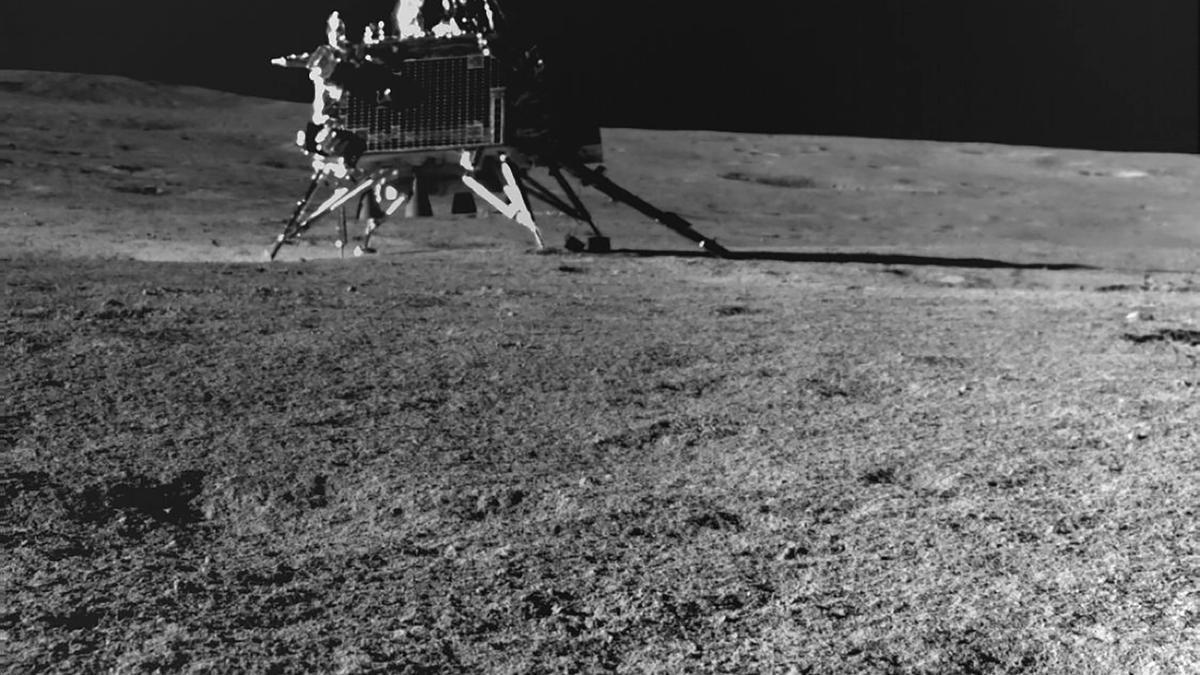
On July 22, 2019, India successfully launched Chandrayaan-2, the second mission to the moon. Twenty-two days later (August 14), after a series of orbit raising manoeuvres, the spacecraft finally escaped the earth’s gravity and followed a path towards the moon. Six days later, Chandrayaan-2 was successfully inserted into lunar orbit. Finally, on September 2, the Vikram lander separated from the Orbiter, performed two de-orbit manoeuvres and on September 6, began its descent to the moon’s surface. The descent went as planned up to an altitude of 2.1 km from the Moon’s surface before communication from the lander to the ground stations was lost. The Vikram lander had apparently crash-landed on the Moon. 

Soon a national-level failure analysis committee headed by Dr. V. Narayanan, Director of the Liquid Propulsion Systems Centre (LPSC), was formed with experts drawn from national institutes and ISRO to study the cause of failure and to propose necessary corrections. The committee pinpointed three crucial mistakes that had happened in succession resulting in the crash.

There are four important phases before the touchdown on the moon — the rough braking phase, the attitude-hold (orientation) phase, the fine braking phase, and the landing phase.

Cause of crash

During the rough braking phase, the velocity of the lander was successfully reduced to a maximum. The problem with the touchdown began when the Vikram lander entered the second phase — the attitude-hold (orientation) phase. During this phase, the thrust had to be maintained at half the level. “But when the engines were commanded to provide half the thrust, the achieved thrust was more than half. The dispersion level [variation in the thrust] was more than what we had assumed during the pre-flight simulations,” explains Dr. K. Sivan, former Chairman of ISRO under whose watch the Chandrayaan-2 was launched in 2019.

The guidance system was supposed to have halved the thrust but it malfunctioned. “The guidance system was not designed to handle large dispersions, and this resulted in the guidance system malfunctioning leading to full thrust being given to the lander,” says Dr. Sivan. “At the end of the attitude-hold phase, the altitude and velocity were very different from the expected values. The guidance-system malfunction was the second crucial error.” 

According to Dr. Sivan, during the fine braking phase, the system was trying to correct the large errors. The large-scale corrections to velocity and altitude demanded large orientation manoeuvres. Changes to orientation are carried out by the control system, but unfortunately the control system was not designed to produce large changes. “Even though there was a large demand for orientation change, the control system restricted the rate. As a result, the control system was unable to provide the necessary large corrections to orientation,” Dr. Sivan says. “The control system was taking more time to correct the orientation due to rate restriction. But by that time the lander had reached the moon’s surface.” This resulted in the lander crashing on the moon.

The crash was caused by three mistakes — the thrust (dispersion level) was more than assumed for design, the flaw in the guidance system resulted in more thrust being given, and the rate restriction in the control system failed to make large-scale changes in the orientation. “The Chandrayaan-2 mission would have been a success if any of the three errors was not there. The three cumulative errors led to the failure,” he says.

Correcting the mistakes

Taking the learnings from Chandrayaan-2 failure, ISRO corrected for all the three major mistakes in the latest mission — the system was corrected to ensure extra dispersion does not happen, the guidance system was corrected, and the restriction in the control system was removed. “These were the major corrections in Chandrayaan-3 lander.

Redundancy was also built into Chandrayaan-3 lander in terms of extra sensors, and extra propellant to allow it to travel to an alternate landing site, if required. And the landing area was expanded from a narrow patch of 500 metres x 500 metres to a 4 km x 2.4 km region.

In addition, other improvements suggested by the failure analysis committee were also incorporated in the Chandrayaan-3 mission.

Extra fuel, sensors and stronger lander legs designed for higher landing velocity led to a net increase in the weight (about 250 kg) of the lander. Since Chandrayaan-3 was not carrying an orbiter like its predecessor, it became possible to accommodate the increased weight.

“Increased weight of the lander meant that a single engine was not sufficient. So the central engine was removed and two engines were used for landing,” Dr. Sivan says. “The central engine was added in the earlier mission as it was suspected that dust stirred by other engines would affect the electronic components. But our analysis found that dust wasn’t a problem.”


Source link

Science Tags:Chandrayaan 3, chandrayaan 3 vikram lander, moon landing india, Soft-landing, vikram lander, Vikram lander to soft-land

Post navigation

Previous Post: Adani Ports, Adani Enterprises’ Promoters Raise Stake
Next Post: India reports far fewer people with orphan diseases

Related Posts

  • Possible pathway for Long COVID pathogenesis uncovered
    Possible pathway for Long COVID pathogenesis uncovered Science
  • Communication a vital skill in today’s era of AI: Vishwanathan Anand
    Communication a vital skill in today’s era of AI: Vishwanathan Anand Science
  • Webb Telescope Discovers Earliest-known ‘dead’ galaxy
    Webb Telescope Discovers Earliest-known ‘dead’ galaxy Science
  • Science for all: A new type of plant that emits light, but without the genetic engineering this time
    Science for all: A new type of plant that emits light, but without the genetic engineering this time Science
  • Defence Minister meets Shubhanshu Shukla, says his journey will motivate young people
    Defence Minister meets Shubhanshu Shukla, says his journey will motivate young people Science
  • Science Snapshots: March 8, 2026
    Science Snapshots: March 8, 2026 Science

More Related Articles

Surviving in India’s salt desert Surviving in India’s salt desert Science
Drogue parachute deployment tests for Gaganyaan mission successful: ISRO Drogue parachute deployment tests for Gaganyaan mission successful: ISRO Science
Andean glacier retreat unprecedented in human civilisation, study finds Andean glacier retreat unprecedented in human civilisation, study finds Science
What do countries and companies want in global plastic treaty talks? | Explained What do countries and companies want in global plastic treaty talks? | Explained Science
What is the NASA Artemis II mission? What is the NASA Artemis II mission? Science
Neither ecologically sustainable nor ethical, says study over translocation of African cheetahs to India Neither ecologically sustainable nor ethical, says study over translocation of African cheetahs to India Science
SiteLock

Archives

  • May 2026
  • April 2026
  • March 2026
  • February 2026
  • January 2026
  • December 2025
  • November 2025
  • October 2025
  • September 2025
  • August 2025
  • July 2025
  • June 2025
  • May 2025
  • April 2025
  • March 2025
  • February 2025
  • January 2025
  • December 2024
  • November 2024
  • October 2024
  • September 2024
  • August 2024
  • July 2024
  • June 2024
  • May 2024
  • April 2024
  • March 2024
  • February 2024
  • January 2024
  • December 2023
  • November 2023
  • October 2023
  • September 2023
  • August 2023
  • July 2023
  • June 2023
  • May 2023
  • April 2023
  • March 2023
  • February 2023
  • January 2023
  • December 2022
  • November 2022
  • October 2022
  • September 2022
  • August 2022
  • July 2022
  • June 2022
  • May 2022

Categories

  • Business
  • Nation
  • Science
  • Sports
  • World

Recent Posts

  • Nicobarese oppose proposal for three wildlife sanctuaries
  • Visakhapatnam Collector calls for inter-departmental synergy to boost investments
  • Kohli’s masterful knock powers Royal Challengers to the top
  • Senior IPS officer Asra Garg posted IGP Intelligence
  • Vijay Narayan earns rare distinction of being Advocate General under two different governments

Recent Comments

  1. StevenLek on UP Teacher Who Asked Students To Slap Muslim Classmate
  2. Leonardren on UP Teacher Who Asked Students To Slap Muslim Classmate
  3. NathanQuins on UP Teacher Who Asked Students To Slap Muslim Classmate
  4. Davidgof on UP Teacher Who Asked Students To Slap Muslim Classmate
  5. NathanJobre on UP Teacher Who Asked Students To Slap Muslim Classmate
  • Asian Games: Indian Men’s Kabaddi Team Beats Chinese Taipei, Secure Semi-Final Berth
    Asian Games: Indian Men’s Kabaddi Team Beats Chinese Taipei, Secure Semi-Final Berth Sports
  • This Public Library In US Is Forgiving Fees For Cat Photos
    This Public Library In US Is Forgiving Fees For Cat Photos World
  • Rohit Sharma Hails India’s T20 World Cup Win As ‘Dream Come True For A Billion’
    Rohit Sharma Hails India’s T20 World Cup Win As ‘Dream Come True For A Billion’ Sports
  • Access Denied Business
  • These Eco-Friendly Polling Booths In Tamil Nadu Is Made Of Coconut, Bamboo Leaves
    These Eco-Friendly Polling Booths In Tamil Nadu Is Made Of Coconut, Bamboo Leaves Nation
  • “Doctor Told Me…”: MS Dhoni Offers Huge Update On Injury And IPL 2024 Return
    “Doctor Told Me…”: MS Dhoni Offers Huge Update On Injury And IPL 2024 Return Sports
  • Over 63% Employees In India Crave Recognition At Workplace, Report Shows
    Over 63% Employees In India Crave Recognition At Workplace, Report Shows Nation
  • Why the GST Council recommended biometric-based Aadhaar authentication for new registrations: Explained
    Why the GST Council recommended biometric-based Aadhaar authentication for new registrations: Explained Business

Editor-in-Chief:
Mohammad Ariff,
MSW, MAJMC, BSW, DTL, CTS, CNM, CCR, CAL, RSL, ASOC.
editor@artifex.news

Associate Editors:
1. Zenellis R. Tuba,
zenelis@artifex.news
2. Haris Daniyel
daniyel@artifex.news

Photograher:
Rohan Das
rohan@artifex.news

Artifex.News offers Online Paid Internships to college students from India and Abroad. Interns will get a PRESS CARD and other online offers.
Send your CV (Subjectline: Paid Internship) to internship@artifex.news

Links:
Associate Journalism
About Us
Privacy Policy

News Links:
Breaking News
World
Nation
Sports
Business
Entertainment
Lifestyle

Registered Office:
72/A, Elliot Road, Kolkata - 700016
Tel: 033-22277777, 033-22172217
Email: office@artifex.news

Editorial Office / News Desk:
No. 13, Mezzanine Floor, Esplanade Metro Rail Station,
12 J. L. Nehru Road, Kolkata - 700069.
(Entry from Gate No. 5)
Tel: 033-46011099, 033-46046046
Email: editor@artifex.news

Copyright © 2023 Artifex.News Newsportal designed by Artifex Infotech.