




Modern computing banks on conventional electronics and algorithms to process data. But because the hardware operates according to the laws of physics, data processing has a physical speed limit. The availability of power further constrains this speed, especially if the software being run is a power-guzzling artificial intelligence (AI) model. Thus one major preoccupation of scientists worldwide is coming up with new kinds of computers that increase the speed limit by operating differently.
One promising kind is light-based, a.k.a. optical, computing. These computers use photons, the particles of light, rather than electrons. Because photons travel at the speed of light and photonic devices generate less heat than electronic devices do, optical computing promises to be faster, have more bandwidth, and be more energy-efficient.
An important part of an optical computer will be the optical fibres that transmit data from one component to another within the machine. This particular technology is already in use worldwide: it transmits billions of bytes of data between countries and continents and enables superfast internet services.
A new door
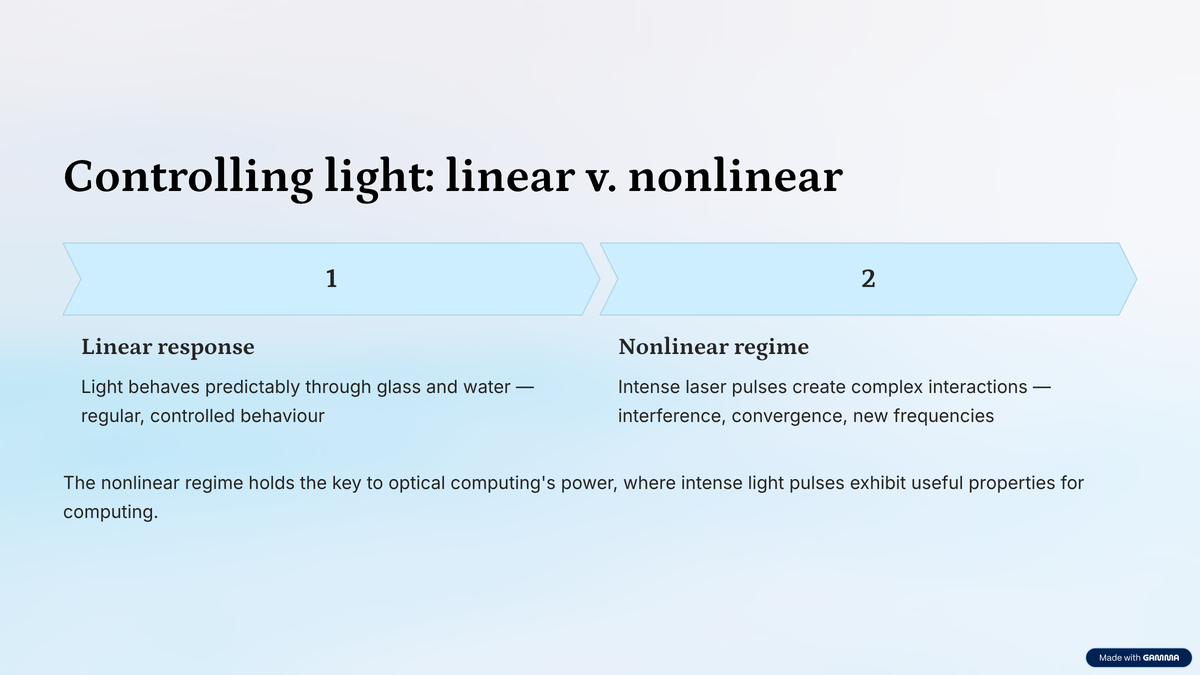
But before scientists can use optical computing to supercharge AI models, they need some handles to control certain physical properties of light. Light usually behaves in a regular, predictable way when it passes through media like glass or water. Scientists know this as light’s linear response.
However, when light pulses are very intense, like those issued by a powerful laser, they elicit a different response from the material they are passing through. This is the non-linear regime. Among others, light pulses in this regime can interfere with each other, spread out or converge, and generate new frequencies (colours) of light.
Linear v. nonlinear regimes
Recently, two research teams — from Tampere University in Finland and Université Marie et Louis Pasteur in France — studied nonlinear interaction between intense light pulses passing through thin glass fibres and uncovered something unusual. The researchers reported that it’s possible to use the physics of light in optical fibres to perform complex AI tasks potentially much faster and with less energy than traditional computers.
The work has opened a door to new types of AI hardware that can be used in areas where speed and efficiency are critical. The findings were published in Optical Letters in June.
Image to numbers and back
In the study, the researchers focused on an AI model called an extreme learning machine (ELM). Instead of using traditional computer chips, they used the physical properties of light travelling through optical fibres to perform calculations. Their main goal was to understand how well this approach worked for recognising images and what factors affected its accuracy.
An ELM is a type of neural network that is fast and simple. It has only one hidden layer (between the input and output layers), and only the output weights are trained. The ELM finds these weights in a single step using a mathematical method, rather than learning through repeated adjustments like in deep neural networks.
In this setup, the input data, like an image, was transformed into a dataset of numbers. This made it easier for the network to separate and classify different types of inputs. Then, the ELM used a simple linear calculation to match the transformed data to the correct label, e.g. which digit an image shows.
Extreme learning machines
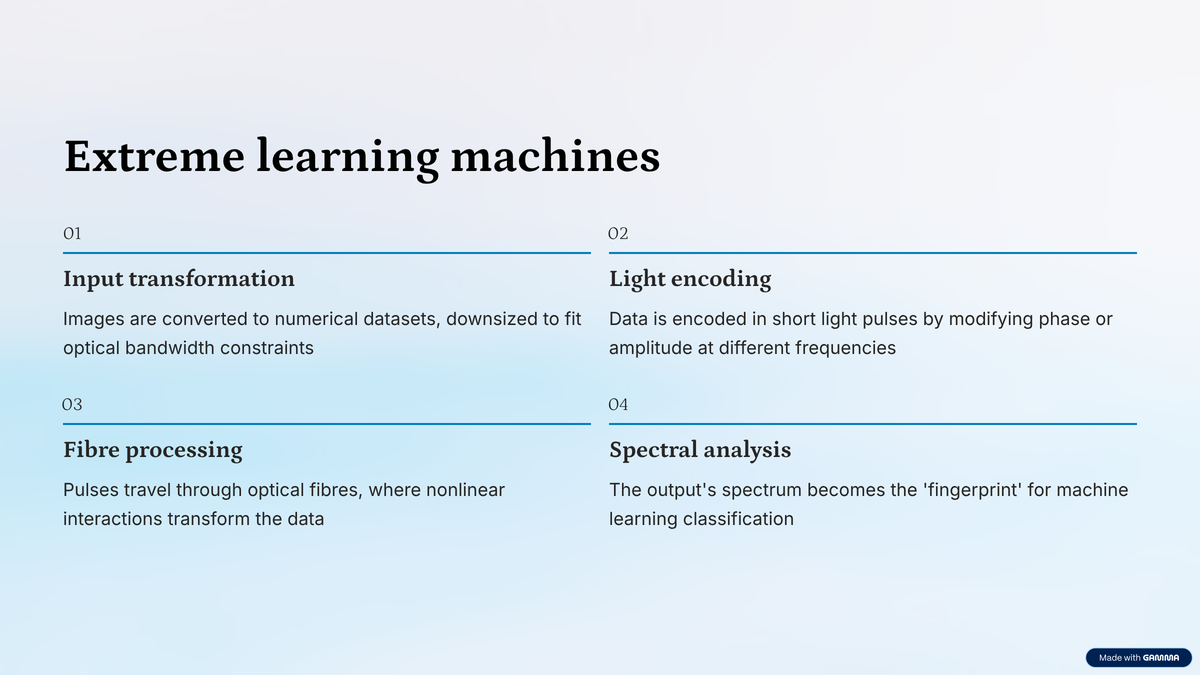
The researchers use the unique properties of light in optical fibres to perform the transformation needed for the ELM.Each image was first downsized — like from 28 × 28 pixels to 10 × 10 — to fit the limited bandwidth of the light pulse. The image data was then encoded onto a very short pulse of light, either by changing the phase (how the light wave oscillates) or the amplitude (how strong the light is) at different frequencies.

Fingerprint in the colours
The encoded light pulse was then sent through a length of optical fibre. The pulse fibre interactions were in the nonlinear regime. The researchers tracked how the fibre responded to the pulses and how different colours of light travel at different speeds, a property called dispersion. These changes mixed up the information in the light pulses in a way that was hard to reverse — but useful for the ELM’s transformation step.
At the end of the fibre, the team measured how much light there was of each colour. This spectrum contained a ‘fingerprint’ of the original image, transformed by the fibre’s nonlinear effects. The team used it as the hidden layer in the ELM — the computing layer between the input and the output that gave rise to the machine’s ‘intelligence’.
In this way, the team trained the ELM on thousands of labelled images. Then they tested the model on new images to see how accurately it could classify them.
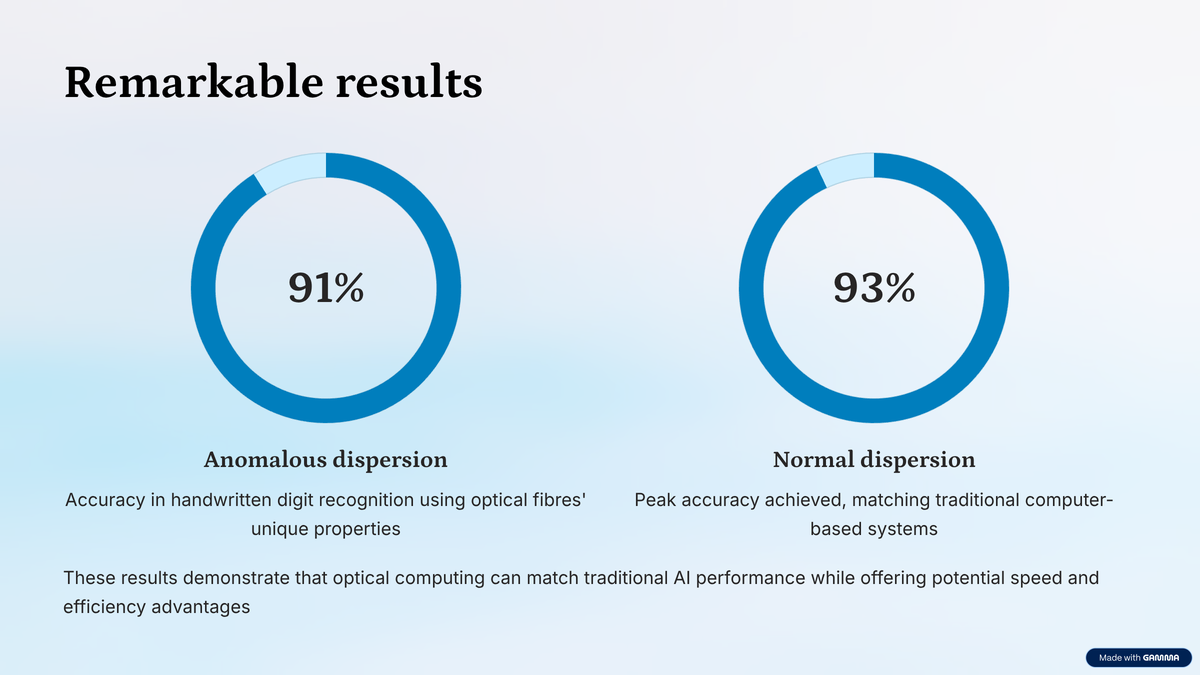
With optimal settings, the team found that the ELM was more than 91% accurate at recognising handwritten digits using the optical fibre’s anomalous dispersion regime and more than 93% accuracy in the normal dispersion regime. These results were close to those achieved by traditional computer-based ELMs but were achieved using the physics of light instead of electronics.
Test with images
Let there be light
According to the published paper, increasing the strength of the nonlinear effects and the fibre fibre length improved accuracy, but only up to a point. Too much of an increase caused the system to become unstable and less accurate. There is thus an optimal range for these parameters.
In sum, the study demonstrated that optical fibres can be used as powerful tools for machine learning, specifically for tasks like image recognition. By carefully tuning the system’s parameters and understanding the effects of noise and encoding, it’s possible to achieve high accuracy using the natural properties of light. This approach could lead to new, faster, and more efficient AI systems in the future.
The scientists who led the teams behind the study said in a statement: “This work demonstrates how fundamental research in nonlinear fibre optics can drive new approaches to computation.”
The study paper did note some limitations it said could be overcome in future research. For example, the team’s model didn’t include all possible real-world effects, such as changes in the light’s polarisation (the direction in which its electric field oscillates). It said future work could also explore encoding information on different polarisation states or using more complex optical fibres. There is also a stated potential to improve the system by measuring not just the spectrum’s intensity but also its phase.
This said, the study highlighted the opportunities within light-based computing with optical fibres to meet the growing demand for faster as well as smarter AI. By using the speed and efficiency of light, computers of the future could think and learn in ways that may make the AI models available to us today seem crude. But this will take many more years as experts and businesspersons design and test new technologies like photonic integrated circuits and optical neural networks.
Paradigm shift
Qudsia Gani is an assistant professor in the Department of Physics, Government Degree College Pattan, Baramulla.
Published – September 12, 2025 05:30 am IST