




Skip to content
  • Facebook
  • X
  • Linkedin
  • WhatsApp
  • YouTube
  • Associate Journalism
  • About Us
  • Privacy Policy
  • 033-46046046
  • editor@artifex.news
Artifex.News

Artifex.News

Stay Connected. Stay Informed.

  • Breaking News
  • World
  • Nation
  • Sports
  • Business
  • Science
  • Entertainment
  • Lifestyle
  • Toggle search form
  • Access Denied Sports
  • Heatwave In 4 States Going To Polls On Friday, Experts Fear Drop In Turnout
    Heatwave In 4 States Going To Polls On Friday, Experts Fear Drop In Turnout Nation
  • ‘No Fear’ As Union Berlin Make Champions League Debut At European Royalty Real Madrid
    ‘No Fear’ As Union Berlin Make Champions League Debut At European Royalty Real Madrid Sports
  • Woman Kills Two Children In Pakistan: Report
    Woman Kills Two Children In Pakistan: Report World
  • Access Denied Sports
  • Access Denied Sports
  • Human Brains Are Not As Fast As We Previously Thought, Study Reveals
    Human Brains Are Not As Fast As We Previously Thought, Study Reveals World
  • How do some cancer cells survive chemotherapy? Scientists find one way
    How do some cancer cells survive chemotherapy? Scientists find one way Science
Microbes that digest plastic may also fuel antibiotic resistance

Microbes that digest plastic may also fuel antibiotic resistance

Posted on August 30, 2025 By admin


Plastic is cheap, versatile, and used almost everywhere, from packaging and textiles to medical supplies. But unlike natural materials, plastic doesn’t simply decay; instead, it breaks down into smaller fragments called microplastics (<5 mm) and nanoplastics (<1 µm).

These particles persist for decades or longer, accumulate in water bodies, and attract other pollutants like heavy metals, antibiotics, and toxic chemicals. They provide sticky surfaces where bacteria thrive, and recent research shows such surfaces can even host microbes carrying antibiotic resistance genes (ARGs). This raises fears that plastic waste may not only choke ecosystems but also help spread antimicrobial resistance (AMR).

Biodegradation offers a potential way forward. Some microbes produce enzymes capable of disintegrating the strong chemical bonds in plastic polymers. A famous example is PETase, discovered in Ideonella sakaiensis, which can degrade polyethylene terephthalate (PET), a common plastic used in bottles. Yet despite such exciting discoveries, natural microbial communities with this ability remain poorly understood, especially in environments where plastic pollution is constant and intense.

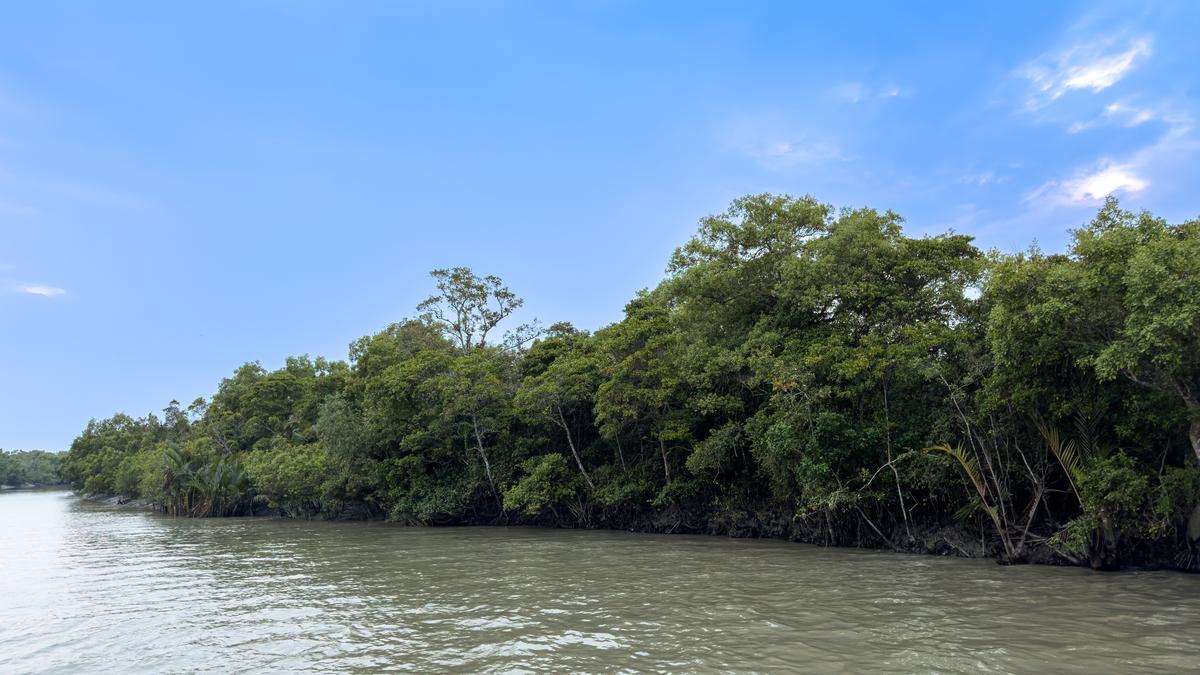
The Sundarbans, stretching across India and Bangladesh, is one such environment. It’s the world’s largest mangrove forest and receives around three billion microplastic particles every day through the rivers that feed into the Bay of Bengal. With such heavy exposure, microbes in this ecosystem may have evolved new ways to handle plastic waste. At the same time, because microplastics can carry antibiotics and metals, the same microbes may also acquire resistance traits.

This two-faced possibility — plastic breakdown plus resistance — is at the heart of new work by scientists at the Indian Institute of Science Education and Research (IISER), Kolkata. Published in FEMS Microbiology Letters, it shows that the floating bacterial community in the Sundarbans possesses the genetic tools to degrade plastics and that these tools are also linked with genes for AMR and metal resistance.

The scientists collected one litre of surface water each month for nearly a year (2020-2021) from a site in the Mooriganga estuary, a branch of the Sundarbans. The water samples were filtered to capture microbial cells, and the DNA from these microbes was extracted. Using a technique called metagenomic sequencing, the researchers read the genetic material of the entire microbial community.

Then they compared the DNA sequences to specialised databases. PlasticDB was used to identify plastic-degrading enzyme (PDE) genes while other resources helped detect ARGs, metal resistance genes (MRGs), and mobile genetic elements — pieces of DNA that allow genes to move between microbes.

The analysis revealed an impressive 838 hits for plastic-degrading enzymes, representing the ability to act on 17 different plastic polymers. Most hits (73%) targeted synthetic plastics such as polyethylene glycol (PEG), polylactic acid, PET, and nylon, while the rest targeted natural polymers like polyhydroxyalkanoates. The single most abundant set of enzymes were those breaking down PEG, suggesting a strong contamination input from biomedical and industrial sources.

The PDEs were more abundant during the monsoon. “HpB reflects the occurrence of PDEs and ARGs per season,” IISER Kolkata biologist and study coauthor Punyasloke Bhadury said this is because “freshwater flow from inland to the coast during monsoon brings in nutrients, bacteria, and other materials including microplastics.”

Crucially, however, the study found that microbes carrying PDEs also often carried resistance genes. Genes for zinc resistance and for resistance to aminoglycoside antibiotics were particularly common among plastic degraders. A co-occurrence network analysis revealed strong associations between PDEs, ARGs, and MRGs, hinting that the same selective pressures — plastic additives, metals, and pollutants — are shaping microbial adaptation.

The findings paint a complex picture. On one hand, the discovery of such a diverse and abundant set of plastic-degrading enzymes is promising. It shows the Sundarbans’ microbial community has already adapted to deal with the flood of plastic waste, potentially offering natural solutions to one of the world’s most pressing environmental challenges.

On the other hand, the very microbes capable of breaking down plastics are also reservoirs of antibiotic and metal resistance genes. If such microbes were deliberately released or enriched in natural settings, they may contribute to the spread of resistance traits, undermining efforts to control AMR. In fact, plastics themselves may serve as hotbeds where resistance genes accumulate and spread between microbes through horizontal gene transfer. This makes the application of plastic-degrading microbes more complicated than it first appears.

“Changing climate can potentially accelerate the transfer of ARGs among bacteria, which may ultimately end up in humans,” Bhadury said. “This could have consequences for One Health and public health in general.”

Madhurima Pattanayak is a freelance science writer and journalist.

Published – August 31, 2025 05:00 am IST



Source link

Science

Post navigation

Previous Post: T20I Tri Series: UAE’s spirited show goes in vain as Pakistan registers second win on trot before Asia Cup
Next Post: Climate, land-use change reduced flows in 70% of China’s river stations

Related Posts

  • On soaps and detergents: how they are made and manufactured
    On soaps and detergents: how they are made and manufactured Science
  • ISRO will take all precautions before manned Gaganyaan mission: Somanath
    ISRO will take all precautions before manned Gaganyaan mission: Somanath Science
  • Argentine biotech firm breeds gene-edited polo super ponies
    Argentine biotech firm breeds gene-edited polo super ponies Science
  • Billion-light-year-wide ‘bubble of galaxies’ discovered
    Billion-light-year-wide ‘bubble of galaxies’ discovered Science
  • New study reveals five genetically-distinct population of Asian elephants in India
    New study reveals five genetically-distinct population of Asian elephants in India Science
  • Investigation into PSLV failures ‘ongoing’, next launch date in June: Minister
    Investigation into PSLV failures ‘ongoing’, next launch date in June: Minister Science

More Related Articles

How can small-scale farmers benefit from trees on farms? How can small-scale farmers benefit from trees on farms? Science
Peripheral neuropathy: why only some mutations cause disease Peripheral neuropathy: why only some mutations cause disease Science
Indian team uses repurposed drug to treat oral cancer subtype Indian team uses repurposed drug to treat oral cancer subtype Science
NISAR mission launch highlights: GSLV-F 16 successfully places NISAR satellite in orbit NISAR mission launch highlights: GSLV-F 16 successfully places NISAR satellite in orbit Science
Why India’s Green Revolution isn’t a blueprint to feed a hungry planet Why India’s Green Revolution isn’t a blueprint to feed a hungry planet Science
Marine heatwave killed four million Alaska seabirds Marine heatwave killed four million Alaska seabirds Science
SiteLock

Archives

  • May 2026
  • April 2026
  • March 2026
  • February 2026
  • January 2026
  • December 2025
  • November 2025
  • October 2025
  • September 2025
  • August 2025
  • July 2025
  • June 2025
  • May 2025
  • April 2025
  • March 2025
  • February 2025
  • January 2025
  • December 2024
  • November 2024
  • October 2024
  • September 2024
  • August 2024
  • July 2024
  • June 2024
  • May 2024
  • April 2024
  • March 2024
  • February 2024
  • January 2024
  • December 2023
  • November 2023
  • October 2023
  • September 2023
  • August 2023
  • July 2023
  • June 2023
  • May 2023
  • April 2023
  • March 2023
  • February 2023
  • January 2023
  • December 2022
  • November 2022
  • October 2022
  • September 2022
  • August 2022
  • July 2022
  • June 2022
  • May 2022

Categories

  • Business
  • Nation
  • Science
  • Sports
  • World

Recent Posts

  • Maruti Suzuki crosses 3 million vehicle dispatches through railways, eyes 35% share by rail
  • Delhi High Court refuses to entertain PIL to prevent suicides
  • Gold ETF prices revive as investors flock on higher import duties on yellow metal
  • Kashmir MLA ‘boycotts’ L-G’s drug campaign after demolition drive in his constituency
  • Assam ships first legal agarwood chips to West Asia

Recent Comments

  1. Jeffreyroure on UP Teacher Who Asked Students To Slap Muslim Classmate
  2. Stevemonge on UP Teacher Who Asked Students To Slap Muslim Classmate
  3. RichardClage on UP Teacher Who Asked Students To Slap Muslim Classmate
  4. StevenLek on UP Teacher Who Asked Students To Slap Muslim Classmate
  5. Leonardren on UP Teacher Who Asked Students To Slap Muslim Classmate
  • Access Denied World
  • Vedanta plans to invest ₹13,226 crore to ramp up aluminium capacity
    Vedanta plans to invest ₹13,226 crore to ramp up aluminium capacity Business
  • Swearing-In Ceremony Of New BJP Government To Be Held In Panchkula On 15 October
    Swearing-In Ceremony Of New BJP Government To Be Held In Panchkula On 15 October Nation
  • Access Denied Sports
  • Pakistan’s Babar Azam rewrites history by scoring record number of fours in Twenty20 internationals
    Pakistan’s Babar Azam rewrites history by scoring record number of fours in Twenty20 internationals Sports
  • IPL Auctions: RCB Batting Coach Dinesh Karthik Delighted With Josh Hazlewood’s Return
    IPL Auctions: RCB Batting Coach Dinesh Karthik Delighted With Josh Hazlewood’s Return Sports
  • Trump Returns To New York Fraud Trial, Complains About Gag Order
    Trump Returns To New York Fraud Trial, Complains About Gag Order World
  • Revisiting Katou-Indel in 17th-century botanical treatise Hortus Malabaricus yields new finds for researchers
    Revisiting Katou-Indel in 17th-century botanical treatise Hortus Malabaricus yields new finds for researchers Science

Editor-in-Chief:
Mohammad Ariff,
MSW, MAJMC, BSW, DTL, CTS, CNM, CCR, CAL, RSL, ASOC.
editor@artifex.news

Associate Editors:
1. Zenellis R. Tuba,
zenelis@artifex.news
2. Haris Daniyel
daniyel@artifex.news

Photograher:
Rohan Das
rohan@artifex.news

Artifex.News offers Online Paid Internships to college students from India and Abroad. Interns will get a PRESS CARD and other online offers.
Send your CV (Subjectline: Paid Internship) to internship@artifex.news

Links:
Associate Journalism
About Us
Privacy Policy

News Links:
Breaking News
World
Nation
Sports
Business
Entertainment
Lifestyle

Registered Office:
72/A, Elliot Road, Kolkata - 700016
Tel: 033-22277777, 033-22172217
Email: office@artifex.news

Editorial Office / News Desk:
No. 13, Mezzanine Floor, Esplanade Metro Rail Station,
12 J. L. Nehru Road, Kolkata - 700069.
(Entry from Gate No. 5)
Tel: 033-46011099, 033-46046046
Email: editor@artifex.news

Copyright © 2023 Artifex.News Newsportal designed by Artifex Infotech.