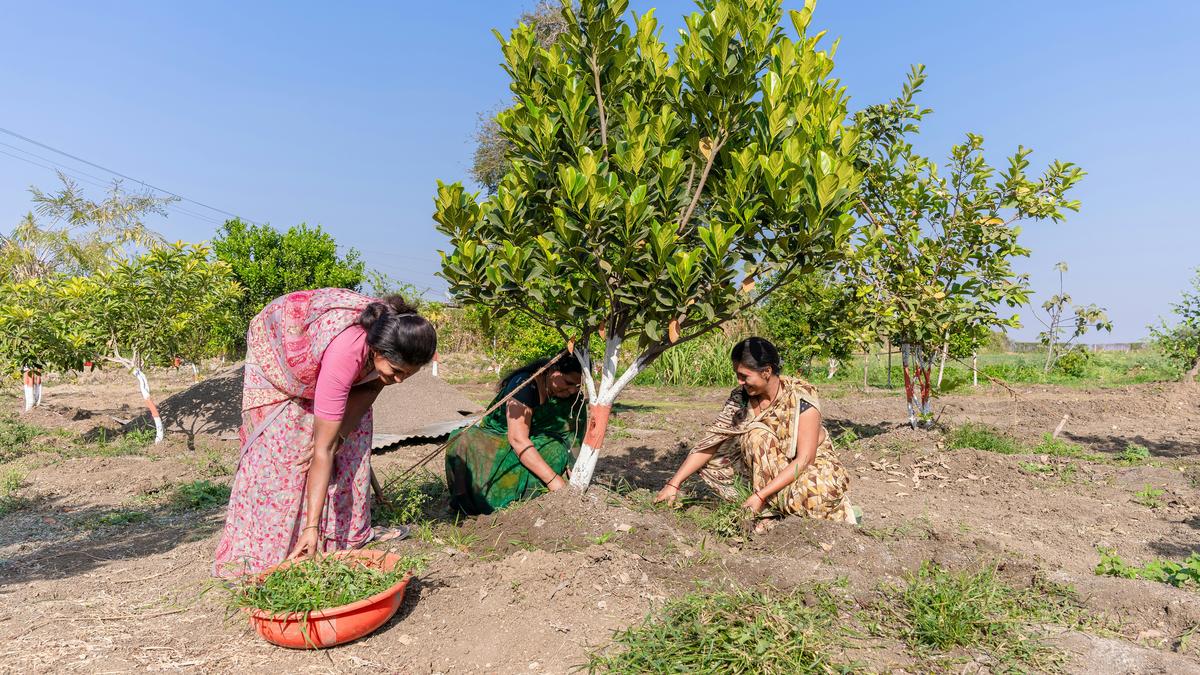







Agriculture in India has historically been a diversified land-use practice, integrating crops, trees, and livestock. This technique, broadly called agroforestry, can enhance farmer livelihoods and the environment and is slowly gaining in popularity after decades of the modus operandus of monocropping inspired by the Green Revolution.
“The Gaja cyclone nearly razed down all coconut trees and made the soils saline; we did not know what to plant after,” said Chitra, a medium-scale farmer in Pudukkottai district of Tamil Nadu, during one of our recent field visits. “We pooled our money and started planting jackfruit and mangoes. It has been six years and we are seeing some good profits.”
This change resulted from India’s pioneering efforts to promote agroforestry. These efforts received an impetus nearly 10 years ago with the establishment of the National Agroforestry Policy (2014) but which also built on significant investments in research over a longer 40-year span. Yet the uptake of agroforestry remains restricted to farmers with medium or large landholdings.
This pattern is unsurprising since smallholder farmers seldom grow trees because of their long gestation, a lack of incentive or investment-based capital, and weak market linkages. Then again, Chitra’s experience demonstrates agroforestry’s potential and presents a case for creating an enabling environment to enhance trees on farms.
A recurrent water problem
The five-year ‘Trees Outside of Forests India’ (TOFI) initiative is one such attempt to assess comprehensive ways to stimulate a change in the status quo. It’s a joint initiative of the U.S. Agency for International Development (USAID) and India’s Ministry of Environment, Forest and Climate Change. TOFI seeks to enhance tree cover in seven Indian states by identifying promising expansion opportunities and engaging the right levers.
Through our research and stakeholder consultations, we have identified key impediments to enhancing trees-outside-forests (TOF) cover through agroforestry in seven states: Andhra Pradesh, Assam, Haryana, Odisha, Rajasthan, Tamil Nadu, and Uttar Pradesh.
In particular, we discovered that water availability and transition finance have been recurrent concerns for smallholders across these states. Still, solutions to these barriers are within reasonable reach.
Finding the right native species
The Ministry of Agriculture recognised water availability as a challenge when it drafted the National Agroforestry Policy in 2014. Yet the problem remains relevant and is especially acute for smallholders, who need additional funding to secure water and/or who incur additional debt in doing so. Moreover, water availability is critical during the sapling stage but remains a constant concern if the trees compete with crops for water in water-constrained environments (e.g. hard rock aquifers and low-rainfall regions).

One way to overcome this constraint is to grow trees that don’t compete with the crops for water. We worked with Bengaluru-based WELL Labs to adapt an open-source water-accounting tool called ‘Jaltol’ to assess instances when these trade-offs occur. The tool provided valuable insights. For example, mango plantations don’t compete with kharif crops in the central Karnataka plateau whereas coconut trees in Tamil Nadu’s uplands demand more water than crops throughout the year.
Such tools enable restoration practitioners and civil society organisations to select appropriate tree-crop combinations for agroforestry in water-stressed regions.
Finding the right native species
In fact, choosing the right species for the right place and the right reason is elemental for agroforestry to enhance the sustainability of livelihoods. Farmers, however, are drawn to tree species that are fast-growing and repel herbivores, but such species are also generally non-native and threaten soil health and human well-being.
For example, casuarina and eucalyptus trees – both non-native timber species – are known to tolerate saline soils and grow fast with very low labour inputs. But both species are also primarily grown as large mono-crop block plantations rather than as an intercrop or a tree-crop combination, which would be essential for small landholdings.
Finding native species that fit multiple criteria is admittedly challenging but necessary to arrest or reverse land degradation while diversifying livelihood opportunities. Decision support tools that leverage extensive plant functional trait databases for hundreds of tree species to identify appropriate species may be helpful in such cases.
‘Diversity for Restoration’ is an example of such a tool. It provides a tailored list of climate-resilient species while aligning with the restoration objectives. Its makers will soon launch it with recommendations for the Western Ghats, followed by other geographies.
Payment for ecosystem services
Several other studies have assessed the impediments and solutions to agroforestry as a sustainable land-use practice. However, its on-ground implementation still suffers from a lack of systemic support for financing this transition and lucrative market linkages. Additionally, new and existing government policies and schemes that can facilitate this transition are standardised, accounting neither for land-holding size nor, importantly, regional biophysical variabilities. As a result, these schemes inherently exclude smallholders.
For example, the Indian Forest and Wood Certification Scheme 2023, which certifies agroforestry and wood-based products as sustainable, has an exhaustive list of eligibility criteria for farmers and industries.
But it remains to be seen if its array of socio-economic and environmental parameters will place certification costs beyond the reach of smallholders. Policymakers also need to consider the viability of existing Central and State policies and schemes as a transition finance pathway for agroforestry.
The emerging concept of ecosystem credits or existing approaches such as ‘payment for ecosystem services’ (PES) are potential incentive mechanisms. (In PES, an ecosystem service user, e.g. a food processing company, volunteers to pay a service provider, such as a small farmer, for trees promoting a service like pollination). These instruments strengthen the ideology of nature-centred economics.

However, identifying buyers and sellers of ecosystem services must be preceded by a detailed assessment of the services unique to a predefined biophysical region, not an administrative boundary. In doing so, these instruments can incentivise farmers to embrace practices that improve soil and groundwater health and enhance biodiversity. These are essential components of healthy agroecosystems.
A modus vivendi
The adoption of agroforestry at scale in India must include smallholders, who hold most of India’s agricultural land. Yet this is currently stymied by both ecological and socio-economic factors. Although secure land tenure is a prerequisite for agroforestry uptake, ensuring economic viability through market linkages while meeting the criteria of sustainable agroforestry is crucial to empower these farmers.
Agroforestry could be the modus vivendi among conservationists, agro-economists, and policymakers to foster healthy ecosystems and resilient livelihoods, creating an enabling environment for rapid uptake by smallholders.
Deepthi R. Shastry, Milind Bunyan, G. Ravikanth are using research to determine context-specific ways to increase tree cover on farms through the TOFI initiative at the Ashoka Trust for Research in Ecology and Environment (ATREE), Bengaluru.