


Skip to content
  • Facebook
  • X
  • Linkedin
  • WhatsApp
  • YouTube
  • Associate Journalism
  • About Us
  • Privacy Policy
  • 033-46046046
  • editor@artifex.news
Artifex.News

Artifex.News

Stay Connected. Stay Informed.

  • Breaking News
  • World
  • Nation
  • Sports
  • Business
  • Science
  • Entertainment
  • Lifestyle
  • Toggle search form
  • Access Denied World
  • Take a pause from Budget politics and rethink governance: Nobel Laureate Abhijit Banerjee
    Take a pause from Budget politics and rethink governance: Nobel Laureate Abhijit Banerjee Business
  • Several Hezbollah Commanders Killed In Southern Lebanon, Claims Israel
    Several Hezbollah Commanders Killed In Southern Lebanon, Claims Israel World
  • Shreyas, Jitesh likely to be back for Asia Cup
    Shreyas, Jitesh likely to be back for Asia Cup Sports
  • Rupee declines five paise to 83.33 against U.S. dollar in early trade
    Rupee declines five paise to 83.33 against U.S. dollar in early trade Business
  • Access Denied
    Access Denied Nation
  • Access Denied
    Access Denied Nation
  • Access Denied Sports
Science for all: First real-time video of how an embryo implants itself produced

Science for all: First real-time video of how an embryo implants itself produced

Posted on August 20, 2025 By admin


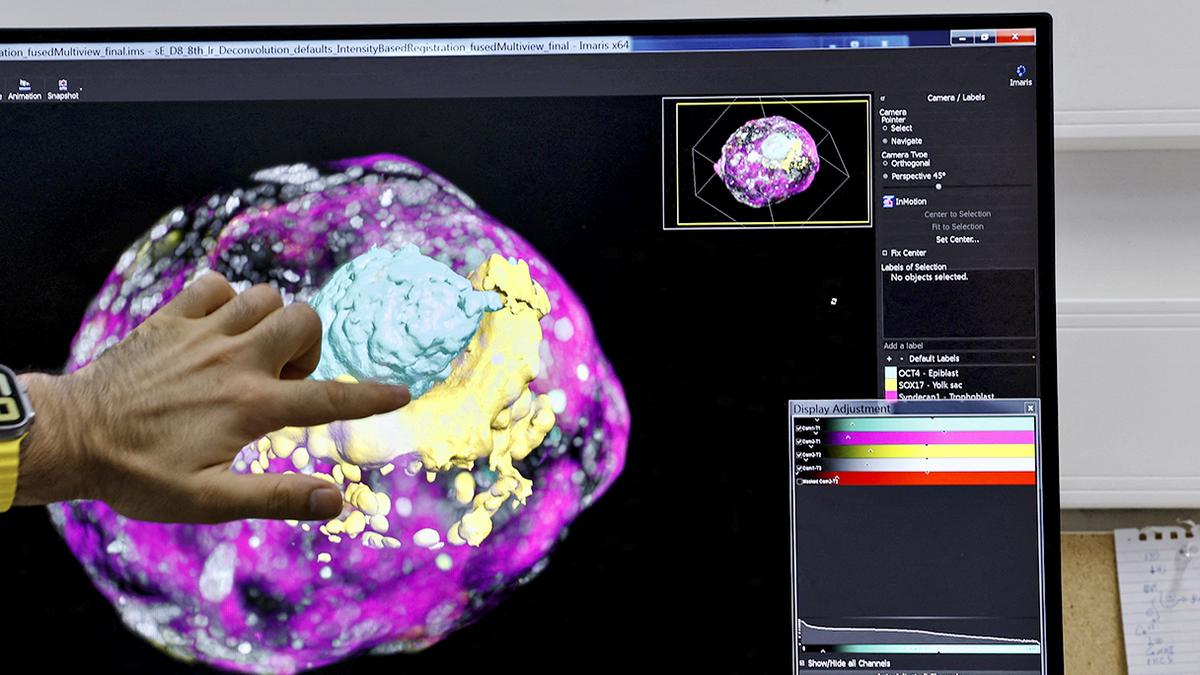
Image used for representation
| Photo Credit: Amir Cohen

(This article forms a part of the Science for All newsletter that takes the jargon out of science and puts the fun in! Subscribe now!)

Embryo implantation is a decisive step in mammalian reproduction. When a fertilised egg reaches the uterus, it must successfully attach to and invade the maternal tissue for pregnancy to continue. However, implantation often fails: an estimated 60% of miscarriages are due to problems at this stage. Traditionally, scientists have investigated implantation by looking at genes and chemical signals that control how embryonic cells behave. While valuable, this focus has had a gap: implantation is also at its core a physical act. An embryo must push, pull, and burrow into the tissue that surrounds it.

Human embryos also invade deeply into the uterine wall, embedding themselves almost entirely. In contrast, mouse embryos attach more superficially, settling into crypt-like spaces rather than tunneling all the way in. These differences affect placental development and pregnancy outcomes. Understanding why they exist and how mechanical forces shape them can illuminate human fertility challenges.

Studying these forces directly in living embryos has been nearly impossible, however. Implantation occurs inside the uterus, hidden from view, and the tools to measure feeble forces in such delicate systems have been lacking. A team of scientists from the Institute for Bioengineering of Catalonia in Spain recently reported in Science Advances a solution to this problem.

The researchers designed an artificial environment outside the body that mimics the uterine lining. They built a flat, 2D collagen gel and a 3D collagen matrix, both resembling the fibrous extracellular tissue embryos naturally encounter. Human and mouse embryos were placed on or within these gels. Then, advanced imaging tools captured how the embryos pulled, pushed, and deformed the surrounding material.

Computational methods tracked small shifts in the fibers, producing colour-coded maps of how the forces spread. The setup allowed researchers to see embryos developing and measure the traction they exerted on their environment in real time.

The experiments revealed that embryos don’t passively sit in the uterus: they actively reshape it. Both mouse and human embryos generated pulling forces that reorganised collagen fibers around them. While mouse embryos produced strong, directional pulls along two or three main axes, human embryos embedded deeply into the matrix, creating multiple small focal points of traction that spread radially. In other words, mice pulled outward and humans pulled inward.

Low-quality human embryos (those that were smaller or contained dead cells) produced weaker forces and failed to invade properly, suggesting force generation is a marker of healthy development. Additional tests showed that disrupting the proteins that connect embryonic cells to the matrix reduced force transmission, confirming that these attachments are critical. When scientists pressed on the gel with a needle, human embryos also sent protrusions towards the pressure point.

The findings indicate that mechanical forces are not side effects but drivers of early development. Clinically, the findings open new directions for fertility research. If healthy implantation depends on embryos generating certain patterns of force, doctors could one day use mechanical signatures to assess embryo quality during in-vitro fertilisation. Such tools could also improve success rates while reducing the emotional and financial toll of repeated treatments.

From the Science pages

Question Corner

How does general anaesthesia work? Find out here

Flora and fauna

Published – August 20, 2025 12:31 pm IST



Source link

Science Tags:Biology, Latest research, Research, science, science news

Post navigation

Previous Post: Access Denied
Next Post: Access Denied

Related Posts

  • Scientists develop mathematical model to optimise elite athletes’ performance
    Scientists develop mathematical model to optimise elite athletes’ performance Science
  • A random number generator using quantum physics and a blockchain
    A random number generator using quantum physics and a blockchain Science
  • What is the Zeigarnik effect? Science
  • Why are space agencies racing to the moon’s south pole?
    Why are space agencies racing to the moon’s south pole? Science
  • Why we need to change the way we talk about antibiotic resistance
    Why we need to change the way we talk about antibiotic resistance Science
  • NASA astronaut Butch Wilmore retires less than five months after extended Starliner spaceflight
    NASA astronaut Butch Wilmore retires less than five months after extended Starliner spaceflight Science

More Related Articles

Why can’t we see well right after entering a darker room? Why can’t we see well right after entering a darker room? Science
How district cooling can ease India’s climate and urban planning troubles How district cooling can ease India’s climate and urban planning troubles Science
Union Minister Suresh Gopi meets ISRO officials in Bengaluru  Union Minister Suresh Gopi meets ISRO officials in Bengaluru  Science
Gaganyaan astronauts | IAF fighter pilots with distinguished service Gaganyaan astronauts | IAF fighter pilots with distinguished service Science
Early northeast monsoon onset creates ‘triple whammy’ in South India Early northeast monsoon onset creates ‘triple whammy’ in South India Science
What is the context window? What is the context window? Science
SiteLock

Archives

  • May 2026
  • April 2026
  • March 2026
  • February 2026
  • January 2026
  • December 2025
  • November 2025
  • October 2025
  • September 2025
  • August 2025
  • July 2025
  • June 2025
  • May 2025
  • April 2025
  • March 2025
  • February 2025
  • January 2025
  • December 2024
  • November 2024
  • October 2024
  • September 2024
  • August 2024
  • July 2024
  • June 2024
  • May 2024
  • April 2024
  • March 2024
  • February 2024
  • January 2024
  • December 2023
  • November 2023
  • October 2023
  • September 2023
  • August 2023
  • July 2023
  • June 2023
  • May 2023
  • April 2023
  • March 2023
  • February 2023
  • January 2023
  • December 2022
  • November 2022
  • October 2022
  • September 2022
  • August 2022
  • July 2022
  • June 2022
  • May 2022

Categories

  • Business
  • Nation
  • Science
  • Sports
  • World

Recent Posts

  • One dead, several injured in landslide in Jamuria coal mines in West Bengal; many feared missing
  • ​Bursting at the seams: On the rise in inflation
  • Sinner reaches Italian Open semis, breaks Masters 1000 winning streak record
  • Trading in organs illegally in Kerala, with forged documents
  • Halt move to appoint principal, DU directs St. Stephen’s College

Recent Comments

  1. AlfredgeK on UP Teacher Who Asked Students To Slap Muslim Classmate
  2. WilliamTOP on UP Teacher Who Asked Students To Slap Muslim Classmate
  3. KevinPrics on UP Teacher Who Asked Students To Slap Muslim Classmate
  4. Davidexomi on UP Teacher Who Asked Students To Slap Muslim Classmate
  5. AllanSwexy on UP Teacher Who Asked Students To Slap Muslim Classmate
  • Pakistan court objects to reopen case of Bhagat Singh’s sentencing
    Pakistan court objects to reopen case of Bhagat Singh’s sentencing World
  • Access Denied
    Access Denied Nation
  • LTIMindtree awarded tender for PAN 2.0, government’s one-stop platform for all PAN issues: Sources
    LTIMindtree awarded tender for PAN 2.0, government’s one-stop platform for all PAN issues: Sources Business
  • Former rebel fighter in Cameroon turns to teaching philosophy, advocates peace
    Former rebel fighter in Cameroon turns to teaching philosophy, advocates peace World
  • Israel-Iran war LIVE: Trump vows U.S. will sink any Iran boats that challenge blockade
    Israel-Iran war LIVE: Trump vows U.S. will sink any Iran boats that challenge blockade World
  • NCP Moves Proposal To Pass Women’s Reservation Bill At All-Party Meet
    NCP Moves Proposal To Pass Women’s Reservation Bill At All-Party Meet Nation
  • Access Denied World
  • Egypt is racing to eliminate hepatitis C
    Egypt is racing to eliminate hepatitis C Science

Editor-in-Chief:
Mohammad Ariff,
MSW, MAJMC, BSW, DTL, CTS, CNM, CCR, CAL, RSL, ASOC.
editor@artifex.news

Associate Editors:
1. Zenellis R. Tuba,
zenelis@artifex.news
2. Haris Daniyel
daniyel@artifex.news

Photograher:
Rohan Das
rohan@artifex.news

Artifex.News offers Online Paid Internships to college students from India and Abroad. Interns will get a PRESS CARD and other online offers.
Send your CV (Subjectline: Paid Internship) to internship@artifex.news

Links:
Associate Journalism
About Us
Privacy Policy

News Links:
Breaking News
World
Nation
Sports
Business
Entertainment
Lifestyle

Registered Office:
72/A, Elliot Road, Kolkata - 700016
Tel: 033-22277777, 033-22172217
Email: office@artifex.news

Editorial Office / News Desk:
No. 13, Mezzanine Floor, Esplanade Metro Rail Station,
12 J. L. Nehru Road, Kolkata - 700069.
(Entry from Gate No. 5)
Tel: 033-46011099, 033-46046046
Email: editor@artifex.news

Copyright © 2023 Artifex.News Newsportal designed by Artifex Infotech.