Skip to content
  • Facebook
  • X
  • Linkedin
  • WhatsApp
  • YouTube
  • Associate Journalism
  • About Us
  • Privacy Policy
  • 033-46046046
  • editor@artifex.news
Artifex.News

Artifex.News

Stay Connected. Stay Informed.

  • Breaking News
  • World
  • Nation
  • Sports
  • Business
  • Science
  • Entertainment
  • Lifestyle
  • Toggle search form
  • Google To Make AI-Generated Content Disclosure Must For Poll Advertisers
    Google To Make AI-Generated Content Disclosure Must For Poll Advertisers World
  • Access Denied Sports
  • 8 Game-Changers In Union Budget 2025
    8 Game-Changers In Union Budget 2025 Nation
  • Access Denied
    Access Denied Nation
  • 47 Indians rescued from cyber scam centres in Laos
    47 Indians rescued from cyber scam centres in Laos World
  • Access Denied
    Access Denied Nation
  • Syed Mushtaq Ali Trophy | Mhatre’s explosive ton does the job for Mumbai
    Syed Mushtaq Ali Trophy | Mhatre’s explosive ton does the job for Mumbai Sports
  • Parawada blast: families of two breadwinners stare at bleak future
    Parawada blast: families of two breadwinners stare at bleak future Nation

In boost to quantum computing, AI makes atoms dance with lasers

Posted on August 11, 2025 By admin


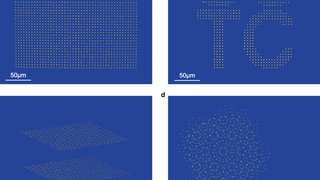
Clockwise from top-left: nearly defect-free 2D square array with 2,024 atoms; 2D pattern of the letters ‘USTC’ with 723 atoms; trilayer cuboid array with 1,077 atoms; trilayer twisted graphene structure with 752 atoms.
| Photo Credit: arxiv:2412.14647

Quantum computing holds the promise to revolutionise science and technology by solving problems currently beyond the limits of classical computers. A critical step to building practical quantum computers is assembling large arrays of qubits — or quantum bits — with no defects.

On August 8, researchers from China reported significant progress on this front by developing a way to rapidly and reliably create large arrays of neutral atoms. Their findings were published in Physical Review Letters.

Neutral atoms, like rubidium atoms, can be trapped and controlled by small laser beams called optical tweezers. These atoms serve as qubits for quantum computing and simulations. Creating arrays with thousands of atoms positioned precisely is vital because it allows for complex quantum operations and error correction. However, placing atoms perfectly in large arrays is a major challenge because atoms are loaded randomly and often with missing sites.

Traditionally, strategies to assemble defect-free arrays involve moving atoms one by one or row by row using movable optical tweezers. This process takes longer with the number of atoms.

The new work has reported overcoming this challenge using artificial intelligence (AI). The AI model quickly calculated the best way to move thousands of atoms simultaneously with precise control of their positions and phases using laser holograms.

The process began with an initially random array, where some sites were occupied by single atoms. Then, using an algorithm known as the Hungarian algorithm, the AI found the ideal pairing between loaded atoms and the target positions, minimising the total distance atoms needed to move while avoiding collisions.

Instead of moving atoms directly in one step, each movement was split into about 20 small steps to prevent heating and atom loss. At each step, the AI model generated a hologram with the optical tweezers that moved all atoms simultaneously and smoothly. This hologram also precisely controlled both where each atom moved and the phase of the light, which is crucial to avoid disturbances.

In this method, the total time to rearrange atoms was roughly the same no matter if the array had 1,000 atoms or 10,000 atoms. In their experiments, the scientists assembled two-dimensional arrays of up to 2,024 atoms free of any defects in about 60 milliseconds, substantially faster and more scalable than previous methods.

The AI model was a convolutional neural network that had been trained on simulated laser holograms. It could quickly produce highly accurate holograms that guided the atoms in smooth movements with minimal loss.

The experimental setup used a high numerical aperture objective lens, which tightly focused the laser beams, using them like tweezers to trap and move the atoms. The scientists imaged the positions of the atoms using a high-fidelity imaging camera. The AI then calculated their movements in real time based on the detected positions.

The team was also able to create a cartoon video animating the Schrödinger’s cat thought experiment by choreographing 549 atoms in a 230 x 230 micrometre grid.

The ability to assemble large, defect-free atom arrays quickly and reliably opens new paths toward building scalable quantum computers.

Published – August 11, 2025 10:46 am IST



Source link

Science

Post navigation

Previous Post: Soybeans rise after Trump says he wants China to buy more U.S. beans
Next Post: SK Hynix expects AI memory market to grow 30% a year to 2030

Related Posts

  • Scientists, diplomats should discuss evolution of quantum computing: Marilyne Andersen
    Scientists, diplomats should discuss evolution of quantum computing: Marilyne Andersen Science
  • 315 successful space launches in 2025, finds Indian Space Situational Assessment Report
    315 successful space launches in 2025, finds Indian Space Situational Assessment Report Science
  • Scientists, civil society members write open letter to Bharat Biotech and ICMR over prosecution of researchers
    Scientists, civil society members write open letter to Bharat Biotech and ICMR over prosecution of researchers Science
  • Proba-3 mission would significantly advance understanding of Sun’s Corona: Ex-ISRO scientist
    Proba-3 mission would significantly advance understanding of Sun’s Corona: Ex-ISRO scientist Science
  • If their ancestors help, weak cancer cells can form tough tumours
    If their ancestors help, weak cancer cells can form tough tumours Science
  • Science Quiz: It works — but we don’t know how
    Science Quiz: It works — but we don’t know how Science

More Related Articles

ISRO hoping to wake up Chandrayaan-3’s Vikram and Pragyan on September 22 ISRO hoping to wake up Chandrayaan-3’s Vikram and Pragyan on September 22 Science
Increasing tropical cyclones of higher intensity necessitates a new category Increasing tropical cyclones of higher intensity necessitates a new category Science
How do cyclones form? How are they measured? | Explained How do cyclones form? How are they measured? | Explained Science
Trump administration fires entire National Science Board Trump administration fires entire National Science Board Science
ISRO and ESA sign agreement for Earth Observation missions ISRO and ESA sign agreement for Earth Observation missions Science
Solar can provide 20% of world electricity on northern summer solstice, thinktank says Solar can provide 20% of world electricity on northern summer solstice, thinktank says Science
SiteLock

Archives

  • September 2026
  • August 2026
  • July 2026
  • June 2026
  • May 2026
  • April 2026
  • March 2026
  • February 2026
  • January 2026
  • December 2025
  • November 2025
  • October 2025
  • September 2025
  • August 2025
  • July 2025
  • June 2025
  • May 2025
  • April 2025
  • March 2025
  • February 2025
  • January 2025
  • December 2024
  • November 2024
  • October 2024
  • September 2024
  • August 2024
  • July 2024
  • June 2024
  • May 2024
  • April 2024
  • March 2024
  • February 2024
  • January 2024
  • December 2023
  • November 2023
  • October 2023
  • September 2023
  • August 2023
  • July 2023
  • June 2023
  • May 2023
  • April 2023
  • March 2023
  • February 2023
  • January 2023
  • December 2022
  • November 2022
  • October 2022
  • September 2022
  • August 2022
  • July 2022
  • June 2022
  • May 2022

Categories

  • Business
  • Nation
  • Science
  • Sports
  • World

Recent Posts

  • Trump claims Houthis agree not to fight U.S., as attacks mount on Saudi allies
  • FSDA cancels 16 pharmacy licences, suspends 8, including Pfizer depot
  • I approach Vaishali whenever I have a doubt: Savitha Shri
  • Apartments, gated communities reel under water crisis; Dependency on tankers increases
  • Russia reports mass cyberattacks targeting elections

Recent Comments

  1. Jasonnekly on UP Teacher Who Asked Students To Slap Muslim Classmate
  2. Jasonnekly on UP Teacher Who Asked Students To Slap Muslim Classmate
  3. Frankenrib on UP Teacher Who Asked Students To Slap Muslim Classmate
  4. Frankenrib on UP Teacher Who Asked Students To Slap Muslim Classmate
  5. Anthonylop on UP Teacher Who Asked Students To Slap Muslim Classmate
  • Trump warns against Taiwan independence after China visit
    Trump warns against Taiwan independence after China visit World
  • Access Denied Sports
  • Garry Sobers: cricket’s greatest— a legacy beyond numbers
    Garry Sobers: cricket’s greatest— a legacy beyond numbers Sports
  • Mining to resume in Bihar after October 15, says CM Samrat Choudhary
    Mining to resume in Bihar after October 15, says CM Samrat Choudhary Nation
  • The impacts of rupee weakening
    The impacts of rupee weakening Business
  • Access Denied
    Access Denied Nation
  • Renowned Singer Sharda Sinha On Ventilator Support At AIIMS, PM Modi Assures Help For Treatment
    Renowned Singer Sharda Sinha On Ventilator Support At AIIMS, PM Modi Assures Help For Treatment Nation
  • Access Denied Sports

Editor-in-Chief:
Mohammad Ariff,
MSW, MAJMC, BSW, DTL, CTS, CNM, CCR, CAL, RSL, ASOC.
editor@artifex.news

Associate Editors:
1. Zenellis R. Tuba,
zenelis@artifex.news
2. Haris Daniyel
daniyel@artifex.news

Photograher:
Rohan Das
rohan@artifex.news

Artifex.News offers Online Paid Internships to college students from India and Abroad. Interns will get a PRESS CARD and other online offers.
Send your CV (Subjectline: Paid Internship) to internship@artifex.news

Links:
Associate Journalism
About Us
Privacy Policy

News Links:
Breaking News
World
Nation
Sports
Business
Entertainment
Lifestyle

Registered Office:
72/A, Elliot Road, Kolkata - 700016
Tel: 033-22277777, 033-22172217
Email: office@artifex.news

Editorial Office / News Desk:
No. 13, Mezzanine Floor, Esplanade Metro Rail Station,
12 J. L. Nehru Road, Kolkata - 700069.
(Entry from Gate No. 5)
Tel: 033-46011099, 033-46046046
Email: editor@artifex.news

Copyright © 2023 Artifex.News Newsportal designed by Artifex Infotech.