Skip to content
  • Facebook
  • X
  • Linkedin
  • WhatsApp
  • YouTube
  • Associate Journalism
  • About Us
  • Privacy Policy
  • 033-46046046
  • editor@artifex.news
Artifex.News

Artifex.News

Stay Connected. Stay Informed.

  • Breaking News
  • World
  • Nation
  • Sports
  • Business
  • Science
  • Entertainment
  • Lifestyle
  • Toggle search form
  • RBI Penalises LIC Housing Finance, IDFC First Bank Over Violation
    RBI Penalises LIC Housing Finance, IDFC First Bank Over Violation Nation
  • Advantage Lando Norris In Brazilian Grand Prix As Title Rival Max Verstappen Handed 5-Place Grid Penalty. Reason Is…
    Advantage Lando Norris In Brazilian Grand Prix As Title Rival Max Verstappen Handed 5-Place Grid Penalty. Reason Is… Sports
  • Bangladeshi Students On Alert, To Remain On Streets To Resist Chaos
    Bangladeshi Students On Alert, To Remain On Streets To Resist Chaos World
  • Plankton balloon to six times their size to reach ocean surface
    Plankton balloon to six times their size to reach ocean surface Science
  • Access Denied World
  • Sudan’s top General rejects U.S. led ceasefire proposal, calling it ’the worst yet’
    Sudan’s top General rejects U.S. led ceasefire proposal, calling it ’the worst yet’ World
  • Pune trekker murder: CCTV clue, a hoodie in 33°C lead police to killers
    Pune trekker murder: CCTV clue, a hoodie in 33°C lead police to killers Nation
  • “Aada Maarne De”: Rohit Sharma Floors Internet With Hilarious Instruction To Kuldeep Yadav. Watch
    “Aada Maarne De”: Rohit Sharma Floors Internet With Hilarious Instruction To Kuldeep Yadav. Watch Sports
Cyclone Fengal was unusually hard to predict and track | Analysis

Cyclone Fengal was unusually hard to predict and track | Analysis

Posted on December 3, 2024 By admin


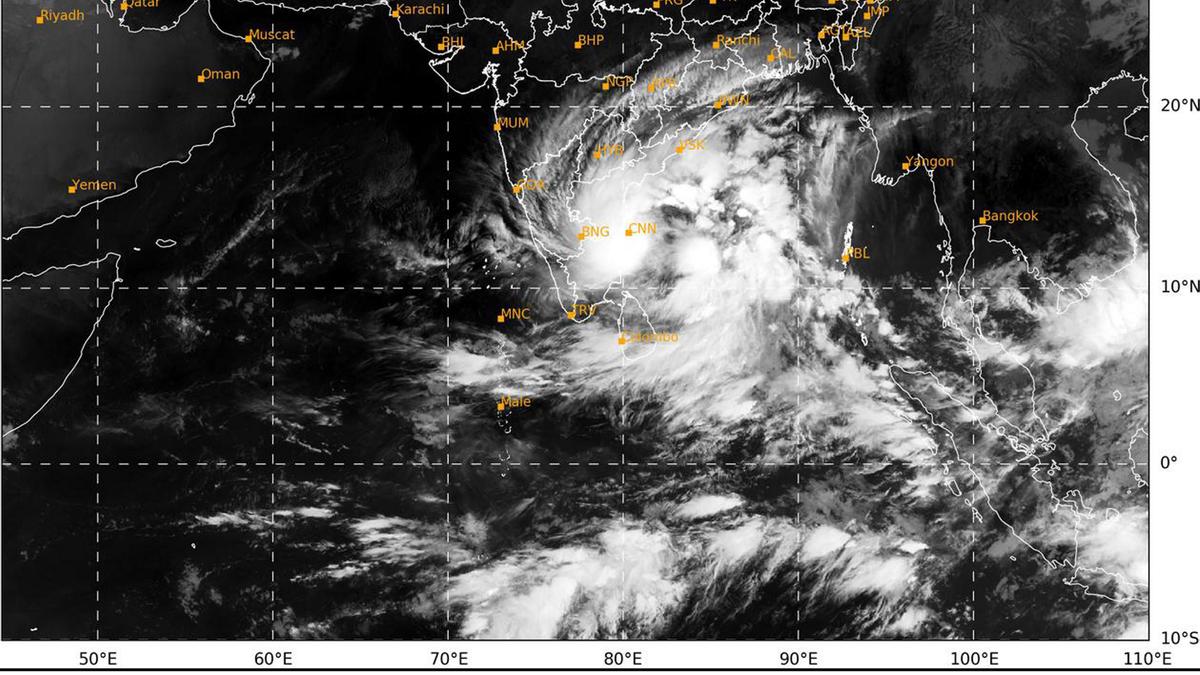
As of December 2, Cyclone Fengal was still alive and kicking, and was predicted  to soak parts of north Kerala and south Karnataka (including Bengaluru) in the following days. It appeared to have retained its identity in the forecasts as it crossed peninsular India en route to the Arabian Sea. It may not reorganise into a cyclone again over the ocean, but considering the way this year has unfolded thus far, anything seems possible.

In fact, nothing has been typical during 2024.

The year 2023 produced a stream of headlines — often days in a row — pointing out the record warming, the strong El Niño, and a litany of extreme weather events strewn around the planet. On the other hand 2024 was expected to continue to be warm but also transition to being a La Niña year. In fact, given that they had successfully predicted the early El Niño, weather models’ confidence ran high when they predicted a strong La Niña in 2024.

Alas, it turned out to be wrong — and fantastically so. The pattern of sea surface temperature anomalies in the eastern tropical Pacific Ocean have been quite unusual, with no significant cooling along the equator and a slight warming just to the north of the band. This situation is best described as “disorganised” — and the same label would hold for the post-monsoon circulation over the North Indian Ocean. Chennai has continued to get doused by the northeast monsoon as well as the rain brought by Cyclone Fengal. But the rest of the country, but especially the peninsula, remains much drier than normal as far as the northeast monsoon is concerned.

Weather models had also predicted an Indian Ocean Dipole but it did not make an appearance either.

Mother Nature has developed a habit of delivering a whiplash just as researchers are riding high on a year of successful forecasts, and this occasion is no different. At the same time, researchers and lawmakers alike are faced with new puzzles now.

The unusually long life of Fengal

Cyclone Fengal remained a low-pressure system after forming in the far eastern Indian Ocean on November 14 and became a depression in the Bay of Bengal only after 10 days. It moved relatively slowly for another week before the India Meteorological Department said it had become a cyclone and ready for a name.

The northern Indian Ocean has been warm since the southwest monsoon ended earlier this year. And during a La Niña year, this warmth should have encouraged more cyclones to form. This hasn’t been the case.

Next, the storm that eventually became Fengal drifted westward, then took a sharp turn northward before wobbling back westward, all due to the northeast and easterly winds blowing in the background. The warm Bay of Bengal also allowed Fengal to move slowly. But just as it made landfall, the soaked coastal soil supplied the energy for the cyclone to remain coherent instead of dissipating rapidly.

It is this prior rainfall that is likely to allow Cyclone Fengal to live longer than it should have, and could even help it survive all the way onto the Arabian Sea.

Cyclone prediction is tough

It’s always tempting to focus on regional features to understand weather predictions or how they fall short, but one shouldn’t forget that 2024 has been unusual for hurricane predictions as well. Researchers had predicted a historic hurricane season over the North Atlantic Ocean but it turned out to be a doozy during much of the summer, only ramping up later in the season.

Modellers have learnt to expect a strong hurricane season during a La Niña but clearly the failure of any significant cooling in the tropical Pacific Ocean has left us with a confusing hurricane season. It is unclear how the overall global cyclone numbers also started to increase later than expected even as they delivered deadly blows during an active November.

In all, the weather events so far raise questions about the effects of typhoons on northern Indian Ocean cyclones as well as on the northeast monsoon.

Indeed, despite all conditions being favourable for cyclogenesis — including a warm ocean, weaker vertical wind shear, moisture loading, and low-level circulation seeds — the post-monsoon cyclone season has been relatively quiet. And Fengal has served yet another reminder of just how hard it is to predict cyclones.

Global warming ≠ more of everything every time

Against the global smorgasbord of extremes, 2023 demonstrated just how erratic weather can get when warming ramps up quickly. The year handed its baton to 2024, which appeared to continue the sprint, although the temperature anomalies in the latest summer stayed below those of 2023.

It seems very likely that the global surface temperature in 2024 will cross 1.5º C over pre-industrial levels — yet the fact that weather models were wrong about the La Niña, the Indian Ocean Dipole, and the hurricane season prompt us to not forget that nature continues to throw the dice each day.

And while global warming loads the dice, modellers still lack the upper hand: they can only say some numbers are more likely, not whether any number is a certainty.

Furthermore, 2024 not seeing a La Niña doesn’t mean it will have normal conditions. Clearly some unexpected pattern turned up to throw a monkey wrench in our forecasts.

Focus on the warming pattern

There are good reasons to focus on global warming but we also need to remember the 1.5º and 2º C targets are not scientific. They are lines in the sand we have drawn for reference. We also know the warming pattern matters much more for how global warming will manifest in local weather patterns.

The North Indian Ocean is affected by  El Niños and the La Niñas as well as by the rapid warming over West Asia and the loss of sea ice over the Arctic. The Southern Ocean has a direct ‘pipeline’ to the tropical Indian Ocean through which warmer water can flow. Cyclone Fengal is a good example of how the global warming pattern mixes with natural modes of climate variability to keep producing unpredictable local weather patterns and extreme events.

Our cyclone seasons have also become unusual. The southwest and the northeast monsoons can provide additional moisture and energy sources for a cyclone even after it has completed landfall. Another good example of how challenging cyclone predictions have become is the mid-monsoon land-borne deep depression in 2024 that transitioned into becoming Cyclone Asna over the Arabian Sea before fizzling away.

With all these uncertainties in mind, we must keep our eyes on global and regional warming patterns and their bout with natural climate modes to develop more reliable forecasts of chronic and acute climate stressors over the Indian subcontinent.

Raghu Murtugudde is professor, IIT Bombay, and emeritus professor, University of Maryland.

Published – December 03, 2024 05:30 pm IST



Source link

Science

Post navigation

Previous Post: Updated WTC Points Table: Rohit Sharma And Co. Get Massive Boost As ICC Punish NZ, England For Bizarre Reason
Next Post: Saurashtra’s batters fire in big win over Tamil Nadu

Related Posts

  • ‘Underwhelming Indian genomics research, and gatekeeping’
    ‘Underwhelming Indian genomics research, and gatekeeping’ Science
  • Why is environmental surveillance important? | Explained
    Why is environmental surveillance important? | Explained Science
  • Collision with NASA spacecraft altered shape of asteroid Dimorphos
    Collision with NASA spacecraft altered shape of asteroid Dimorphos Science
  • Russia’s Luna-25 spacecraft enters lunar orbit
    Russia’s Luna-25 spacecraft enters lunar orbit Science
  • CSIR-CCMB scientists discover novel way to expedite tissue repair and regeneration
    CSIR-CCMB scientists discover novel way to expedite tissue repair and regeneration Science
  • Hydrogel developed for targeted breast cancer therapy
    Hydrogel developed for targeted breast cancer therapy Science

More Related Articles

Indian Immunologicals Ltd develops needle-free COVID-19 intranasal booster vaccine in collaboration with Australian university Indian Immunologicals Ltd develops needle-free COVID-19 intranasal booster vaccine in collaboration with Australian university Science
Artemis II: Indian-American Amit Kshatriya, senior NASA official behind U.S.’s moon mission Artemis II: Indian-American Amit Kshatriya, senior NASA official behind U.S.’s moon mission Science
The Science Quiz | Computer viruses The Science Quiz | Computer viruses Science
Young Scientist Award for CIFT scientist Young Scientist Award for CIFT scientist Science
Why is earth’s atmosphere not blown away into space? Why is earth’s atmosphere not blown away into space? Science
Sun’s magnetic field may form close to the surface: new study Sun’s magnetic field may form close to the surface: new study Science
SiteLock

Archives

  • September 2026
  • August 2026
  • July 2026
  • June 2026
  • May 2026
  • April 2026
  • March 2026
  • February 2026
  • January 2026
  • December 2025
  • November 2025
  • October 2025
  • September 2025
  • August 2025
  • July 2025
  • June 2025
  • May 2025
  • April 2025
  • March 2025
  • February 2025
  • January 2025
  • December 2024
  • November 2024
  • October 2024
  • September 2024
  • August 2024
  • July 2024
  • June 2024
  • May 2024
  • April 2024
  • March 2024
  • February 2024
  • January 2024
  • December 2023
  • November 2023
  • October 2023
  • September 2023
  • August 2023
  • July 2023
  • June 2023
  • May 2023
  • April 2023
  • March 2023
  • February 2023
  • January 2023
  • December 2022
  • November 2022
  • October 2022
  • September 2022
  • August 2022
  • July 2022
  • June 2022
  • May 2022

Categories

  • Business
  • Nation
  • Science
  • Sports
  • World

Recent Posts

  • Samrat Choudhary promises jobs to one crore women
  • U.S. military says it killed 4 in strike on alleged drug-smuggling boat in Caribbean
  • Davis Cup: Czechs beat USA to qualify for finals
  • Ed Sheeran set to return to stage after Palestinian controversy
  • Asian Games 2026 opens in Japan with 11,000 athletes competing | LIVE updates

Recent Comments

  1. AlvinNet on UP Teacher Who Asked Students To Slap Muslim Classmate
  2. AlvinNet on UP Teacher Who Asked Students To Slap Muslim Classmate
  3. Jamesslits on UP Teacher Who Asked Students To Slap Muslim Classmate
  4. MichaelClear on UP Teacher Who Asked Students To Slap Muslim Classmate
  5. Jamesslits on UP Teacher Who Asked Students To Slap Muslim Classmate
  • Doctors Treat Accident Victims Under Cell Phone Light At UP Health Centre
    Doctors Treat Accident Victims Under Cell Phone Light At UP Health Centre Nation
  • Access Denied Sports
  • Jeffrey Epstein files go on display at New York pop-up exhibit featuring 3.5 million pages
    Jeffrey Epstein files go on display at New York pop-up exhibit featuring 3.5 million pages World
  • Cabinet approves ₹7.42 crore ancillary works at Kukke Subrahmanya to be undertaken by Temple management
    Cabinet approves ₹7.42 crore ancillary works at Kukke Subrahmanya to be undertaken by Temple management Nation
  • Access Denied World
  • PM Modi To NDTV On 2024 Polls
    PM Modi To NDTV On 2024 Polls Nation
  • On the heels of World Diabetes Day, the story of insulin discovery and the Flame of Hope
    On the heels of World Diabetes Day, the story of insulin discovery and the Flame of Hope Science
  • Access Denied Sports

Editor-in-Chief:
Mohammad Ariff,
MSW, MAJMC, BSW, DTL, CTS, CNM, CCR, CAL, RSL, ASOC.
editor@artifex.news

Associate Editors:
1. Zenellis R. Tuba,
zenelis@artifex.news
2. Haris Daniyel
daniyel@artifex.news

Photograher:
Rohan Das
rohan@artifex.news

Artifex.News offers Online Paid Internships to college students from India and Abroad. Interns will get a PRESS CARD and other online offers.
Send your CV (Subjectline: Paid Internship) to internship@artifex.news

Links:
Associate Journalism
About Us
Privacy Policy

News Links:
Breaking News
World
Nation
Sports
Business
Entertainment
Lifestyle

Registered Office:
72/A, Elliot Road, Kolkata - 700016
Tel: 033-22277777, 033-22172217
Email: office@artifex.news

Editorial Office / News Desk:
No. 13, Mezzanine Floor, Esplanade Metro Rail Station,
12 J. L. Nehru Road, Kolkata - 700069.
(Entry from Gate No. 5)
Tel: 033-46011099, 033-46046046
Email: editor@artifex.news

Copyright © 2023 Artifex.News Newsportal designed by Artifex Infotech.