







At the Saha Institute of Nuclear Physics, Kolkata, synthetic biologist Sangram Bagh has a major and somewhat unusual goal: to build intelligent bacteria.
Despite being single-celled, bacteria are very sensitive and responsive to their environments. Organisms that are generally called intelligent — including dolphins, chimpanzees, octopuses, crows, and humans — are on the other hand multicellular, with brains composed of billions of specialised cells called neurons.
The bacteria that compute
But in a major breakthrough, Bagh’s lab has engineered bacteria that can decide whether a given number is prime and whether an alphabet is a vowel. These could earlier be done only “by humans or computers”, Bagh said, “but now genetically engineered bacteria are doing the same. Such observations raise new questions about the meaning of intelligence.”
Bagh’s team introduced ‘genetic circuits’ in bacteria that could be activated by a combination of chemical inducers. Then they combined bacteria with different engineered circuits in a solution to build bacterial ‘computers’ that behaved like artificial neural networks. In this setting, each type of engineered bacteria was a “bactoneuron” and the combination of bactoneurons behaved like a multicellular organism capable of abstract mathematics.
The team reported its findings in Nature Chemical Biology in September. The paper’s publication has stirred significant interest among synthetic biologists — experts who engineer new abilities in organisms. For example Pawan Dhar, executive director of the C.V.J. Centre for Synthetic Biology and Biomanufacturing, Kochi, said, “We’ve entered a new era where bacteria can be programmed to solve mathematical problems through chemical conversations”.
The creation of these bacterial computers could herald significant advances in the pharmaceutical industry and medical sciences and in the biomanufacturing sector, Dhar added.
Switching the computer on
In an artificial neural network (ANN), processing units called nodes are connected to each other in layers. Each node takes in an input (or inputs), performs a computation on it, and produces an output — which can be the ANN’s output or the input for another node. ANNs with more layers can perform more complex computational tasks.
Bagh’s team used tools from molecular biology to introduce transcriptional genetic circuits in Escherichia coli, a bacteria commonly used in research.
During transcription, a bacteria transcribes a part of its DNA into RNA and reads from that RNA to make proteins. The microbe knows to begin transcription when proteins called transcription factors recognise specific DNA sequences called promoters, and kick off transcription.
The team built the genetic circuits in bacteria by introducing synthetic promoters that could be recognised by four transcription factors, individually or together. “The transcription factors and promoters and their interactions formed various feed-forward, feedback, and combination mechanisms,” the authors wrote in their paper. (Machine-learning models use these mechanisms to perform their calculations.)
In this way the researchers created 14 bactoneurons that could be brought together in different combinations, each working like a single-layered ANN.
They tested each combination for its ability to perform specific tasks. A combination could be switched ‘on’ by the presence or absence of four chemical compounds in the solution containing the bacteria.
The chemistry of input and output
Conventional computers manipulate the voltage of electrical devices made of silicon to perform calculations. High voltage is the ‘on’ state, represented by 1, and low voltage is the ‘off’ state, represented by 0. To mimic this in a bacterial computer, Bagh’s team coded their problems first in the language of 0s and 1s and translated this to the presence (1) or absence (0) of the chemical inducers.
For example, to ask a bacterial computer if a number between 0-9 is prime, the team first converted it to binary, then used the 0s and 1s in the binary form to present or withhold the chemicals. E.g., the presence of chemicals one, two, and three (111), and the absence of chemical four (0) would be read by the bacterial computer as ‘7’, while the absence of chemicals one, three and four, and the presence of chemical two would signal ‘4’.
Similarly, the team understood the output by checking for the presence or absence of red and green fluorescent proteins, engineered into the bacteria along with the genetic circuits.

In ANNs, the relationship between the output and the input of a node is captured in an equation called the activation function. When we write f(x, y) = z, we’re using the language of mathematics to say the value of z depends in a specific way on the values of x and y. Similarly, the activation function says the value of the bactoneuron’s output depends on (i) the strength of the input; (ii) its relative importance with respect to other inputs, called the weight; and (iii) a constant added to the weighted sum of all inputs, called the bias.
A node is activated when the weighted sum of the inputs plus the bias crosses a threshold. The weighted sum is calculated by multiplying the weight of each input with its strength and adding such terms for all inputs. For example, for inputs x and y with weights w1 and w2, the weighted sum would be w1x + w2y.
Answers in the light
According to Bagh, all ANNs have a similar activation function in form. The differences arise due to the inputs and their weights.
Whether each bactoneuron produced red or green fluorescent protein was contingent on an activation function that captured whether a certain concentration of chemical inducers, their weights (i.e. each inducer’s ability to trigger a genetic circuit relative to other inducers), and a bias (which the team is yet to explain in molecular terms) crossed a threshold.
According to Bagh, the team did this “by designing, constructing, and optimising the artificial genetic circuits such that the given chemical signals are recognised and processed by the circuits to produce specific fluorescent proteins (output).”
The presence of the fluorescent proteins could be interpreted as 1 (‘on’) and their absence as 0 (‘off’). A combination of 0s and 1s could be used to read the output as “yes” or “no”.
When the team asked the bactoneuron computer if 7 is prime, it responded “yes” by expressing green fluorescent protein (1) but not the red (0).
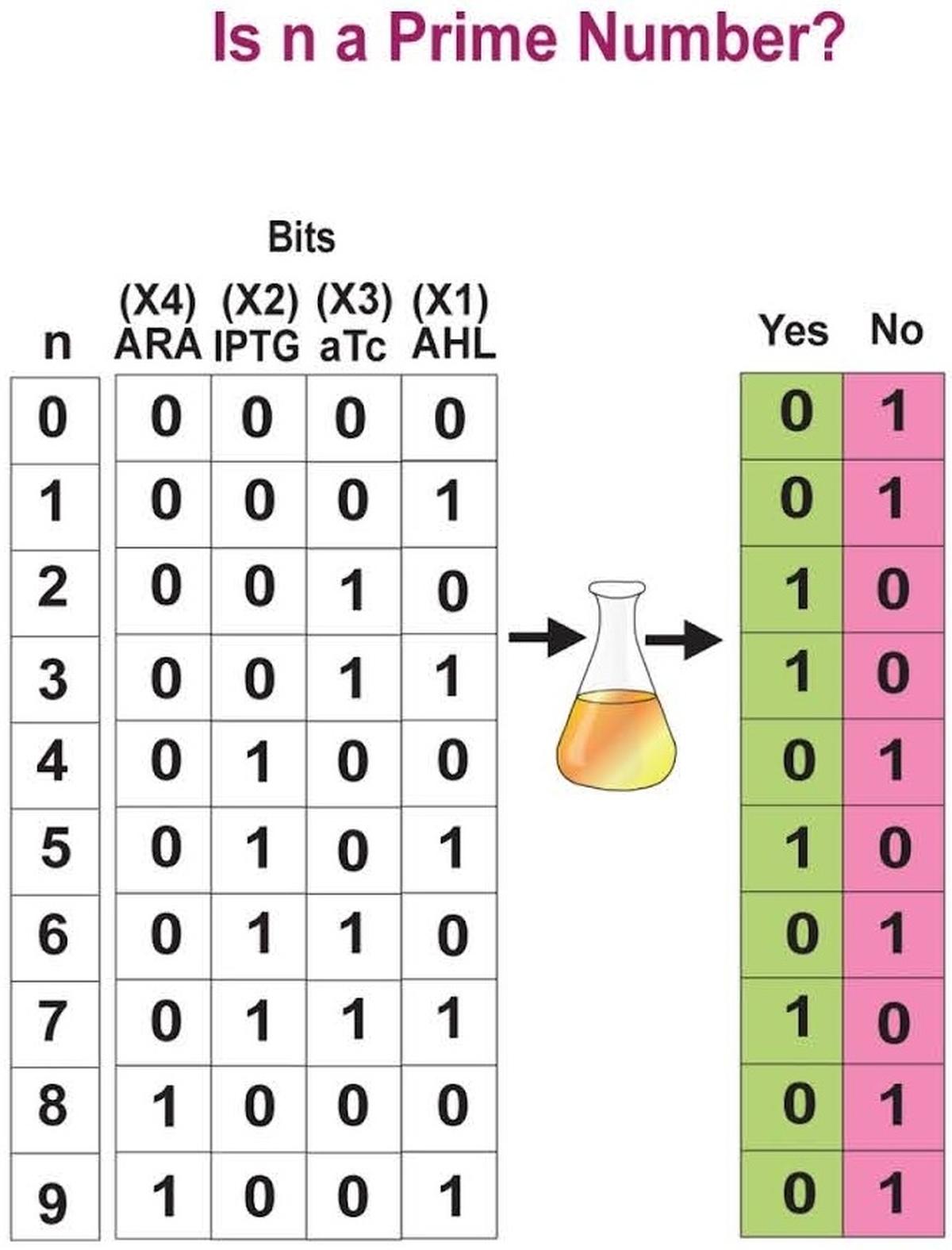
A table from the study showing the input and the output for a bacterial computer calculating whether a given number is prime. ARA, IPTG, aTc and AHL are the chemical inducers. Green and pink boxes indicate the expression of green and crimson fluorescent proteins, respectively.
| Photo Credit:
Sangram Bagh/Special arrangement
The computer could also say whether a number between 0 and 9 was a perfect power (a number that can be expressed as one integer raised to another; e.g. 8 is a perfect power because 8 = 23) and whether a letter between A and L was a vowel.
Encouraged by this success, the team upped the ante by having the computers answer more complex questions. They were able to say whether adding three to an integer would create a prime number (e.g. “is 2 + 3 a prime number?”) and whether the square of a certain number could be expressed as the sum of three factorials.
Next level: optimisation
Finally, the researchers tested whether the bactoneurons could solve problems that couldn’t be settled with yes/no answers. For this, they asked one computer to find the maximum number of pieces cutting a pie using a fixed number of straight cuts would create. This is an example of an optimisation problem, where researchers try to identify the best solution from a pool of possible solutions.
The team input the number of straight cuts in the form of chemical signals again, including certain compounds and leaving others out. Since the output in this case would have to be a number, the team modified some bactoneurons to express other fluorescent proteins (blue and orange) in addition to the green and the crimson ones. The presence or absence of these fluorescence proteins could be read in binary and converted to decimal.
When they asked the computer to solve the problem for two straight cuts, it didn’t express the orange fluorescent protein (0), expressed the blue fluorescent protein (1), and didn’t express either the green or crimson fluorescent proteins (00). 0100 in binary is 4 in decimal, and the correct answer. Then they asked it to solve for four straight cuts, and the computer responded by expressing the orange fluorescent protein (1), not expressing the blue (0), and expressing both the green and crimson ones (11). Together, 1011 is the code for the decimal number 11, again the correct answer.

Breaking new ground
Areejit Samal, a professor of computational biology at the Institute of Mathematical Sciences, Chennai, said a striking feature of the work of Bagh et al. is that the bacterial computers are able to work on progressively more complex mathematical and computational tasks.
Calling the paper “groundbreaking”, Dhar, the Kochi-based synthetic biologist, said the future may not be far off where such biocomputers “recognise the molecular patterns of cancer at its earliest stages, signal their presence to physicians, and administer localised treatments before tumours ever form.” He added that as scientists engineer bacterial computers with the ability to perform more complex tasks, “computational tasks could be outsourced to microbes, reducing the need for traditional silicon-based computers.”
Whereas for Dhar the study reinvigorated his hunger for more innovations in biocomputing, for Bagh, his engineered bactoneurons are a gateway to “think about the biochemical nature of intelligence.”
Sayantan Datta is a science journalist and a faculty member at Krea University.
Published – November 13, 2024 05:30 am IST