


Skip to content
  • Facebook
  • X
  • Linkedin
  • WhatsApp
  • YouTube
  • Associate Journalism
  • About Us
  • Privacy Policy
  • 033-46046046
  • editor@artifex.news
Artifex.News

Artifex.News

Stay Connected. Stay Informed.

  • Breaking News
  • World
  • Nation
  • Sports
  • Business
  • Science
  • Entertainment
  • Lifestyle
  • Toggle search form
  • PM Plays Up Budget Tax Breather At Delhi Poll Rally
    PM Plays Up Budget Tax Breather At Delhi Poll Rally Nation
  • Haryana BJP Expels Rebel Contesting Against Chief Minister, Seven Others
    Haryana BJP Expels Rebel Contesting Against Chief Minister, Seven Others Nation
  • Roman Baths may harbour novel antimicrobial natural products
    Roman Baths may harbour novel antimicrobial natural products Science
  • Jaishankar’s meeting with Thai counterpart contributed to strengthening of bilateral ties: MEA
    Jaishankar’s meeting with Thai counterpart contributed to strengthening of bilateral ties: MEA World
  • “Haven’t Seen That”: Ex-India Star’s Blunt Take On KKR’s Rs 24.75 Crore Buy Mitchell Starc
    “Haven’t Seen That”: Ex-India Star’s Blunt Take On KKR’s Rs 24.75 Crore Buy Mitchell Starc Sports
  • Brown, botany, and Brownian motion
    Brown, botany, and Brownian motion Science
  • Access Denied World
  • Access Denied Sports
Melting polar ice due to climate change is making earth’s days longer

Melting polar ice due to climate change is making earth’s days longer

Posted on August 14, 2024 By admin


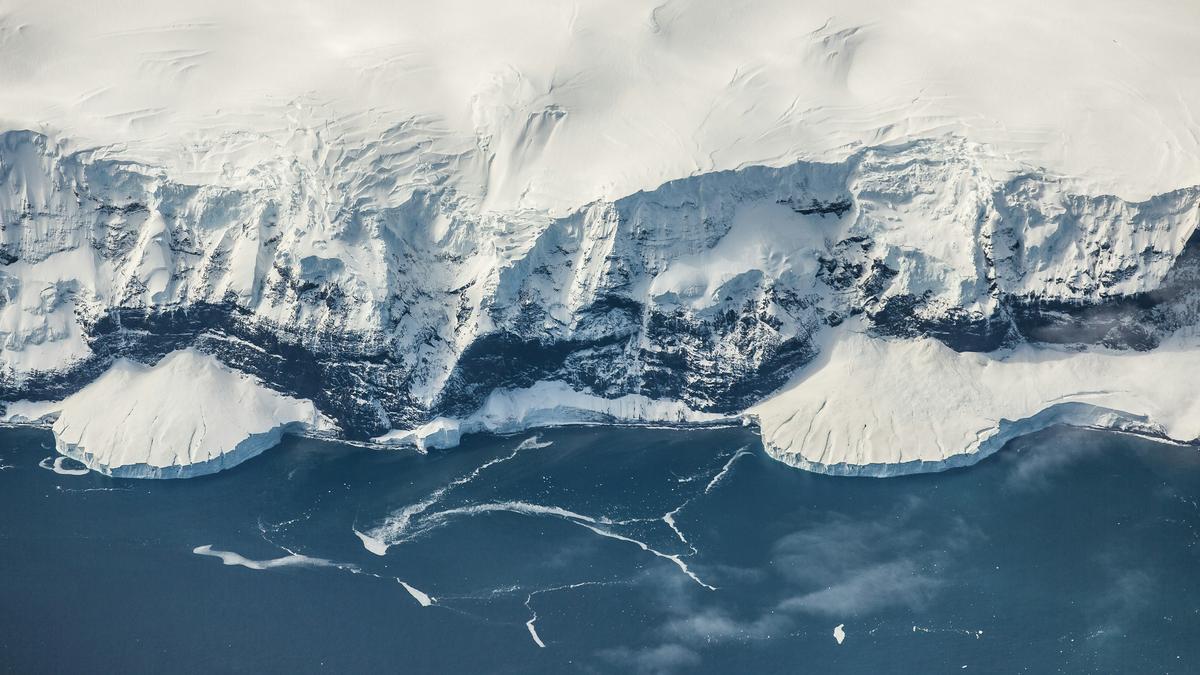
The coastline of a small island off the coast of Antarctica, seen from a window on a commercial flight, February 8, 2017. After the previous ice age, a lot of ice melted from the northernmost and the southernmost parts of the earth, causing the planet to spin faster.
| Photo Credit: Matt Palmer/Unsplash

In yet another unprecedented effect of climate change, scientists find that the melting polar ice caps have caused the earth to spin slower. This can lead to minuscule changes in the actual duration of a day — something that, ironically, does not affect our daily lives as much but could affect the technology we rely on.

As we build more connections not just among ourselves in this world but also with outer space, tools that rely on precise timekeeping, like computer networks and the ones involved in space travel, can be thrown off course.

Making the world go around…

A basic physics phenomenon called the conservation of angular momentum is key to what is happening to the earth right now. When an ice-skater rotates, if their arms are held in tightly, their moment of inertia decreases and they spin faster. If they stretched their arms out wide, their moment of inertia would increase, making them spin slower. This is because angular momentum — a product of the moment of inertia and angular velocity — is conserved no matter how the skater is spinning.

As polar ice continues to melt rapidly in a warming world, the globe isn’t affected very differently from the spinning ice-skater.

“When polar ice sheets and global glaciers melt, then this would go to the equatorial regions — we call this pole-to-equator mass flux,” Mostafa Kiani Shahvandi, a geophysicist at ETH Zurich and the lead author of the July 15 paper describing the recent results, said. “As the ice sheets melt, the earth’s oblateness increases and the region around the equator elongates slightly. The moment of inertia increases and the rotation rate gets smaller.”

Water from the melt flows towards the equator, making the earth bulge out slightly, slowing its rotation and increasing the time taken to complete one rotation, lengthening our day.

‘A pretty big thing’

Using a mix of climate models and real-world data, the scientists looked at a 200-year period, between 1900 and 2100. They found that over the last two decades, the changing climate’s effects on sea levels around the equator have slowed the rate of earth’s rotation by around 1.3 milliseconds (ms) per century.

Based on their projections, if the high emission scenarios persist, this rate will change to 2.6 ms per century. This will end up making climate change the dominant factor in slowing the earth’s rotation, surpassing other factors.

“What’s impressive about this is that it’s another indicator of just how big the effect of climate change has become,” Duncan Agnews, an emeritus professor of geophysics at the Scripps Institute of Oceanography at University of California, San Diego, said. “The fact that it can change — not by a large amount, but still, some amount — the actual rotation rate of the entire earth, it’s a pretty big thing to have been affected.”

The effect may be in the order of milliseconds but it can still affect accurate timekeeping with atomic clocks. Even though we have kept time since the 1950s with the help of these ultra-precise devices, we also track the time taken for the earth’s rotations and ensure they both match up. Just like the earth’s revolution around the sun takes just a bit longer than 365 days, requiring the addition of a leap day, its rotation is also not always exactly 24 hours. It’s a couple of milliseconds more.

When a second is a lot

A process called lunar tidal friction, or the moon pulling on the earth’s oceans, has already been slowing the planet’s rotation at about 2 ms per century. So if right now the earth takes about 2 ms longer to complete one day than the time predicted by atomic clocks, a 100 years later a day will be about 4 ms longer. As the milliseconds added up, leap seconds were added to keep pace with the earth’s rotation.

This is imperceptible to us but systems like GPS, stock trading, and space travel bank on accurate measures of time and can be thrown off.

“In the precise timekeeping world, a second is a lot,” Dr. Agnews said.

Some other processes like the slowed rotation of the earth’s core have been speeding up the earth’s rotation time. After the previous ice age, a lot of ice melted from the northernmost and the southernmost parts of the earth, causing the crust to rebound at the poles. This has also helped the earth to spin faster, so much so that scientists have mooted debates to understand if we need a negative leap second to correct for it.

The axis is shifting, too

Dr. Agnews published a paper in Nature in March showing a similar result: that climate change and the resulting melting ice are slowing the earth’s rotation and that that will actually delay the negative leap second.

Either way, both studies are proof climate change is exerting its effects over the entire planet by interfering with something as fundamental as how it spins around its axis.

Dr. Shahvandi and his collaborators published another recent paper in Nature Geophysics detailing the effects of melting polar ice on the earth’s axis of rotation. Using observed data and predictions made by physics-informed neural networks, they found the melting of polar ice and glaciers is one phenomenon driving the earth’s polar motion. The location where the earth’s axis of rotation intersects the crust is moving ever so slightly over time.

For people in low-lying coastal areas, rising sea levels because of melting ice leads to more devastating consequences than the mere wobble of the earth’s axis or a gradually lengthening day. Nevertheless, this is another example of how climate change is affecting our planet, pushing us towards a desperate need to curb emissions before the situation spins out of control.

Rohini Subrahmanyam is a freelance journalist in Bengaluru.


Source link

Science

Post navigation

Previous Post: Volodymyr Zelensky Says Ukraine Controls 74 Russian Settlements
Next Post: “Every Symbol Of India’s Ties With Bangladesh Is Being Attacked”: Shashi Tharoor

Related Posts

  • South Africa petrochem unit world’s single largest greenhouse gas source
    South Africa petrochem unit world’s single largest greenhouse gas source Science
  • Astronomers just found complex carbon molecules in space – a step closer to deciphering the origins of life
    Astronomers just found complex carbon molecules in space – a step closer to deciphering the origins of life Science
  • As sun nears peak of solar cycle, small satellites are paying the price
    As sun nears peak of solar cycle, small satellites are paying the price Science
  • Extreme heat threatens global food systems, UN agencies warn
    Extreme heat threatens global food systems, UN agencies warn Science
  • IPR Gandhinagar team proposes roadmap for India’s fusion power plans
    IPR Gandhinagar team proposes roadmap for India’s fusion power plans Science
  • Is global warming accelerating? – The Hindu
    Is global warming accelerating? – The Hindu Science

More Related Articles

Does the fluid-filled sac around the lungs function merely as a cushion from external damage? Does the fluid-filled sac around the lungs function merely as a cushion from external damage? Science
Sci-Five | The Hindu Science Quiz: on semi-conductors Sci-Five | The Hindu Science Quiz: on semi-conductors Science
DRDO conducts key test in scramjet technology development DRDO conducts key test in scramjet technology development Science
World breached 1.5° Celsius limit for entire year for first time: European climate agency World breached 1.5° Celsius limit for entire year for first time: European climate agency Science
India is running out of phosphorus. Does the solution lie in our sewage? India is running out of phosphorus. Does the solution lie in our sewage? Science
HIV breakthrough: new pre-exposure prophylaxis called lenacapavir found 100% effective in trial HIV breakthrough: new pre-exposure prophylaxis called lenacapavir found 100% effective in trial Science
SiteLock

Archives

  • May 2026
  • April 2026
  • March 2026
  • February 2026
  • January 2026
  • December 2025
  • November 2025
  • October 2025
  • September 2025
  • August 2025
  • July 2025
  • June 2025
  • May 2025
  • April 2025
  • March 2025
  • February 2025
  • January 2025
  • December 2024
  • November 2024
  • October 2024
  • September 2024
  • August 2024
  • July 2024
  • June 2024
  • May 2024
  • April 2024
  • March 2024
  • February 2024
  • January 2024
  • December 2023
  • November 2023
  • October 2023
  • September 2023
  • August 2023
  • July 2023
  • June 2023
  • May 2023
  • April 2023
  • March 2023
  • February 2023
  • January 2023
  • December 2022
  • November 2022
  • October 2022
  • September 2022
  • August 2022
  • July 2022
  • June 2022
  • May 2022

Categories

  • Business
  • Nation
  • Science
  • Sports
  • World

Recent Posts

  • Kohli’s masterful knock powers Royal Challengers to the top
  • Vijay Narayan earns rare distinction of being Advocate General under two different governments
  • Learn from Sri Lanka’s experience on impact of fertilizer supply chains: experts
  • Sewage pollution of Cooum, groundwater depletion raise alarm
  • Netanyahu’s office says he visited UAE secretly during the Iran war

Recent Comments

  1. NathanQuins on UP Teacher Who Asked Students To Slap Muslim Classmate
  2. Davidgof on UP Teacher Who Asked Students To Slap Muslim Classmate
  3. NathanJobre on UP Teacher Who Asked Students To Slap Muslim Classmate
  4. Davidcag on UP Teacher Who Asked Students To Slap Muslim Classmate
  5. RichardClage on UP Teacher Who Asked Students To Slap Muslim Classmate
  • Access Denied
    Access Denied Nation
  • At USD 642.29 Billion, India’s Foreign Exchange Reserves Hit All-Time High
    At USD 642.29 Billion, India’s Foreign Exchange Reserves Hit All-Time High Nation
  • Access Denied World
  • Access Denied Business
  • Access Denied World
  • Access Denied Sports
  • Gautam Gambhir’s 5 Coaching Staff Suggestions Rejected By BCCI, Only 1 Gets Nod: Report
    Gautam Gambhir’s 5 Coaching Staff Suggestions Rejected By BCCI, Only 1 Gets Nod: Report Sports
  • The Impact Of Muslim Votes On Maharashtra Assembly Election Results
    The Impact Of Muslim Votes On Maharashtra Assembly Election Results Nation

Editor-in-Chief:
Mohammad Ariff,
MSW, MAJMC, BSW, DTL, CTS, CNM, CCR, CAL, RSL, ASOC.
editor@artifex.news

Associate Editors:
1. Zenellis R. Tuba,
zenelis@artifex.news
2. Haris Daniyel
daniyel@artifex.news

Photograher:
Rohan Das
rohan@artifex.news

Artifex.News offers Online Paid Internships to college students from India and Abroad. Interns will get a PRESS CARD and other online offers.
Send your CV (Subjectline: Paid Internship) to internship@artifex.news

Links:
Associate Journalism
About Us
Privacy Policy

News Links:
Breaking News
World
Nation
Sports
Business
Entertainment
Lifestyle

Registered Office:
72/A, Elliot Road, Kolkata - 700016
Tel: 033-22277777, 033-22172217
Email: office@artifex.news

Editorial Office / News Desk:
No. 13, Mezzanine Floor, Esplanade Metro Rail Station,
12 J. L. Nehru Road, Kolkata - 700069.
(Entry from Gate No. 5)
Tel: 033-46011099, 033-46046046
Email: editor@artifex.news

Copyright © 2023 Artifex.News Newsportal designed by Artifex Infotech.