



Skip to content
  • Facebook
  • X
  • Linkedin
  • WhatsApp
  • YouTube
  • Associate Journalism
  • About Us
  • Privacy Policy
  • 033-46046046
  • editor@artifex.news
Artifex.News

Artifex.News

Stay Connected. Stay Informed.

  • Breaking News
  • World
  • Nation
  • Sports
  • Business
  • Science
  • Entertainment
  • Lifestyle
  • Toggle search form
  • The Science Quiz: The evolutionary edge to human survival
    The Science Quiz: The evolutionary edge to human survival Science
  • Access Denied Business
  • Access Denied World
  • “Biggest Piece Of Rubbish”: Ex RCB Star On Doubts Over Virat Kohli’s T20 World Cup Spot
    “Biggest Piece Of Rubbish”: Ex RCB Star On Doubts Over Virat Kohli’s T20 World Cup Spot Sports
  • Access Denied Sports
  • Watch: Union Budget 2025 | What’s in it for health sector?
    Watch: Union Budget 2025 | What’s in it for health sector? Business
  • Access Denied
    Access Denied Nation
  • Access Denied Sports
Earthquake 2,500 years ago abruptly changed Ganga river’s course

Earthquake 2,500 years ago abruptly changed Ganga river’s course

Posted on August 7, 2024 By admin


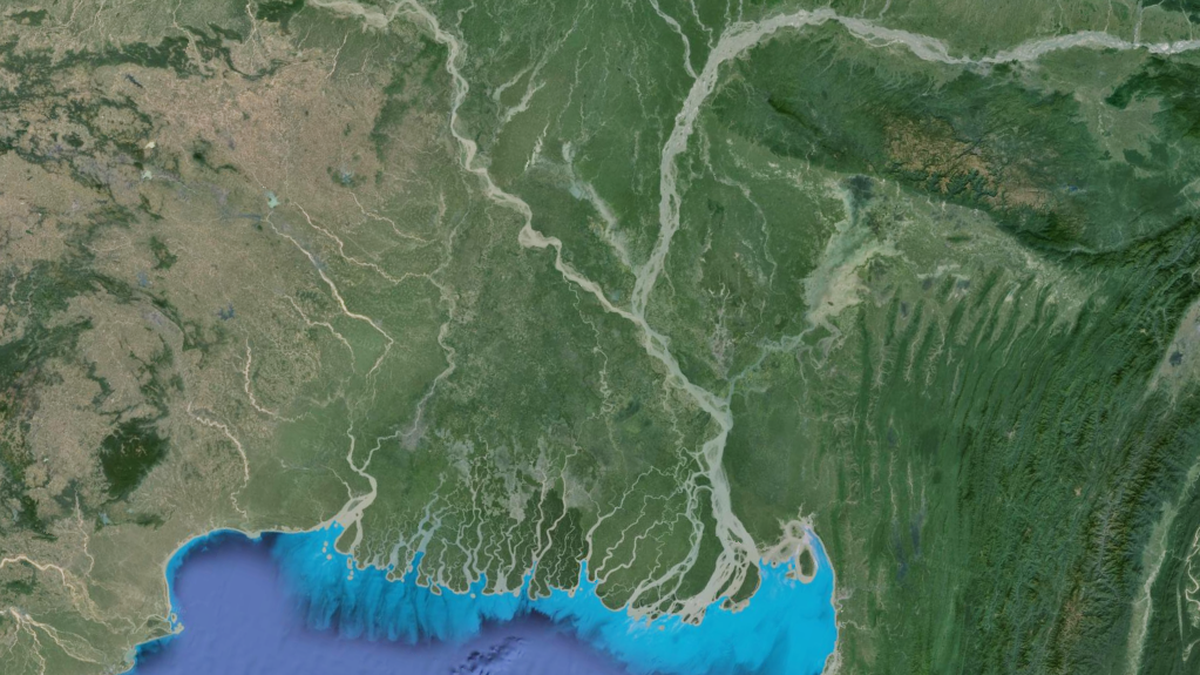
In 2018, geochronologist Elizabeth Chamberlain, an assistant professor at the Wageningen University & Research, Netherlands, and her team were in Bangladesh to study the movement of river channels in the Ganga delta. They were exploring an almost 2-km-wide “paleochannel” — a well-preserved mud and sand archive of the river’s ancient course — about 45 km to the south of the modern Ganga river. Today, the area is used to cultivate rice.

Based on geological measures in this area, they found the Ganga had abruptly changed its course — or avulsed — about 2,500 years ago, leaving behind the palaeochannel.

During their fieldwork, the team also chanced upon two large sand dikes a kilometre to the east of the palaeochannel. These dikes are formed when earthquakes disturb the river bed and cause sediments to flow as if they were liquid. Scientists call this process liquefaction.

When Dr. Chamberlain’s team spotted these sand dikes, they had a hunch they were looking at a “big event — the type that is rarely recorded and studied by scientists,” she told this reporter. They were right: these sand dikes held the first proof that earthquakes can move rivers. In their June 2024 paper published in the journal Nature Communications, the team reported an earthquake of magnitude 7 to 8 was responsible for shifting the course of the Ganga more than two millennia ago.

The study’s findings call for urgent forecasting of major earthquakes that can cause avulsion of rivers like the Ganges, Till Hanebuth, a professor of marine geosciences at Coastal Carolina University in the U.S., said. He added that making decision-makers and the people at large aware of the risk is of paramount importance so they can prepare better for such events in future.

How earthquakes move rivers

The sand dikes and their composition, consisting of “fine sands” and “silty muds”, as the researchers reported in their paper, provided conclusive evidence of a major ancient earthquake. The team figured that if this earthquake indeed caused the Ganga to avulse, the time of the earthquake and the time of avulsion should coincide.

To find the time when these two events occurred, Dr. Chamberlain used a technique called optically stimulated luminescence (OSL) dating. This method relies on estimating how long a mineral grain (i.e. a mineral particle less than a few millimetres in size, like quartz grains in sand or mud) has been buried by measuring the amount of natural radiation stored in it.

The researchers extracted mineral samples from the sand dikes and the paleochannel and treated the grains in these samples to light and heat. “As buried grains absorb low doses of natural radiation, energy builds up in their crystals,” Dr. Chamberlain explained. This is because the natural radioactivity forces electrons in the minerals to escape their atoms and become trapped in the crystal structure — or the space between the atoms — of these minerals.

“The stored energy increases over time. By estimating how much energy is stored in the grains, and measuring how radioactive their surroundings are, we can obtain how long the grains have been buried,” Dr. Chamberlain said.

To estimate the amount of energy stored, the researchers shine blue light on the grains, causing the trapped electrons to escape the crystal structure and return to the atoms. When they do so, they emit a photon of light. A photomultiplier tube captures the photons and estimates their number, leading to a measure of the trapped energy.

The subsequent OSL dating of samples from the paleochannel told the researchers that the avulsion occurred around 2,500 years ago. When the authors used the technique to date samples from the sand dikes and surrounding sand and mud, they found the dikes had been formed around the same time, strengthening their hypothesis that the earthquake led to the avulsion.

But one piece of the puzzle still remains: where did the earthquake originate? The researchers speculated in their paper that it was either born in the Indo-Burma mountain ranges or in the hills of Shillong, both locations where the Indian and the Eurasian tectonic plates meet. But “its impact was immense” irrespective of the origin, they wrote in their paper.

Future hazards

“This discovery that large earthquakes can potentially trigger major river avulsions suggests that the impact of large earthquakes can be even more devastating than previously thought,” Vamsi Ganti, a sedimentologist and associate professor at the University of California, Santa-Barbara, said.

This is because, Dr. Ganti added, “avulsions have caused some of the deadliest floods in human history, and the cascading impacts of earthquakes and flooding can be severe for heavily populated regions like the Ganges-Meghna-Brahmaputra delta.” One 2011 analysis estimated 630 million people to be living in the delta.

The risk is exacerbated by human activities and climate change, Dr. Hanebuth, the Coastal Carolina University geoscientist, said. According to him, rivers like the Ganges are more prone to avulsion now owing to two factors: the “rapid subsidence”, i.e. sinking of the ground near the river banks due to “widespread embankment”; and climate-change–induced rise in sea levels and extreme weather events.

Dr. Hanebuth further said future research should focus efforts to find out how often such quake-driven avulsions have happened and how such major earthquakes can be forecast. He added that decision-makers and the residents of the Ganga delta should prepare themselves against the risk from such avulsions. Such preparedness would require India, Bangladesh and Myanmar to work “closely together in terms of research, monitoring, preparedness, and support coordination,” he said.

“Geological and climatic issues of such magnitude do not care about political borders.”

Sayantan Datta is a science journalist and a faculty member at Krea University. They tweet at @queersprings.

Source link

Science Tags:ancient earthquake, Ganga delta, Ganga delta arsenic, Ganga river, Ganga river avulsion, Ganges delta map, Ganges river dolphin, geochronology

Post navigation

Previous Post: Deeply Concerned About Reports Of Violence In Bangladesh: US
Next Post: Google Antitrust Ruling May Pose $20 Billion Risk For Apple: Report

Related Posts

  • Risky geoengineering should be banned, climate group says
    Risky geoengineering should be banned, climate group says Science
  • IAU approves ‘Statio Shiv Shakti’ as name for Chandrayaan-3 landing site
    IAU approves ‘Statio Shiv Shakti’ as name for Chandrayaan-3 landing site Science
  • Science Quiz | The obscure mathematics of string theory
    Science Quiz | The obscure mathematics of string theory Science
  • How skuas, frigatebirds, and gulls are helping spread avian influenza
    How skuas, frigatebirds, and gulls are helping spread avian influenza Science
  • Cartesian coordinates: a way to find your way
    Cartesian coordinates: a way to find your way Science
  • Gene therapy offers hope for patients with hearing loss
    Gene therapy offers hope for patients with hearing loss Science

More Related Articles

Origins of COVID still unclear, but climate is driving new viral threats, says top scientist Soumya Swaminathan Origins of COVID still unclear, but climate is driving new viral threats, says top scientist Soumya Swaminathan Science
Gaganyaan mission: ISRO completes second Integrated Air Drop Test Gaganyaan mission: ISRO completes second Integrated Air Drop Test Science
How has Daniel Kahneman’s work in psychology withstood the test of time? How has Daniel Kahneman’s work in psychology withstood the test of time? Science
NISAR mission launch highlights: GSLV-F 16 successfully places NISAR satellite in orbit NISAR mission launch highlights: GSLV-F 16 successfully places NISAR satellite in orbit Science
Mpox clade Ia has evolved to jump from humans to humans: new study Mpox clade Ia has evolved to jump from humans to humans: new study Science
How are blood groups differentiated? How are blood groups differentiated? Science
SiteLock

Archives

  • May 2026
  • April 2026
  • March 2026
  • February 2026
  • January 2026
  • December 2025
  • November 2025
  • October 2025
  • September 2025
  • August 2025
  • July 2025
  • June 2025
  • May 2025
  • April 2025
  • March 2025
  • February 2025
  • January 2025
  • December 2024
  • November 2024
  • October 2024
  • September 2024
  • August 2024
  • July 2024
  • June 2024
  • May 2024
  • April 2024
  • March 2024
  • February 2024
  • January 2024
  • December 2023
  • November 2023
  • October 2023
  • September 2023
  • August 2023
  • July 2023
  • June 2023
  • May 2023
  • April 2023
  • March 2023
  • February 2023
  • January 2023
  • December 2022
  • November 2022
  • October 2022
  • September 2022
  • August 2022
  • July 2022
  • June 2022
  • May 2022

Categories

  • Business
  • Nation
  • Science
  • Sports
  • World

Recent Posts

  • Water conservation a challenge in Ernakulam
  • IPL 2026: Gill and Rashid sizzle in Titans’ thumping victory over Royals
  • CPCL unit achieves highest ever crude throughput in FY ’26
  • Aadhav Arjuna, ‘Bussy’ Anand, Sengottaiyan among 9 TVK Ministers to be sworn in with Vijay on May 10
  • Williams’ goal helps BFC beat JFC

Recent Comments

  1. ShaneElden on UP Teacher Who Asked Students To Slap Muslim Classmate
  2. JasonCobby on UP Teacher Who Asked Students To Slap Muslim Classmate
  3. Andrewveift on UP Teacher Who Asked Students To Slap Muslim Classmate
  4. KennethCof on UP Teacher Who Asked Students To Slap Muslim Classmate
  5. WalterAston on UP Teacher Who Asked Students To Slap Muslim Classmate
  • Access Denied Sports
  • 7 Of Two Families Killed In landslides Due To Heavy Rain
    7 Of Two Families Killed In landslides Due To Heavy Rain Nation
  • “Same 50 Gram”: Japanese Olympic Champion Rei Higuchi Consoles Vinesh Phogat
    “Same 50 Gram”: Japanese Olympic Champion Rei Higuchi Consoles Vinesh Phogat Sports
  • Access Denied Business
  • Like Dad, Like Daughter: Suhana Khan’s Post On KKR Ending 12-Year Jinx Has Our Heart
    Like Dad, Like Daughter: Suhana Khan’s Post On KKR Ending 12-Year Jinx Has Our Heart Sports
  • Leopard Enters Ashram In Hardiwar, Gets Stuck In Bathroom Attic
    Leopard Enters Ashram In Hardiwar, Gets Stuck In Bathroom Attic Nation
  • Access Denied World
  • Access Denied
    Access Denied Nation

Editor-in-Chief:
Mohammad Ariff,
MSW, MAJMC, BSW, DTL, CTS, CNM, CCR, CAL, RSL, ASOC.
editor@artifex.news

Associate Editors:
1. Zenellis R. Tuba,
zenelis@artifex.news
2. Haris Daniyel
daniyel@artifex.news

Photograher:
Rohan Das
rohan@artifex.news

Artifex.News offers Online Paid Internships to college students from India and Abroad. Interns will get a PRESS CARD and other online offers.
Send your CV (Subjectline: Paid Internship) to internship@artifex.news

Links:
Associate Journalism
About Us
Privacy Policy

News Links:
Breaking News
World
Nation
Sports
Business
Entertainment
Lifestyle

Registered Office:
72/A, Elliot Road, Kolkata - 700016
Tel: 033-22277777, 033-22172217
Email: office@artifex.news

Editorial Office / News Desk:
No. 13, Mezzanine Floor, Esplanade Metro Rail Station,
12 J. L. Nehru Road, Kolkata - 700069.
(Entry from Gate No. 5)
Tel: 033-46011099, 033-46046046
Email: editor@artifex.news

Copyright © 2023 Artifex.News Newsportal designed by Artifex Infotech.