



Skip to content
  • Facebook
  • X
  • Linkedin
  • WhatsApp
  • YouTube
  • Associate Journalism
  • About Us
  • Privacy Policy
  • 033-46046046
  • editor@artifex.news
Artifex.News

Artifex.News

Stay Connected. Stay Informed.

  • Breaking News
  • World
  • Nation
  • Sports
  • Business
  • Science
  • Entertainment
  • Lifestyle
  • Toggle search form
  • Top Court Verdict Tomorrow On Pan-India Property Demolition Guidelines
    Top Court Verdict Tomorrow On Pan-India Property Demolition Guidelines Nation
  • Access Denied World
  • Access Denied Sports
  • Access Denied
    Access Denied Nation
  • Access Denied World
  • Cash-For-Job Scam Report Placed In Assam Assembly, BJP Targets Congress
    Cash-For-Job Scam Report Placed In Assam Assembly, BJP Targets Congress Nation
  • Access Denied
    Access Denied Nation
  • Baranica Elangovan vaults to a new mark in National Indoor championships
    Baranica Elangovan vaults to a new mark in National Indoor championships Sports
Gene therapy offers hope for patients with hearing loss

Gene therapy offers hope for patients with hearing loss

Posted on June 16, 2024 By admin


Hearing loss is one of the most prevalent disorders and it is estimated that over one billion people suffer from hearing loss and approximately one-two children in every 1,000 births are born with congenital hearing loss. It is not therefore surprising that screening for newborns is an essential component of newborn screening programmes.

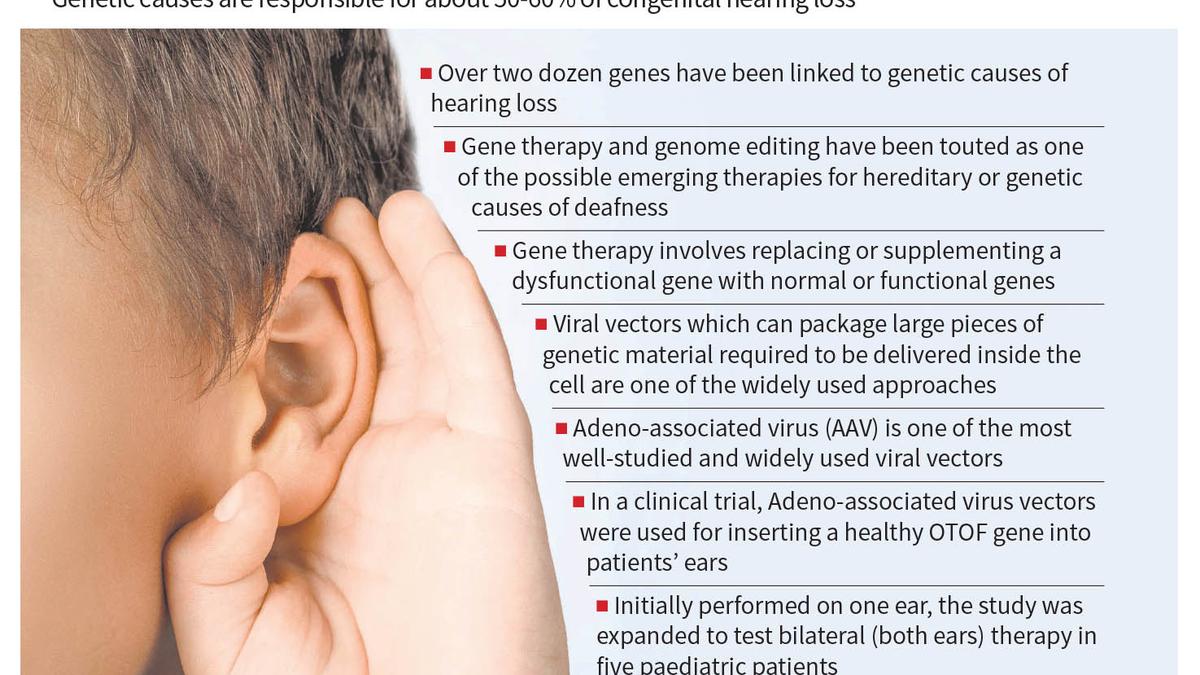
Hearing loss is a complex condition that can result from a variety of environmental and genetic factors including ear infections. Often, hearing loss serves as symptoms indicating defects or pathologies in the ear’s process that converts sound into electrical signals sent to the brain. It is widely estimated that a significant majority, amounting to approximately 50-60% of congenital hearing loss cases, are attributed to genetic causes. Among the various populations, genetic variants play a significant role. For example, mutations in the GJB2 gene are the most common genetic cause of hearing loss in Caucasian, Asian and Hispanic populations. In Africa, the MYO15A and ATP6V1B1 genes are more frequently implicated. In total, over two dozen genes have been linked to genetic causes of hearing loss. Besides genomic mutations, mitochondrial genetic defects can also lead to hearing impairment. Genetic variants could also play a role in the complex interplay with other factors, like medications. For instance, a prevalent genetic defect in the mitochondrial MTRNR1 gene can predispose individuals to hearing loss when administered with the aminoglycoside antibiotics, widely used in treatment of TB.

Correction of the gene defect underlies the genetic cause of hearing loss, and therefore gene therapy and genome editing have been touted as one of the possible emerging therapies for hereditary or genetic causes of deafness. Gene therapy typically involves replacing or supplementing a dysfunctional gene with normal or functional genes. There are a number of molecular approaches that have been widely used for such replacement or supplementation.

In addition to viral vectors, advanced non-viral methods are revolutionising gene therapy for genetic hearing loss. Lipid nanoparticles (LNPs) facilitate gene delivery by encapsulating nucleic acids and fusing with cell membranes, enabling efficient and targeted gene transfer. Electroporation employs controlled electrical pulses to transiently permeabilize the cell membrane, allowing direct uptake of genetic material. Cutting-edge genome editing technologies, such as CRISPR-Cas9, enable precise modification of specific DNA sequences through RNA-guided endonuclease activity, allowing targeted gene disruption or correction. These methodologies collectively enhance the potential for precise, efficient, and lasting correction of genetic defects underlying hearing loss. One of the widely used approaches involves viral vectors, which can package large pieces of genetic material required to be delivered inside the cell (referred to as cargo). Adeno-associated virus (AAV) is one of the most well-studied and widely used vectors for this purpose. AAV offers several advantages: it is a safe vector, as it does not cause human diseases, and it can infect both dividing and non-dividing cells, thus having a broad spectrum of cells it can target for genetic editing.

In a recent report published in Nature Medicine, Chinese researchers provide early promise towards using gene therapy for at least one genetic hearing loss. Researchers at the Fudan University, in collaboration with a number of research and clinical centres in China, proposed that gene therapy could effectively treat a form of genetic deafness involving the OTOF gene, known as hereditary deafness 9. Mutations in the OTOF gene account for approximately 2-8% of all genetic hearing loss cases. In this clinical trial, researchers employed Adeno-associated virus vectors with the intention of inserting a healthy OTOF gene into patients’ ears using a harmless virus. All patients experienced improved hearing in both ears. Initially performed on one ear, the study was expanded to test bilateral (both ears) therapy in five paediatric patients.

The researchers in the report suggest that no severe side effects were observed, while among the recorded 36-odd minor side effects, the most common were increased lymphocyte counts and cholesterol levels apart from an increase in lactate dehydrogenase levels, which is a marker for tissue damage in the body. Hearing tests showed significant improvement in all patients reported and all patients regained the ability to understand speech and locate sound sources. The promising results indicate that AAV gene therapy is safe and effective for treating hereditary deafness.

While the initial results are encouraging, Adeno-associated virus vectors come with their own set of caveats. The foremost being that our immune system can recognise and eliminate the virus making it less effective in individuals who are immunised, and also limits the re-administration of the gene therapy vector, since the primary administration would produce antibodies against the virus. Previous studies have suggested that approximately one-fifth to one-third of the patients have neutralising antibodies against AAV.

The present report is limited by the small number of patients studied and reported over a short follow-up period. However, it is encouraging that the clinical trial is ongoing and longer-term follow-up data of the patients would be available soon. While the results are encouraging and provide immense hope, we are not yet on a firm ground to assert that gene therapy for hearing loss is paving the way towards a sound future.

(Vinod Scaria is a consultant at Vishwanath Cancer Care Foundation, and Rahul Bhoyar is a senior scientist at Karkinos Healthcare. Opinions are personal)




Source link

Science Tags:Congenital hearing loss, gene therapy, Genetic hearing disability

Post navigation

Previous Post: Former Odisha Governor Murlidhar Chandrakant Bhandare passes away
Next Post: Study reveals alarming economic burden of TB treatment

Related Posts

  • How a Bronze Age rock became a ‘treasure map’ for researchers
    How a Bronze Age rock became a ‘treasure map’ for researchers Science
  • AI’s Cassandra moment
    AI’s Cassandra moment Science
  • Inside India’s ‘Deep Ocean Mission’, a challenge harder than going to space
    Inside India’s ‘Deep Ocean Mission’, a challenge harder than going to space Science
  • If 23andMe goes bust, what happens to its DNA database?
    If 23andMe goes bust, what happens to its DNA database? Science
  • The magpies of the Himalayas
    The magpies of the Himalayas Science
  • The Hindu Morning Digest, March 08, 2024
    The Hindu Morning Digest, March 08, 2024 Science

More Related Articles

Chandrayaan-4 to launch in 2027: Jitendra Singh Chandrayaan-4 to launch in 2027: Jitendra Singh Science
Seals, birds under threat in new ‘red list’ of endangered species Seals, birds under threat in new ‘red list’ of endangered species Science
As calculations catch up, muon anomaly nearly vanishes As calculations catch up, muon anomaly nearly vanishes Science
Why can’t light microscopes see inside cells? Why can’t light microscopes see inside cells? Science
Concurrent heatwaves, sea level rises pose a threat to coastlines Concurrent heatwaves, sea level rises pose a threat to coastlines Science
Catalytic boost for cheaper biodiesel production Catalytic boost for cheaper biodiesel production Science
SiteLock

Archives

  • May 2026
  • April 2026
  • March 2026
  • February 2026
  • January 2026
  • December 2025
  • November 2025
  • October 2025
  • September 2025
  • August 2025
  • July 2025
  • June 2025
  • May 2025
  • April 2025
  • March 2025
  • February 2025
  • January 2025
  • December 2024
  • November 2024
  • October 2024
  • September 2024
  • August 2024
  • July 2024
  • June 2024
  • May 2024
  • April 2024
  • March 2024
  • February 2024
  • January 2024
  • December 2023
  • November 2023
  • October 2023
  • September 2023
  • August 2023
  • July 2023
  • June 2023
  • May 2023
  • April 2023
  • March 2023
  • February 2023
  • January 2023
  • December 2022
  • November 2022
  • October 2022
  • September 2022
  • August 2022
  • July 2022
  • June 2022
  • May 2022

Categories

  • Business
  • Nation
  • Science
  • Sports
  • World

Recent Posts

  • Nicobarese oppose proposal for three wildlife sanctuaries
  • Visakhapatnam Collector calls for inter-departmental synergy to boost investments
  • Kohli’s masterful knock powers Royal Challengers to the top
  • Senior IPS officer Asra Garg posted IGP Intelligence
  • Vijay Narayan earns rare distinction of being Advocate General under two different governments

Recent Comments

  1. StevenLek on UP Teacher Who Asked Students To Slap Muslim Classmate
  2. Leonardren on UP Teacher Who Asked Students To Slap Muslim Classmate
  3. NathanQuins on UP Teacher Who Asked Students To Slap Muslim Classmate
  4. Davidgof on UP Teacher Who Asked Students To Slap Muslim Classmate
  5. NathanJobre on UP Teacher Who Asked Students To Slap Muslim Classmate
  • Shocked by that amazing catch: Avesh on Bishnoi’s wonder grab in India’s win against Zimbabwe
    Shocked by that amazing catch: Avesh on Bishnoi’s wonder grab in India’s win against Zimbabwe Sports
  • Access Denied
    Access Denied Nation
  • Access Denied World
  • Access Denied Sports
  • Times magazine names Donald Trump as ‘Person of the Year’ for 2024
    Times magazine names Donald Trump as ‘Person of the Year’ for 2024 World
  • “The Way Rohit Sharma Played…”: Babar Azam Clean Bowled By India Captain In World Cup Clash
    “The Way Rohit Sharma Played…”: Babar Azam Clean Bowled By India Captain In World Cup Clash Sports
  • Access Denied World
  • VinFast to enter India with premium electric SUV to take on rivals
    VinFast to enter India with premium electric SUV to take on rivals Business

Editor-in-Chief:
Mohammad Ariff,
MSW, MAJMC, BSW, DTL, CTS, CNM, CCR, CAL, RSL, ASOC.
editor@artifex.news

Associate Editors:
1. Zenellis R. Tuba,
zenelis@artifex.news
2. Haris Daniyel
daniyel@artifex.news

Photograher:
Rohan Das
rohan@artifex.news

Artifex.News offers Online Paid Internships to college students from India and Abroad. Interns will get a PRESS CARD and other online offers.
Send your CV (Subjectline: Paid Internship) to internship@artifex.news

Links:
Associate Journalism
About Us
Privacy Policy

News Links:
Breaking News
World
Nation
Sports
Business
Entertainment
Lifestyle

Registered Office:
72/A, Elliot Road, Kolkata - 700016
Tel: 033-22277777, 033-22172217
Email: office@artifex.news

Editorial Office / News Desk:
No. 13, Mezzanine Floor, Esplanade Metro Rail Station,
12 J. L. Nehru Road, Kolkata - 700069.
(Entry from Gate No. 5)
Tel: 033-46011099, 033-46046046
Email: editor@artifex.news

Copyright © 2023 Artifex.News Newsportal designed by Artifex Infotech.