



The Deep Ocean Mission (DOM) is India’s ambitious quest to explore and harness the depths of the ocean. As part of this initiative, India will, for the first time, embark on a journey to a depth of 6,000 metres in the ocean using an indigenously developed submersible with a three-member crew. The mission will require technologies to access and transport tonnes of valuable minerals from the ocean-bed in an environmentally safe manner. The following interview, with M. Ravichandran, Secretary of the Ministry of Earth Sciences, breaks down the mission and its salient features and challenges. It was conducted by Bhavya Khanna, a scientist in the Ministry.
Please tell us about the DOM and how MoES contributes to this programme.
DOM is India’s ambitious programme, chiefly implemented by the MoES. DOM was approved by the Union Cabinet in 2021 at a cost of nearly Rs 4,077 crore over a five-year period in a phased manner. The mission has six pillars:
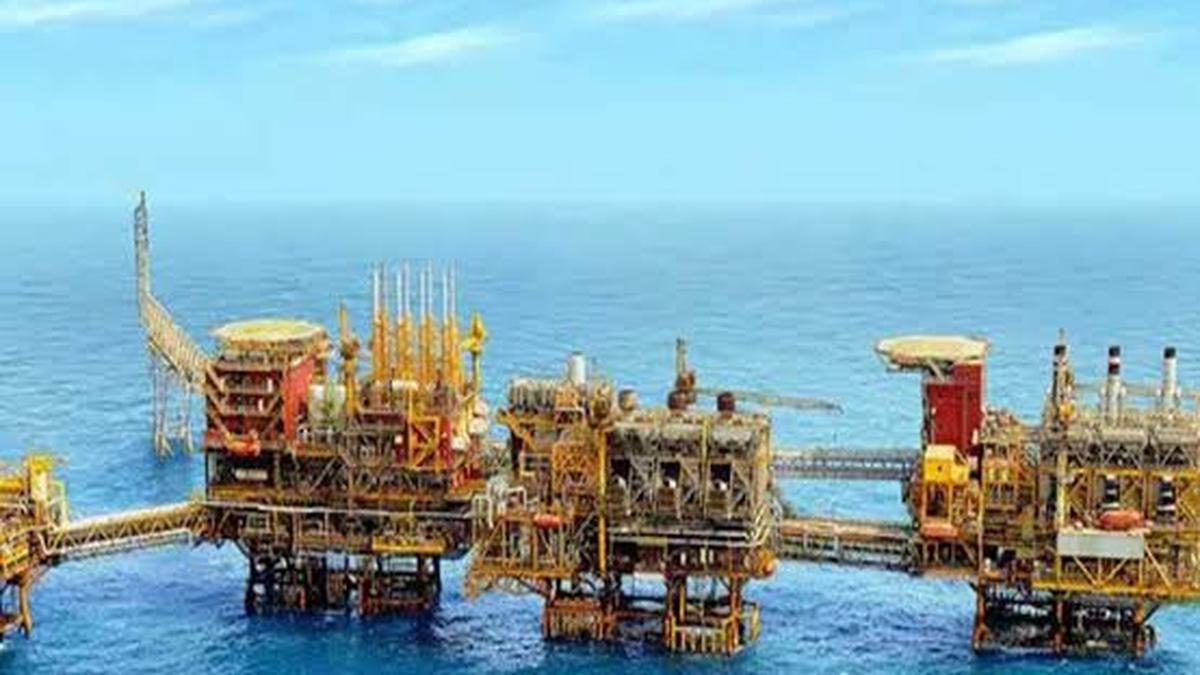
(i) Development of technologies for deep-sea mining and a manned submersible to carry three people to a depth of 6,000 metres in the ocean. The submersible will be equipped with a suite of scientific sensors, tools and an integrated system for mining polymetallic nodules from the central Indian Ocean;
(ii) Development of ocean climate change advisory services, involving an array of ocean observations and models to understand and provide future climate projections;
(iii) Technological innovations for the exploration and conservation of deep-sea biodiversity;
(iv) Deep-ocean survey and exploration aimed at identifying potential sites of multi-metal hydrothermal sulphides mineralisation along the Indian Ocean mid-oceanic ridges;
(v) Harnessing energy and freshwater from the ocean; and
(vi) Establishing an advanced Marine Station for Ocean Biology, as a hub for nurturing talent and driving new opportunities in ocean biology and blue biotechnology.
The ‘New India 2030’ document outlines a blue economy as the sixth core objective for India’s growth. The years 2021-2030 have been designated by the United Nations as the ‘Decade of Ocean Science’, and Prime Minister Narendra Modi has, on several occasions, emphasised the need for India to work towards sustainably harnessing the ocean’s potential for the nation’s growth.
DOM is one of nine missions under the Prime Minister’s Science, Technology, and Innovation Advisory Council (PMSTIAC). It is imperative that DOM supports the blue-economy priority area, blue trade, and blue manufacturing in India.
MoES institutes, especially the Centre for Marine Living Resources and Ecology (CMLRE), Indian National Centre for Ocean Information Services (INCOIS), National Centre for Coastal Research (NCCR), National Centre for Polar and Ocean Research (NCPOR) and National Institute of Ocean Technology (NIOT) will collaborate with other national institutes and academia to achieve the objectives outlined in DOM, albeit with well-segregated responsibilities. DOM’s progress is closely monitored by special councils and committees comprising experts from across the national and multi-institutions, given its status as a priority and focus area for us.
Please tell us about the progress of the first pillar of DOM, which requires the development of technologies for deep-sea mining and a crewed submersible.
The NIOT, an autonomous institute under MoES, has been entrusted with the mandate of developing indigenous technologies to address engineering challenges associated with exploring and utilising oceanic resources. As a part of DOM, India’s flagship deep ocean mission, ‘Samudrayaan’, was initiated in 2021 by the Minister of Earth Sciences.
With ‘Samudrayaan’, India is embarking on a groundbreaking crewed expedition to reach a depth of 6,000 m to the ocean bed in the central Indian Ocean. This historic journey will be accomplished by Matsya6000, a deep-ocean submersible designed to accommodate a crew of three members. Equipped with a suite of scientific sensors and tools, Matsya6000 boasts an operational endurance of 12 hours, which is extendable to 96 hours in the event of an emergency.
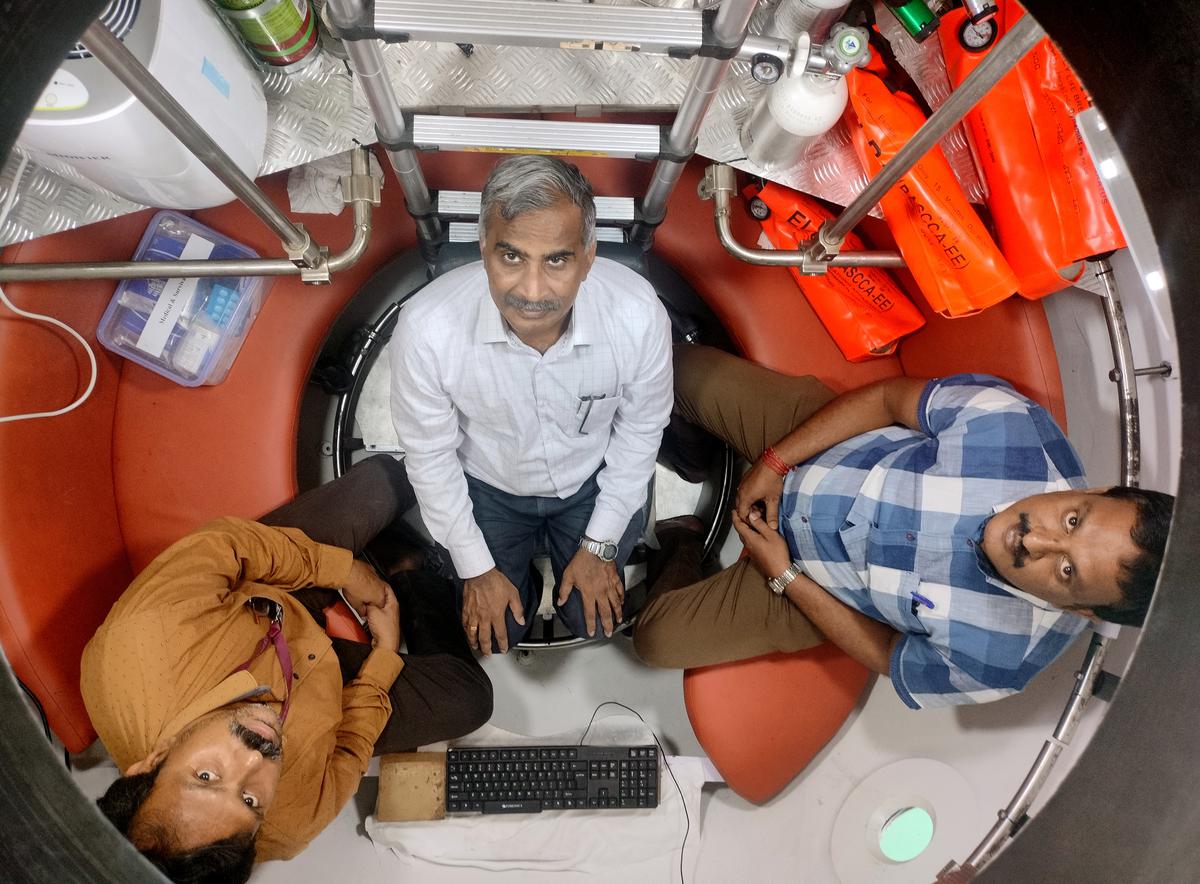
The design of Matsya6000 has now been completed. Our initial phase will involve testing and experimentation at a depth of 500 metres (shallow water) within the upcoming year, followed by a realisation of the full 6,000-metre depth capability within two to three years. The shallow-water personnel sphere of Matsya6000 has been certified for human-rated operations at up to 500-m water depths. A human acclimatisation test in a shallow-water sphere was successfully conducted with three personnel for two hours at a depth of 7 m.
Three people sit inside a prototype of the Matsya6000 submersible made by the National Institute of Ocean Technology, Chennai.
| Photo Credit:
Ravindran R./The Hindu
The Ministry is also working on an integrated system to mine polymetallic nodules of precious minerals from the central Indian Ocean bed. The minerals we can mine from the ocean bed in the central Indian Ocean region, allocated to us by the United Nations International Seabed Authority (ISA), include copper, manganese, nickel, and cobalt.
NIOT has successfully conducted deep-sea locomotion trials on the seabed at a depth of 5,270 m using our underwater mining system, ‘Varaha’. This milestone is a step towards future exploration and harvesting of deep-sea resources. With encouraging progress observed in field tests and trials, we remain steadfastly on course.
The deepest point in the oceans, the Mariana Trench, is 11,000 m deep. Why has a depth of 6,000 m been chosen?
The decision to target a depth of 6,000 m for the DOM holds strategic significance. India has committed to the sustainable extraction of valuable resources, including polymetallic nodules and polymetallic sulphides. ISA has allocated a 75,000-sq.-km region in the central Indian Ocean and an additional 10,000 sq. km at 26° S to India for this purpose.
Polymetallic nodules, which contain precious metals like copper, manganese, nickel, iron, and cobalt, are found approximately 5,000 m deep, and polymetallic sulphides occur at around 3,000 m in the central Indian Ocean. Therefore, our interests span depths of 3,000-5,500 m. By equipping ourselves to operate at a depth of 6,000 m, we can effectively cater to both the Indian Exclusive Economic Zone and the central Indian Ocean.
It is said that exploring the deep oceans is more challenging than exploring outer space. Can you elaborate on some of the important challenges of India’s DOM?
Indeed, exploring the depths of the oceans has proved to be more challenging than exploring outer space. The fundamental distinction lies with the high pressure in the deep oceans. While outer space is akin to a near perfect vacuum, being one meter underwater puts as much pressure on an object of one square meter area as if it were carrying about of 10,000kg of weight, which is equivalent to a huge adult elephant.
Operating under such high-pressure conditions requires the use of meticulously designed equipment crafted from durable metals or materials. Additionally, electronics and instruments find it simpler to function in a vacuum or in space. Conversely, inside the water, poorly designed objects collapse or implode.
Landing on the ocean bed also presents challenges due to its incredibly soft and muddy surface. This factor renders it exceedingly difficult for heavy vehicles to land or manoeuvre, as they would inevitably sink.
Moreover, extracting materials requires them to be pumped to the surface, an undertaking that demands a large amount of power and energy. Unlike controlling rovers on distant planets, remotely operated vehicles prove ineffective in the deep oceans due to the absence of electromagnetic wave propagation in this medium. Visibility also poses a significant hurdle as natural light can penetrate only a few tens of metres beneath the surface, whereas space observations are facilitated through telescopes.
All these intricate challenges are further compounded by factors like variations in temperature, corrosion, salinity, etc., all of which must also be dealt with.
This is where NIOT plays an important role. Since its establishment in 1993, NIOT has provided scientific engineering solutions for a wide variety of earth-system-related issues. These solutions span beach restoration and buoy observations to the creation of vehicles tailored for polar regions and lakes. One of the pillars, which revolves around developing technologies for deep-ocean crewed missions and mining systems, has been progressing well.
Please tell us about the Matsya6000. Where does this keep us on the global front?
The Matsya6000 is India’s flagship deep-ocean human submersible that aims to reach the ocean bed at a depth of 6,000 m. Accompanied by three crew members, called “aquanauts”, the submersible carries a suite of scientific tools and equipment designed to facilitate observations, sample collection, basic video and audio recording, and experimentation.
The primary mission of Matsya6000 revolves around exploration. Notably, countries such as the U.S.A., Russia, China, France, and Japan have already achieved successful deep-ocean crewed missions. India is poised to join the ranks of these nations by demonstrating expertise of and capability for deep-ocean crewed missions. As a country, this makes us very proud. It is also important to note that our focus remains on developing these technologies indigenously, aligned with the vision of ‘Atmanirbhar Bharat’.
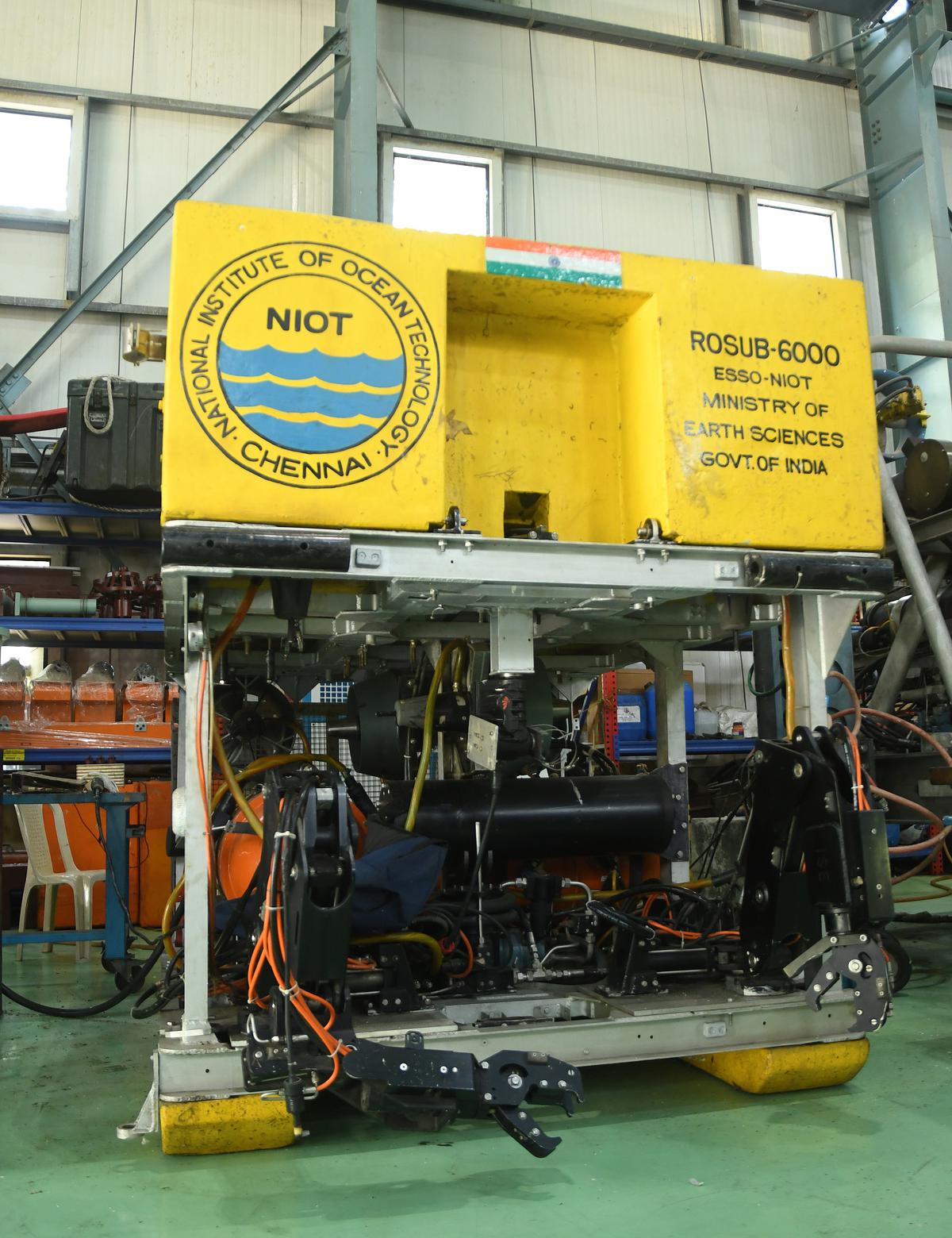
A remotely operable vehicle built by the National Institute of Ocean Technology, Chennai, as part of India’s ‘Deep Ocean Mission’.
| Photo Credit:
Ravindran R./The Hindu
Matsya6000 seamlessly combines the best and most feasible features of remote operated vehicles (ROVs) and autonomous remote vehicles (AUVs). Although its sub-sea endurance is limited, it offers an excellent intervention mechanism and operates untethered. This feature positions it ideally for deep-sea observation missions.
The interior of Matsya6000 is designed to accommodate three humans travelling within a specialised sphere with a diameter of 2.1 m. The human sphere would weigh approximately 28 tonnes and have a short-sleeved environment with life support, where oxygen is supplied and carbon dioxide is scrubbed away.
Constructed from a titanium alloy, the sphere is engineered to withstand pressures of up to 6,000 bar. It is equipped with propellers enabling movement in all six directions and features three viewports that allow the crew to observe its surroundings in real-time.
There will be about 12 cameras and 16 lights powered by lithium polymer batteries with an energy budget of 1 kWh. Communication is achieved through sound – an acoustic phone and modem. The navigation and positioning systems are state-of-the-art, too.
The overall dimensions of Matsya are 9 m in length, 3 m in breadth, and 5 m in height. Importantly, it will not be actively lowered through sinking; instead, it will function as a free-floating system, for energy efficiency. It can move at a speed of about 5.5 km/hr using underwater thrusters, which is adequate.
With Matsya, India will be the only country to have an entire ecosystem of underwater vehicles encompassing deep-water ROVs, polar ROVs, AUVs, deep-water coring systems, and more.
Please tell us about the Indian deep-ocean mining system ‘Varaha’. Which other countries have successfully taken up deep-sea mining so far?
ISA has granted deep-ocean exploration and mining contracts to several countries, including China, France, Germany, Japan, Russia, South Korea, and India. Our own deep-ocean mining vehicle, ‘Varaha’, is a self-propelled track-based seabed mining system.
It operates on the flexible riser technique: the mining vehicle is lowered to the ocean bed from a surface ship using a high-strength flexible cord system. Once the vehicle reaches the ocean bed, it will be able to move around while the surface ship moves in tandem.
Positioned at a pre-surveyed mineral-rich site, Varaha uses a high-power pressure pump system to facilitate the extraction of precious polymetallic nodules. These nodules are pumped from the ocean bed to the surface ship.
Last year, NIOT successfully conducted deep-sea locomotion trials of ‘Varaha’ at a depth of 5,270 m in the central Indian Ocean. Over a span of 2.5 hours, the surface ship covered a distance of 120 m with Varaha. This achievement marked the world’s deepest dive for an underwater mining machine.
‘Varaha’ was able to collect the polymetallic nodules from the ocean bed during the trial. An environmental impact assessment for this operation has been submitted to international authorities, signifying the successful completion of stage 1.
Nonetheless, much work remains in stage 2, which includes the extraction of valuable minerals. In this stage, our mining system has to make a slurry by combining polymetallic nodules with ocean water on the ocean bed using a powerful crusher. Then, the mineral slurry will be pumped up to the surface (5,000-6,000 m) through a riser.
Given that the power supply – of about 1 MW per hour – can only be supplied from the surface ship, the pump must be very powerful. More power would mean very high riser friction. The slurry has to be transported so that the minerals can be extracted. We are working on addressing all these aspects, and our progress is promising.
I would like to add that the Ministry of Earth Sciences, various national institutes, and academia all involved as part of DOM have demonstrated excellent collaboration, knowledge exchange, and pooling of human capital. This embodies the very essence of the scientific zeal that defines our nation. By 2025, we are confident of moving the DOM ahead. Our commitment to success and service remains unwavering.