


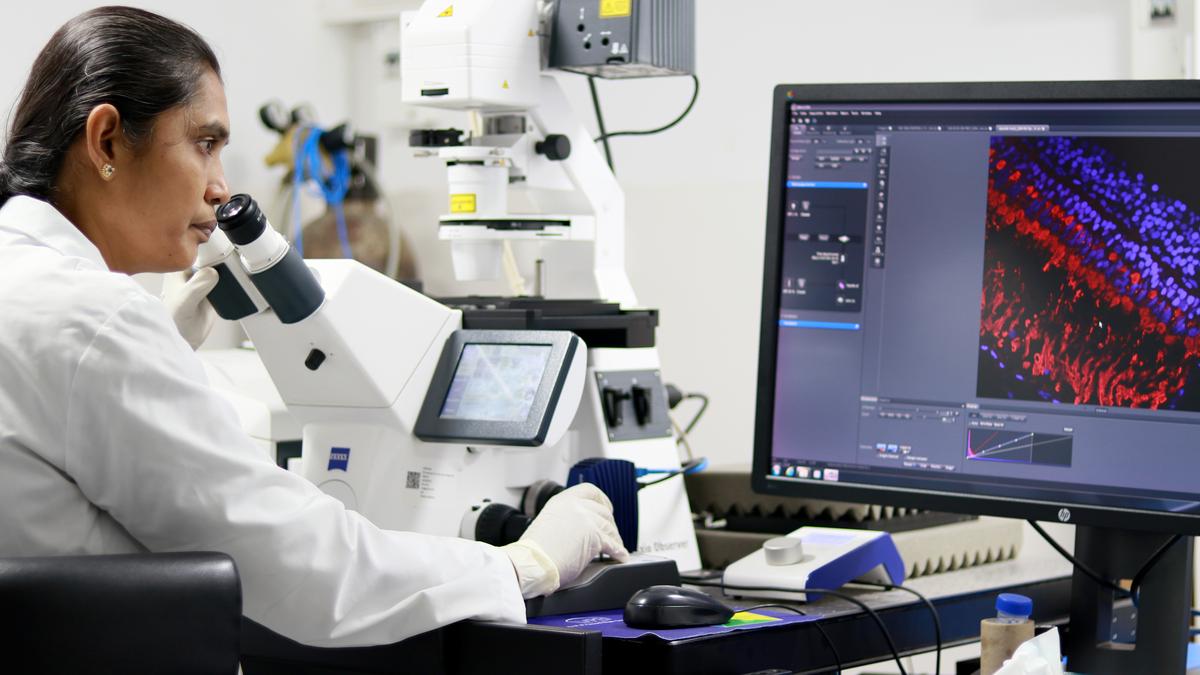
Scientists from the CSIR-Institute of Genomics and Integrative Biology, New Delhi, have developed an enhanced genome-editing system that can modify DNA more precisely and more efficiently than existing CRISPR-based technologies.
CRISPR occurs naturally in some bacteria, as a part of their immune system that limits infections by recognising and destroying viral DNA. In Nobel-prize winning work, scientists repurposed this bacterial defence mechanism to develop a novel approach for editing the genomes of higher-order organisms.
CRISPR’s off-target problem
Today, using CRISPR-Cas9, researchers can add, remove or alter specific DNA sequences in the genome of animals. This system has been used in various fields, including in agriculture — to improve the nutritional value of plants and increase the yield — and in healthcare to diagnose several diseases and treat genetic disorders.
The CRISPR-Cas9 gene editing tool uses a guide-RNA (gRNA) designed to find and bind to a specific part of the target genome. The gRNA directs an enzyme, Cas9, to the target site, which is followed by a short DNA sequence called protospacer adjacent motif (PAM). Cas9 recognises and binds to the PAM sequence, and acts as a molecular scissor that snips some damaged DNA. This automatically triggers the cell’s DNA repair system, which repairs the snipped part to insert the correct DNA sequence.
But the CRISPR-Cas9 system can also recognise and cut parts of the genome other than the intended portion. Such “off-target” effects are more common when using the SpCas9 enzyme derived from Streptococcus pyogenes bacteria. Scientists have been able to engineer versions of SpCas9 with higher fidelity but only at the cost of editing efficiency.
Switching SpCas9 with FnCas9
To overcome these issues, researchers are exploring Cas9 enzymes from Francisella novicida bacteria. While this Cas9, called FnCas9, is highly precise, it has a low efficiency as well.
To enhance it without compromising its specificity, researchers led by Debojyoti Chakraborty at CSIR-IGIB modified and engineered new versions of FnCas9.
The researchers tinkered with amino acids in FnCas9 that recognise and interact with the PAM sequence on the host genome. “By doing this, we increase the binding affinity of the Cas protein with the PAM sequence,” Dr. Chakraborty said. “The Cas9 can then sit on the DNA in a stronger configuration, and your gene editing becomes much more effective.”
The researchers also engineered the enhanced FnCas9 to be more flexible and edit regions of the genome that are otherwise harder to access. “This opens up more avenues for gene editing,” Dr. Chakraborty said.
Juicing the enzyme
Experiments to measure enzyme activity showed that enhanced FnCas9 cut target DNA at a higher rate compared to unmodified FnCas9.
CRISPR-based tools for diagnostics and therapeutics rely on the ability of the system to recognise specific single-nucleotide changes in the DNA. Nucleotides are the building blocks of DNA and RNA. Each nucleotide consists of a nucleobase, a phosphate group, and a sugar. Each nucleotide in DNA has one of four nucleobases: adenosine, thymine, guanine, and cytosine. A single-nucleotide change is when just one nucleotide in the genome needs to be ‘repaired’.
When the researchers tested the ability of enhanced FnCas9 to identify such changes in the genome, they found enFnCas9 outperformed unmodified FnCas9. An enhanced FnCas9-based diagnostic could target almost twice the number of changes compared to FnCas9, increasing the scope of detecting more disease-causing genetic changes.

Testing against an inherited blindness
Once Dr. Chakraborty’s team had shown the increased efficiency and activity of the enhanced FnCas9 enzyme, a team led by Indumathi Mariappan at the L.V. Prasad Eye Institute in Hyderabad explored the enzyme’s suitability for therapeutic applications.
The researchers used enhanced FnCas9 to edit the genome of human kidney and eye cells grown in lab dishes. It not only edited genes in these cells at a better rate than did SpCas9, it also showed negligible off-target effects.
The team finally sought to understand whether enhanced FnCas9 is a viable option for treating genetic disorders. They tested the enzyme’s efficiency at correcting a genetic mutation that causes Leber congenital amaurosis type 2 (LCA2), a form of inherited blindness. A single mutation in the RPE65 gene results in the loss of expression of a protein called retinal pigment epithelial-specific (RPE65), resulting in severe vision loss.
A surprising efficiency
The team isolated skin cells from an individual with LCA2 carrying the RPE65 mutation, and reprogrammed these cells to become induced pluripotent stem cells (iPSCs). Such cells can be made to grow into any cell type in the human body. When the researchers differentiated the iPSCs into cells of the eye’s retina, the cells expressed negligible levels of RPE65 protein.
The researchers delivered a CRISPR system with the enhanced FnCas9 enzyme into the individual’s iPSCs to correct the mutation responsible for low levels of this protein. When they sequenced the edited cells, they found that the CRISPR tool had corrected the mutation. The edited iPSCs when differentiated into retinal cells also showed normal levels of the RPE65 protein.
Dr. Mariappan said the team was taken aback by the efficiency of the editing. Most of the iPSCs carried the edits, and when the researchers grew colonies from individual edited iPSCs, they found that two colonies showed 100% mutation correction.
“We also examined the whole genome for off-target interactions and found only a few, of no major concern, as compared to several hits seen with other Cas9 proteins [we] examined,” she added.
What the research community needed
Previous reports have suggested that such corrected (person-specific) retinal cells can be transplanted back into a person to treat inherited blindness conditions like LCA2.
A group of U.S. researchers reported on May 6, 2024, in the New England Journal of Medicine that CRISPR injected directly into the eyes of people suffering from LCA2 has shown success in early clinical trials. But editing patient-specific stem cells and transplanting the mutation-corrected cells into patients is a safer option, according to Dr. Mariappan, “because this allows us to screen and confirm precise edits.”
“The research community needed this precision” in the CRISPR system, Shailja Singh, a researcher at Jawaharlal Nehru University, New Delhi, who uses CRISPR-based tools to model and study genetic diseases like sickle cell anaemia and β-thalassaemia, said. Such reduced off-target effects are critical for those who use CRISPR-based therapy to correct mutations, “so this is a very welcome approach.”
Dr. Singh added that while a precise enzyme without any off-target effects is much-needed, the delivery system must also be equally proficient. According to her, researchers should next focus on precisely delivering this tool into the nuclei of the target cells.

Making therapies for India
Dr. Chakraborty said the team is working on adapting the system to different delivery methods as well as reducing the size of the enFnCas9. “All these will come in the following studies,” he said.
The team is also in contact with some Indian companies to patent the technology. “This opens up the doors for not licensing from a foreign entity, which could be very, very expensive.”
Dr. Mariappan agreed: “With an indigenous patent for such a high precision editor, we are now in a better position to develop newer therapeutics at affordable costs for people in low- and middle-income countries like ours.”
Sneha Khedkar is a biologist turned freelance science journalist.