






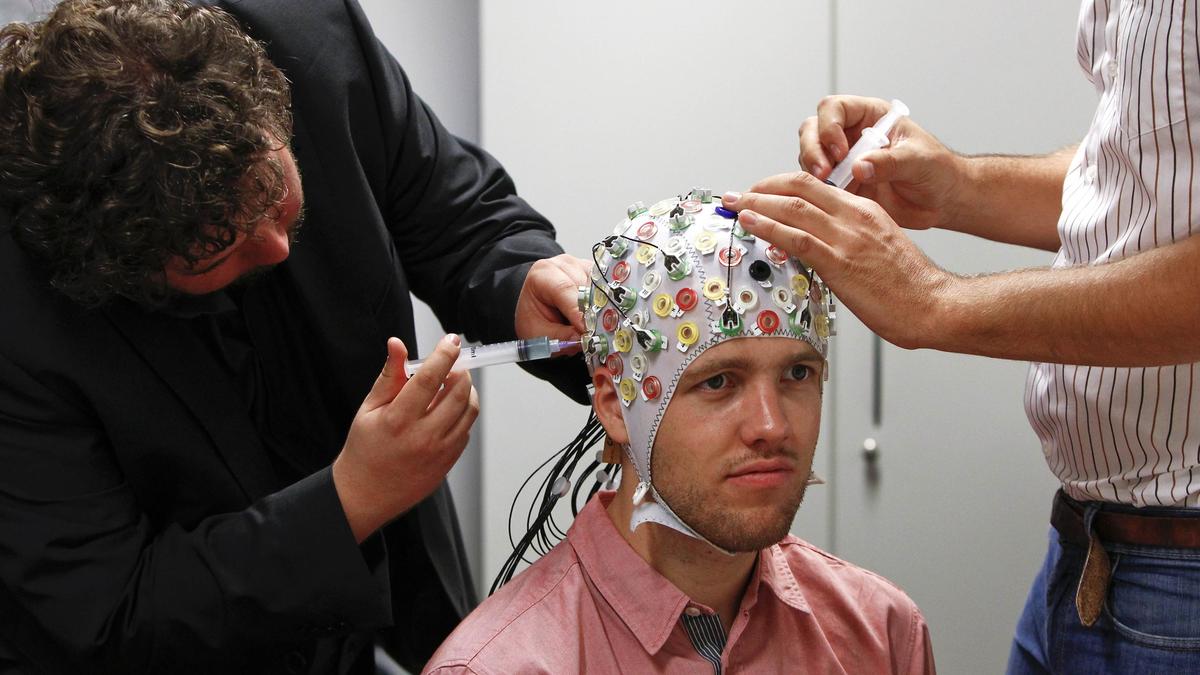
The EEG is a marvel of physics and neurobiology that opens a simple window into the human brain. This window is often small and yet it reveals so much. But not least is the wonder that it reveals anything at all without having to break open the skull first. This year is the centenary of the first human EEG, produced by German physiologist Hans Berger.
How was the EEG invented?
Berger’s feat was preceded by incremental but significant advances across Europe from the late 19th century. In 1875, British physician Richard Caton reported evidence of electrical activity in the brains of monkeys and rabbits. Fifteen years on, his Polish peer Adolf Beck found evidence of fluctuating activity in the brains of dogs and rabbits when he stimulated their senses.
In 1912, Vladimir Pravdich-Neminsky produced the first mammalian EEG, of a dog’s brain. Berger succeeded him in 1924 with the human counterpart. He is also credited with inventing the EEG, naming it, and introducing its utility in clinical settings.
What is EEG?
EEG stands for electroencephalography. ‘Electro-’ pertains to electricity; ‘-encephalo-’ refers to the brain; and ‘-graphy’ is a suffix meaning to show or to represent.
Neurons in the brain perform various functions by moving electrically charged particles such as ions. The movement of these particles gives rise to electrical activity that a health worker can use an EEG test to visualise. Researchers have also been able to relate data obtained from an EEG with different levels and modes of brain activity, and can use it to distinguish reliably between normal and abnormal states.
EEG is not an uncommon diagnostic test in clinical settings. Among other applications, it is the reference standard — i.e. the best test available — to diagnose epilepsy. An EEG test can also reveal the effects of anaesthesia, sleeping patterns, neurological activity during a coma, and availability of oxygen. EEG can also help confirm brain death, one of the two legally recognised forms of death in India.
In research, scientists use EEG for neuroscience, cognitive psychology, neurolinguistics, and neuromarketing studies and to develop brain-computer interfaces.
What is volume conduction?
EEG measures electrical activity in the brain generated by neurons. During an EEG test, a health worker will place electrodes on your scalp. There are many layers of skin, fluid, and bone between the electrodes and the neurons. When a neuron produces electrical activity, charged particles will move through all these media before reaching the electrodes, and will be reflected, refracted, scattered, etc. en route.
Volume conduction refers to the movement of electrical activity through this three-dimensional volume. It also stands for the fact that the electrical activity is produced in one place whereas the detectors that detect it are located at some distance.
The raw data collected by the electrodes will first need to be corrected for the effects of volume conduction, and then for noise in the data arising from faulty electrodes, incidental physiological activity (e.g. blinking or muscle activity). A clinician finally interprets the processed data.
How does an EEG test work?
The neurons that make up the human brain are constantly exchanging atoms, molecules, proteins, etc. with their surroundings. Sometimes neurons will push ions out into the space between neurons. Since ions of the same charge repel each other, this ‘motion’ can push away other ions, which push away even other ions, and so on.
When a large number of neurons start this cascade at the same time, a (relatively) big wave of electrical activity flows through the brain. The electrodes on the scalp are made of metal and track the changes in voltage as the waves move past them, creating an electroencephalogram.
Where are the electrodes placed?
You can place them anywhere, but if you’re comparing notes with a scientist or want to follow clinical standards, you should follow the International 10-20 System. In this system, the distance between two adjacent electrodes is either 10% or 20% of the total distance between two points on the head along which electrodes are being placed.
Four common points of reference are the nasion (the depression between the eyes, just above the bridge of the nose) and the inion (the crest at the back of the skull) going front to back, and from tragus to tragus going side to side. (The tragus is the small flap-like projection on the outer ear; you push it in to shut your ears when there’s a loud noise.)
What does and doesn’t EEG show?
The changes in voltage recorded at the electrodes are transmitted to a computer, which plots the readings on a graph with voltage on one axis and time passed on another. Health workers are typically interested in two types of data in the graph: the voltage (measured in millionths of a volt) and the frequency of the variations (measured in hertz). They will also factor in, among other things, the location of the neurons responsible for the electrical activity recorded by the test (e.g. in the neocortex or the allocortex, the two types of cortices of the cerebral cortex).
EEG is better than other diagnostic devices at tracking relatively rapid electrical activity in the brain, in the order of milliseconds. On the downside, it is biased towards electrical signals generated closer to the surface of the cortex, and significantly so towards currents generated by neurons’ dendrites and against those generated by the axons. The process to pinpoint where some electrical activity originated within the brain, to result in some electrical data, is also less than straightforward.
To overcome these and other challenges, researchers have used EEG together with other tests, like magnetic resonance imaging (MRI), and have developed sophisticated data acquisition, processing, and reconstruction methods.
Are EEGs affordable?
Aside from its metrological and diagnostic abilities, an EEG setup is also relatively simple and cost-effective. The equipment involved doesn’t take up much space, doesn’t emit high-energy radiation or sounds, doesn’t confine patients to small spaces (like MRI), is non-invasive, and is portable. (The invasive version of EEG is called electrocorticography, or ECoG).
Similarly, aside from its diagnostic downsides, setting up an EEG test requires time — including applying a gel on the person’s head and placing the electrodes in precise locations according to the 10-20 System — and its readings can be affected if the person has so much as thicker hair.