


Skip to content
  • Facebook
  • X
  • Linkedin
  • WhatsApp
  • YouTube
  • Associate Journalism
  • About Us
  • Privacy Policy
  • 033-46046046
  • editor@artifex.news
Artifex.News

Artifex.News

Stay Connected. Stay Informed.

  • Breaking News
  • World
  • Nation
  • Sports
  • Business
  • Science
  • Entertainment
  • Lifestyle
  • Toggle search form
  • Start-up India to move out of Invest India’s ambit: Goyal
    Start-up India to move out of Invest India’s ambit: Goyal Business
  • PM Pedro Sanchez: India, Spain must contribute in building open and secure Indo-Pacific region
    PM Pedro Sanchez: India, Spain must contribute in building open and secure Indo-Pacific region World
  • “Are Umpires Blind?” World Cup Winner Angry As Dinesh Karthik Survives Controversial LBW In RCB vs RR IPL Clash
    “Are Umpires Blind?” World Cup Winner Angry As Dinesh Karthik Survives Controversial LBW In RCB vs RR IPL Clash Sports
  • Access Denied World
  • Former Thai leader Thaksin Shinawatra, jailed after returning from exile, requests a royal pardon
    Former Thai leader Thaksin Shinawatra, jailed after returning from exile, requests a royal pardon World
  • Access Denied
    Access Denied Nation
  • Access Denied Sports
  • Learn from Sri Lanka’s experience on impact of fertilizer supply chains: experts
    Learn from Sri Lanka’s experience on impact of fertilizer supply chains: experts Business
100 years of electroencephalography (EEG) in human medicine

100 years of electroencephalography (EEG) in human medicine

Posted on July 15, 2024 By admin


The EEG is a marvel of physics and neurobiology that opens a simple window into the human brain. This window is often small and yet it reveals so much. But not least is the wonder that it reveals anything at all without having to break open the skull first. This year is the centenary of the first human EEG, produced by German physiologist Hans Berger.

How was the EEG invented?

Berger’s feat was preceded by incremental but significant advances across Europe from the late 19th century. In 1875, British physician Richard Caton reported evidence of electrical activity in the brains of monkeys and rabbits. Fifteen years on, his Polish peer Adolf Beck found evidence of fluctuating activity in the brains of dogs and rabbits when he stimulated their senses.

In 1912, Vladimir Pravdich-Neminsky produced the first mammalian EEG, of a dog’s brain. Berger succeeded him in 1924 with the human counterpart. He is also credited with inventing the EEG, naming it, and introducing its utility in clinical settings.

What is EEG?

EEG stands for electroencephalography. ‘Electro-’ pertains to electricity; ‘-encephalo-’ refers to the brain; and ‘-graphy’ is a suffix meaning to show or to represent.

Neurons in the brain perform various functions by moving electrically charged particles such as ions. The movement of these particles gives rise to electrical activity that a health worker can use an EEG test to visualise. Researchers have also been able to relate data obtained from an EEG with different levels and modes of brain activity, and can use it to distinguish reliably between normal and abnormal states.

EEG is not an uncommon diagnostic test in clinical settings. Among other applications, it is the reference standard — i.e. the best test available — to diagnose epilepsy. An EEG test can also reveal the effects of anaesthesia, sleeping patterns, neurological activity during a coma, and availability of oxygen. EEG can also help confirm brain death, one of the two legally recognised forms of death in India.

In research, scientists use EEG for neuroscience, cognitive psychology, neurolinguistics, and neuromarketing studies and to develop brain-computer interfaces.

What is volume conduction?

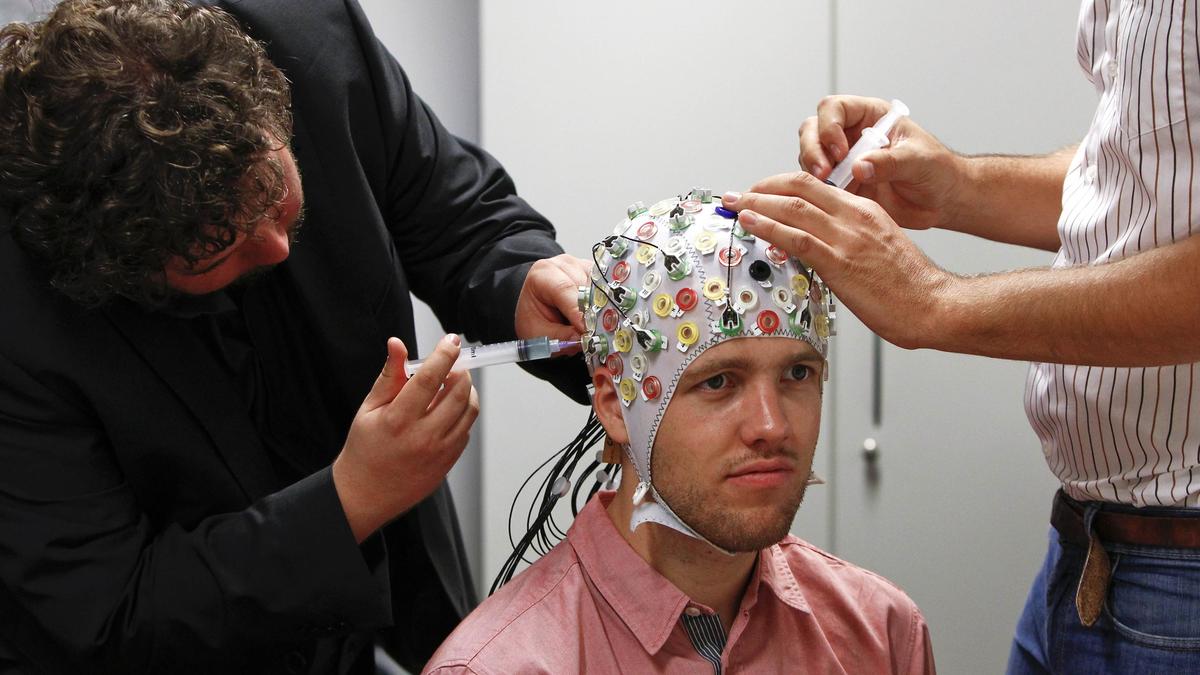
EEG measures electrical activity in the brain generated by neurons. During an EEG test, a health worker will place electrodes on your scalp. There are many layers of skin, fluid, and bone between the electrodes and the neurons. When a neuron produces electrical activity, charged particles will move through all these media before reaching the electrodes, and will be reflected, refracted, scattered, etc. en route.

Volume conduction refers to the movement of electrical activity through this three-dimensional volume. It also stands for the fact that the electrical activity is produced in one place whereas the detectors that detect it are located at some distance.

The raw data collected by the electrodes will first need to be corrected for the effects of volume conduction, and then for noise in the data arising from faulty electrodes, incidental physiological activity (e.g. blinking or muscle activity). A clinician finally interprets the processed data.

How does an EEG test work?

The neurons that make up the human brain are constantly exchanging atoms, molecules, proteins, etc. with their surroundings. Sometimes neurons will push ions out into the space between neurons. Since ions of the same charge repel each other, this ‘motion’ can push away other ions, which push away even other ions, and so on.

When a large number of neurons start this cascade at the same time, a (relatively) big wave of electrical activity flows through the brain. The electrodes on the scalp are made of metal and track the changes in voltage as the waves move past them, creating an electroencephalogram.

Where are the electrodes placed?

You can place them anywhere, but if you’re comparing notes with a scientist or want to follow clinical standards, you should follow the International 10-20 System. In this system, the distance between two adjacent electrodes is either 10% or 20% of the total distance between two points on the head along which electrodes are being placed.

Four common points of reference are the nasion (the depression between the eyes, just above the bridge of the nose) and the inion (the crest at the back of the skull) going front to back, and from tragus to tragus going side to side. (The tragus is the small flap-like projection on the outer ear; you push it in to shut your ears when there’s a loud noise.)

What does and doesn’t EEG show?

The changes in voltage recorded at the electrodes are transmitted to a computer, which plots the readings on a graph with voltage on one axis and time passed on another. Health workers are typically interested in two types of data in the graph: the voltage (measured in millionths of a volt) and the frequency of the variations (measured in hertz). They will also factor in, among other things, the location of the neurons responsible for the electrical activity recorded by the test (e.g. in the neocortex or the allocortex, the two types of cortices of the cerebral cortex).

EEG is better than other diagnostic devices at tracking relatively rapid electrical activity in the brain, in the order of milliseconds. On the downside, it is biased towards electrical signals generated closer to the surface of the cortex, and significantly so towards currents generated by neurons’ dendrites and against those generated by the axons. The process to pinpoint where some electrical activity originated within the brain, to result in some electrical data, is also less than straightforward.

To overcome these and other challenges, researchers have used EEG together with other tests, like magnetic resonance imaging (MRI), and have developed sophisticated data acquisition, processing, and reconstruction methods.

Are EEGs affordable?

Aside from its metrological and diagnostic abilities, an EEG setup is also relatively simple and cost-effective. The equipment involved doesn’t take up much space, doesn’t emit high-energy radiation or sounds, doesn’t confine patients to small spaces (like MRI), is non-invasive, and is portable. (The invasive version of EEG is called electrocorticography, or ECoG).

Similarly, aside from its diagnostic downsides, setting up an EEG test requires time — including applying a gel on the person’s head and placing the electrodes in precise locations according to the 10-20 System — and its readings can be affected if the person has so much as thicker hair.


Source link

Science Tags:cerebral cortex, EEG 100 years, eeg in human medicine, electroencephalography, epilepsy diagnosis, Hans Berger EEG inventor, neocortex, volume conduction

Post navigation

Previous Post: 100 years of electroencephalography (EEG) in human medicine
Next Post: Trump Riding Wave Of Wins

Related Posts

  • Bird deaths raise red flags as India expands wind energy
    Bird deaths raise red flags as India expands wind energy Science
  • Hand-held ‘electric labs’ can rapidly identify pathogens
    Hand-held ‘electric labs’ can rapidly identify pathogens Science
  • ISRO gearing up for next U.S. collaboration with BlueBird communications satellite launch after NISAR
    ISRO gearing up for next U.S. collaboration with BlueBird communications satellite launch after NISAR Science
  • How AI is helping communities restore Madagascar’s ancient baobab forests
    How AI is helping communities restore Madagascar’s ancient baobab forests Science
  • How are zebrafishes able to repair damaged hearts?
    How are zebrafishes able to repair damaged hearts? Science
  • Lab-grown human ‘embryo’ created without eggs or sperm
    Lab-grown human ‘embryo’ created without eggs or sperm Science

More Related Articles

Unwrapping India’s plastic packaging problem: from boom to crisis Unwrapping India’s plastic packaging problem: from boom to crisis Science
RNA, not DNA, is the main cause of acute sunburn RNA, not DNA, is the main cause of acute sunburn Science
Scientists map fruit fly brain in neurobiological milestone Scientists map fruit fly brain in neurobiological milestone Science
Rhino dehorning brings poaching in African reserves crashing down Rhino dehorning brings poaching in African reserves crashing down Science
Radar study puts spotlight on Saturn moon Titan’s hydrocarbon seas Radar study puts spotlight on Saturn moon Titan’s hydrocarbon seas Science
Science for All | New atlas reveals tiled bodies are common across life on earth Science for All | New atlas reveals tiled bodies are common across life on earth Science
SiteLock

Archives

  • September 2026
  • August 2026
  • July 2026
  • June 2026
  • May 2026
  • April 2026
  • March 2026
  • February 2026
  • January 2026
  • December 2025
  • November 2025
  • October 2025
  • September 2025
  • August 2025
  • July 2025
  • June 2025
  • May 2025
  • April 2025
  • March 2025
  • February 2025
  • January 2025
  • December 2024
  • November 2024
  • October 2024
  • September 2024
  • August 2024
  • July 2024
  • June 2024
  • May 2024
  • April 2024
  • March 2024
  • February 2024
  • January 2024
  • December 2023
  • November 2023
  • October 2023
  • September 2023
  • August 2023
  • July 2023
  • June 2023
  • May 2023
  • April 2023
  • March 2023
  • February 2023
  • January 2023
  • December 2022
  • November 2022
  • October 2022
  • September 2022
  • August 2022
  • July 2022
  • June 2022
  • May 2022

Categories

  • Business
  • Nation
  • Science
  • Sports
  • World

Recent Posts

  • Davis Cup: Czechs beat USA to qualify for finals
  • Ed Sheeran set to return to stage after Palestinian controversy
  • Asian Games 2026 opens in Japan with 11,000 athletes competing | LIVE updates
  • Union Home Minister Amit Shah falls ill in Hubballi, skips function
  • Raphinha hat-trick maintains Barcelona’s perfect LaLiga start

Recent Comments

  1. AlvinNet on UP Teacher Who Asked Students To Slap Muslim Classmate
  2. AlvinNet on UP Teacher Who Asked Students To Slap Muslim Classmate
  3. Jamesslits on UP Teacher Who Asked Students To Slap Muslim Classmate
  4. MichaelClear on UP Teacher Who Asked Students To Slap Muslim Classmate
  5. Jamesslits on UP Teacher Who Asked Students To Slap Muslim Classmate
  • Access Denied World
  • Access Denied
    Access Denied Nation
  • Access Denied
    Access Denied Nation
  • Access Denied
    Access Denied Nation
  • Former India Shooter Ronjan Sodhi Slams Shooting Preparations Ahead Of Paris Olympics 2024
    Former India Shooter Ronjan Sodhi Slams Shooting Preparations Ahead Of Paris Olympics 2024 Sports
  • Owner Of Delhi Hospital Where 7 Newborns Killed In Fire Arrested
    Owner Of Delhi Hospital Where 7 Newborns Killed In Fire Arrested Nation
  • Shock diamonds: supersonic heat nuggets
    Shock diamonds: supersonic heat nuggets Science
  • Access Denied Sports

Editor-in-Chief:
Mohammad Ariff,
MSW, MAJMC, BSW, DTL, CTS, CNM, CCR, CAL, RSL, ASOC.
editor@artifex.news

Associate Editors:
1. Zenellis R. Tuba,
zenelis@artifex.news
2. Haris Daniyel
daniyel@artifex.news

Photograher:
Rohan Das
rohan@artifex.news

Artifex.News offers Online Paid Internships to college students from India and Abroad. Interns will get a PRESS CARD and other online offers.
Send your CV (Subjectline: Paid Internship) to internship@artifex.news

Links:
Associate Journalism
About Us
Privacy Policy

News Links:
Breaking News
World
Nation
Sports
Business
Entertainment
Lifestyle

Registered Office:
72/A, Elliot Road, Kolkata - 700016
Tel: 033-22277777, 033-22172217
Email: office@artifex.news

Editorial Office / News Desk:
No. 13, Mezzanine Floor, Esplanade Metro Rail Station,
12 J. L. Nehru Road, Kolkata - 700069.
(Entry from Gate No. 5)
Tel: 033-46011099, 033-46046046
Email: editor@artifex.news

Copyright © 2023 Artifex.News Newsportal designed by Artifex Infotech.