



Skip to content
  • Facebook
  • X
  • Linkedin
  • WhatsApp
  • YouTube
  • Associate Journalism
  • About Us
  • Privacy Policy
  • 033-46046046
  • editor@artifex.news
Artifex.News

Artifex.News

Stay Connected. Stay Informed.

  • Breaking News
  • World
  • Nation
  • Sports
  • Business
  • Science
  • Entertainment
  • Lifestyle
  • Toggle search form
  • Neeraj Chopra Finishes Second In Zurich Diamond League With 85.71m Throw
    Neeraj Chopra Finishes Second In Zurich Diamond League With 85.71m Throw Sports
  • Israel Says Hamas Must Leave Gaza, Surrender Arms
    Israel Says Hamas Must Leave Gaza, Surrender Arms World
  • Baltimore bridge collapse | Cargo ship Dali had power blackouts hours before leaving port
    Baltimore bridge collapse | Cargo ship Dali had power blackouts hours before leaving port World
  • Assam College NIT Silchar Students Write To President Over Suicide On Campus
    Assam College NIT Silchar Students Write To President Over Suicide On Campus Nation
  • Access Denied World
  • Access Denied
    Access Denied Nation
  • Mumbai-Pune train services suspended after landslides in Karjat-Lonavala section | Monsoon LIVE updates
    Mumbai-Pune train services suspended after landslides in Karjat-Lonavala section | Monsoon LIVE updates Nation
  • Access Denied Sports
‘Outstanding work’: IIT-M team makes mineral nanoparticles with water

‘Outstanding work’: IIT-M team makes mineral nanoparticles with water

Posted on July 10, 2024 By admin


Water drops are ubiquitous around us and come in different sizes. They can be as large as a raindrop or as small as aerosol particles released from a spray can.

They can be even smaller — invisible to the naked eye — when they come as microdroplets. The latter are just a thousandth the size of a typical raindrop.

“We think that droplets are very tiny, and they are not important enough,” Thalappil Pradeep, a chemist at IIT Madras, told The Hindu.

But they can pack a punch.

Dr. Pradeep led a study recently published in the journal Science that showed microdroplets of water can break minerals down into nanoparticles. The team involved researchers from IIT Madras and the Jawaharlal Nehru Centre for Advanced Studies, Bengaluru.

“This outstanding work adds significantly to the growing body of evidence that water droplets enable chemical transformations that bulk water does not make possible,” Richard Zare, a chemist at Stanford University who wasn’t involved in the study, told The Hindu. 

Eccentricity of water microdroplets

In a bucket of water, water molecules at the surface can participate more easily in chemical reactions than those in the bulk. But even at the surface, they’ll need to be supplied some energy before they can participate. The water molecules of microdroplets do one better: because they have so little room and are packed closely together, they’re more eager to participate in chemical reactions.

The water in microdroplets thus engage more readily in exotic chemical reactions that also proceed faster, up to a million-times in some cases. This isn’t possible with water molecules in bulk.

For the same reason, microdroplets are also good carriers of electric charge. Dr. Pradeep said they’re easy to encounter in this form. Go to the beach, and close to the shore, microdroplets from the spray of water could carry an excess of ions from the salt in the water and settle on your skin, he said.

A microdroplet can also become electrically charged in other ways. For example, when a larger droplet loses some water by evaporation and shrinks, the water molecules left behind are pushed closer together, and establish (weak) hydrogen bonds between themselves. This often results in a water molecule shedding one of its hydrogen atoms and becomes a negatively charged hydroxyl ion (OH–). The freed H+ is essentially a proton.

This process happens in bulk water as well — but because each molecule is surrounded by other water molecules, the protons can’t move around much. In microdroplets, the protons easily reach the surface, rendering the surface more acidic and creating fertile ground for chemical reactions.

Researchers have shown that amino acids use free protons on their surfaces as an intermediary to form peptide linkages.

The new study reported microdroplets have yet another ability.

An explosive experiment

Dr. Pradeep & co. were interested in whether water microdroplets could break bonds in crystals like silica (SiO2) and alumina (Al2O3) to create nanometre-sized pieces.

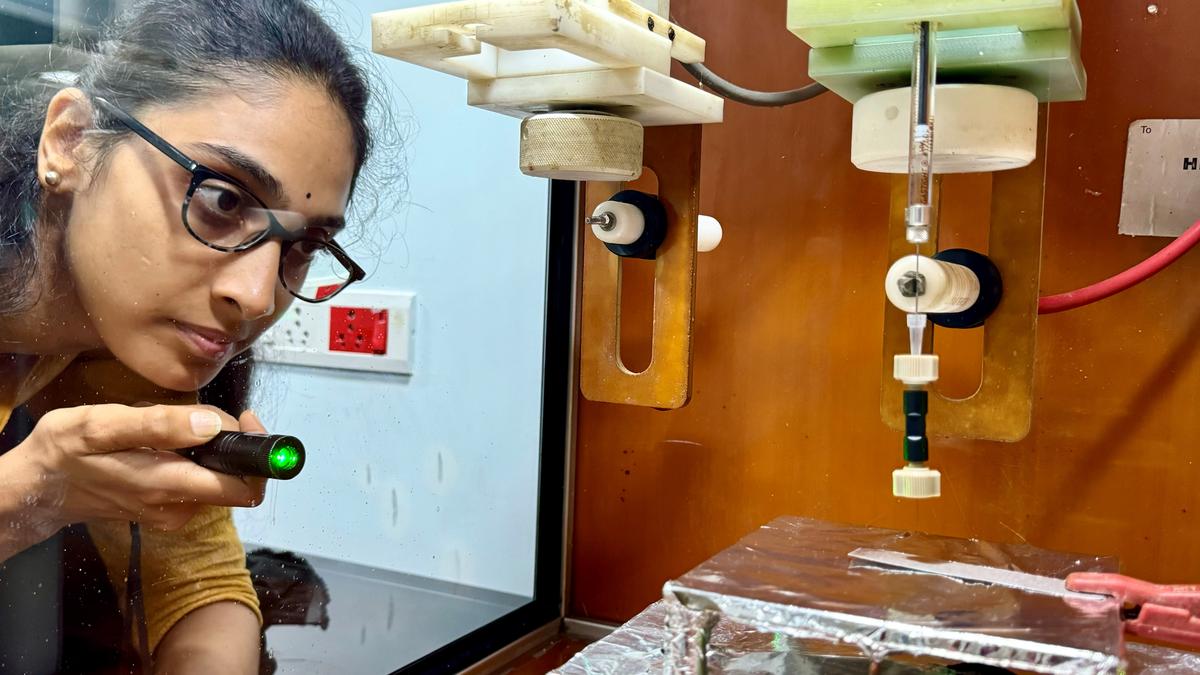
Spoorthi Bhat, then a PhD student under Dr. Pradeep and one of the paper’s coauthors, set up an experiment to confirm this hypothesis in crystals of quartz (silica), ruby, and fused alumina.

She pressed a battery terminal against the outside of a capillary tube. The terminal delivered a few thousand volts to mineral microparticles suspended in water inside the tube. The voltage elongated the suspension, squeezing it out of one end, and sending it flying through the air as a mist of microdroplets. They were still airborne when, in just 10 ms, the mineral microparticles broke up into nanoparticles.

The researchers had a few ideas about what could have caused this break up. The free protons could have squeezed themselves into crystal layers, which they scraped the mineral off from within if supplied some energy. The study suggests the electric fields produced by the charged surface could have provided this energy.

Surface tension — the force that keeps droplets spherical — could have been involved as well. In the experiment, a contest between surface tension, which is attractive, and like charges on the surface repelling each other could have set off shockwaves that blew up the microdroplets.

“This is a striking and non-intuitive result,” Shashi Thutupalli, a biophysicist at the National Centre for Biological Sciences, Bengaluru, who was not involved in the study, said to The Hindu. “It seems quite plausible that the high electric field within the droplets could cause the particle breakup.”

He added that the findings could be useful to the study of proto-cells, the precursors to cells as we know them today. Scientists are interested in proto-cells because they could have played an important part in the processes that first created life on the earth. “For me personally, the relevance of these results to the context of the origins of life is very exciting.”

He said the microdroplets could mimic proto-cells by being little compartments in which biochemical reactions play out.

Making a green paradise

The formation of nanoparticles from microparticles, Dr. Pradeep said, is “related to the origin of life, the problem of agriculture, … to issues as large as water itself. Another problem as big as water is food. It is in this context that soil is probably an interesting thing.”

Silica makes up half of sand. Plants absorb silica in the form of nanoparticles to help them become taller. The rice crop usually has high levels of silica.

Supplying soil with silica nanoparticles could thus have a positive impact on agriculture. “Here is a way to convert unproductive soil, unproductive fields or even desertified areas into productive areas,” Dr. Pradeep said.

He implored scientists to investigate whether water microdroplets react with minerals to form nanoparticles as part of atmospheric processes, in the form of ‘microdroplet showers’. Dr. Pradeep was optimistic they do.

Karthik Vinod is a freelance science journalist and co-founder of Ed Publica. He has masters’ degrees in astrophysics and science, technology and society.

Source link

Science

Post navigation

Previous Post: Austrian Foreign Minister Welcomes PM Modi In Vienna
Next Post: Probe Agency Summons Elvish Yadav For Questioning In Money Laundering Case

Related Posts

  • Researchers develop performance metrics to test traffic control algorithms
    Researchers develop performance metrics to test traffic control algorithms Science
  • What on Earth (or Beyond) is a Time Crystal?
    What on Earth (or Beyond) is a Time Crystal? Science
  • Scientists obtain first 3D images from inside Mexican volcano
    Scientists obtain first 3D images from inside Mexican volcano Science
  • The Nobel Prize has been awarded to women 62 times. Katalin Karikó becomes the 13th to win in Medicine
    The Nobel Prize has been awarded to women 62 times. Katalin Karikó becomes the 13th to win in Medicine Science
  • Sci-Five | The Hindu Science Quiz: On Antoine Lavoisier
    Sci-Five | The Hindu Science Quiz: On Antoine Lavoisier Science
  • What remote-sensing reveals about plants, forests, and minerals from space
    What remote-sensing reveals about plants, forests, and minerals from space Science

More Related Articles

Watch | ‘Artificial skin’ prototype developed by scientists in Austria Watch | ‘Artificial skin’ prototype developed by scientists in Austria Science
How does general anaesthesia work? How does general anaesthesia work? Science
Indigenously built stroke device approved on domestic trial data, launch set for February 2026 Indigenously built stroke device approved on domestic trial data, launch set for February 2026 Science
Why did the U.S. FDA decline to review the new mRNA influenza vaccine? Why did the U.S. FDA decline to review the new mRNA influenza vaccine? Science
The story of dapsone: from dye to drug The story of dapsone: from dye to drug Science
Lunar governance should be multilateral Lunar governance should be multilateral Science
SiteLock

Archives

  • September 2026
  • August 2026
  • July 2026
  • June 2026
  • May 2026
  • April 2026
  • March 2026
  • February 2026
  • January 2026
  • December 2025
  • November 2025
  • October 2025
  • September 2025
  • August 2025
  • July 2025
  • June 2025
  • May 2025
  • April 2025
  • March 2025
  • February 2025
  • January 2025
  • December 2024
  • November 2024
  • October 2024
  • September 2024
  • August 2024
  • July 2024
  • June 2024
  • May 2024
  • April 2024
  • March 2024
  • February 2024
  • January 2024
  • December 2023
  • November 2023
  • October 2023
  • September 2023
  • August 2023
  • July 2023
  • June 2023
  • May 2023
  • April 2023
  • March 2023
  • February 2023
  • January 2023
  • December 2022
  • November 2022
  • October 2022
  • September 2022
  • August 2022
  • July 2022
  • June 2022
  • May 2022

Categories

  • Business
  • Nation
  • Science
  • Sports
  • World

Recent Posts

  • U.S. seeks ‘AI dialogue’ with China as officials set stage for Trump-Xi summit
  • Locally-built drone is highlight of Belagavi tech summit
  • Typhoon approaches eastern Japan, prompting flood and landslide warnings
  • Minimum salary needed in Bengaluru to afford daily commute by Namma Metro is ₹70,000
  • Agentic AI is not a magic wand, says Arundhati Bhattacharya, President and CEO at Salesforce, South Asia

Recent Comments

  1. LarryKef on UP Teacher Who Asked Students To Slap Muslim Classmate
  2. Josephjab on UP Teacher Who Asked Students To Slap Muslim Classmate
  3. LarryKef on UP Teacher Who Asked Students To Slap Muslim Classmate
  4. Jasonnekly on UP Teacher Who Asked Students To Slap Muslim Classmate
  5. Jasonnekly on UP Teacher Who Asked Students To Slap Muslim Classmate
  • Stock markets tumble as Sensex, Nifty decline nearly 1% 
    Stock markets tumble as Sensex, Nifty decline nearly 1%  Business
  • Play Scheduled To Start At 9:30, Abandoned At 9:12: Horror Story Of Afghanistan vs New Zealand Test
    Play Scheduled To Start At 9:30, Abandoned At 9:12: Horror Story Of Afghanistan vs New Zealand Test Sports
  • Scotland, Netherlands criticise ICC’s World Cup format changes
    Scotland, Netherlands criticise ICC’s World Cup format changes Sports
  • India’s Auto Sales Report October 2025: Retail sales surge 40.5%, led by 2Ws, CVs and PVs, says FADA
    India’s Auto Sales Report October 2025: Retail sales surge 40.5%, led by 2Ws, CVs and PVs, says FADA Business
  • Access Denied World
  • Access Denied
    Access Denied Nation
  • Access Denied
    Access Denied Nation
  • Indonesia evacuates hundreds near erupting volcano
    Indonesia evacuates hundreds near erupting volcano World

Editor-in-Chief:
Mohammad Ariff,
MSW, MAJMC, BSW, DTL, CTS, CNM, CCR, CAL, RSL, ASOC.
editor@artifex.news

Associate Editors:
1. Zenellis R. Tuba,
zenelis@artifex.news
2. Haris Daniyel
daniyel@artifex.news

Photograher:
Rohan Das
rohan@artifex.news

Artifex.News offers Online Paid Internships to college students from India and Abroad. Interns will get a PRESS CARD and other online offers.
Send your CV (Subjectline: Paid Internship) to internship@artifex.news

Links:
Associate Journalism
About Us
Privacy Policy

News Links:
Breaking News
World
Nation
Sports
Business
Entertainment
Lifestyle

Registered Office:
72/A, Elliot Road, Kolkata - 700016
Tel: 033-22277777, 033-22172217
Email: office@artifex.news

Editorial Office / News Desk:
No. 13, Mezzanine Floor, Esplanade Metro Rail Station,
12 J. L. Nehru Road, Kolkata - 700069.
(Entry from Gate No. 5)
Tel: 033-46011099, 033-46046046
Email: editor@artifex.news

Copyright © 2023 Artifex.News Newsportal designed by Artifex Infotech.