





Skip to content
  • Facebook
  • X
  • Linkedin
  • WhatsApp
  • YouTube
  • Associate Journalism
  • About Us
  • Privacy Policy
  • 033-46046046
  • editor@artifex.news
Artifex.News

Artifex.News

Stay Connected. Stay Informed.

  • Breaking News
  • World
  • Nation
  • Sports
  • Business
  • Science
  • Entertainment
  • Lifestyle
  • Toggle search form
  • Sachin Tendulkar Shares Viral Video Of Young Girl Playing Cricket In Sopore, Kashmir. Says, “Brings A Smile”
    Sachin Tendulkar Shares Viral Video Of Young Girl Playing Cricket In Sopore, Kashmir. Says, “Brings A Smile” Sports
  • Mitchell Marsh’s DRS Brain-Fade In Pink-Ball Stuns Australia Great: “All Of A Sudden…” – Watch
    Mitchell Marsh’s DRS Brain-Fade In Pink-Ball Stuns Australia Great: “All Of A Sudden…” – Watch Sports
  • Daily Quiz: On life and work of Isaac Newton
    Daily Quiz: On life and work of Isaac Newton Science
  • Ranji Trophy | Emanjot resurrects Punjab after Karnataka bowlers fail to drive home the advantage
    Ranji Trophy | Emanjot resurrects Punjab after Karnataka bowlers fail to drive home the advantage Sports
  • India faces high debt, but sustainable for now: NCAER Director General Poonam Gupta
    India faces high debt, but sustainable for now: NCAER Director General Poonam Gupta Business
  • Access Denied
    Access Denied Nation
  • Rupee falls 8 paise to hit new record low of 85.35 against US dollar in early trade
    Rupee falls 8 paise to hit new record low of 85.35 against US dollar in early trade Business
  • Nepal’s interim government: Two new ministers take oath as PM Sushila Karki expands Cabinet
    Nepal’s interim government: Two new ministers take oath as PM Sushila Karki expands Cabinet World
Study reveals how new species evolve without geographic barriers 

Study reveals how new species evolve without geographic barriers 

Posted on May 30, 2024 By admin


A new study conducted by scientists from the Indian Institute of Technology Bombay (IIT Bombay), Mumbai published in NPJ Systems Biology and Applications, has shed light on the process of speciation, meaning the formation of new species, in the absence of geographic barriers. Traditionally, it is believed that speciation largely occurs when populations of a species are isolated from each other by geographical barriers such as mountains or bodies of water. This is called allopatric speciation. However, the new IIT Bombay research suggests that speciation can happen even when populations live in the same area without geographical barriers. This mode of speciation is called sympatric speciation. 

Professor Supreet Saini, from Department of Chemical Engineering and DBT/Wellcome Trust (India Alliance) Fellow at IIT Bombay and the lead researcher of this study said, “While there is ecological evidence in favour of sympatric hypothesis, there is no experimental evidence. And without a laboratory model to study sympatric speciation, it becomes difficult to understand it as a process. The motivation behind our work is to understand how the environment and the underlying genetics can lead to sympatric speciation and design biologically insightful experiments.” 

The researchers used a genetic-based model to investigate the factors that contribute to speciation when populations live in the same geographic area. This theoretical study focused on a population of birds using simulated data and specifically looked at how three aspects that encourage speciation, namely, disruptive selection, sexual selection, and genetic architecture play a role in driving and maintaining sympatric speciation. 

Disruptive speciation  

“In sympatric speciation, the “divide” in the population can be created due to non-uniform resources present in the environment, and geography has no role to play here. This is called ecological disruptive selection,” co-author Pavithra Venkataraman, PhD student and a Prime Minister’s Research Fellow at IIT Bombay explained. In other words, disruptive selection is a process by which individuals with extreme traits have a higher fitness than those with intermediate traits.  

Ms. Venkataraman added, “Disruptive selection is necessary for speciation to occur in sympatry because it favours heritable differences in the population and ensures that the offsprings produced by the mating of individuals belonging to two different groups do not survive. These two factors are extremely important for maintaining biodiversity in sympatry.” 

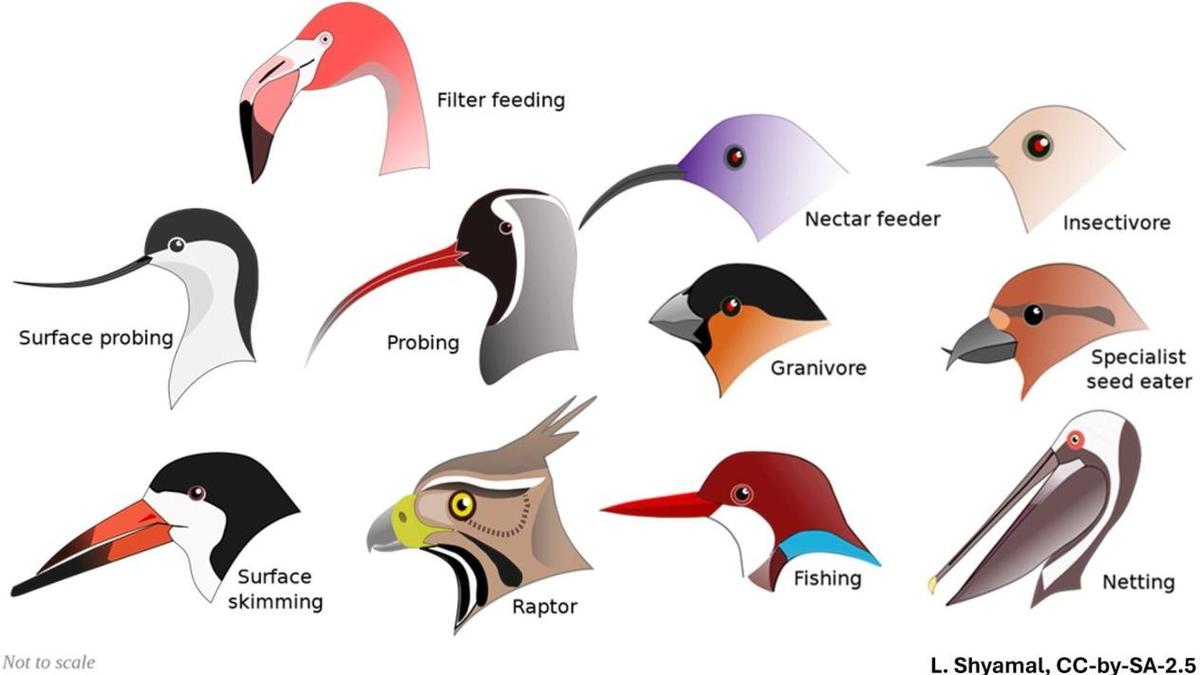
In this study, the researchers focused on a physical trait of the birds – the beak size. The birds in the population had to adapt their beak size to best utilise two types of food resources, such as nuts and flower nectar. Birds with small beaks will be better at utilising resource nuts, while those with longer beaks will be more efficient at utilising flower nectar as their resource.  

Role of sexual selection 

Sexual selection, on the other hand, is a type of natural selection driven by competition for mates. It can lead to the evolution of elaborate traits that are attractive to potential mates. In this study, the researchers looked at how female mating preference, based on a male’s intensity of the trait (unique character), could play a role in speciation. 

“Sexual selection has been thought to be one of the main, or often, the sole driver of sympatric speciation. Essentially, it was thought that some members of the populations could evolve a ‘bias’ towards a trait like feather colour, and a difference in this bias could lead to sympatric speciation. For example, consider a bird population where there are two types of feathers – blue and red. If a bias evolves among the blue birds to only mate with their kind, sympatric speciation would occur because the red birds don’t mix their genes with the blue ones,” Ms. Venkataraman explained. 

In other words, this could lead to populations with distinct blue and red traits. 

“The drawback of this hypothesis is that there is no basis for such a bias to evolve unless there is a fitness benefit. In other words, why does a blue bird mate only with a blue one, reducing its mate pool is not clear,” Ms. Venkataraman said. 

The researchers then incorporated the ability of the bird to utilise resources in the environment into their model. Surprisingly, the researchers found that sexual selection based on special traits did not contribute to speciation in sympatry. Instead, they found that the preference for mates based on a relevant trait that helps in utilising the environmental resources better, (this case, beak size), was the driving force behind speciation. The study also acknowledges the possibility of lower fitness of the offsprings due to sexual selection. 

Genetic architecture has a key role 

Furthermore, the researchers discovered that genetic architecture, or how genes control the trait under selection, was a crucial factor in determining the likelihood of sympatric speciation. If the genetic architecture allowed changes in beak size, then a new species could develop even with a weak role of disruptive selection. 

On the limitations of the study, Professor Saini said, “In our model, we assume that birds from the two groups mate without any bias and that this bias does not change with time. This may not be true in natural populations, where a bias based on the beak size is expected to evolve. It is also possible for the birds of the two groups to evolve with distinct markers that help them distinguish their “kind” from the other.” 

Nevertheless, this study provides valuable insights into the conditions and mechanisms that can lead to sympatric speciation. It challenges the traditional view that speciation can only occur in geographical isolation and highlights the importance of genetic architecture and ecological selection in driving the formation of new species, said Mr. Saini. 

“A large part of our research effort is to take lessons from theory and to design experiments for understanding how reproductive barriers evolve between members of the population in sympatry. Towards this, we work with yeast to demonstrate and establish a laboratory model to study speciation in sympatry,” Mr. Saini added while indicating the path ahead. 

By unravelling the mysteries of speciation, scientists are gaining a deeper understanding of the incredible diversity of life on our planet and the processes that generate it. By demonstrating how sympatric speciation can occur, even with relatively low levels of disruptive selection, the researchers have provided a framework for future experimental studies on biodiversity. This knowledge could open up new avenues for research and help scientists better understand the mechanisms behind the biodiversity on Earth. With the imminent threat of climate change, perhaps this can also shed light on the impacts of climate change on biodiversity at large, Mr. Saini said.  



Source link

Science Tags:IIT Bombay study, science news, speciation, sympatric speciation

Post navigation

Previous Post: Donald Trump May Give Elon Musk Advisory Role If Elected President: Report
Next Post: Did Shah Rukh Khan Say Rahul Gandhi Will Be Next PM?

Related Posts

  • IMF chief warns global monetary system not ready for AI cyber threats
    IMF chief warns global monetary system not ready for AI cyber threats Science
  • Quiz | Easy like Sunday morning: Know your flora and fauna
    Quiz | Easy like Sunday morning: Know your flora and fauna Science
  • New mpox clade Ib disproportionately affects children
    New mpox clade Ib disproportionately affects children Science
  • Roman Baths may harbour novel antimicrobial natural products
    Roman Baths may harbour novel antimicrobial natural products Science
  • Why public health nutrition policies need novelty, precise targeting
    Why public health nutrition policies need novelty, precise targeting Science
  • ‘I’m really proud’: Victor Glover — first Black astronaut candidate reflects on historic Moon mission
    ‘I’m really proud’: Victor Glover — first Black astronaut candidate reflects on historic Moon mission Science

More Related Articles

What is the Minor Planet Centre? What is the Minor Planet Centre? Science
Study brings lifestyle of enigmatic extinct humans into focus Study brings lifestyle of enigmatic extinct humans into focus Science
Poliovirus found in wastewater in Spain, Germany, and Poland Poliovirus found in wastewater in Spain, Germany, and Poland Science
National Technology Day: Committed to making U.P. India’s ‘Deep Tech Capital’, says Yogi Adityanath National Technology Day: Committed to making U.P. India’s ‘Deep Tech Capital’, says Yogi Adityanath Science
Math whiz Ramanujan’s century old formulae for pi echo in modern cosmology Math whiz Ramanujan’s century old formulae for pi echo in modern cosmology Science
Common man may get a peek into Chandrayaan-3 at Bengaluru Tech Summit Common man may get a peek into Chandrayaan-3 at Bengaluru Tech Summit Science
SiteLock

Archives

  • May 2026
  • April 2026
  • March 2026
  • February 2026
  • January 2026
  • December 2025
  • November 2025
  • October 2025
  • September 2025
  • August 2025
  • July 2025
  • June 2025
  • May 2025
  • April 2025
  • March 2025
  • February 2025
  • January 2025
  • December 2024
  • November 2024
  • October 2024
  • September 2024
  • August 2024
  • July 2024
  • June 2024
  • May 2024
  • April 2024
  • March 2024
  • February 2024
  • January 2024
  • December 2023
  • November 2023
  • October 2023
  • September 2023
  • August 2023
  • July 2023
  • June 2023
  • May 2023
  • April 2023
  • March 2023
  • February 2023
  • January 2023
  • December 2022
  • November 2022
  • October 2022
  • September 2022
  • August 2022
  • July 2022
  • June 2022
  • May 2022

Categories

  • Business
  • Nation
  • Science
  • Sports
  • World

Recent Posts

  • China, U.S. should be ‘partners not rivals’, says Xi Jinping after meeting Donald Trump
  • Iran working on Hormuz ‘protocol’ to cover ‘costs’, says Deputy Foreign Minister Gharibabadi
  • Zydus Lifesciences arm to acquire U.S. oncology firm Assertio for $166 million
  • Israel-Iran war LIVE: Iran working on Hormuz ‘protocol’ to cover ‘costs’, says Dy FM Gharibabadi
  • Russia to fulfil all agreements on energy supply to India: FM Lavrov

Recent Comments

  1. OrvalMaync on UP Teacher Who Asked Students To Slap Muslim Classmate
  2. Jeffreyroure on UP Teacher Who Asked Students To Slap Muslim Classmate
  3. Stevemonge on UP Teacher Who Asked Students To Slap Muslim Classmate
  4. RichardClage on UP Teacher Who Asked Students To Slap Muslim Classmate
  5. StevenLek on UP Teacher Who Asked Students To Slap Muslim Classmate
  • Access Denied Sports
  • Kremlin says one Russian citizen freed from U.S. jail in Fogel deal
    Kremlin says one Russian citizen freed from U.S. jail in Fogel deal World
  • Access Denied Business
  • Sadhguru Undergoes Surgery For Chronic Brain Bleed At Delhi Indraprastha Apollo Hospitals
    Sadhguru Undergoes Surgery For Chronic Brain Bleed At Delhi Indraprastha Apollo Hospitals Nation
  • Biden, Netanyahu Speak On Israel’s Plans For Retaliation Against Iran
    Biden, Netanyahu Speak On Israel’s Plans For Retaliation Against Iran World
  • PPP’s Sarfaraz Bugti elected unopposed as new CM of Pakistan’s restive Balochistan province
    PPP’s Sarfaraz Bugti elected unopposed as new CM of Pakistan’s restive Balochistan province World
  • Bihar Teacher Kidnapped On Way To School, Forced To Marry Woman At Gunpoint
    Bihar Teacher Kidnapped On Way To School, Forced To Marry Woman At Gunpoint Nation
  • UNGA 80: As World convulses in war, contentiousness, its leaders convene at U.N. to figure it out
    UNGA 80: As World convulses in war, contentiousness, its leaders convene at U.N. to figure it out World

Editor-in-Chief:
Mohammad Ariff,
MSW, MAJMC, BSW, DTL, CTS, CNM, CCR, CAL, RSL, ASOC.
editor@artifex.news

Associate Editors:
1. Zenellis R. Tuba,
zenelis@artifex.news
2. Haris Daniyel
daniyel@artifex.news

Photograher:
Rohan Das
rohan@artifex.news

Artifex.News offers Online Paid Internships to college students from India and Abroad. Interns will get a PRESS CARD and other online offers.
Send your CV (Subjectline: Paid Internship) to internship@artifex.news

Links:
Associate Journalism
About Us
Privacy Policy

News Links:
Breaking News
World
Nation
Sports
Business
Entertainment
Lifestyle

Registered Office:
72/A, Elliot Road, Kolkata - 700016
Tel: 033-22277777, 033-22172217
Email: office@artifex.news

Editorial Office / News Desk:
No. 13, Mezzanine Floor, Esplanade Metro Rail Station,
12 J. L. Nehru Road, Kolkata - 700069.
(Entry from Gate No. 5)
Tel: 033-46011099, 033-46046046
Email: editor@artifex.news

Copyright © 2023 Artifex.News Newsportal designed by Artifex Infotech.