



Skip to content
  • Facebook
  • X
  • Linkedin
  • WhatsApp
  • Associate Journalism
  • About Us
  • Privacy Policy
  • 033-46046046
  • editor@artifex.news
Artifex.News

Artifex.News

Stay Connected. Stay Informed.

  • Breaking News
  • World
  • Nation
  • Sports
  • Business
  • Science
  • Entertainment
  • Lifestyle
  • Toggle search form
  • Daily Quiz: On Uruguay – The Hindu
    Daily Quiz: On Uruguay – The Hindu World
  • Women's ACT Live: Unbeaten India Eye Silverware, Take On China In Final
    Women's ACT Live: Unbeaten India Eye Silverware, Take On China In Final Sports
  • No Government Has Given Such Tax Relief To Middle Class So Far: Amitabh Kant To NDTV
    No Government Has Given Such Tax Relief To Middle Class So Far: Amitabh Kant To NDTV Nation
  • Access Denied World
  • U.S. says North Korea troops ready for Ukraine combat as missile raises tensions
    U.S. says North Korea troops ready for Ukraine combat as missile raises tensions World
  • Mangoes 2025: Tamil Nadu farmers on the season’s specialities
    Mangoes 2025: Tamil Nadu farmers on the season’s specialities Business
  • Early northeast monsoon onset creates ‘triple whammy’ in South India
    Early northeast monsoon onset creates ‘triple whammy’ in South India Science
  • Access Denied
    Access Denied Nation
Math whiz Ramanujan’s century old formulae for pi echo in modern cosmology

Math whiz Ramanujan’s century old formulae for pi echo in modern cosmology

Posted on December 11, 2025 By admin


Earlier this month, Indian Institute of Science, Bengaluru, professor Aninda Sinha and his former doctoral student Faizan Bhat linked the esoteric mathematics of Srinivasa Ramanujan with the principles underlying the physics of turbulent fluids and the expansion of the universe.

The bridge they laid was π (pi) — not the humble one but the transcendental one school students know to be the ratio of any circle’s circumference to its diameter.

Their paper appeared in Physical Review Letters.

Recipe for pi

While π is central to computing the volume and areas of objects, it is itself interminable and thus irrational. Its value is 3.14159265… There is no known pattern to the infinite avalanche of digits after the decimal point. Even today, professional mathematicians are developing formulae that rapidly and reliably predict this sequence.

For rough-ready use the ratio 22/7, first discovered by the Greek mathematician Archimedes 1500 years ago gives a series of numbers which is considered a coarse approximation to pi. There have been several improvements through the years, employing different branches of mathematics to compute pi, usually involving several terms and laborious substitutions.

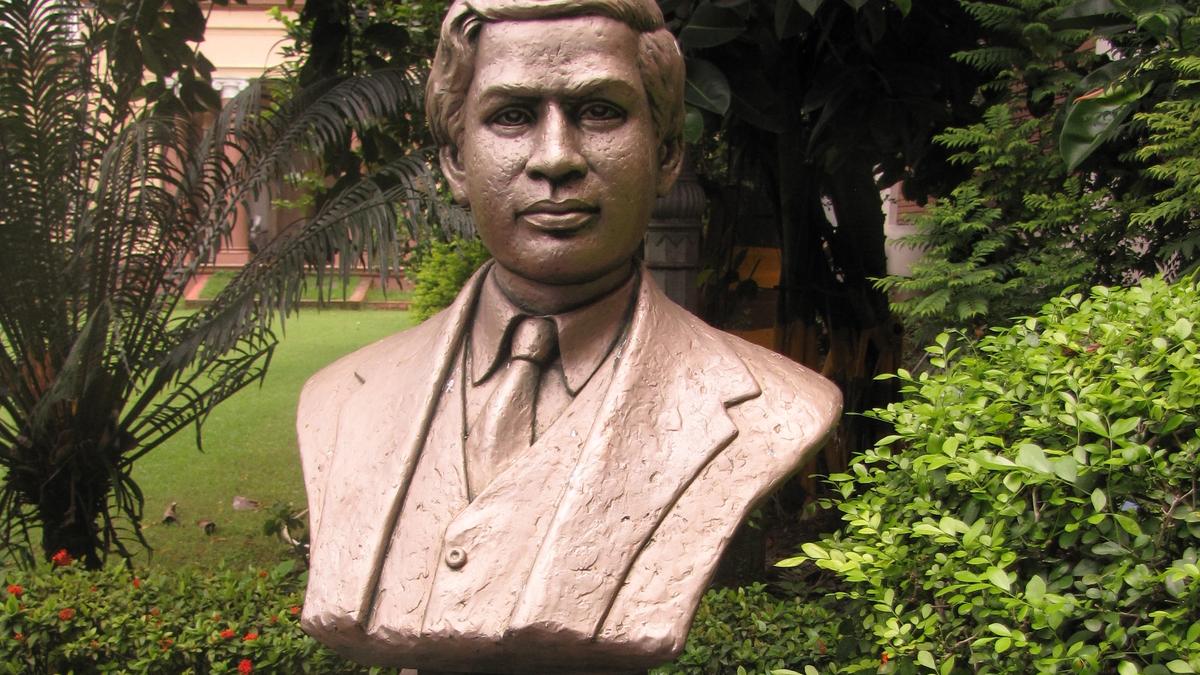
More than a century ago Srinivasa Ramanujan, an accountant in Chennai and yet to be admitted to the pantheon of mathematical greats, discovered a set of astonishingly fast-converging formulas for 1/π.  He discovered at least 17 distinct infinite series for 1/π. Each of them acts like a special “recipe”: add the first term, you get a rough value; add a second, it becomes dramatically more accurate; continue a bit more, and the approximation converges very quickly to π.

Some of these formulae are so efficient that they underpin the Chudnovsky algorithm, which scientists have used to compute π to over 200 trillion digits on modern supercomputers.

Like a rubber band

But Dr. Sinha wasn’t interested in merely adding to the pi. “We were interested in the maths behind Ramanujan’s thinking,” he said over the phone.

The trail began unexpectedly in string theory — a grand theory of theoretical physics that seeks to explain how all the fundamental particles of matter, electrons, neutrinos, quarks, gravitons, etc., could have emerged from the vibrations of invisible little coils of energy called ‘strings’.

Last year, Dr. Sinha and a collaborator were studying certain string-theoretic calculations and realised some of the existing answers in the literature were incomplete or incorrectly quoted.

“In the process of finding new representations of those string answers, we found a new formula for π,” he recalled. “In fact, an infinite number of new formulae.”

A string, Dr. Sinha explained, can be thought of like a rubber band: you can stretch it in many ways and its elasticity can take many values.

“If π is somehow hidden in the string answer, it should have an infinite number of different ways of looking at it. That is what we found.”

“That’s what pushed me to go back and look more carefully at Ramanujan’s formulae,” he continued. “Once I looked at the modern presentation, something jumped out. Because of my training, I immediately recognised structures I had seen before in conformal field theories.”

At a critical point

Conformal field theories (CFT) are the mathematical language of critical phenomena, those special points where systems are on the edge of change.

For instance, when water boils at 100°C and room pressure, you can clearly distinguish the liquid and vapour. But at a much higher temperature and pressure of 374°C and 221 atm, it reaches a critical point where that distinction vanishes: the fluid becomes ‘superfluid’ and is neither clearly liquid nor clearly gas, no matter how closely you zoom in.

“At the critical point, you cannot actually say which is liquid and which is vapour,” Dr. Sinha said. “That is the point where CFTs enter: they are used to explain what happens in this kind of critical phenomena.”

The Ramanujan equations, particularly the terms that are used, appeared to be analogous to those in certain kinds of CFTs. The mathematical engine Ramanujan intuitively deployed to find pi — involving modular equations, elliptic integrals and special functions — exactly matched the structure of correlation functions in the CFTs (specifically logarithmic CFTs).

As of now, their work doesn’t yet settle any grand conjecture in number theory or cosmology. Instead it stands as an intriguing bridge between two distant regions of thought: Ramanujan’s intuitive modular equations and modern CFT.

New line of inquiry

“[In] any piece of beautiful mathematics, you almost always find that there is a physical system which actually mirrors the mathematics,” Mr. Bhat in a press statement. “Ramanujan’s motivation might have been very mathematical, but without his knowledge, he was also studying black holes, turbulence, percolation, all sorts of things.”

This said, history is replete with examples of mathematical ideas developed in isolation, sometimes even as pure flights of fancy, eventually resonating with the physics of the real world decades later.

“Riemannian geometry (or the geometry of curved spaces) was being developed in the 19th century as pure mathematics. Much later, Einstein’s general theory of relativity showed that the geometry of spacetime itself is Riemannian (because of gravity’s impact on space-time). Today, we even use it with GPS,” Dr. Sinha said.

Napoleon Bonaparte’s mathematical advisor Joseph Fourier developed Fourier transforms as a mathematical tool to analyse heat flow. Today it underlines digital image and music compression.

For now, the Ramanujan-CFT connection has already spawned a new line of inquiry in Dr. Sinha’s group: the mathematical structure they identified appears again, he said, in models of an expanding universe.

On the mathematical side, the work hints that other transcendental numbers — of which π is just one example — could admit similarly efficient representations rooted in physics.

jacob.koshy@thehindu.co.in

Published – December 11, 2025 08:30 am IST



Source link

Science

Post navigation

Previous Post: Satellites, science, and the new fight for spectrum in space
Next Post: Access Denied

Related Posts

  • Firm to produce ‘rectangular’ solar cells that require less land
    Firm to produce ‘rectangular’ solar cells that require less land Science
  • Huge underground reservoir of liquid water on Mars, seismic data indicates
    Huge underground reservoir of liquid water on Mars, seismic data indicates Science
  • Sci-Five | The Hindu Science Quiz: On Dormancy
    Sci-Five | The Hindu Science Quiz: On Dormancy Science
  • What ended the ‘dark ages’ in the early universe? Webb telescope finds clue
    What ended the ‘dark ages’ in the early universe? Webb telescope finds clue Science
  • PM Modi “directs” ISRO to land man on moon by 2040
    PM Modi “directs” ISRO to land man on moon by 2040 Science
  • How was popcorn discovered? An archaeologist explains
    How was popcorn discovered? An archaeologist explains Science

More Related Articles

Kerala takes a pioneering step to curb antimicrobial resistance Kerala takes a pioneering step to curb antimicrobial resistance Science
Gluten: animator of the dough Gluten: animator of the dough Science
Why sustainable funding matters for India’s ‘science power’ ambition | Explained Why sustainable funding matters for India’s ‘science power’ ambition | Explained Science
science for all newsletter What are Trojan asteroids? science for all newsletter What are Trojan asteroids? Science
Summer of insect-counting gets underway in Germany Summer of insect-counting gets underway in Germany Science
The Science Quiz: Scientific terms beginning with ‘X’ The Science Quiz: Scientific terms beginning with ‘X’ Science
SiteLock

Archives

  • December 2025
  • November 2025
  • October 2025
  • September 2025
  • August 2025
  • July 2025
  • June 2025
  • May 2025
  • April 2025
  • March 2025
  • February 2025
  • January 2025
  • December 2024
  • November 2024
  • October 2024
  • September 2024
  • August 2024
  • July 2024
  • June 2024
  • May 2024
  • April 2024
  • March 2024
  • February 2024
  • January 2024
  • December 2023
  • November 2023
  • October 2023
  • September 2023
  • August 2023
  • July 2023
  • June 2023
  • May 2023
  • April 2023
  • March 2023
  • February 2023
  • January 2023
  • December 2022
  • November 2022
  • October 2022
  • September 2022
  • August 2022
  • July 2022
  • June 2022
  • May 2022

Categories

  • Business
  • Nation
  • Science
  • Sports
  • World

Recent Posts

  • Access Denied
  • Access Denied
  • Access Denied
  • Access Denied
  • Math whiz Ramanujan’s century old formulae for pi echo in modern cosmology

Recent Comments

  1. dfb{{98991*97996}}xca on UP Teacher Who Asked Students To Slap Muslim Classmate
  2. "dfbzzzzzzzzbbbccccdddeeexca".replace("z","o") on UP Teacher Who Asked Students To Slap Muslim Classmate
  3. 1}}"}}'}}1%>"%>'%> on UP Teacher Who Asked Students To Slap Muslim Classmate
  4. bfg6520<s1﹥s2ʺs3ʹhjl6520 on UP Teacher Who Asked Students To Slap Muslim Classmate
  5. pHqghUme9356321 on UP Teacher Who Asked Students To Slap Muslim Classmate
  • “We Should Wrap It Up…”: R Ashwin Reveals Target Expectations For India vs New Zealand In 3rd Test
    “We Should Wrap It Up…”: R Ashwin Reveals Target Expectations For India vs New Zealand In 3rd Test Sports
  • ‘I Heard Monkey Noises’: Athletic Bilbao’s Nico Williams Abused At Atletico Madrid
    ‘I Heard Monkey Noises’: Athletic Bilbao’s Nico Williams Abused At Atletico Madrid Sports
  • He who saves his country does not violate any law: Trump in defiance of legal challenges
    He who saves his country does not violate any law: Trump in defiance of legal challenges World
  • Trump Calls For US-Canada “Merger”, Hours After Trudeau Resignation
    Trump Calls For US-Canada “Merger”, Hours After Trudeau Resignation World
  • India Thrash UAE By 78 Runs For Second Successive Win In Women’s Asia Cup
    India Thrash UAE By 78 Runs For Second Successive Win In Women’s Asia Cup Sports
  • Union Budget 2023 a disappointment to Telangana as many of its demands remain unfulfilled
    Union Budget 2023 a disappointment to Telangana as many of its demands remain unfulfilled Business
  • Olaf Scholz promises new weapons controls after Germany knife attack
    Olaf Scholz promises new weapons controls after Germany knife attack World
  • Assam Cabinet Approves Amendment For Electronic Voting Machines In Panchayat Polls
    Assam Cabinet Approves Amendment For Electronic Voting Machines In Panchayat Polls Nation

Editor-in-Chief:
Mohammad Ariff,
MSW, MAJMC, BSW, DTL, CTS, CNM, CCR, CAL, RSL, ASOC.
editor@artifex.news

Associate Editors:
1. Zenellis R. Tuba,
zenelis@artifex.news
2. Haris Daniyel
daniyel@artifex.news

Photograher:
Rohan Das
rohan@artifex.news

Artifex.News offers Online Paid Internships to college students from India and Abroad. Interns will get a PRESS CARD and other online offers.
Send your CV (Subjectline: Paid Internship) to internship@artifex.news

Links:
Associate Journalism
About Us
Privacy Policy

News Links:
Breaking News
World
Nation
Sports
Business
Entertainment
Lifestyle

Registered Office:
72/A, Elliot Road, Kolkata - 700016
Tel: 033-22277777, 033-22172217
Email: office@artifex.news

Editorial Office / News Desk:
No. 13, Mezzanine Floor, Esplanade Metro Rail Station,
12 J. L. Nehru Road, Kolkata - 700069.
(Entry from Gate No. 5)
Tel: 033-46011099, 033-46046046
Email: editor@artifex.news

Copyright © 2023 Artifex.News Newsportal designed by Artifex Infotech.