


Skip to content
  • Facebook
  • X
  • Linkedin
  • WhatsApp
  • Associate Journalism
  • About Us
  • Privacy Policy
  • 033-46046046
  • editor@artifex.news
Artifex.News

Artifex.News

Stay Connected. Stay Informed.

  • Breaking News
  • World
  • Nation
  • Sports
  • Business
  • Science
  • Entertainment
  • Lifestyle
  • Toggle search form
  • Rupee falls seven paise to 83.38 against U.S. dollar in early trade Business
  • Spreading False Narrative Of Genocide Over 2009 Incident: Sri Lanka On Canada World
  • Sensex, Nifty recover in early trade, lifted by firm trend in global markets Business
  • India vs Pakistan, Asia Cup 2023: “In The Name Of Justice…” – Pace Great Wants IND vs PAK To Be Washed Out Sports
  • In Dance Of Wimbledon Champions, Carlos Alcaraz Shakes Leg With Barbora Krejcikova. Watch Sports
  • BJP Chief JP Nadda Slams Congress Over Muslim Quota In Karnataka Nation
  • Babar Azam Gets Scared Of Spider Cam During PSL Match His Reaction Is Viral. Watch Sports
  • IPL 2024 Full Schedule Revealed By BCCI. Date And Venue For Final Are… Sports

Archaeological excavation reveals 5,200-year-old Harappan settlement in Kachchh, Gujarat

Posted on April 3, 2024 By admin


April 03, 2024 06:40 pm | Updated April 04, 2024 09:14 am IST – THIRUVANANTHAPURAM

A settlement unearthed during the excavation at the Padta Bet hillock in Kachchh, Gujarat.
| Photo Credit: Special Arrangement

The Indus Valley civilisation, considered one of the earliest cradles of civilisation, has enthralled the academic community and aficionados of history alike. Excavations undertaken in several sites where the ancient city of Harappa thrived several centuries ago continue to unravel the secrets of the civilisation.

Archaeologists from Kerala University, who had earlier undertaken many successful expeditions to discover an Early Harappan necropolis Juna Khatiya in Gujarat in 2019, has stumbled upon more crucial findings from a 5,200-year old Harappan settlement at Padta Bet, around 1.5 km away, near Khatiya village, in Kachchh district.

During a collaborative expedition conducted last month, a team led by assistant professors Abhayan G.S. and Rajesh S.V. of the Department of Archaeology in Kerala University found evidence that could shed light on the role played by Harappan settlements around the necropolis in the cultural formation of Early Harappan and subsequent occupations in the arid area.
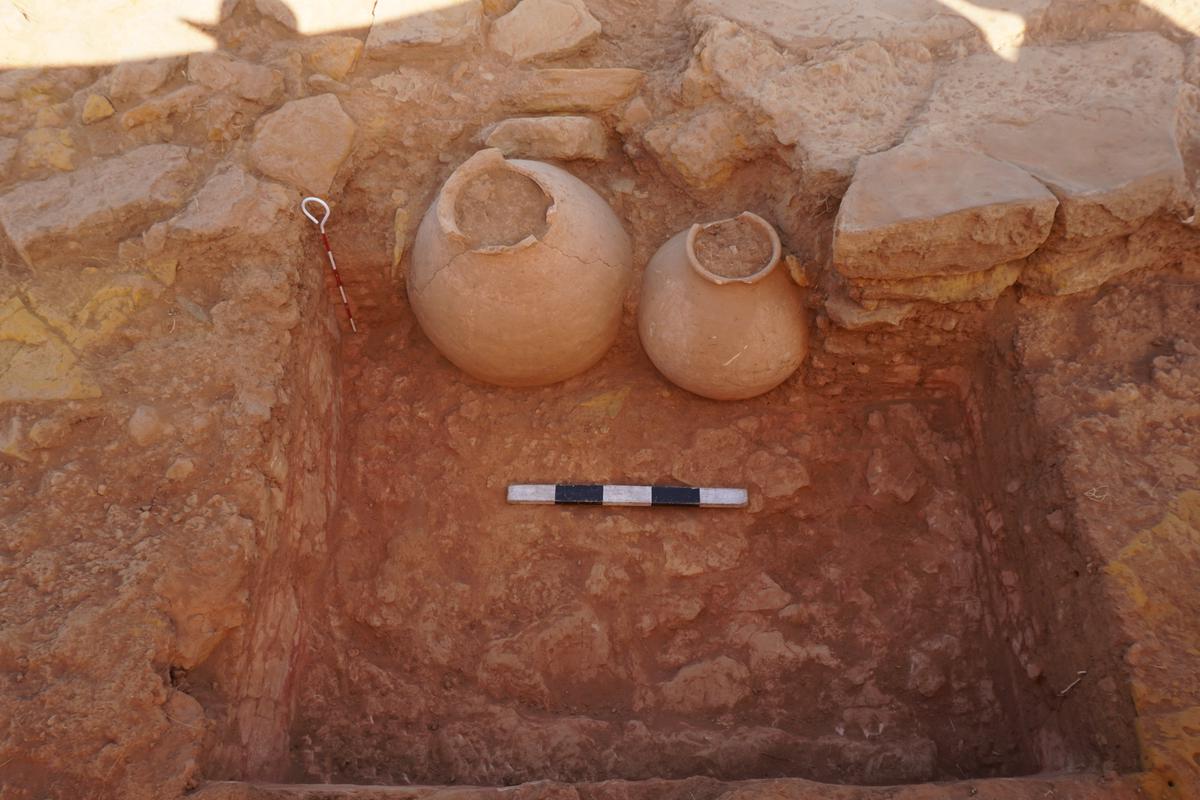
Terracotta clay storage pots that have been excavated during the archaeological expedition in Padta Bet.

Terracotta clay storage pots that have been excavated during the archaeological expedition in Padta Bet.
| Photo Credit:
Special Arrangement

The settlement was excavated from the slopes of a small hillock locally called Padta Bet. The site’s archaeological deposits were found in different clusters in two separate localities located within an area of approximately 200mx200m. The excavated remains included the remains of a circular structure and other rectangular structures of varying sizes and made of locally available sandstone and shales.

“The presence of plenty of pottery, artefacts, and a few animal bone fragments from these areas are indicative of the occupation of Harappan people in the region from the Early Harappan to Late Harappan periods, i.e. circa 3200 BCE to 1700 BCE. The evidence of ceramics also indicate the presence of Early Harappan, Classical Harappan, and Late Harappan types,” Mr. Rajesh said.

While many pottery sherds are identical to the reported Harappan pottery of other sites, a considerable portion of ceramics appear to be of novel kinds. These ceramic types are apparently a local tradition of this region which could be one of the so far unidentified pottery traditions of the Harappans. These potteries involve large storage jars to small bowls and dishes.
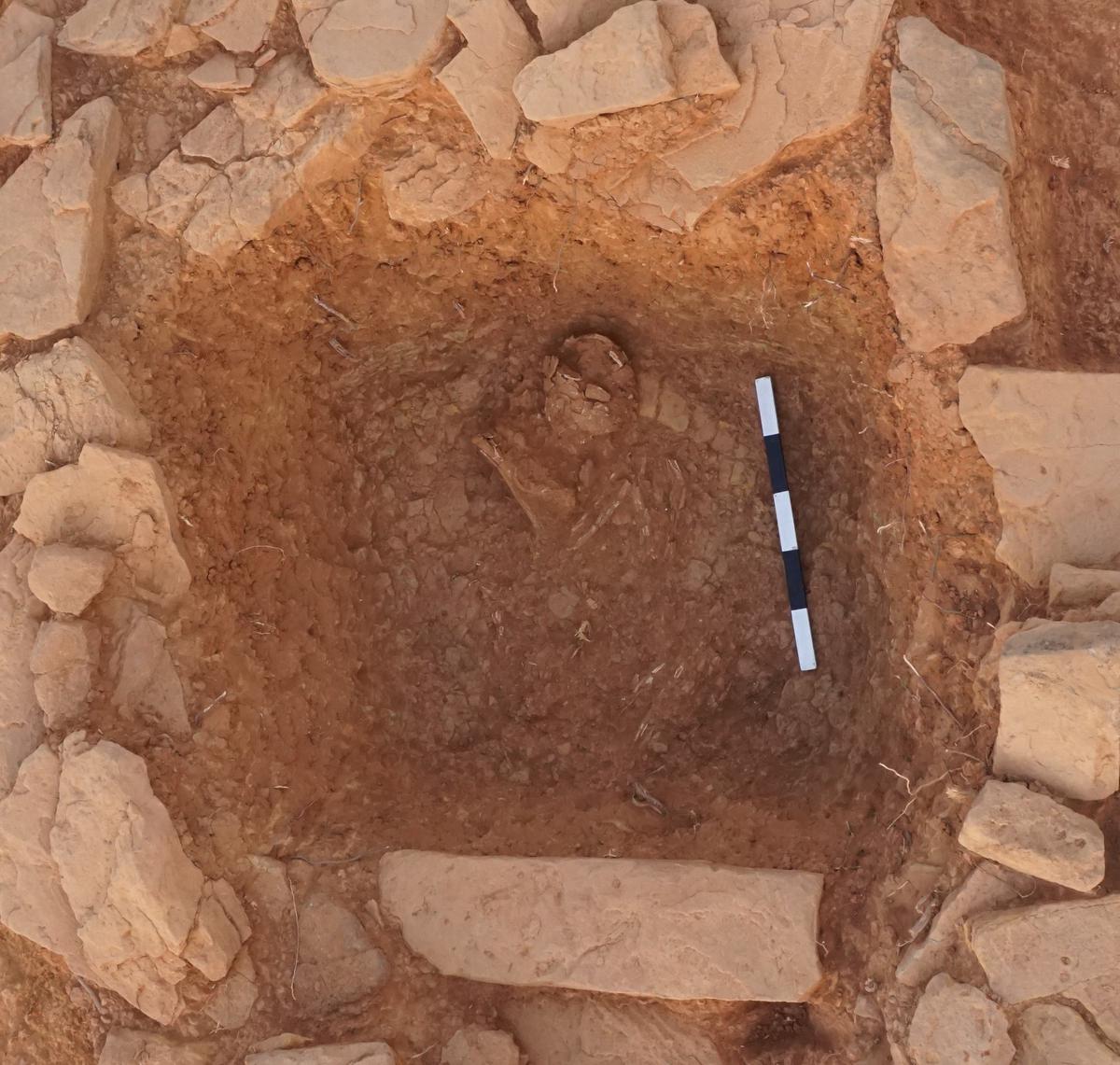
A human remain unearthed at the excavation site in Padta Bet

A human remain unearthed at the excavation site in Padta Bet
| Photo Credit:
Special Arrangement

Mr. Abhayan suggested the possibility of many of the structural remains having been eroded due to the unstable nature of the landscape. Such a theory could explain the presence of only a few structures on the habitation site.

“Harappan settlements, both small and large, have mostly been discovered and excavated on the plains, while this site is located in a unique setting on top of the hillock. The location of Padta Bet is a strategic one, having a vast view of the valley formed in between the ridged mountainous formations all around. A small stream that flows close to the hillock must have been an active source of water during the thriving periods at the site,” he points out.
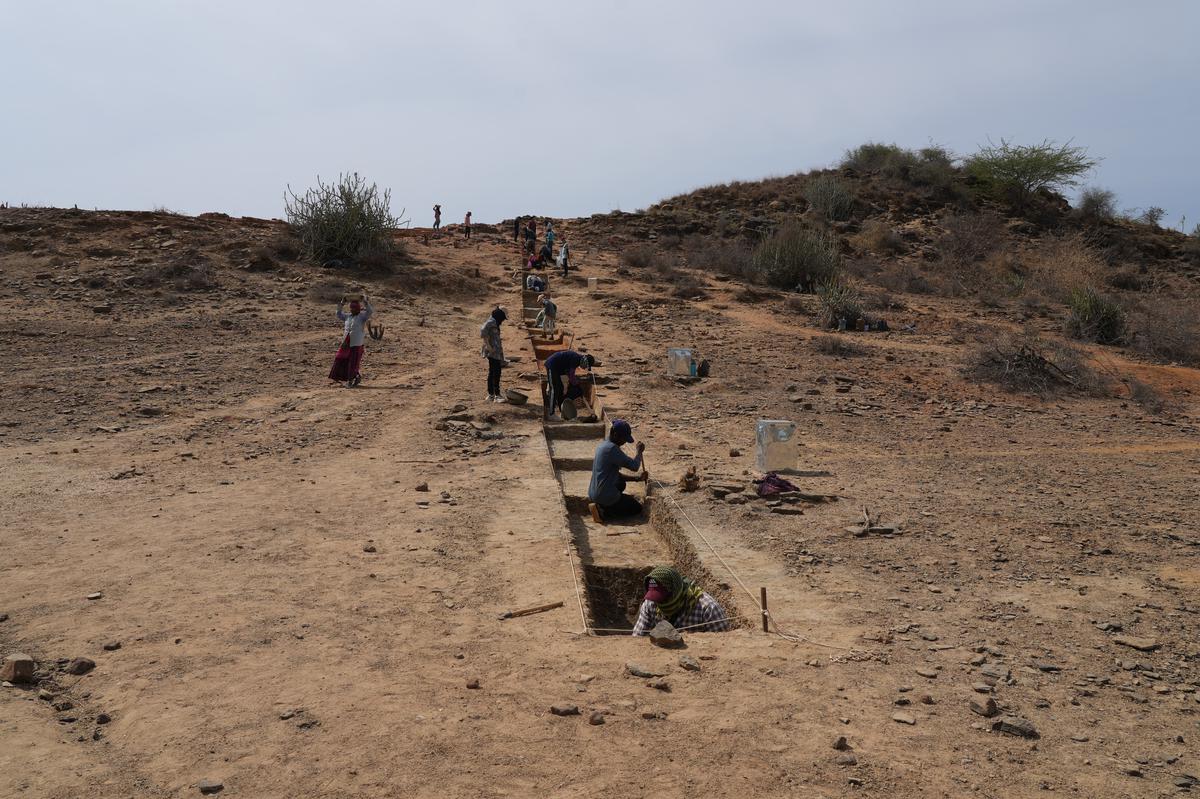
Trenches dug at the excavated site in Padta Bet to locate the cultural deposits that have been buried in the region.

Trenches dug at the excavated site in Padta Bet to locate the cultural deposits that have been buried in the region.

The artefact repertoire includes semi-precious stone beads made of carnelian and agate, terracotta spindle whorls, copper, lithic tools, cores and debitage, grinding stones, and hammer stones. The excavations also revealed remains of animal bones representing cattle, sheep or goat and edible shell fragments, thereby indicating animal domestication as well as shellfish exploitation by the inhabitants. Some archaeobotanical samples have been collected for further identification of plant exploitation.

Other institutions, including the Catalan Institute of Classical Archaeology; Spanish National Research Council; University of La Laguna, Spain; Albion College and Texas A&M University, United States; Deccan College Post Graduate and Research Institute, Pune; KSKV Kachchh University, Gujarat; Central University of Karnataka; and Assumption College, Changanassery, are collaborating in the research programme.


Source link

Science

Post navigation

Previous Post: IPL | Mustafizur goes home for US Visa formalities, will miss at least next two CSK matches
Next Post: Taiwan Shook By Biggest Quake In 25 Years

Related Posts

  • Sci-Five | The Hindu Science Quiz: On Sci-fi writers Science
  • India was a tree planting laboratory for 200 years – here are the results Science
  • Vikram lander makes soft-landing on Moon again, successfully undergoes hop test: ISRO Science
  • Toying with toys and making it big Science
  • Long-term health issues following COVID-19 Science
  • Brains that don’t see in greyscale first over-rely on colours: Project Prakash study Science

More Related Articles

Pragyan rover finds an unexpected surprise on the moon: sulphur | Explained Science
Why is NASA allotting a standard time for the moon? Science
Read the rocks to improve India’s geological literacy Science
IN-SPACe announces pre-incubation programme for space startups Science
Gaganyaan: ISRO all geared up for first test flight Science
Should we ditch BMI and use the ‘body roundness index’ instead? Science
SiteLock

Archives

  • July 2024
  • June 2024
  • May 2024
  • April 2024
  • March 2024
  • February 2024
  • January 2024
  • December 2023
  • November 2023
  • October 2023
  • September 2023
  • August 2023
  • July 2023
  • June 2023
  • May 2023
  • April 2023
  • March 2023
  • February 2023
  • January 2023
  • December 2022
  • November 2022
  • October 2022
  • September 2022
  • August 2022
  • July 2022
  • June 2022
  • May 2022

Categories

  • Business
  • Nation
  • Science
  • Sports
  • World

Recent Posts

  • Women’s Asia Cup: Jemimah Rodrigues, Dayalan Hemalatha, Harmanpreet Kaur Solving India’s No 3 Conundrum
  • “I Cook, Do Laundry”: India Star Hits Back After Getting Misquoted On ‘Car, Flat In UK’ Comment
  • How A Chart On Immigration From Joe Biden’s Regime Saved Trump’s Life
  • Karnataka job reservation row: Nasscom opposes Karnataka’s local jobs reservations bill, warns firms might relocate
  • Daily Quiz: On leaders who have survived assassination attempts

Recent Comments

  1. ywdVpqHiNZCtUDcl on UP Teacher Who Asked Students To Slap Muslim Classmate
  2. bRstIalYyjkCUJqm on UP Teacher Who Asked Students To Slap Muslim Classmate
  3. GkJwRWEAbS on UP Teacher Who Asked Students To Slap Muslim Classmate
  4. xreDavBVnbGqQA on UP Teacher Who Asked Students To Slap Muslim Classmate
  5. aANVRzfUdmyb on UP Teacher Who Asked Students To Slap Muslim Classmate
  • Protests shut streets in Armenia’s capital, roads in other parts to demand the Prime Minister’s resignation World
  • Dubai’s 5-Year Multiple-Entry Tourist Visa For Indians: How Does It Work Nation
  • BJP Reels Under Series Of Protests Over Ticket For Rajasthan Polls Nation
  • Top 1% Indians’ income share is higher now than under British-rule: Data Business
  • Amid Hunt For India’s Next Head Coach, Sourav Ganguly Posts Intriguing Message Sports
  • 7 Houses Destroyed In Massive Fire In Assam’s Dibrugarh Nation
  • North Korea fires missile into ocean in its latest weapons launch, South Korea says World
  • ‘Didi’ Bets On ‘Didi No.1’ Star To Woo Women Voters Amid Sandeshkhali Row Nation

Editor-in-Chief:
Mohammad Ariff,
MSW, MAJMC, BSW, DTL, CTS, CNM, CCR, CAL, RSL, ASOC.
editor@artifex.news

Associate Editors:
1. Zenellis R. Tuba,
zenelis@artifex.news
2. Haris Daniyel
daniyel@artifex.news

Photograher:
Rohan Das
rohan@artifex.news

Artifex.News offers Online Paid Internships to college students from India and Abroad. Interns will get a PRESS CARD and other online offers.
Send your CV (Subjectline: Paid Internship) to internship@artifex.news

Links:
Associate Journalism
About Us
Privacy Policy

News Links:
Breaking News
World
Nation
Sports
Business
Entertainment
Lifestyle

Registered Office:
72/A, Elliot Road, Kolkata - 700016
Tel: 033-22277777, 033-22172217
Email: office@artifex.news

Editorial Office / News Desk:
No. 13, Mezzanine Floor, Esplanade Metro Rail Station,
12 J. L. Nehru Road, Kolkata - 700069.
(Entry from Gate No. 5)
Tel: 033-46011099, 033-46046046
Email: editor@artifex.news

Copyright © 2023 Artifex.News Newsportal designed by Artifex Infotech.