

Skip to content
  • Facebook
  • X
  • Linkedin
  • WhatsApp
  • Associate Journalism
  • About Us
  • Privacy Policy
  • 033-46046046
  • editor@artifex.news
Artifex.News

Artifex.News

Stay Connected. Stay Informed.

  • Breaking News
  • World
  • Nation
  • Sports
  • Business
  • Science
  • Entertainment
  • Lifestyle
  • Toggle search form
  • U.S.A. vs Bangladesh, 1st T20 | Harmeet’s power-hitting, Anderson’s finishing cameo take U.S. to upset win Sports
  • World Cup 2023 – “Hard To Knock India Off Their Perch”: England’s Chris Woakes Sports
  • US Woman Killed Boyfriend Thinking He Inherited $30 Million But Cops Say It Was A Scam World
  • Rahul Gandhi, 2024 Lok Sabha Election: Will Remove 50% Cap, Give As Much Reservation As Needed: Rahul Gandhi Nation
  • Israeli Airstrike In Syria Kills Girl, Injures 10 Civilians World
  • Women Sarpanches In Madhya Pradesh: A Reality Check Nation
  • Knight Riders made me a successful leader: Gambhir Sports
  • Pakistan MMA Fighter Shahzaib Rindh, Who Held India Flag After Win, Slams His Government’s “Lack Of Support” Sports

How a 6.3 magnitude quake caused another of same intensity

Posted on October 14, 2023 By admin


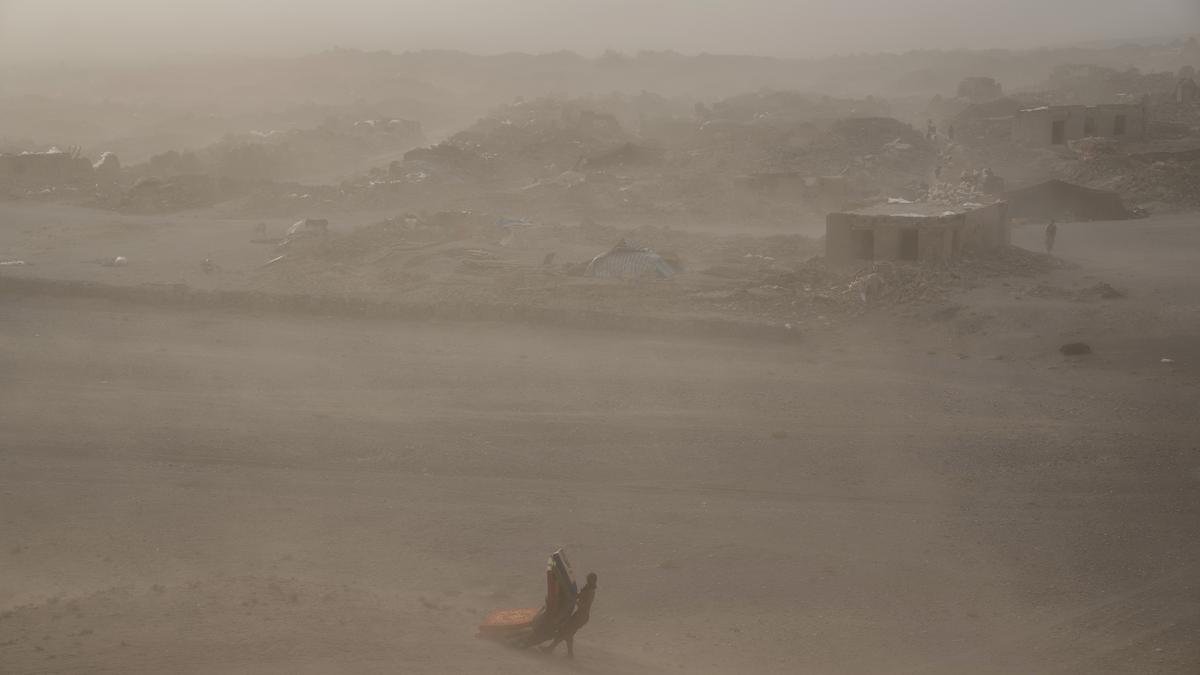
In what can be termed as unusual, a shallow focus (14 km depth) earthquake of 6.3 magnitude struck about 40 kms northwest of Herat in Afghanistan at around 11:00 am local time on October 7 (Saturday). The earthquake occurred as the result of thrust faulting near the far western terminus of the Hindu Kush Mountain range. Just 30 minutes after the first quake, Herat was struck by another shallow earthquake (about 13.5 km depth) of the same intensity — 6.3 magnitude. According to the U.S. Geological Survey (USGS): “[The first] earthquake was followed by a second earthquake [with 6.3 magnitude] that occurred approximately 30 minutes later. Both earthquakes occurred on east-west striking fault planes that dip to either the north or south. The earthquakes occurred within the Eurasia plate in an intracontinental mountain belt”. There were about a half-a-dozen aftershocks following the earthquakes.

Four days later, on October 11 (Wednesday), Herat witnessed yet another shallow earthquake at around 5.10 am local time with the focus of the quake being just 9 km below the surface. It had the same intensity (6.3 magnitude) as the previous ones on October 7.

All three earthquakes have been thrust faults, otherwise known as reverse faults. Thrust faults form due to horizontal compressive stresses and so cause shortening of the crust. Here one block or wall (the hanging wall) moves up relative to the other (called the footwall).

These three quakes struck a little over a year after another shallow earthquake at 10 km depth struck near Khōst, Afghanistan on June 22, 2022 at around 1:25 am local time.

Cause of second quake

Earthquakes are generally followed by aftershocks of relatively lesser magnitude. Why was the second earthquake on October 7 that struck within 30 minutes called a fresh quake and not an aftershock? “To call a quake an aftershock, the magnitude has to be lesser than the magnitude of the main event [quake],” explains Dr. R. K. Chadha, former senior scientist at the Hyderabad-based National Geophysical Research Institute (NGRI) and currently a Raja Ramanna Fellow at NGRI. “A quake of 6.3 magnitude was followed by another of the same magnitude. This can happen when a fault at one place ruptures resulting in an earthquake that releases the stress. The release of stress in one fault results in the loading of stress at another fault. The loading of stress can result in another earthquake which can be of similar magnitude or even higher magnitude. But the magnitude will not be smaller than the first quake.”

In the case of the October 7 earthquakes, the two quakes occurred in the same fault. Generally, in Afghanistan, the fault can be very long and wide. “In subduction zones and in the Himalayas where there is interaction between two continental plates, the fault lengths can be very large and also very wide. That is the reason why an earthquake in the fault can trigger another in the same fault,” he says. The second earthquake occurred quite close to the first one (about 20 km distance) in the same fault.

“When I see the three earthquakes in two parallel faults, there could be an interplay of these faults,” he says. “All three earthquakes are quite close by, and if you see the locations of all the three quakes, there is a systematic migration pattern visible. In this case, there is a migration of quakes from west to east.”

Two faults

“In any thrust fault environment in a subduction zone, there will be a series of parallel thrust faults. In this case the faults are aligned in an east-west direction. The two faults on October 7 and the one on October 11 have been on two faults trending east-west,” Dr. Chadha adds. The precise location of the first quake epicentre on October 7 was 34.610 degree north and 61.924 degree east, while the October 11 earthquake was 34.557 degree north 62.045 degree east.

Earthquakes are quite common in Afghanistan due to active interactions between three tectonic plates — the Arabia, Eurasia, and India plates. According to the USGS, earthquakes in western and central Afghanistan are “primarily influenced by the northward movement of the Arabia plate relative to the Eurasia plate.”

According to USGS, beneath the Pamir-Hindu Kush Mountains of northern Afghanistan, earthquakes occur to depths as great as 200 km as a result of remnant lithospheric subduction. “Shallower crustal earthquakes in the Pamir-Hindu Mountains occur primarily along the Main Pamir Thrust and other active Quaternary faults, which accommodate much of the region’s crustal shortening. The western and eastern margins of the Main Pamir Thrust display a combination of thrust and strike-slip mechanisms,” notes USGS.

Source link

Science Tags:earthquake in afghanistan, Half-dozen aftershocks, Hindu Kush, Quaternary faults

Post navigation

Previous Post: India vs Pakistan, ODI World Cup 2023: Bowlers Set It Up, Rohit Sharma Finishes Off One-Sided Contest vs Pakistan
Next Post: PM Modi Says India Will Leave No Stone Unturned In Preparation For Organisation Of 2036 Olympics

Related Posts

  • Race to global eradication of Guinea worm disease nears finish line Science
  • The mysterious fate of the Neanderthal Y chromosome Science
  • India needs youth mental health focus to strike demographic gold Science
  • New portable atomic clock offers very accurate timekeeping at sea Science
  • Dial it up to Category 6? As warming stokes storms, some want a bigger hurricane category Science
  • Estivation: The summer’s urge to nap Science

More Related Articles

Argentine scientists find speedy 90-million-year-old herbivore dinosaur Science
IISc announces distinguished alumni awards for 2023 Science
Is it possible to remove microplastics from water? Science
How an Indian can go to space for just $2.50 Science
‘Multi-omics’ is changing how India spots and treats TB, cancers Science
Climate change is causing marine ‘coldwaves’ too, killing wildlife Science
SiteLock

Archives

  • July 2024
  • June 2024
  • May 2024
  • April 2024
  • March 2024
  • February 2024
  • January 2024
  • December 2023
  • November 2023
  • October 2023
  • September 2023
  • August 2023
  • July 2023
  • June 2023
  • May 2023
  • April 2023
  • March 2023
  • February 2023
  • January 2023
  • December 2022
  • November 2022
  • October 2022
  • September 2022
  • August 2022
  • July 2022
  • June 2022
  • May 2022

Categories

  • Business
  • Nation
  • Science
  • Sports
  • World

Recent Posts

  • Andy Murray’s Wimbledon Career Ended Due To Emma Raducanu Withdrawal, Her Response…
  • Markets decline in early trade
  • Boeing to plead guilty in U.S. probe of fatal 737 MAX crashes, says DOJ official
  • Mumbai records over 300mm rainfall in six-hour period; more rains expected
  • France President Emmanuel Macron to start efforts to extract from severe political uncertainty

Recent Comments

  1. GkJwRWEAbS on UP Teacher Who Asked Students To Slap Muslim Classmate
  2. xreDavBVnbGqQA on UP Teacher Who Asked Students To Slap Muslim Classmate
  3. aANVRzfUdmyb on UP Teacher Who Asked Students To Slap Muslim Classmate
  4. YQCyszVBmIP on UP Teacher Who Asked Students To Slap Muslim Classmate
  5. aiXothgwe on UP Teacher Who Asked Students To Slap Muslim Classmate
  • Bhutan-China border demarcation talks inching towards completion: Bhutan PM Tshering World
  • Straighter Run-Up, Aggressive Rhythm Key To My ODI Success: Kuldeep Yadav Sports
  • North Korea fires ballistic missile, South Korea’s military says World
  • Amit Shah, Arvind Kejriwal, AAP vs BJP: “People Will See Liquor Bottle Whenever Arvind Kejriwal Campaigns”: Amit Shah Nation
  • Switzerland Defeat Hungary 3-1 In UEFA Euro 2024 Opener Sports
  • Albert Einstein’s Rare Manuscript Explaining His Theories Set For Auction World
  • Indo-Bangla Rail, Power Projects Likely To Be Launched On November 1 Nation
  • Rohit Sharma Completes 4000 Test Runs During Fourth Test Against England Sports

Editor-in-Chief:
Mohammad Ariff,
MSW, MAJMC, BSW, DTL, CTS, CNM, CCR, CAL, RSL, ASOC.
editor@artifex.news

Associate Editors:
1. Zenellis R. Tuba,
zenelis@artifex.news
2. Haris Daniyel
daniyel@artifex.news

Photograher:
Rohan Das
rohan@artifex.news

Artifex.News offers Online Paid Internships to college students from India and Abroad. Interns will get a PRESS CARD and other online offers.
Send your CV (Subjectline: Paid Internship) to internship@artifex.news

Links:
Associate Journalism
About Us
Privacy Policy

News Links:
Breaking News
World
Nation
Sports
Business
Entertainment
Lifestyle

Registered Office:
72/A, Elliot Road, Kolkata - 700016
Tel: 033-22277777, 033-22172217
Email: office@artifex.news

Editorial Office / News Desk:
No. 13, Mezzanine Floor, Esplanade Metro Rail Station,
12 J. L. Nehru Road, Kolkata - 700069.
(Entry from Gate No. 5)
Tel: 033-46011099, 033-46046046
Email: editor@artifex.news

Copyright © 2023 Artifex.News Newsportal designed by Artifex Infotech.