


Skip to content
  • Facebook
  • X
  • Linkedin
  • WhatsApp
  • YouTube
  • Associate Journalism
  • About Us
  • Privacy Policy
  • 033-46046046
  • editor@artifex.news
Artifex.News

Artifex.News

Stay Connected. Stay Informed.

  • Breaking News
  • World
  • Nation
  • Sports
  • Business
  • Science
  • Entertainment
  • Lifestyle
  • Toggle search form
  • Hamas Armed Wing Says “No Compromise” In Gaza Truce Talks
    Hamas Armed Wing Says “No Compromise” In Gaza Truce Talks World
  • “God’s Plan Bro Yo Baby”: Shah Rukh Khan’s Crazy Celebration With Rinku Singh After IPL Triumph
    “God’s Plan Bro Yo Baby”: Shah Rukh Khan’s Crazy Celebration With Rinku Singh After IPL Triumph Sports
  • Pakistan bombs Kabul in ‘open war’ on Afghanistan’s Taliban government
    Pakistan bombs Kabul in ‘open war’ on Afghanistan’s Taliban government World
  • Homeless Man Finds ,100 At Amsterdam Train Station, Returns Money To Cops
    Homeless Man Finds $2,100 At Amsterdam Train Station, Returns Money To Cops World
  • Access Denied
    Access Denied Nation
  • Malaysia imposes anti-dumping duties on plastic imports from China, Indonesia 
    Malaysia imposes anti-dumping duties on plastic imports from China, Indonesia  Science
  • “Sabki Soch Alag Hoti”: Ashish Nehra On His Decision To Not Apply For India Coach Job
    “Sabki Soch Alag Hoti”: Ashish Nehra On His Decision To Not Apply For India Coach Job Sports
  • Access Denied Sports
How a 6.3 magnitude quake caused another of same intensity

How a 6.3 magnitude quake caused another of same intensity

Posted on October 14, 2023 By admin


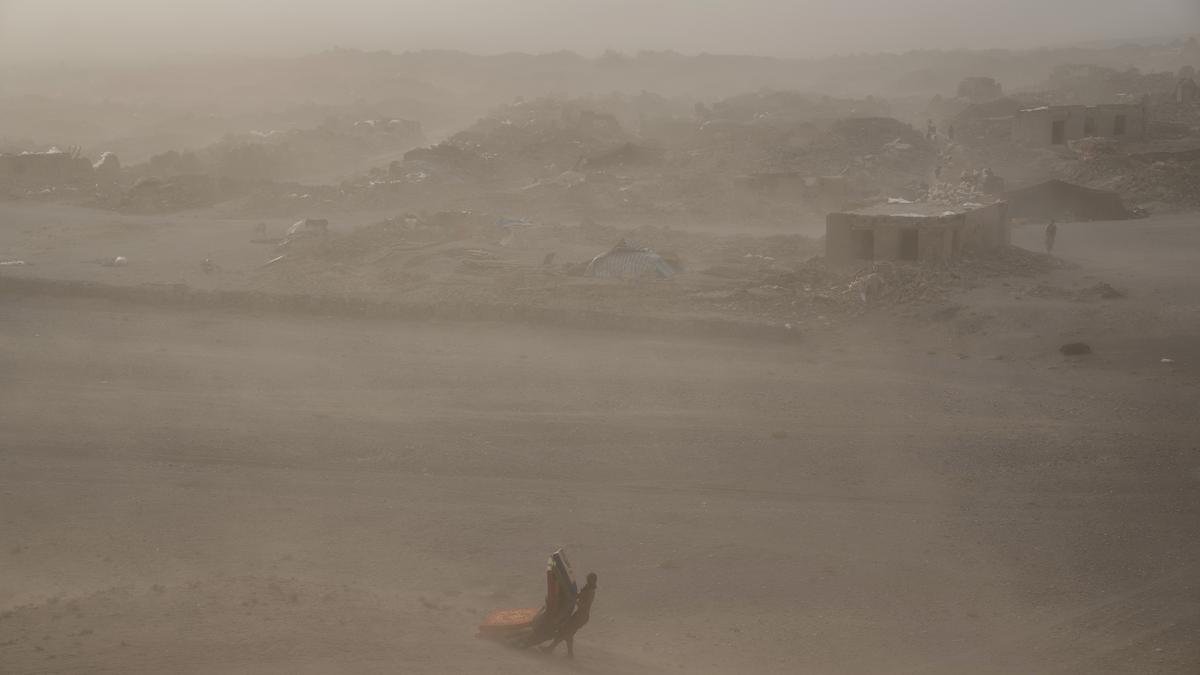
In what can be termed as unusual, a shallow focus (14 km depth) earthquake of 6.3 magnitude struck about 40 kms northwest of Herat in Afghanistan at around 11:00 am local time on October 7 (Saturday). The earthquake occurred as the result of thrust faulting near the far western terminus of the Hindu Kush Mountain range. Just 30 minutes after the first quake, Herat was struck by another shallow earthquake (about 13.5 km depth) of the same intensity — 6.3 magnitude. According to the U.S. Geological Survey (USGS): “[The first] earthquake was followed by a second earthquake [with 6.3 magnitude] that occurred approximately 30 minutes later. Both earthquakes occurred on east-west striking fault planes that dip to either the north or south. The earthquakes occurred within the Eurasia plate in an intracontinental mountain belt”. There were about a half-a-dozen aftershocks following the earthquakes.

Four days later, on October 11 (Wednesday), Herat witnessed yet another shallow earthquake at around 5.10 am local time with the focus of the quake being just 9 km below the surface. It had the same intensity (6.3 magnitude) as the previous ones on October 7.

All three earthquakes have been thrust faults, otherwise known as reverse faults. Thrust faults form due to horizontal compressive stresses and so cause shortening of the crust. Here one block or wall (the hanging wall) moves up relative to the other (called the footwall).

These three quakes struck a little over a year after another shallow earthquake at 10 km depth struck near Khōst, Afghanistan on June 22, 2022 at around 1:25 am local time.

Cause of second quake

Earthquakes are generally followed by aftershocks of relatively lesser magnitude. Why was the second earthquake on October 7 that struck within 30 minutes called a fresh quake and not an aftershock? “To call a quake an aftershock, the magnitude has to be lesser than the magnitude of the main event [quake],” explains Dr. R. K. Chadha, former senior scientist at the Hyderabad-based National Geophysical Research Institute (NGRI) and currently a Raja Ramanna Fellow at NGRI. “A quake of 6.3 magnitude was followed by another of the same magnitude. This can happen when a fault at one place ruptures resulting in an earthquake that releases the stress. The release of stress in one fault results in the loading of stress at another fault. The loading of stress can result in another earthquake which can be of similar magnitude or even higher magnitude. But the magnitude will not be smaller than the first quake.”

In the case of the October 7 earthquakes, the two quakes occurred in the same fault. Generally, in Afghanistan, the fault can be very long and wide. “In subduction zones and in the Himalayas where there is interaction between two continental plates, the fault lengths can be very large and also very wide. That is the reason why an earthquake in the fault can trigger another in the same fault,” he says. The second earthquake occurred quite close to the first one (about 20 km distance) in the same fault.

“When I see the three earthquakes in two parallel faults, there could be an interplay of these faults,” he says. “All three earthquakes are quite close by, and if you see the locations of all the three quakes, there is a systematic migration pattern visible. In this case, there is a migration of quakes from west to east.”

Two faults

“In any thrust fault environment in a subduction zone, there will be a series of parallel thrust faults. In this case the faults are aligned in an east-west direction. The two faults on October 7 and the one on October 11 have been on two faults trending east-west,” Dr. Chadha adds. The precise location of the first quake epicentre on October 7 was 34.610 degree north and 61.924 degree east, while the October 11 earthquake was 34.557 degree north 62.045 degree east.

Earthquakes are quite common in Afghanistan due to active interactions between three tectonic plates — the Arabia, Eurasia, and India plates. According to the USGS, earthquakes in western and central Afghanistan are “primarily influenced by the northward movement of the Arabia plate relative to the Eurasia plate.”

According to USGS, beneath the Pamir-Hindu Kush Mountains of northern Afghanistan, earthquakes occur to depths as great as 200 km as a result of remnant lithospheric subduction. “Shallower crustal earthquakes in the Pamir-Hindu Mountains occur primarily along the Main Pamir Thrust and other active Quaternary faults, which accommodate much of the region’s crustal shortening. The western and eastern margins of the Main Pamir Thrust display a combination of thrust and strike-slip mechanisms,” notes USGS.



Source link

Science Tags:earthquake in afghanistan, Half-dozen aftershocks, Hindu Kush, Quaternary faults

Post navigation

Previous Post: India vs Pakistan, ODI World Cup 2023: Bowlers Set It Up, Rohit Sharma Finishes Off One-Sided Contest vs Pakistan
Next Post: How a 6.3 magnitude quake caused another of same intensity

Related Posts

  • Study cracks when cracks come and go in paint, clay, milk, blood
    Study cracks when cracks come and go in paint, clay, milk, blood Science
  • ISRO’s Chandrayaan-3 moon lander separates from propulsion module
    ISRO’s Chandrayaan-3 moon lander separates from propulsion module Science
  • Climate change could become the main driver of biodiversity decline by mid-century: report
    Climate change could become the main driver of biodiversity decline by mid-century: report Science
  • Can India’s One Health Mission help tackle the rising number of infectious diseases? | In Focus podcast
    Can India’s One Health Mission help tackle the rising number of infectious diseases? | In Focus podcast Science
  • ‘Today, mathematics is not only necessary in daily life but pervasive’
    ‘Today, mathematics is not only necessary in daily life but pervasive’ Science
  • More than 3,600 food packaging chemicals found in human bodies
    More than 3,600 food packaging chemicals found in human bodies Science

More Related Articles

What is the ‘responsible quantum technologies’ movement? | Explained What is the ‘responsible quantum technologies’ movement? | Explained Science
Scientists change how El Nino is labelled to keep up with temperature spikes Scientists change how El Nino is labelled to keep up with temperature spikes Science
The natural universe remains captivating when it skips the people The natural universe remains captivating when it skips the people Science
Big Butterfly Month | A month for the winged ones Big Butterfly Month | A month for the winged ones Science
Chile’s giant ‘living fossil’ frog faces threat from climate change and humans Chile’s giant ‘living fossil’ frog faces threat from climate change and humans Science
India among four nations driving most global pesticide toxicity: study India among four nations driving most global pesticide toxicity: study Science
SiteLock

Archives

  • May 2026
  • April 2026
  • March 2026
  • February 2026
  • January 2026
  • December 2025
  • November 2025
  • October 2025
  • September 2025
  • August 2025
  • July 2025
  • June 2025
  • May 2025
  • April 2025
  • March 2025
  • February 2025
  • January 2025
  • December 2024
  • November 2024
  • October 2024
  • September 2024
  • August 2024
  • July 2024
  • June 2024
  • May 2024
  • April 2024
  • March 2024
  • February 2024
  • January 2024
  • December 2023
  • November 2023
  • October 2023
  • September 2023
  • August 2023
  • July 2023
  • June 2023
  • May 2023
  • April 2023
  • March 2023
  • February 2023
  • January 2023
  • December 2022
  • November 2022
  • October 2022
  • September 2022
  • August 2022
  • July 2022
  • June 2022
  • May 2022

Categories

  • Business
  • Nation
  • Science
  • Sports
  • World

Recent Posts

  • Learn from Sri Lanka’s experience on impact of fertilizer supply chains: experts
  • Sewage pollution of Cooum, groundwater depletion raise alarm
  • Device with low-grade explosives found inside private hospital in Pune; ATS joins probe
  • Punjab Kings seeks turnaround against Mumbai Indians
  • Around 83% of candidates lost their deposit in Tamil Nadu polls, says ECI

Recent Comments

  1. RichardClage on UP Teacher Who Asked Students To Slap Muslim Classmate
  2. JeffryFok on UP Teacher Who Asked Students To Slap Muslim Classmate
  3. DerrickSef on UP Teacher Who Asked Students To Slap Muslim Classmate
  4. Leonardren on UP Teacher Who Asked Students To Slap Muslim Classmate
  5. NathanQuins on UP Teacher Who Asked Students To Slap Muslim Classmate
  • Ola founder Bhavish Agarwal, stand up comedian Kunal Kamra spar over service quality issues
    Ola founder Bhavish Agarwal, stand up comedian Kunal Kamra spar over service quality issues Business
  • Access Denied
    Access Denied Nation
  • Access Denied Sports
  • WPL 2025 Auction: Full List Of Sold Players With Price
    WPL 2025 Auction: Full List Of Sold Players With Price Sports
  • North Korea conducts strategic cruise missile test
    North Korea conducts strategic cruise missile test World
  • Quiz | Easy like Sunday morning: Know your flora and fauna
    Quiz | Easy like Sunday morning: Know your flora and fauna Science
  • Access Denied World
  • Access Denied Sports

Editor-in-Chief:
Mohammad Ariff,
MSW, MAJMC, BSW, DTL, CTS, CNM, CCR, CAL, RSL, ASOC.
editor@artifex.news

Associate Editors:
1. Zenellis R. Tuba,
zenelis@artifex.news
2. Haris Daniyel
daniyel@artifex.news

Photograher:
Rohan Das
rohan@artifex.news

Artifex.News offers Online Paid Internships to college students from India and Abroad. Interns will get a PRESS CARD and other online offers.
Send your CV (Subjectline: Paid Internship) to internship@artifex.news

Links:
Associate Journalism
About Us
Privacy Policy

News Links:
Breaking News
World
Nation
Sports
Business
Entertainment
Lifestyle

Registered Office:
72/A, Elliot Road, Kolkata - 700016
Tel: 033-22277777, 033-22172217
Email: office@artifex.news

Editorial Office / News Desk:
No. 13, Mezzanine Floor, Esplanade Metro Rail Station,
12 J. L. Nehru Road, Kolkata - 700069.
(Entry from Gate No. 5)
Tel: 033-46011099, 033-46046046
Email: editor@artifex.news

Copyright © 2023 Artifex.News Newsportal designed by Artifex Infotech.