




On a cold winter night on March 13, 1989, the power grid in Quebec, Canada, went down without a warning, plunging the province into darkness. The underground metro railway in the city of Montreal came to a grinding halt and airport operations were disrupted. Down south in the neighbouring United States, nights lit up in beautiful bright aurorae as far south as Texas, which is not used to seeing such spectacles. Several sensors on the space shuttle Discovery started misbehaving. The broadcast of Radio Free Europe over Russia fell silent, giving rise to fears of jammed communications.
More than three decades later, in the first week of February 2022, almost an entire batch of newly launched SpaceX Starlink communication satellites fell out of their orbit unexpectedly, as if sunk by a storm.
Despite the variety of events across continents, all of them have a common cause: bad space weather.
Sun, meet Aditya
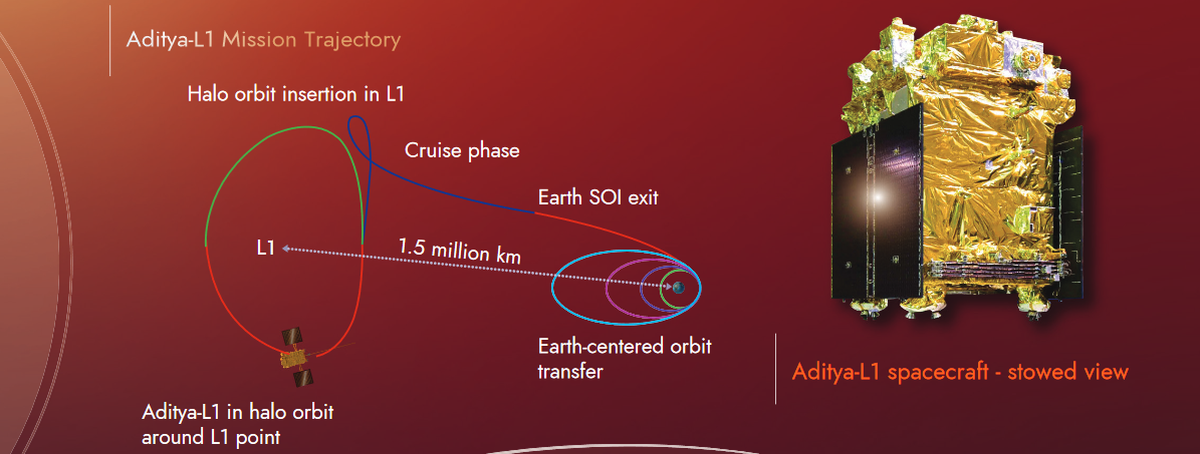
On September 2 this year, the Indian Space Research Organisation (ISRO) launched the Aditya-L1 satellite, its first space mission to explore the activities of the sun. After swinging by the earth a few times in increasingly distant orbits, the spacecraft will be boosted towards Lagrange point L1 – a strategic location in space about 1.5 million km from the earth. From here, a spacecraft can continuously observe the sun and monitor the changing local environment, or space weather, just before the earth experiences it – giving us critical tens of minutes of advance warning.
The path Aditya-L1 will take to get to L1.
| Photo Credit:
ISRO
The sun is a massive ball of fiery plasma. Energy is generated by nuclear fusion at its core, where temperatures are as high as 15 million degrees Celsius and the density more than 20-times that of iron. From the centre to the surface of the sun, the temperature drops and energy flows outwards. Inside the sun, the temperature is high enough that atoms are broken up into negatively charged electrons and positively charged ions – the state of matter called plasma. Below the sun’s surface lies the convection zone, where heated plasma rises and radiates its energy as sunlight upon reaching the surface. The light from the sun that reaches us sustains life and drives atmospheric processes that govern the earth’s climate.
After the solar plasma radiates its energy away from the surface, it cools and sinks back down, much like cyclonic convection in the earth’s atmosphere. This twisting, churning motion of plasma within the sun creates vast electric currents and, as a by-product, powerful magnetic fields. This process, known as the solar dynamo, generates dark, earth-sized blotches on the sun’s surface known as sunspots, and magnetic loops that rise up like giant arches threading the star’s outer atmosphere, the corona.
A storm in space
While the sun’s visible surface, or photosphere, is only about 6,000 degrees Celsius hot, the temperature in the sun’s corona rises to a million degrees. How does it get so hot – in apparent contradiction to the laws of thermodynamics, which state that heat energy can only flow from a region of higher to lower temperature?
We know that other novel processes, such as waves rippling along those giant coronal magnetic loops, superhot plasma jets rising from the surface to coronal layers, and a process known as magnetic reconnection, are at the heart of coronal heating. The hot magnetic corona of the sun is also responsible for the supersonic outflow of plasma wind that bathes all planets in the solar system and forms the background space weather. Sometimes that environment can be violently disturbed.
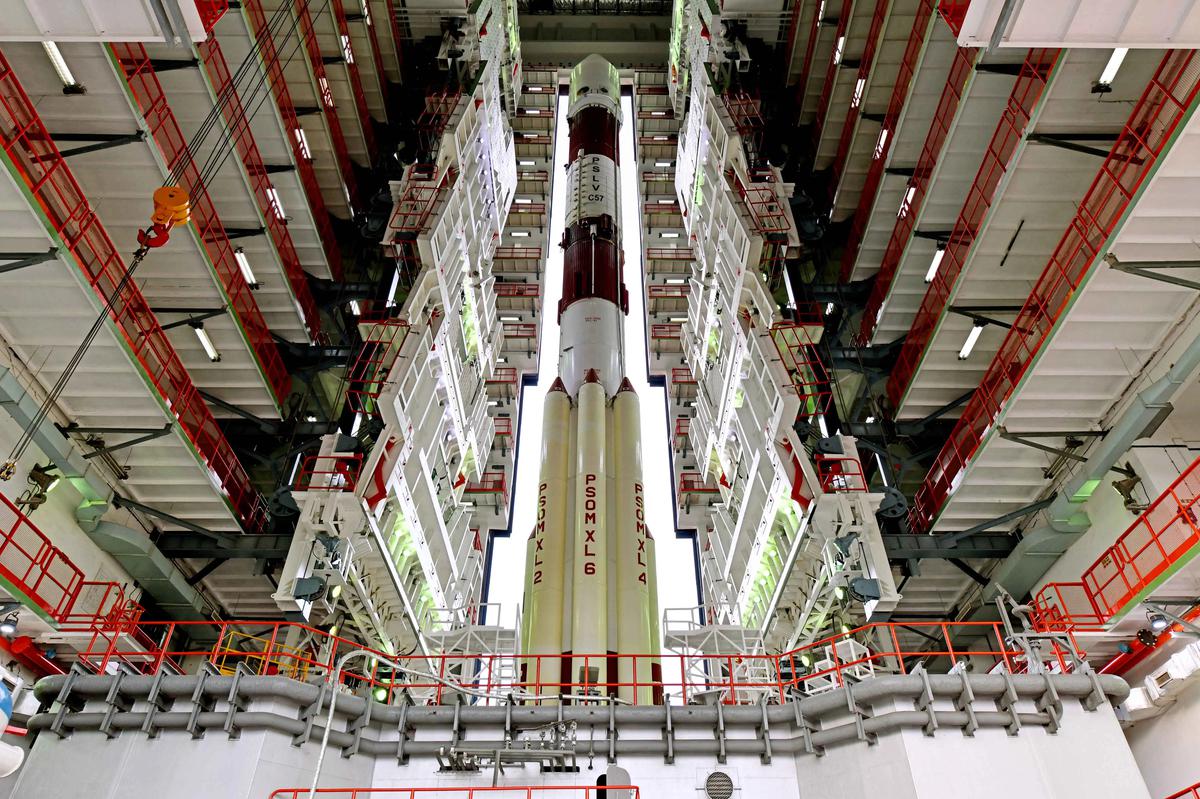
The PSLV C57 launch vehicle in its XL configuration inside the Vehicle Assembly Building, ahead of launch.
| Photo Credit:
ISRO
The legs of the magnetic loops in the solar corona are being constantly jostled around by turbulent plasma flows beneath the surface, where they are rooted. These loops, energised by the serpentine motion of the plasma, sustain huge electric currents, and sometimes, in the course of their frenzied dance, they cross each other’s path. When the conditions are right, this results in a magnetic reconnection event that destroys the loops. The magnetic energy they shed is harnessed to create the most violent events we witness in our star: a solar flare, with an energy yield that can surpass a 100 billion nuclear bombs.
The energy released in such a solar storm heats the solar atmosphere even further, generating intense X-ray radiation and accelerating charged particles to a nontrivial fraction of the speed of light. The most energetic events can hurl magnetised coronal plasma material into outer space at speeds exceeding a few million kilometres an hour, giving rise to a coronal mass ejection – a space storm that, when directed at the earth, severely perturbs our own space environment.
A new infrastructure dependence
Severe space weather can give rise to geomagnetic storms that create beautiful aurorae on the one hand and cause power-grid failures in high-latitude regions, disrupt communications and GPS navigational networks, affect air-traffic over polar routes, and jam radar signals on the other. They can fry sensitive electronics of satellites and sometimes precipitate catastrophic orbital decays, as in the loss of the Starlink satellites in 2022.
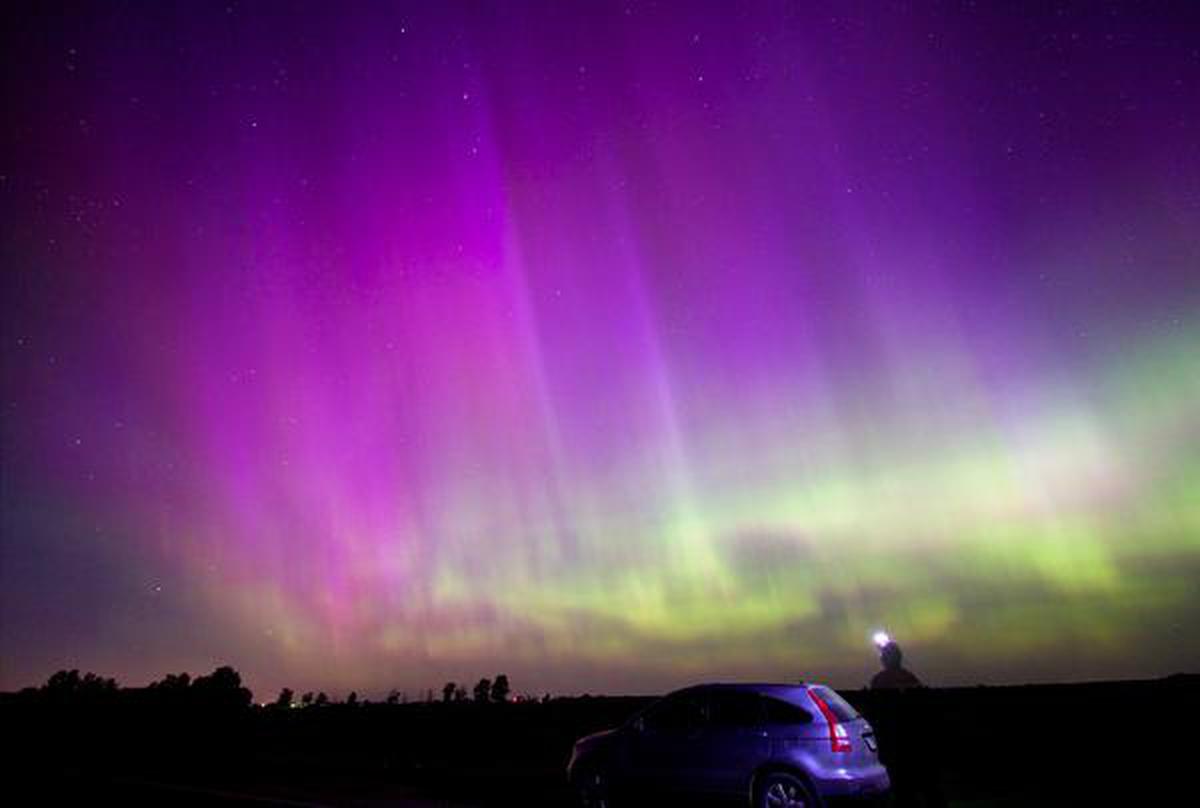
Aurorae are the product of disturbances in the earth’s magnetic field as a result of the sun’s solar wind.
| Photo Credit:
The Hindu
With our increasing dependence on space-based infrastructure, a catastrophic solar storm could result in a trillion-dollar adverse economic impact. Yet we don’t yet have the means to accurately forecast severe space weather.
ISRO’s Aditya-L1 mission will explore how magnetic fields result in variations in the sun’s ultraviolet radiation, which plays a critical role in governing the earth’s atmosphere and climate dynamics. It will observe the flow of energy in the sun’s outer atmosphere to test competing theories for the heating of the sun’s corona. By analysing X-ray radiation, it will seek to understand how violent solar storms are born. Aditya-L1 will also track the early motion of magnetic storms near the sun and monitor the local space environment in its vicinity at Lagrange point L1, the environment that eventually affects the earth.
A national collaboration
Aditya-L1 was originally envisaged as a mission of purely fundamental scientific enquiry. In 2020, ISRO constituted a committee to explore how mission data could be used to extract relevant information for space-weather monitoring and predictions. I chaired that committee; it drafted a set of specific recommendations on onboard intelligence for space weather alerts and supporting data analytics and computational modelling initiatives to create value-added space weather knowledge.
More than 60 scientists from about 20 academic organisations participated in that exercise, and many more scientists, engineers, and students contributed to the mission – exemplifying the national collaborative effort that produced Aditya-L1.
If the mission succeeds, it will be a resounding vindication of India’s investment in space science research, which can on the one hand spur fundamental enquiry of our cosmos and on the other generate knowledge of strong societal relevance. Today, we wake up to the weather forecast. The day is not far when we will wake up to space weather forecasts. Not since our first sounding rocket screamed over a remote beach in Thumba have the people of India been so excited about space.
Dr. Dibyendu Nandi is professor of physics and head of the Centre of Excellence in Space Sciences India at IISER Kolkata. He specialises in understanding and predicting space weather.