


Skip to content
  • Facebook
  • X
  • Linkedin
  • WhatsApp
  • YouTube
  • Associate Journalism
  • About Us
  • Privacy Policy
  • 033-46046046
  • editor@artifex.news
Artifex.News

Artifex.News

Stay Connected. Stay Informed.

  • Breaking News
  • World
  • Nation
  • Sports
  • Business
  • Science
  • Entertainment
  • Lifestyle
  • Toggle search form
  • Summer 2023 Was The Hottest In 2,000 Years: Study
    Summer 2023 Was The Hottest In 2,000 Years: Study World
  • United Nations warns Gaza blockade could force it to sharply cut relief operations as bombings rise
    United Nations warns Gaza blockade could force it to sharply cut relief operations as bombings rise World
  • Name Kochi airport after K. Karunakaran, says Congress leader V.M. Sudheeran
    Name Kochi airport after K. Karunakaran, says Congress leader V.M. Sudheeran Nation
  • Access Denied World
  • NCBS to collaborate with various organisations on forest research and conservation
    NCBS to collaborate with various organisations on forest research and conservation Science
  • Trump says the U.S. and Iran ‘getting along very well’
    Trump says the U.S. and Iran ‘getting along very well’ World
  • China probe finds Taiwanese smugglers controlled vessel that damaged subsea cables
    China probe finds Taiwanese smugglers controlled vessel that damaged subsea cables World
  • Vistara Cuts Flights To Deal With Pilot Shortage, Offers Refund To Passengers
    Vistara Cuts Flights To Deal With Pilot Shortage, Offers Refund To Passengers Nation
‘Strange’ particle found to have mass when moving in one direction, not another

‘Strange’ particle found to have mass when moving in one direction, not another

Posted on January 16, 2025 By admin


Since the start of the 20th century, physicists have discovered a veritable zoo of subatomic particles. Matter can be both wave and particle. If you take the particle route, these subatomic particles are what you could say the universe and everything in it is made of. There are many ways to further categorise them.

A common one is as fermions and bosons: fermions make up matter and bosons mediate the forces between matter. For example, electrons and protons are fermions whereas photons are bosons.

Fermions can be further classified as Dirac or Majorana fermions. Dirac fermions are fermions that may or may not have mass but are always different from their anti-particles. Majorana fermions are fermions that are also their own antiparticles (neutrinos are suspected to be Majorana fermions).

The zoo smells funny

Even if these distinctions seem too fine, they’re of considerable interest to physicists. They know something’s up in the subatomic zoo. Some animals that should obviously be there are missing, like the particle for the force of gravity. Some animals are much heavier than they should be (Higgs bosons and neutrinos). One enclosure, dark matter, remains empty even though physicists have been looking for it under every rock and leaf. Their knowledge of quite a few animals is just incomplete or at odds with what they studied in school. There’s a lot of work left if the zoo is to be a fully understood place without any surprises.

To do this physicists have one advantage: a common theory that collects all these animals under a single, unified description, called the Standard Model (SM) of particle physics. Physicists can explore ‘new physics’ in terms of whether it agrees or disagrees with the SM. Right now it’s like a big jigsaw puzzle with a few important pieces missing. If physicists find a new piece in their calculations or their particle collider experiments, they can check if it fits into the puzzle. If it doesn’t, maybe the puzzle itself needs to be changed.

In a sense, grouping fermions into fine categories is an exercise in meticulously cataloguing the exact shapes of the puzzle’s pieces. This way, if physicists find a piece whose shape is new even in a very small way, they stand to make a big update.

Something strange comes this way

A particle as it exists in the wilderness of space is slightly different from a particle that exists inside solids and liquids. “In condensed-matter physics, every material can behave like a new universe,” IIT Kanpur assistant professor Adhip Agarwala said. “Here strange particles can arise and be experimentally detectable, which are otherwise not usually seen in three dimensions.”

For example, two-dimensional materials can host particles called anyons whose properties lie somewhere between those of fermions and bosons.

Recently, physicists at Columbia University and Pennsylvania State University reported finding another strange particle called a semi-Dirac fermion.

Dirac fermions have mass and aren’t their own anti-particles. A semi-Dirac fermion has mass when it’s moving in one particular direction but not in a perpendicular direction. This unusual characteristic, which makes semi-Dirac fermions very exotic, is the result of the fermion’s interaction with the electric and magnetic forces acting on it in certain materials.

The semi-Dirac fermion reported in the experiment is technically a quasiparticle. A quasiparticle is a clump of particles or energy-packets that, in some given conditions, behaves like a single particle. Protons are quasiparticles, for example: each proton is made of three quarks and the gluons holding them together. In most settings, what separates particles from quasiparticles is a distinction without a difference. If a quasiparticle is a fermion, it’s a fermion in the same way an electron is a fermion.

Location, location, location

When trying to find puzzle pieces with new shapes, physicists need to know exactly which material to look in or they could be searching forever. This is much like in life sciences research. By studying the 1-mm-long roundworm Caenorhabditis elegans, for example, scientists have discovered many fundamental principles of biology and have won four Nobel Prizes so far. The locale of choice in the new study was a layered crystalline material called zirconium silicon sulphide (ZrSiS).

When a magnetic field is applied to a metal, the electrons inside are accelerated along a curved path. (The protons are confined to the atomic nuclei.) The energy of these electrons is called cyclotron energy.

In the metal, the cyclotron energy increases linearly with the strength of the magnetic field. This relationship can be denoted as B1, where B is the strength of the magnetic field and 1 is the exponent to which it is raised. In graphene, which is a single-layer sheet of carbon atoms linked together, the cyclotron energy increases in step with the square-root of the magnetic field strength. The relationship is thus B1/2.

In ZrSiS, the researchers found the cyclotron energy to increase as B2/3. Previous theoretical research has found that this scaling factor is a unique signature of semi-Dirac fermions.
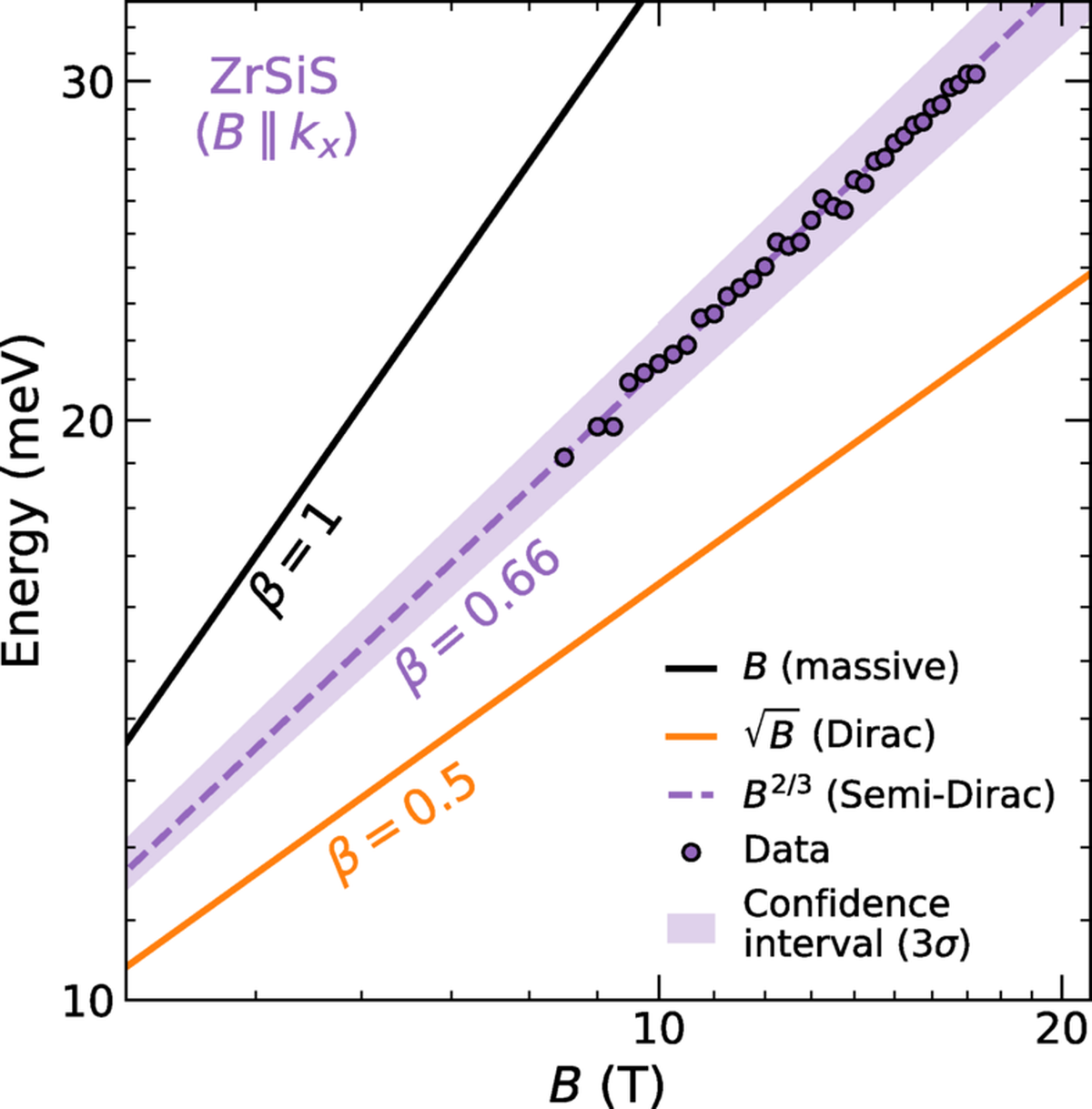
Comparison of the power law of transitions for different fermions in a log-log scale plot. Power-law fitting associated with the semi-Dirac fermions in ZrSiS shown as purple dashed line. Orange and black lines show the power-law scaling for other fermions.

Comparison of the power law of transitions for different fermions in a log-log scale plot. Power-law fitting associated with the semi-Dirac fermions in ZrSiS shown as purple dashed line. Orange and black lines show the power-law scaling for other fermions.
| Photo Credit:
PhysRevX.14.041057

‘The same laws of nature’

The researchers didn’t land up at ZrSiS by accident; the locale is crucial, after all. Physicists in general knew for some time that there could be semi-Dirac fermions in graphene. But to reveal the quasiparticles’ presence, they had to first stretch graphene to such a degree that they often ended up tearing it apart. (Curiously, non-stretched graphene is a material that hosts a Dirac fermion, so its power law is denoted by the orange line in the graph above.) An older study also revealed some unusual electronic properties in zirconium silicon selenide (ZrSiSe), which has a similar structure, in the presence of a magnetic field.

The authors of the present study put these and other indications together and decided to look for semi-Dirac fermions in ZrSiS — and voila.

“This shows the magic of condensed matter physics, where every material, be it graphene or ZrSiS, can host exotic particles that one can discover in table-top experiments — whereas to discover subatomic particles we often need huge colliders,” Agarwala said. “It is the same laws of nature that guide them all.”

The zoo expands

Physicists regularly subject subatomic particles to extreme conditions to elucidate the laws of nature at the edge of reality. The Large Hadron Collider in CERN in Europe smashes billions of protons head on with as much energy as there was just 0.000000000000004 seconds after the Big Bang. Even in the present study, the researchers subjected ZrSiS crystals to a magnetic field of up to 17.5 tesla — about 270,000-times stronger than the earth’s magnetic field.

The researchers have said they plan to continue their studies calculations to understand more about ZrSiS and try to explain some other unusual electronic behaviour they observed in their study.

The finding is a new animal in the particle zoo. As one more enclosure awaits its occupant and zoo authorities fill out the paperwork, the question arises: how will it change the zoo?

The author thanks IISc assistant professor Nirmal Raj for feedback.

Published – January 16, 2025 05:30 am IST


Source link

Science

Post navigation

Previous Post: ‘Kaante Wale Baba’ Amazes Devotees At Maha Kumbh In Prayagraj
Next Post: Trump Considers Suspending TikTok Ban Enforcement For 60 To 90 Days: Report

Related Posts

  • Musk’s xAI is raising  billion from Sequoia and others
    Musk’s xAI is raising $6 billion from Sequoia and others Science
  • Explained: What is Shigella infection?
    Explained: What is Shigella infection? Science
  • UK regulators rush to assess risks of latest Anthropic AI model: Report
    UK regulators rush to assess risks of latest Anthropic AI model: Report Science
  • HPV vaccine prevents cervical cancer cases in deprived groups: study
    HPV vaccine prevents cervical cancer cases in deprived groups: study Science
  • Peter Higgs, who proposed existence of Higgs boson particle, has died at 94, university says
    Peter Higgs, who proposed existence of Higgs boson particle, has died at 94, university says Science
  • The first man to experience jet streams
    The first man to experience jet streams Science

More Related Articles

ISRO will conduct START 2024 during April-May ISRO will conduct START 2024 during April-May Science
Asteroid named after Bengaluru Professor Asteroid named after Bengaluru Professor Science
Science Quiz | The obscure mathematics of string theory Science Quiz | The obscure mathematics of string theory Science
Does the fluid-filled sac around the lungs function merely as a cushion from external damage? Does the fluid-filled sac around the lungs function merely as a cushion from external damage? Science
NASA overhauls Artemis moon programme with new docking test mission NASA overhauls Artemis moon programme with new docking test mission Science
‘Underwhelming Indian genomics research, and gatekeeping’ ‘Underwhelming Indian genomics research, and gatekeeping’ Science
SiteLock

Archives

  • September 2026
  • August 2026
  • July 2026
  • June 2026
  • May 2026
  • April 2026
  • March 2026
  • February 2026
  • January 2026
  • December 2025
  • November 2025
  • October 2025
  • September 2025
  • August 2025
  • July 2025
  • June 2025
  • May 2025
  • April 2025
  • March 2025
  • February 2025
  • January 2025
  • December 2024
  • November 2024
  • October 2024
  • September 2024
  • August 2024
  • July 2024
  • June 2024
  • May 2024
  • April 2024
  • March 2024
  • February 2024
  • January 2024
  • December 2023
  • November 2023
  • October 2023
  • September 2023
  • August 2023
  • July 2023
  • June 2023
  • May 2023
  • April 2023
  • March 2023
  • February 2023
  • January 2023
  • December 2022
  • November 2022
  • October 2022
  • September 2022
  • August 2022
  • July 2022
  • June 2022
  • May 2022

Categories

  • Business
  • Nation
  • Science
  • Sports
  • World

Recent Posts

  • Asian Games 2026 opens in Japan with 11,000 athletes competing | LIVE updates
  • Union Home Minister Amit Shah falls ill in Hubballi, skips function
  • Raphinha hat-trick maintains Barcelona’s perfect LaLiga start
  • Saudi Arabia confirms Yemen’s Houthi rebels tried to attack its capital with ballistic missile
  • Martin recovers from early setback to win Austrian sprint and retake championship lead

Recent Comments

  1. AlvinNet on UP Teacher Who Asked Students To Slap Muslim Classmate
  2. AlvinNet on UP Teacher Who Asked Students To Slap Muslim Classmate
  3. Jamesslits on UP Teacher Who Asked Students To Slap Muslim Classmate
  4. MichaelClear on UP Teacher Who Asked Students To Slap Muslim Classmate
  5. Jamesslits on UP Teacher Who Asked Students To Slap Muslim Classmate
  • 8 Afghan Taliban soldiers killed in border clash with Pakistani forces
    8 Afghan Taliban soldiers killed in border clash with Pakistani forces World
  • Maharashtra Boy Goes In For Leg Surgery, Comes Out Circumcised, Probe On
    Maharashtra Boy Goes In For Leg Surgery, Comes Out Circumcised, Probe On Nation
  • Chandrayaan-2 makes first ever observation of Sun’s impact on Moon, says ISRO
    Chandrayaan-2 makes first ever observation of Sun’s impact on Moon, says ISRO Science
  • “Stop Trolling, Athletes Are Going Into Depression”: Avinash Sable Slams Social Media Critics During Olympics 2024
    “Stop Trolling, Athletes Are Going Into Depression”: Avinash Sable Slams Social Media Critics During Olympics 2024 Sports
  • U.S. government shutdown begins as nation faces new period of uncertainty
    U.S. government shutdown begins as nation faces new period of uncertainty World
  • Access Denied Sports
  • Veteran space scientist Eknath Vasant Chitnis dies at 100
    Veteran space scientist Eknath Vasant Chitnis dies at 100 Science
  • Teacher Stripped, Paraded For ‘Misbehaving’ With Girls; Handed Over To Cops
    Teacher Stripped, Paraded For ‘Misbehaving’ With Girls; Handed Over To Cops Nation

Editor-in-Chief:
Mohammad Ariff,
MSW, MAJMC, BSW, DTL, CTS, CNM, CCR, CAL, RSL, ASOC.
editor@artifex.news

Associate Editors:
1. Zenellis R. Tuba,
zenelis@artifex.news
2. Haris Daniyel
daniyel@artifex.news

Photograher:
Rohan Das
rohan@artifex.news

Artifex.News offers Online Paid Internships to college students from India and Abroad. Interns will get a PRESS CARD and other online offers.
Send your CV (Subjectline: Paid Internship) to internship@artifex.news

Links:
Associate Journalism
About Us
Privacy Policy

News Links:
Breaking News
World
Nation
Sports
Business
Entertainment
Lifestyle

Registered Office:
72/A, Elliot Road, Kolkata - 700016
Tel: 033-22277777, 033-22172217
Email: office@artifex.news

Editorial Office / News Desk:
No. 13, Mezzanine Floor, Esplanade Metro Rail Station,
12 J. L. Nehru Road, Kolkata - 700069.
(Entry from Gate No. 5)
Tel: 033-46011099, 033-46046046
Email: editor@artifex.news

Copyright © 2023 Artifex.News Newsportal designed by Artifex Infotech.