


Skip to content
  • Facebook
  • X
  • Linkedin
  • WhatsApp
  • YouTube
  • Associate Journalism
  • About Us
  • Privacy Policy
  • 033-46046046
  • editor@artifex.news
Artifex.News

Artifex.News

Stay Connected. Stay Informed.

  • Breaking News
  • World
  • Nation
  • Sports
  • Business
  • Science
  • Entertainment
  • Lifestyle
  • Toggle search form
  • Bihar Man Dies Of Heat In Delhi Hospital, Fever Shot Up To 107 Degrees
    Bihar Man Dies Of Heat In Delhi Hospital, Fever Shot Up To 107 Degrees Nation
  • Pranjali Dhumal Wins Bronze, India Reach 13 Medals At World Deaf Shooting Championship 2024
    Pranjali Dhumal Wins Bronze, India Reach 13 Medals At World Deaf Shooting Championship 2024 Sports
  • Thai court issues arrest warrants for foreign businessman, his wife for money-laundering
    Thai court issues arrest warrants for foreign businessman, his wife for money-laundering World
  • Stock markets trade lower in early deals
    Stock markets trade lower in early deals Business
  • Access Denied World
  • President Muizzu to take 50% salary cut amid worsening financial crunch in the Maldives
    President Muizzu to take 50% salary cut amid worsening financial crunch in the Maldives World
  • Access Denied Sports
  • Rahul Dravid’s Son Samit Smashes Sensational Inside-Out Six, Internet Says “Genetics”. Watch
    Rahul Dravid’s Son Samit Smashes Sensational Inside-Out Six, Internet Says “Genetics”. Watch Sports
Is the shallow pool in Paris really slowing Olympic swimmers down?

Is the shallow pool in Paris really slowing Olympic swimmers down?

Posted on August 1, 2024 By admin


There has been plenty of rain, sweat and tears shed at the Paris Olympics this week. But the pool at the heart of La Defénce Arena has suffered a drought of world records that has athletes and officials scratching their heads.

After five days, Paris 2024 has seen only a single world record fall in a swimming event. That compares with six new swimming world records set at Tokyo in 2021 and eight at Rio in 2018. Even the much-hyped women’s 400 metre freestyle – billed as the “race of the century” – failed to topple any personal bests from the three most recent world-record holders, Ariarne Titmus (Australia), Summer McIntosh (Canada) and Katie Ledecky (United States).

To earn a spot on the winners’ podium, of course, place – not pace – is what matters. But the near-absence of the letters WR alongside any of the finishing times on the Olympic scoreboard has coaches, competitors and commentators searching for a culprit.

Several athletes, including Titmus, have pointed to problems with the accommodation, food and transport at the games. And some are pointing to the Olympic pool itself with cries of “J’accuse…!”

The slow pool theory

It is undeniable that the pool at La Défence Arena is shallower than at recent Olympics. It’s 2.15m deep – deeper than the required minimum of 2m but quite a bit shallower than the standard 3m used at the Tokyo and Rio games.

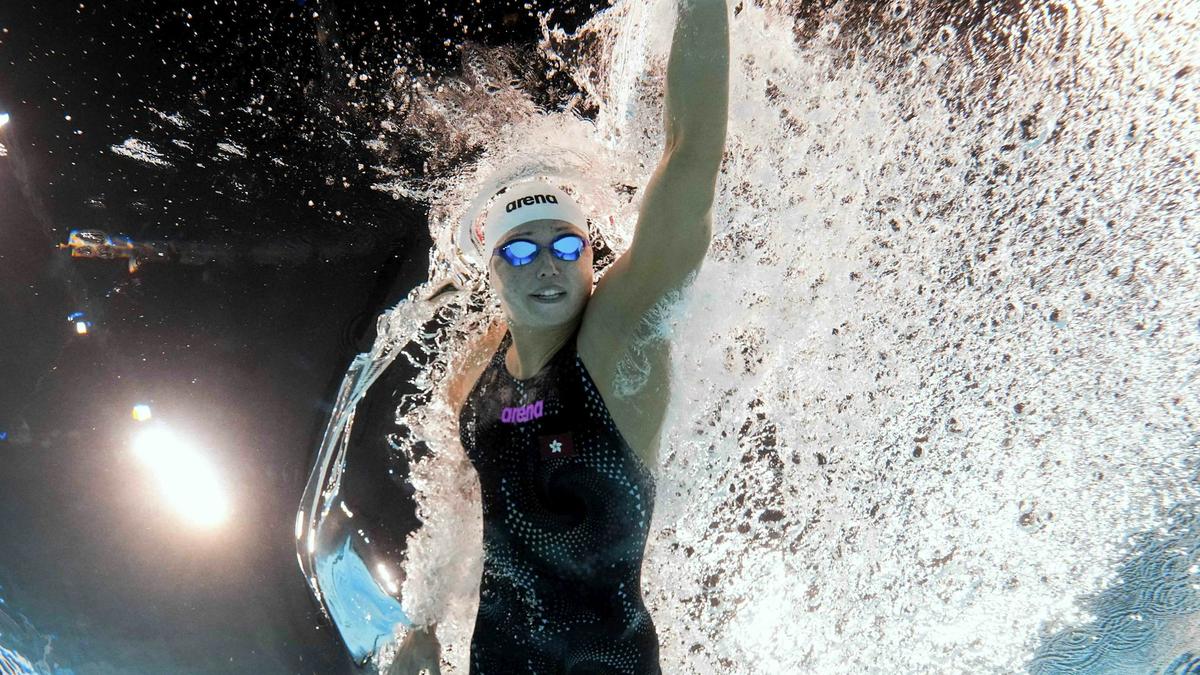
Why would this make a difference? Well, when swimmers dive into the pool and power through the water, they naturally create waves that radiate outwards. Some of these waves will propagate along the surface of the pool and be damped by gutters at the edge. Others will travel downward, bounce off the bottom of the pool, and return to the surface to create turbulence.

Turbulence can slow a swimmer down in two ways. First, it creates a choppy pool surface that can disrupt a swimmer’s rhythm and reduce their speed.

Second, turbulence increases the effect of water drag by dissipating the swimmer’s momentum – the water motion literally “sucks” the speed from the swimmer.

The slow pool theory says the shallower pool means more waves bounce back to the surface, creating more turbulence and slowing swimmers down. But does it hold water?

Not according to Roberto Colletto, chief executive of the Italian company that constructed the pool in Paris. “On the technical side, there is no problem with the pool,” he told French broadcaster RMC Sport.

And scientifically speaking, the theory has some holes. One problem is that the waves bouncing off the pool bottom are quite different from the ones that travel across the surface. Subsurface waves are essentially sound waves generated by differences in water pressure.

Sound waves travel at about 1,500m per second in water. In a 2.15m-deep pool, a sound wave takes a little under 3 milliseconds to bounce off the bottom and return to the surface, compared with 4 milliseconds in a 3m pool. This millisecond difference in travel time likely has a negligible effect on the generation of turbulence at the pool surface.

On the surface

Water depth does have an effect on the waves at the pool surface, however. Surface waves travel more slowly in shallow water – which is why you see ocean waves piling up and breaking as they approach the beach.

So the waves the swimmers are creating at the surface of the competition pool in Paris will be travelling marginally more slowly than the waves in a 3m-deep pool.

Elite swimmers can take advantage of the surface waves they generate in the pool. By adjusting their swimming speed, they can create a wave that has a wavelength close to their own body length. This means the swimmer can position themselves between two crests to effectively “surf” the wave.

This critical speed, known as “hull velocity”, is well known in sailing. For elite middle- and long-distance swimmers, swimming at their own personal hull velocity can save energy – and win races.

Because the competition pool at the Paris Olympics is shallower than a standard 3m pool, the hull velocity of each swimmer will be slightly slower. So it is possible that some of the swimmers – especially in middle-distance races such as the 400m freestyle – may unconsciously be adjusting their pace to match the slower hull velocity. But, since the effect is the same for all competitors, no one will have an unfair advantage.

That’s only one possible explanation for the dreaded “slow pool”. It’s also possible that the perception of a slow pool has a larger effect than the reality.

As some have pointed out, the Australian Olympic Trials at the Brisbane Aquatic Centre resulted in a new world record in the women’s 200m freestyle – despite the pool being only 2m deep.

Faster, higher, stronger

It’s also possible swimmers are approaching the limits of human performance – at least until we work out how to break those limits once again.

New technology, improved nutrition and training, and greater access to clubs and coaches have boosted elite performance. But each toppled record reduces the likelihood of another, even better performance.

It shouldn’t be surprising that the rate of record-breaking performances will decrease over time.

In marathon running, for example, the men’s world record fell by 12 minutes over the 1950s and ‘60s. But further progress has been slow: it has only dropped another 8 minutes in the past 60 years, and now stubbornly hovers just above the two-hour mark. A statistical study published in 2019 predicted there is only a 1 in 4 chance anyone would beat the two-hour threshold in a competitive event by 2027.

Compared to track events, swimming seems to still have plenty of capacity to shatter records.

At Tokyo in 2021, the winning times in three-quarters of the swimming events were faster than at the Beijing Games in 2008. This was despite the use of swimming suits in the Beijing games that were later banned by the sport’s governing body. Over the past decade, swimming world records have been broken 43% more often than in Olympic track races.

The desire to push our limits, to break the unbreakable barrier, is at the heart of the Olympic motto: “Faster, higher, stronger.”

It just might take a little longer to get there.

Shane Keating is an associate professor at UNSW Sydney. This article is republished from The Conversation.



Source link

Science

Post navigation

Previous Post: Indian Students Win Laurels At 4 Academic Olympiads
Next Post: Iran holds funeral for slain Hamas chief Haniyeh

Related Posts

  • Leading Indian woman scientist is International Brain Research Organisation’s president-elect
    Leading Indian woman scientist is International Brain Research Organisation’s president-elect Science
  • Sun bears appear so human-like they are mistaken for people in suits – experts explain
    Sun bears appear so human-like they are mistaken for people in suits – experts explain Science
  • Sex bias: key to a DNA puzzle
    Sex bias: key to a DNA puzzle Science
  • What is India’s first orbital data centre satellite?
    What is India’s first orbital data centre satellite? Science
  • India’s place in the meandering life of the ‘Loss and Damage’ fund
    India’s place in the meandering life of the ‘Loss and Damage’ fund Science
  • Russia’s war is weakening scientists’ ability to track the climate
    Russia’s war is weakening scientists’ ability to track the climate Science

More Related Articles

Daily Quiz: On World Meteorological Day Daily Quiz: On World Meteorological Day Science
Is pregnancy-related brain impairment also seen in fish? Is pregnancy-related brain impairment also seen in fish? Science
Pfizer reports patient death in Duchenne gene therapy study Pfizer reports patient death in Duchenne gene therapy study Science
How does U.K.’s OpenSAFELY ensure transparency? How does U.K.’s OpenSAFELY ensure transparency? Science
NASA’s Moon flyby mission primed for launch NASA’s Moon flyby mission primed for launch Science
Colombian scientists develop supplement to protect bees from pesticides Colombian scientists develop supplement to protect bees from pesticides Science
SiteLock

Archives

  • May 2026
  • April 2026
  • March 2026
  • February 2026
  • January 2026
  • December 2025
  • November 2025
  • October 2025
  • September 2025
  • August 2025
  • July 2025
  • June 2025
  • May 2025
  • April 2025
  • March 2025
  • February 2025
  • January 2025
  • December 2024
  • November 2024
  • October 2024
  • September 2024
  • August 2024
  • July 2024
  • June 2024
  • May 2024
  • April 2024
  • March 2024
  • February 2024
  • January 2024
  • December 2023
  • November 2023
  • October 2023
  • September 2023
  • August 2023
  • July 2023
  • June 2023
  • May 2023
  • April 2023
  • March 2023
  • February 2023
  • January 2023
  • December 2022
  • November 2022
  • October 2022
  • September 2022
  • August 2022
  • July 2022
  • June 2022
  • May 2022

Categories

  • Business
  • Nation
  • Science
  • Sports
  • World

Recent Posts

  • China, U.S. should be ‘partners not rivals’, says Xi Jinping after meeting Donald Trump
  • Iran working on Hormuz ‘protocol’ to cover ‘costs’, says Deputy Foreign Minister Gharibabadi
  • Zydus Lifesciences arm to acquire U.S. oncology firm Assertio for $166 million
  • Israel-Iran war LIVE: Iran working on Hormuz ‘protocol’ to cover ‘costs’, says Dy FM Gharibabadi
  • Russia to fulfil all agreements on energy supply to India: FM Lavrov

Recent Comments

  1. OrvalMaync on UP Teacher Who Asked Students To Slap Muslim Classmate
  2. Jeffreyroure on UP Teacher Who Asked Students To Slap Muslim Classmate
  3. Stevemonge on UP Teacher Who Asked Students To Slap Muslim Classmate
  4. RichardClage on UP Teacher Who Asked Students To Slap Muslim Classmate
  5. StevenLek on UP Teacher Who Asked Students To Slap Muslim Classmate
  • Weeks After “Blue Screen Of Death”, Cyberattack Causes New Microsoft Outage
    Weeks After “Blue Screen Of Death”, Cyberattack Causes New Microsoft Outage World
  • Gaikwad likely to captain India A, Ishan Kishan expected to make comeback on Australia tour
    Gaikwad likely to captain India A, Ishan Kishan expected to make comeback on Australia tour Sports
  • What do the Atlantic Ocean hurricane forecasts foretell for India?
    What do the Atlantic Ocean hurricane forecasts foretell for India? Science
  • Access Denied Business
  • ‘Crop shortages could quicken inflation following MSP hikes’ 
    ‘Crop shortages could quicken inflation following MSP hikes’  Business
  • Access Denied
    Access Denied Nation
  • Economics Nobel Prize 2025: How innovation drives economic growth
    Economics Nobel Prize 2025: How innovation drives economic growth Business
  • Access Denied Business

Editor-in-Chief:
Mohammad Ariff,
MSW, MAJMC, BSW, DTL, CTS, CNM, CCR, CAL, RSL, ASOC.
editor@artifex.news

Associate Editors:
1. Zenellis R. Tuba,
zenelis@artifex.news
2. Haris Daniyel
daniyel@artifex.news

Photograher:
Rohan Das
rohan@artifex.news

Artifex.News offers Online Paid Internships to college students from India and Abroad. Interns will get a PRESS CARD and other online offers.
Send your CV (Subjectline: Paid Internship) to internship@artifex.news

Links:
Associate Journalism
About Us
Privacy Policy

News Links:
Breaking News
World
Nation
Sports
Business
Entertainment
Lifestyle

Registered Office:
72/A, Elliot Road, Kolkata - 700016
Tel: 033-22277777, 033-22172217
Email: office@artifex.news

Editorial Office / News Desk:
No. 13, Mezzanine Floor, Esplanade Metro Rail Station,
12 J. L. Nehru Road, Kolkata - 700069.
(Entry from Gate No. 5)
Tel: 033-46011099, 033-46046046
Email: editor@artifex.news

Copyright © 2023 Artifex.News Newsportal designed by Artifex Infotech.