





The journey towards recognising and addressing the disproportionate impacts of climate change on vulnerable countries has been long and fraught with resistance. In 1991, Vanuatu, representing the Alliance of Small Island States (AOSIS), first proposed the creation of an international climate fund to support nations most threatened by rising sea levels. However, entrenched opposition from economically developed countries reluctant to assume financial responsibility for historical emissions has delayed meaningful progress for decades.
Likewise, while the establishment of the United Nations Framework Convention on Climate Change (UNFCCC) in 1992 laid the groundwork for international cooperation, it was not until 2007 that the concept of “loss and damage” formally entered the global climate discourse. Subsequent milestones — including the Warsaw International Mechanism in 2013 and the Paris Agreement in 2015 — advanced the conversation but fell short on finance.
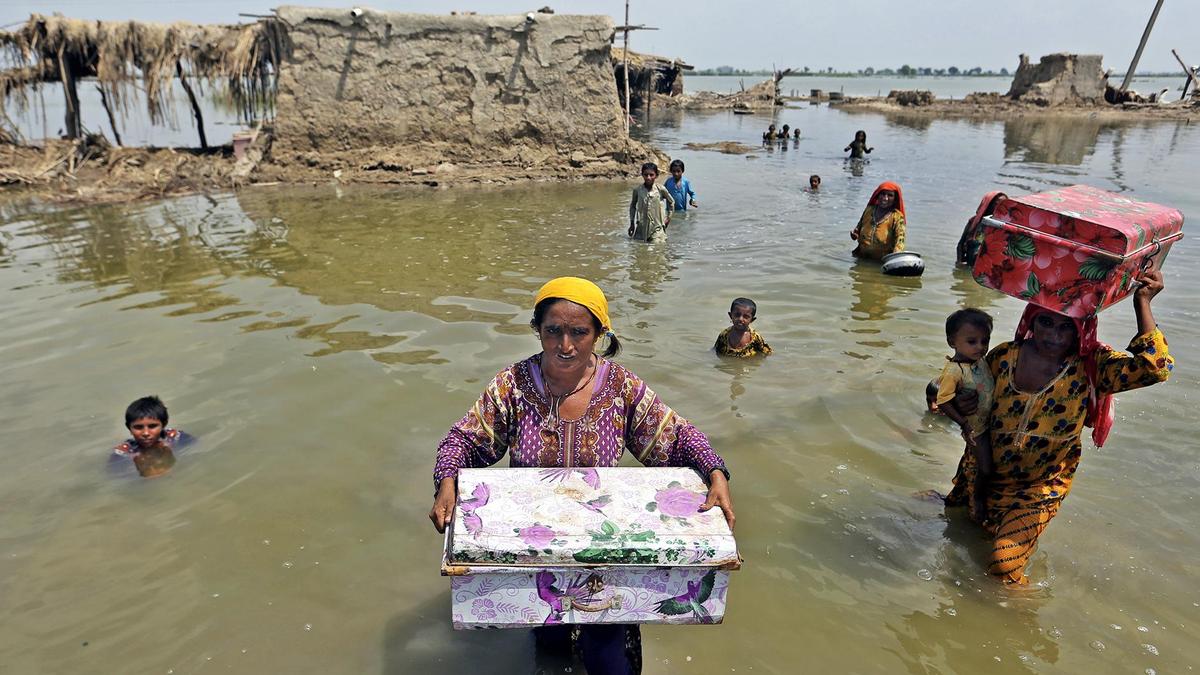
Only in 2022 was the first ‘Loss and Damage’ fund finally established at the COP27 climate talks, a breakthrough spurred by climate disasters including catastrophic floods in Pakistan that claimed thousands of lives and left the country’s economy in tatters.
India’s role in this long-winded and still-evolving narrative is particularly complex given its dual identity as a climate-vulnerable nation and an emerging economic power. This chapter explores the historical development of the ‘Loss and Damage’ fund, India’s stance, and the wider political arena in which climate finance is taking shape today.
The genesis of the fund
On June 4, 1991, Vanuatu, a small island country in Oceania, submitted a proposal on behalf of the Alliance of Small Island States (AOSIS) outlining the elements of a ‘Framework Convention on Climate Change’. This was one of the world’s first proposals to set up an international climate fund to assist vulnerable countries against the effects of climate change, especially since AOSIS realised the need to safeguard their land against the threat of rising seas.
But economically developed countries did not accept the proposal and progress on the matter remained slow on the back of their reluctance to bear financial responsibility for historical emissions.
However, the UNFCCC was established in 1992 to foster international cooperation in addressing and ameliorating the consequences of climate change. The conversation around a fund to help economically developing countries take on the disproportionate effects of climate change they were incurring gained momentum in the early 2000s, even if it was not until 2007 for “Loss and Damage” to formally appear in an international climate plan.
Call for support: Climate activists take part in a protest during the COP27 climate summit, in Sharm el-Sheikh, Egypt, on November 17, 2022.
| Photo Credit:
Reuters
In that year, at the 13th session of the Conference of Parties (COP13) of the UNFCCC in Bali, Indonesia, member states agreed to consider loss and damage in developing countries that were “particularly vulnerable” to climate change effects. In 2010, a work programme on loss and damage was established at the COP16 talks held at Cancun, Mexico.
The real milestone, however, came in 2013: when at the COP19 talks in Warsaw, Poland, member states established the Warsaw International Mechanism for Loss and Damage associated with Climate Change Impacts (shortened as WIM) to address the devastating effects of climate change, including extreme events and slow-onset events, in developing countries. The next landmark on this journey was the Paris Agreement in 2015, albeit a negative landmark. Even though the Agreement recognised addressing loss and damage caused due to the climate crisis, finance was still not a part of the outcome.
The world took an actual step towards financially compensating particularly vulnerable countries in 2022 at the COP27 talks held at Sharm el-Sheikh in Egypt. The first-ever ‘Loss and Damage’ fund was established here, with money from the funds vouchsafed for compensating vulnerable countries against disasters instigated or exacerbated by climate change. Countries here also decided that a transitional committee would recommend the management, contributions to, and other details of the fund.
Once this committee had met five times, it decided that the World Bank would host the fund for four years and that it would be overseen by an independent secretariat. The member states of the UNFCCC agreed to operationalise the fund at the COP28 talks held in the United Arab Emirates in 2023, and pledged $800 million to its corpus.
The significance of COP27 was also that it occurred shortly after widespread floods in Pakistan, causing damage to the tune of billions of dollars. Attribution research quickly revealed that the floods had been made so deadly by climate change and that Pakistan had borne the brunt of carbon emissions that economically developed countries had released as they first industrialised. In the run-up to COP27, the devastation reminded many countries that climate change is a transboundary problem and spurred them to engage more closely with the issue of loss and damage.
At the last UNFCCC conference, the COP29 held in Baku in Azerbaijan in 2024, the ‘Loss and Damage’ fund was at long last operationalised.
India’s position
India’s climate action commitments at multilateral fora have typically been a tightrope walk as its representatives try to pull off wearing two identities at once: a country disproportionately vulnerable to the effects of climate change and a country ranking among the world’s top economic powers. (According to the Global Climate Risk Index released by Germanwatch in 2025, India ranked sixth in countries most affected by climate change between 1993 and 2022. Various studies have recognised that extreme weather events like floods, heat waves, cyclones, and droughts are becoming more common.)
To this end, at the COP26 talks held in Glasgow, Scotland, in 2021, India focused on the principle of Common but Differentiated Responsibilities and Respective Capabilities (CBDR-RC) — one of the foundational principles of the UNFCCC — with the idea that climate funding should enhance developing countries’ capacity to cope with the natural disasters exacerbated by climate change. India also contended that its historical cumulative emissions and per capita emissions were “very low” despite being home to more than 17% of the world’s population.
(Indeed, the country is currently the third largest emitter of greenhouse gases in the world, but its per capita emissions are 1.776 tCO2/capita (2022) — much lower than the global average, which was 4.3 tCO2/capita in 2022.)
India engaged actively with the demand for a ‘Loss and Damage’ fund at the COP27 talks held in Egypt in 2022, where it also raked up CBDR-RC once again. “You are presiding over a historic COP where agreement has been secured for loss and damage funding arrangements including setting up a loss and damage fund,” Union Environment Minister Bhupender Yadav said at the climate conference while addressing the Egyptian presidency. “The world has waited far too long for this. We congratulate you on your untiring efforts to evolve consensus.”
The Indian government has also maintained that the most copious emitters of greenhouse gases through human history should also take the lead in shoring up the financial assistance available to more vulnerable countries.
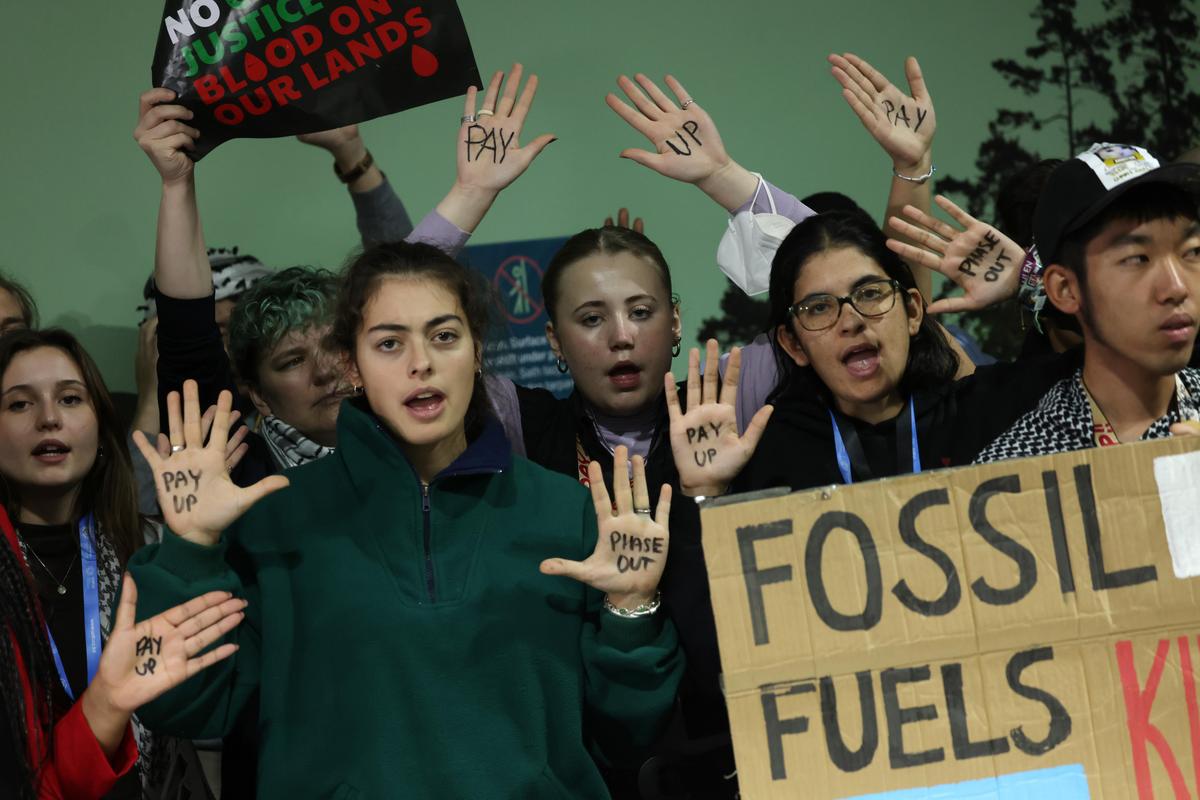
In one voice: Activists protest for climate finance grants for poor countries.
| Photo Credit:
Getty Images
India is part of the G77 bloc of developing countries, and also at COP27, the G77 plus China group called for new funding arrangements to support developing countries. And at the ministerial meeting of G77 plus China held in New York in September 2024, the members asked for the ‘Loss and Damage’ fund to be the “centrepiece of the new loss and damage funding arrangements”.
Importantly, India has been at the forefront of demands that the ‘Loss and Damage’ fund should be above and beyond other climate finance commitments. An example of the latter is the New Collective Quantified Goal, which is the money that developed countries are to give developing countries to help them meet their goals to transition away from the continued use of fossil fuels and curb greenhouse-gas emissions.
The larger political picture
India is part of multiple blocs and its perspectives on loss and damage are influenced by its relative standing in them. Perhaps the bloc that most closely mirrors its stand is the BRICS, which has otherwise also positioned itself as a champion of emerging economies worldwide and has expressed support for the ‘Loss and Damage’ fund. A joint statement issued by BRICS countries’ foreign ministers on June 10, 2024, said: “The Ministers welcomed the creation of the loss and damage fund under the UNFCCC in COP27 in Sharm el-Sheikh and its operationalisation in the UAE at COP28 and confirmed its important role in supporting all developing countries in responding to the losses and damages of climate impacts.”
At the third Voice of Global South Summit hosted by India in August 2024, it highlighted economically developing countries’ demand for more and better climate finance and the importance of urgently improving the resilience of these countries — but especially Small Island Developing States — against the effects of climate change
Finally, India is currently also an alternate board member of the Fund for Responding to Loss and Damage for those “developing countries not included in the regional groups and constituencies” segment.
All this said, many experts have expressed belief that India’s engagement with loss and damage has fallen short of expectations. India is a growing economy, a member of the G20 bloc, and has been hoping to secure a spot in the UN Security Council. These are some geopolitical aspirations that have led to the country’s low engagement with the demands for loss and damage, despite being highly vulnerable to climate change.
Future of the fund
In April 2025, the Board of the Fund for Responding to Loss and Damage launched the Barbados Implementation Modalities (BIM), a global work plan to provide financial assistance to countries especially vulnerable to the effects of climate change. The meeting was held in Bridgetown, Barbados, from April 8 to 10. Barbados itself is a small island developing state (SIDS).
This is the start-up phase of the mechanism: under BIM, vulnerable countries are set to receive $250 million until the end of 2026 entirely in the form of grants. Meanwhile, the fund will also explore how it can engage the private sector. Each intervention under BIM will amount to between $5 million and $20 million. A 50% minimum allocation floor under BIM will be reserved for SIDS and the least developed countries (LDCs).
However, a status of resources report published by the UNFCCC on April 7 — right before the meeting in Barbados — revealed that even though the world’s countries had pledged $768 million to the ‘Loss and Damage’ fund, only $319 million had been made available thus far and that funds to the tune of $388 million are expected to arrive by December 31, 2025.
The problem is that this is nowhere close to the amount vulnerable countries have estimated they need. According to a study conducted by the Loss and Damage Collaboration and the Heinrich-Böll-Stiftung Washington, D.C., and published in 2023, loss and damage finance should have $400 billion a year to work with at a minimum. The gap is an entire order of magnitude.
Ahead of the COP29 talks in Baku in November 2024, representatives of the LDCs adopted the 2024 Lilongwe Declaration on Climate Change in Malawi. Under this declaration, they demanded that loss and damage and mitigation efforts be addressed through new and additional climate finance. The declaration estimated the financial needs of economically developing countries to be around $5.8-5.9 trillion by 2030 and that LDCs will need around $1 trillion to implement their current NDCs.
Priyali Prakash is principal staff writer, The Hindu.