





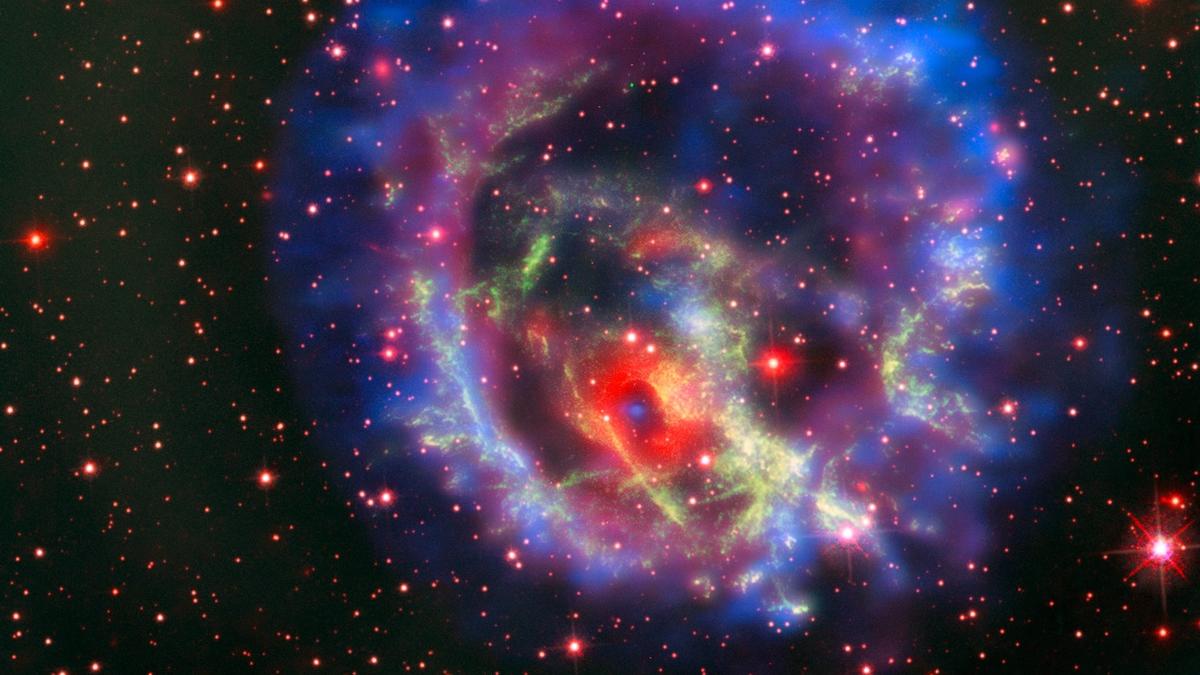
The blue spot at the centre of the red ring is an isolated neutron star in the Small Magellanic Cloud. Neutron stars are formed after heavy stars go supernova, in the process emitting gamma rays alongside radiation at other energies.
| Photo Credit: ESA and NASA
The Major Atmospheric Cherenkov Experiment (MACE) telescope is a state-of-the-art ground-based gamma-ray telescope inaugurated in Hanle, Ladakh, on October 4. Located at around 4.3 km above sea level, it is the highest imaging Cherenkov telescope in the world. It boasts of a 21-metre-wide dish, the largest of its kind in Asia and second-largest in the world.
The facility was built by the Bhabha Atomic Research Centre, the Tata Institute of Fundamental Research, the Electronics Corporation of India Ltd., and the Indian Institute of Astrophysics.
Light comes in a wide range of wavelengths but humans can only see a small portion. In the electromagnetic spectrum, gamma rays have the shortest wavelength and the highest energy, with each light-particle possessing more than 100,000 electron volts. (Visible-light photons have around 1.63-3.26 eV each.)

A strange blue light
Gamma rays are produced by exotic energetic objects in the cosmos, including rapidly spinning pulsars, supernova explosions, hot whirlpools of matter around black holes, and gamma-ray bursts. Because of their high energy, gamma rays are a health hazard. They can damage living cells and may even trigger deleterious mutations in DNA. Fortunately the earth’s atmosphere blocks gamma rays from reaching the ground. Thus, astronomers who want to study objects that emit gamma rays prefer using space observatories — although there are indirect techniques to detect gamma rays with very high energies from the ground.
When a gamma ray from a cosmic source enters the atmosphere, it interacts with molecules in the air to produce a copious shower of electron-positron pairs. As these charged particles travel through the atmosphere at speeds greater than the speed of light in air, they emit a faint blue light, called Cherenkov radiation. This radiation has wavelengths typical of violet and blue light of the visible spectrum and of the ultraviolet wavelength range.
The light is emitted in about a fraction of a second, and the light-particles spread out evenly over a vast region on the earth’s surface. This region is a suitable place to locate a detector that can collect the photons and study them to indirectly understand the gamma rays. Instruments used for this kind of detection are called imaging atmospheric Cherenkov telescopes (IACTs). The MACE telescope is an IACT.
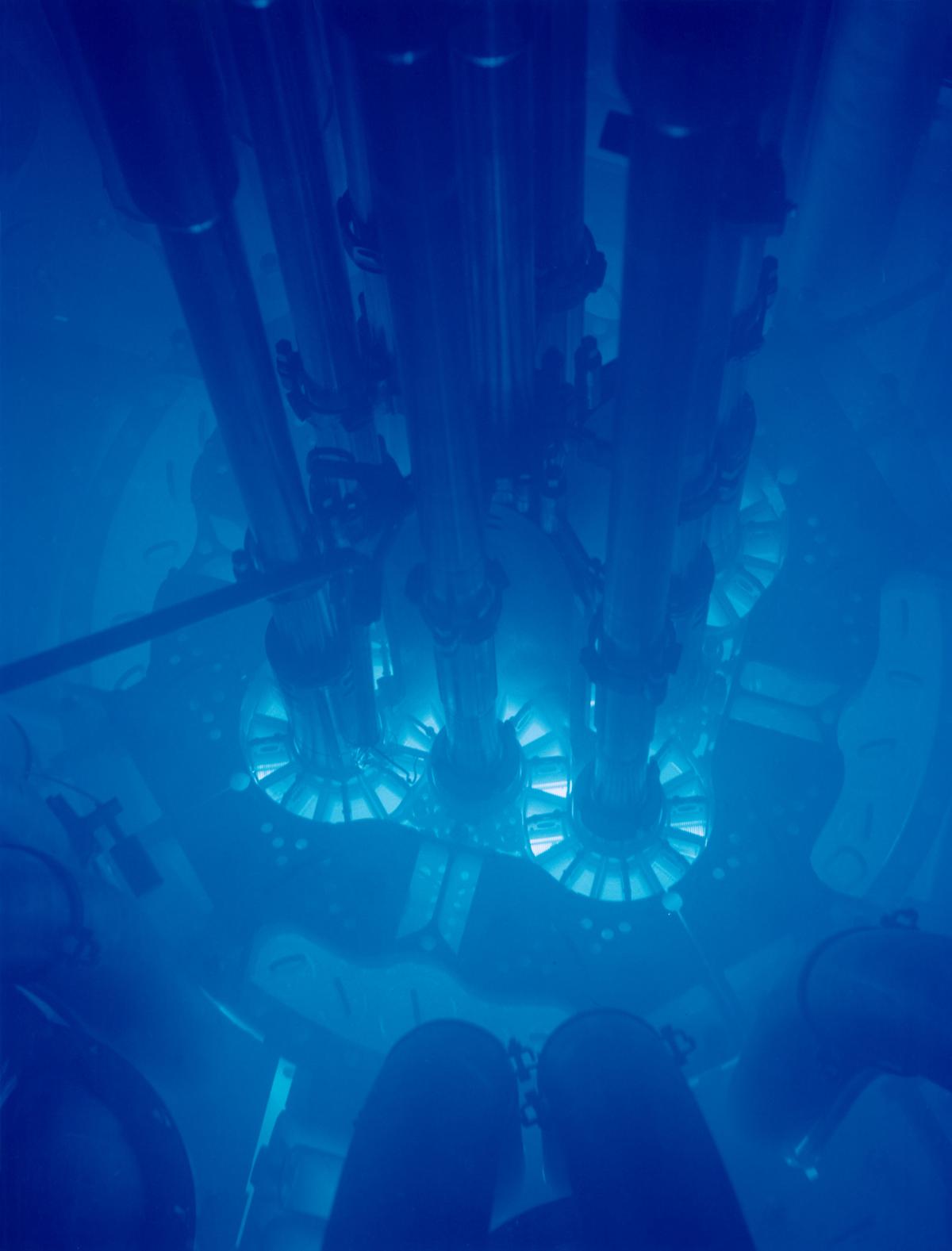
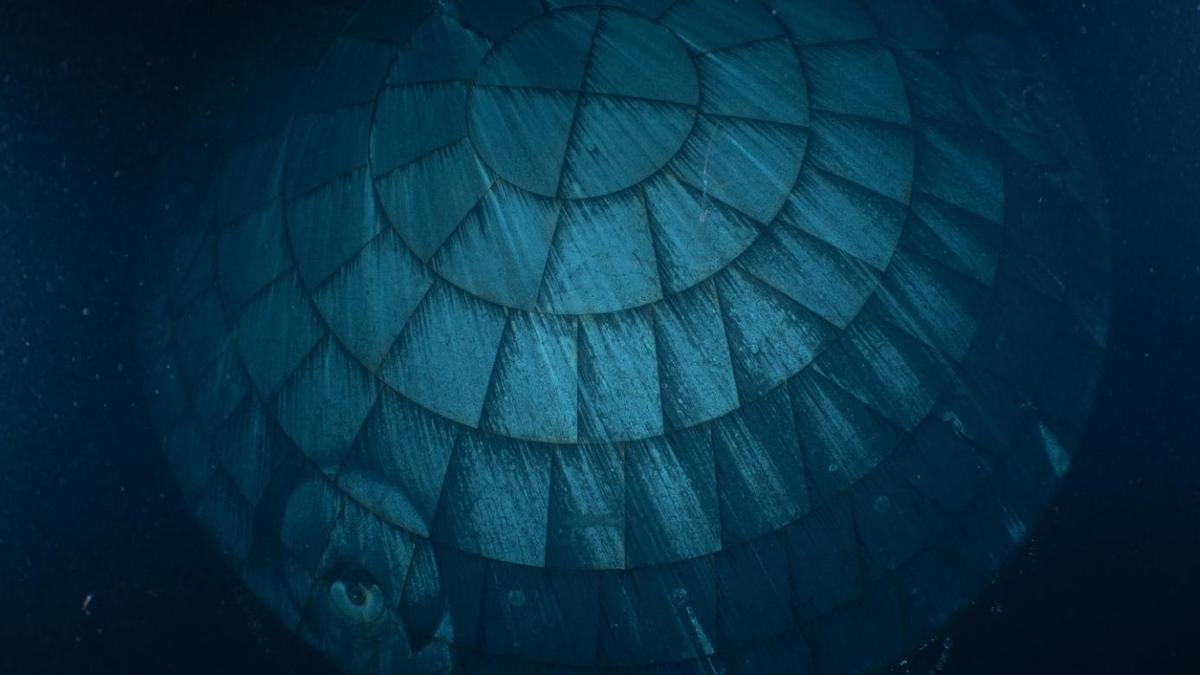
Cherenkov radiation glowing in the core of the Advanced Test Reactor at Idaho National Laboratory, 2009.
| Photo Credit:
Argonne National Laboratory (CC BY-SA 2.0)
Strength in the numbers
Every IACT has a light collector and a camera. The size of the light collector determines the minimum energy of gamma rays it can detect. MACE’s light collector has 356 mirror panels. Each panel consists of four smaller mirrors arranged in a honeycomb structure. These honeycomb arrangements have been shown to be lighter yet more stable than solid mirrors because they reduce the empty space between segments and increase the total reflective area. The James Webb Space Telescope uses honeycomb-segmented mirrors for this reason.
To ensure it can detect gamma rays in the required energy range, MACE’s construction and its geographical station were carefully planned. The high altitude location puts the telescope above disturbances in the lower reaches of the troposphere. MACE is also not housed in a dome because of its large size, leaving its mirrors continuously exposed to the environment. Each mirror is coated with a thin layer of silicon dioxide for protection.

The mirrors are aligned to collect and focus the Cherenkov radiation into the high-resolution camera, which is made up of 1,088 photomultiplier tubes that detect the faint signals and amplify them. All the necessary electronic components for processing and recording data are placed within the camera, including a specialised device that continuously converts signals from photomultiplier tubes into digital data, allowing computers to perform real-time analysis.
The telescope has a moving weight of 180 tonnes. It stands on a base with six wheels that roll along a 27-metre-wide curved track. The drive system that moves the telescope uses an altitude-azimuth mount, meaning the telescope can shift its gaze both vertically and horizontally, to observe all patches of the sky.
Searching for WIMPs
MACE’s main goal is to study gamma rays with more than 20 billion eV of energy. The telescope can examine high-energy gamma rays emitted from near black holes beyond the Milky Way and which are digesting large volumes of matter. Other potential astrophysical targets include gamma-ray pulsars, blazars, and gamma-ray bursts.
One important goal is to find dark matter particles. Dark matter is a type of matter believed to make up more than 85% of the total mass in our universe. It is a fundamental part of the standard model of cosmology — but scientists don’t know what subatomic particles it could be made of.
One of the proposed particle constituents of dark matter is weakly interacting massive particles (WIMPs). Scientists have predicted that these particles can produce high-energy gamma rays when they collide into and destroy each other. These gamma rays could be produced in large galaxy clusters, small galaxies, and/or the centre of large galaxies, including the Milky Way.

India’s MACE is the next step
Previous studies have shown that the MACE telescope can help find and measure the high-energy gamma rays produced by WIMPs. This will allow astronomers to learn more about dark matter and the behaviour of WIMPs. But just as likely, MACE could help verify whether WIMPs actually exist and make up dark matter or whether this hypothesis is flawed.
India has been active in gamma-ray astronomy for more than five decades now. The unveiling of the MACE telescope marked a significant step towards further technological and scientific advancements in the field. Most of MACE’s subsystems were also built and designed within the country. With its advanced capabilities, MACE could play an important role in addressing fundamental open questions in the field of high-energy astrophysics and particle physics, and pave the way for cutting-edge research.
Shreejaya Karantha is a freelance science writer and a content writer and research specialist at The Secrets of The Universe.
Published – November 26, 2024 05:30 am IST