



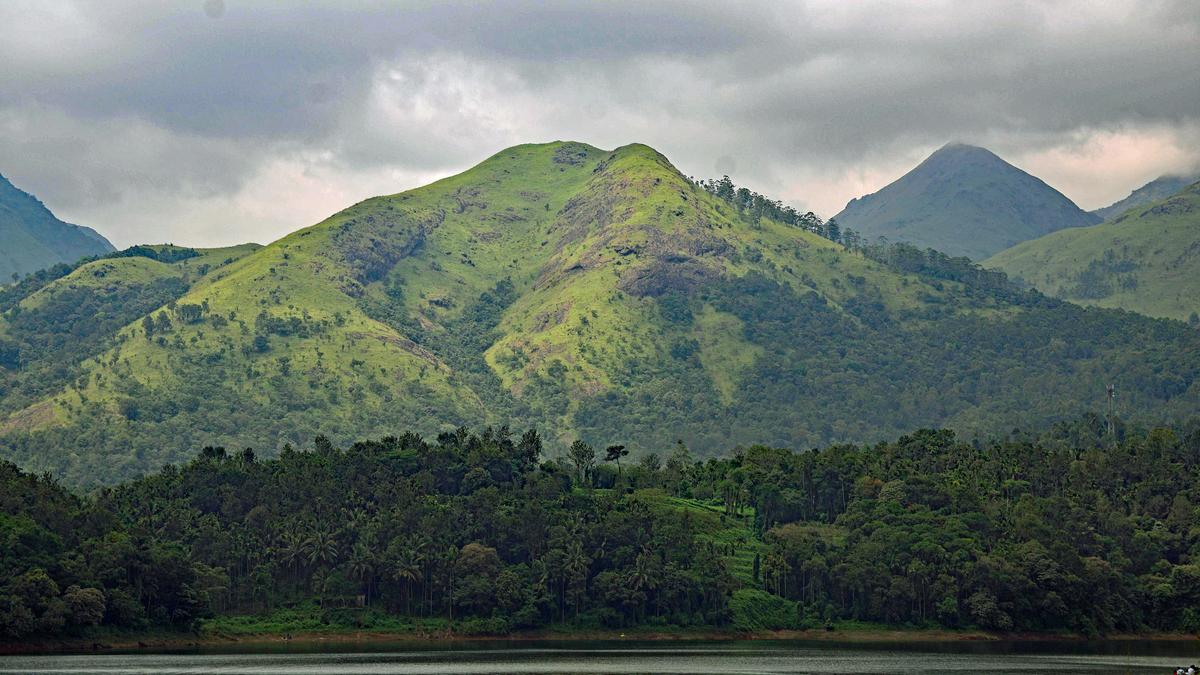
Tragedies like the Wayanad landslides repeat themselves partly because their lessons are not brought to bear on our understanding of the local amplifiers of extreme events. A view of a mountain of the Western Ghats in Wayanad, Kerala, November 15, 2022.
| Photo Credit: Nakkeeran Raveendran/Unsplash
At no place on the earth is the climate risk zero — yet when natural hazards strike, the resulting loss of lives, livelihoods, and assets sting. Disaster management and recovery play a crucial role in alleviating the pain. Unfortunately, however, a blame game may follow asking whether early warnings could have averted the tragedy.
Any early warning that may have been issued will always start with the weather forecast for the area where the hazard manifested. Proactively mitigating disasters instead of always managing them after they happen requires climate risk outlooks that go out to a decade or longer.

Further, post-facto analyses of deadly disasters — like the landslides in Wayanad, Kerala, on July 30 — often do not appreciate the fact that broad warnings of risks can hardly be translated to specific actions. For example, if we declare the entire Western Ghats to be vulnerable to landslides, governments can develop and enforce regulations to protect the whole range from deforestation, development, monoculture plantations, etc.
However, doing so will mitigate some landslides; it won’t get rid of extreme events induced by climate change anytime soon. Some landslides will occur anyway even if the Ghats enjoy the fullest protections from human perturbations because the risk is never zero.
Predictions for disaster management, mitigation
Similarly, the predictions of models will also always be imperfect. If we are to improve their ability to predict extreme events more accurately (in terms of their location and amplitude), we need to fully understand the effects of local drivers that could exacerbate the climate’s effects. After every extreme event, someone claims global warming is a contributor — yet the relationship between local events and global warming complicates the truth of such claims.
The drivers of climate extremes originate from a far-away place but are usually exacerbated by some regional, location-specific factors.
For instance, a 2015 study (which included this author) indicated that coastal sea surface temperatures have a strong influence on heavy rain along India’s west coast. Wayanad district lies about 80 km from this coast. Monsoon winds stream across the equator and continue to load up on moisture as they turn southwesterly and head towards the Western Ghats. As they approach the coast, the winds sense they will have to climb the Western Ghats and slow down. Slower winds reduce the evaporation over the coastal ocean and the coastal waters tend to warm up — and warm waters exert a strong control on the atmosphere and rainfall.
Such a warming is typically seen up to 10 days ahead of a heavy rain event over the coastal ocean. Global models typically miss such local, small-scale warming or cooling processes and tend to underestimate the amount of rain in an extreme event. Enhancing the coastal observations and assimilating them into forecast models is expected to improve predictions.
This is also why adopting location-specific measures like legal protections for biodiversity can help mitigate disasters. Governments can also bolster their regulatory strategies using predictions of the climate up to a decade in the future and combining each prediction with hyperlocal risks.

Similarly, national and local governments will have to work together and share monitoring, reporting, and verification responsibilities to mitigate risk. Finally, all these consequences of the relationship between global warming and local events will have to be accounted for in budgetary provisions. Otherwise, mitigating disasters may not be sustainable.
Further, predictions with a lead time of a few weeks could help disaster management personnel mobilise towards locales with the highest imminent risk and avoid surprises. This is where the location-specific drivers can help ensure the hyperlocal risk information is reliable in crisis times.
Coarse global to fine hyperlocal
Global models provide seasonal outlooks and predictions at the short (1-3 days), medium (3-10 days), and extended (2-4 weeks) ranges. They have been getting better at offering outlooks of the monsoon, the El Niño and La Niña events, and early extreme-event warnings. Researchers around the world — in academia and national laboratories — constantly diagnose imperfections in these models and remove them.
One particular approach to improving the models is called downscaling, especially to enhance predictions of extreme events like small-scale heavy rain. In downscaling, researchers use a global model to drive local predictions in a higher resolution regional model to capture the weather at scales that the global model will miss.
Of late, they have been executing such two-tier strategies using techniques in artificial intelligence and machine learning (AI/ML). Their costs are lower than those incurred by running a high-resolution regional model. Such AI/ML approaches are also many times faster than regional models, further lending themselves to more effective disaster management.
Spotting location-specific amplifiers
Tragedies like that in Wayanad on July 30 tend to repeat themselves partly because their lessons are not always brought to bear on our understanding of the local amplifiers of extreme events. Simple changes in land use patterns — associated with urbanisation, say, or the deforestation of mountain slopes — could lead to a crushing cloudburst and or a punishing hailstorm.

The relatively more coarse resolutions of global models — which deal with changes in the tens of kilometres — tend to miss such local features and add to their imperfections. To acquire a better sense of the effects of these features and thus enable regional dynamic or AI/ML downscaling for hyperlocal predictions, we need more local data of weather and climate variables.
Disaster mitigation efforts are crucial to weather-proof the country and make it more climate-resilient at longer timescales. To this end we urgently need a data network that supports the mapping of local extreme event amplifiers.
Raghu Murtugudde is a professor, IIT Bombay, and emeritus professor, University of Maryland.