

Skip to content
  • Facebook
  • X
  • Linkedin
  • WhatsApp
  • YouTube
  • Associate Journalism
  • About Us
  • Privacy Policy
  • 033-46046046
  • editor@artifex.news
Artifex.News

Artifex.News

Stay Connected. Stay Informed.

  • Breaking News
  • World
  • Nation
  • Sports
  • Business
  • Science
  • Entertainment
  • Lifestyle
  • Toggle search form
  • Access Denied Sports
  • “New To The Job But…”: Ravi Shastri’s Honest Assessment Of Shubman Gill’s Captaincy
    “New To The Job But…”: Ravi Shastri’s Honest Assessment Of Shubman Gill’s Captaincy Sports
  • I Am Going All-Out To Win Gold In Paris: PV Sindhu
    I Am Going All-Out To Win Gold In Paris: PV Sindhu Sports
  • England Star All-Rounder Ben Stokes Pulls Out Of T20 World Cup
    England Star All-Rounder Ben Stokes Pulls Out Of T20 World Cup Sports
  • Minister On Indians Coming Back From Israel
    Minister On Indians Coming Back From Israel Nation
  • Decoding cryptos – The Hindu
    Decoding cryptos – The Hindu Business
  • Intel customers to test new Crescent Island GPU in second half of next year
    Intel customers to test new Crescent Island GPU in second half of next year Business
  • Virat Kohli Sent Blunt Ranji Trophy Message By DDCA, Asked To Copy Mumbai Cricketers
    Virat Kohli Sent Blunt Ranji Trophy Message By DDCA, Asked To Copy Mumbai Cricketers Sports
Getting a closer look at Pluto

Getting a closer look at Pluto

Posted on February 3, 2024 By admin


The most detailed view up till 2010 of the entire surface of the dwarf planet Pluto. It was constructed from multiple NASA Hubble Space Telescope photographs taken from 2002 to 2003 and released on February 4, 2010.
| Photo Credit: HO

Come February 18, and it will be 94 years since we’ve known of the existence of Pluto. Pluto has enjoyed popularity with the public throughout its known existence. Right from the time it was discovered in 1930 and hailed as the ninth planet, through to 2006 when it was demoted to the status of a dwarf planet, and since, Pluto has held the imagination of the masses.

Pluto takes nearly 248 years to orbit around the sun and its elongated orbit ensures that it is about 7.3 billion kilometres from the sun at its farthest and gets closest when it is about 4.4 billion kilometres from it! With its closest distance to the sun in itself being very very far, this Kuiper belt object is naturally very distant from Earth as well.

So far, in fact, that trying to see and resolve the surface of Pluto from Earth is akin to trying to see the print on a ball when the ball is placed over 50 km away! Pluto’s disk is so small that it can’t be resolved from beneath the Earth’s atmosphere. We are not just talking about plain viewing, but also using the most powerful ground-based telescopes.

Hubble comes to the rescue

It was a space-based telescope in the form of the Hubble Space Telescope that enabled the first unobstructed viewing of Pluto. Tasked with observing and imaging the planet in June-July 1994 (remember that it was still a planet back then), it was put together and released for public consumption on March 7, 1996.

The Hubble Space Telescope was tasked with snapping Pluto again in 2002-2003. Astronomers had installed in it a new camera called the Advanced Camera for Surveys (ACS). This new camera was equipped with an operating mode called the High-Resolution Camera (HRC). The ACS/HRC system produced 384 images of Pluto – the most detailed set of observations made of Pluto until then.

These raw images were then worked on by scientists and engineers for years on end before they were eventually released to the public on February 4, 2010. This set of images were, until then, the most detailed ever of Pluto.

Special algorithms
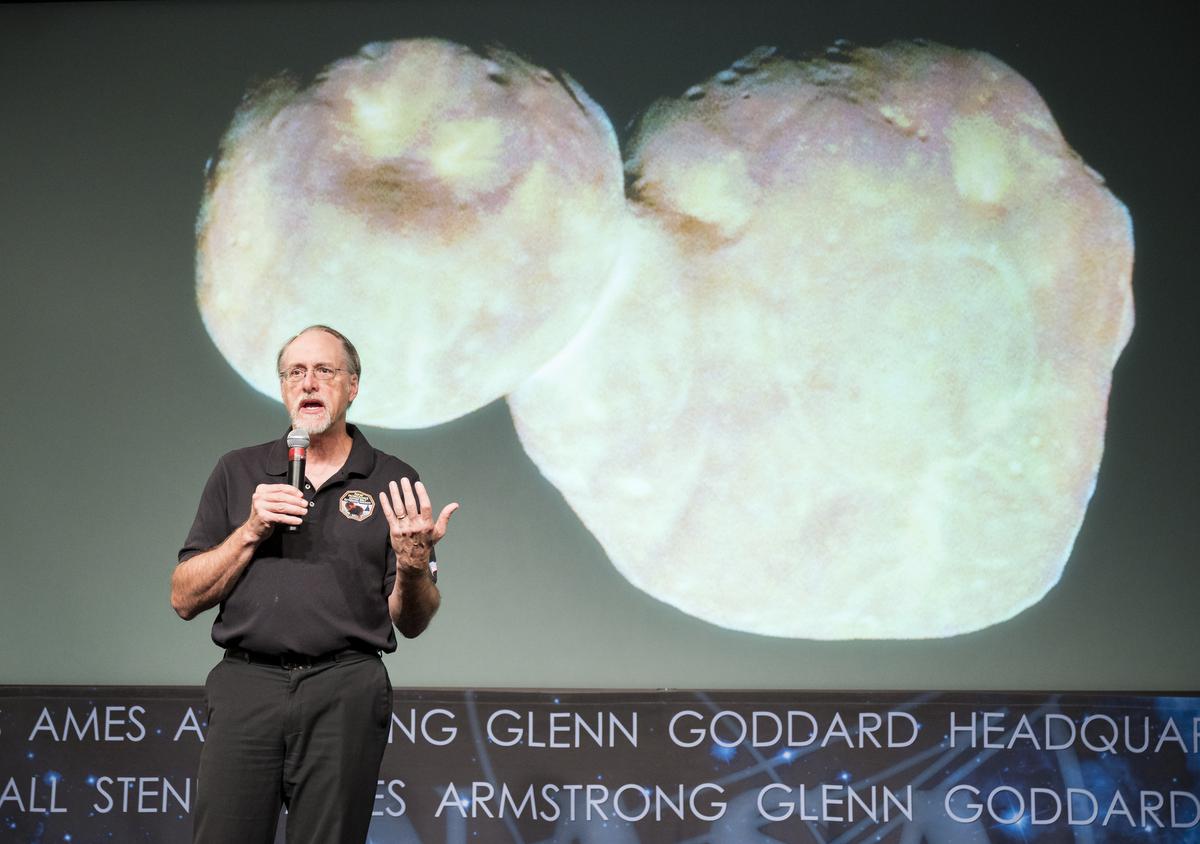
Marc Buie, who was also part of the New Horizons Discovery Team,  speaks at a naming ceremony for 2014 MU69, a celestial body discovered by the New Horizons mission and Hubble Space Telescope, formerly nicknamed “Ultima Thule”, in November 2019.

Marc Buie, who was also part of the New Horizons Discovery Team, speaks at a naming ceremony for 2014 MU69, a celestial body discovered by the New Horizons mission and Hubble Space Telescope, formerly nicknamed “Ultima Thule”, in November 2019.
| Photo Credit:
NASA/Aubrey Gemignani

“This has taken four years and 20 computers operating continuously and simultaneously to accomplish,” said lead investigator Mark Buie of the Southwest Research Institute in Boulder, Colorado at a NASA press conference on that day. Even though Buie, who had developed special algorithms to sharpen the Hubble data, put it across in just a statement at the press conference, he went into more details when writing about this research project for his website.

While speaking about the technique employed to get the best out of the raw images, Buie mentions the difficulty involved in working with the ACS data. The idea is to start with a guess of Pluto’s map and arrive at the best map using the data and a computer.

It all adds up

The process of dithering combines multiple, slightly offset pictures to generate a higher resolution view. While that might sound easy, “taking the map and computing what one image must look like took about 5 seconds on a circa 2004 computer.” Since it took five seconds to process one image on one of the most powerful computers of the time, it would add up to 30 minutes to test one guess for the map with all 384 images. Buie realised that at this rate, he would need 20 years on one computer to arrive at an answer.

To overcome this obstacle, Buie came up with a scheme by working with a great programmer, Doug Loucks. They maximised the computing power by utilising parallel processing. In their scheme, there was one computer that worked as the master – pulling all data together and producing the final answer, another that worked as a foreman – listening to the master and handing off tasks to workers who were not busy, and the rest were workers. The computers that served as foreman and workers didn’t really know what they were doing and were like puppets in the hands of a puppeteer – the master computer.

It still took them years to arrive at the final answer, which they released to the public in February 2010. In addition to being the sharpest images of the dwarf planet until months before the New Horizons spacecraft made its Pluto flyby in 2015, these images also helped the scientists plan for that flyby.


Source link

Science

Post navigation

Previous Post: Finnish phone maker says Nokia, HMD brands will co-exist
Next Post: Why is fiscal consolidation so important? | Explained

Related Posts

  • What helped Vikram lander to soft-land on the moon
    What helped Vikram lander to soft-land on the moon Science
  • What does the India-Brazil critical minerals MoU mean for the two countries?
    What does the India-Brazil critical minerals MoU mean for the two countries? Science
  • NASA astronaut Butch Wilmore retires less than five months after extended Starliner spaceflight
    NASA astronaut Butch Wilmore retires less than five months after extended Starliner spaceflight Science
  • New genus of jumping spiders ‘Tenkana’ discovered in south India
    New genus of jumping spiders ‘Tenkana’ discovered in south India Science
  • Where does dust come from?
    Where does dust come from? Science
  • First U.S. moon lander in 52 years touches down but sends weak signal
    First U.S. moon lander in 52 years touches down but sends weak signal Science

More Related Articles

Why participatory science is crucial to tackling coconut root wilt disease Why participatory science is crucial to tackling coconut root wilt disease Science
Can heat-related illnesses be prevented in dogs? Can heat-related illnesses be prevented in dogs? Science
AstroSat unravels mysteries surrounding Black Hole X-ray Binary MAXI J1820+070 AstroSat unravels mysteries surrounding Black Hole X-ray Binary MAXI J1820+070 Science
‘STEMinism is an attempt to bring more women into science without critiquing the field of science’ ‘STEMinism is an attempt to bring more women into science without critiquing the field of science’ Science
The Science Quiz | On World Cancer Day The Science Quiz | On World Cancer Day Science
Intuitive Machines clinches .8 bln navigation services contract from NASA Intuitive Machines clinches $4.8 bln navigation services contract from NASA Science
SiteLock

Archives

  • May 2026
  • April 2026
  • March 2026
  • February 2026
  • January 2026
  • December 2025
  • November 2025
  • October 2025
  • September 2025
  • August 2025
  • July 2025
  • June 2025
  • May 2025
  • April 2025
  • March 2025
  • February 2025
  • January 2025
  • December 2024
  • November 2024
  • October 2024
  • September 2024
  • August 2024
  • July 2024
  • June 2024
  • May 2024
  • April 2024
  • March 2024
  • February 2024
  • January 2024
  • December 2023
  • November 2023
  • October 2023
  • September 2023
  • August 2023
  • July 2023
  • June 2023
  • May 2023
  • April 2023
  • March 2023
  • February 2023
  • January 2023
  • December 2022
  • November 2022
  • October 2022
  • September 2022
  • August 2022
  • July 2022
  • June 2022
  • May 2022

Categories

  • Business
  • Nation
  • Science
  • Sports
  • World

Recent Posts

  • Government hikes paddy MSP by ₹72 to ₹2,441/qtl; sunflower seed sees steepest rise at ₹622
  • CCMB researchers find molecular ‘glue’ that blocks viral spread in plants
  • Donald Trump lands in Beijing for vital talks with Xi Jinping
  • Shrimp feed manufacturers put on hold price hike following govt.’s intervention
  • Refurbished Bharat Scouts and Guides Training Centre inaugurated at Papanasam

Recent Comments

  1. NathanJobre on UP Teacher Who Asked Students To Slap Muslim Classmate
  2. DavidNup on UP Teacher Who Asked Students To Slap Muslim Classmate
  3. JeffryFok on UP Teacher Who Asked Students To Slap Muslim Classmate
  4. Jesusetexy on UP Teacher Who Asked Students To Slap Muslim Classmate
  5. WilliamGoT on UP Teacher Who Asked Students To Slap Muslim Classmate
  • Cuba restores power to most of country after another blackout
    Cuba restores power to most of country after another blackout World
  • Clearest black hole merger signal yet allows probe of Hawking’s law
    Clearest black hole merger signal yet allows probe of Hawking’s law Science
  • In Kerala, a squabble over shirts and seers
    In Kerala, a squabble over shirts and seers Nation
  • Ex-India Star Takes Dig At Riyan Parag Over ‘World Cup’ Stance, Mentions Patriotism
    Ex-India Star Takes Dig At Riyan Parag Over ‘World Cup’ Stance, Mentions Patriotism Sports
  • Access Denied
    Access Denied Nation
  • Cricket World Cup 2023: Shreyas Iyer Works On ‘Weakness’; Rohit Sharma, Virat Kohli Skip Optional Practice
    Cricket World Cup 2023: Shreyas Iyer Works On ‘Weakness’; Rohit Sharma, Virat Kohli Skip Optional Practice Sports
  • “That’s Critical…”: Rohit Sharma’s Blunt Take After India’s T20 World Cup Super 8 Win vs Afghanistan
    “That’s Critical…”: Rohit Sharma’s Blunt Take After India’s T20 World Cup Super 8 Win vs Afghanistan Sports
  • Access Denied Sports

Editor-in-Chief:
Mohammad Ariff,
MSW, MAJMC, BSW, DTL, CTS, CNM, CCR, CAL, RSL, ASOC.
editor@artifex.news

Associate Editors:
1. Zenellis R. Tuba,
zenelis@artifex.news
2. Haris Daniyel
daniyel@artifex.news

Photograher:
Rohan Das
rohan@artifex.news

Artifex.News offers Online Paid Internships to college students from India and Abroad. Interns will get a PRESS CARD and other online offers.
Send your CV (Subjectline: Paid Internship) to internship@artifex.news

Links:
Associate Journalism
About Us
Privacy Policy

News Links:
Breaking News
World
Nation
Sports
Business
Entertainment
Lifestyle

Registered Office:
72/A, Elliot Road, Kolkata - 700016
Tel: 033-22277777, 033-22172217
Email: office@artifex.news

Editorial Office / News Desk:
No. 13, Mezzanine Floor, Esplanade Metro Rail Station,
12 J. L. Nehru Road, Kolkata - 700069.
(Entry from Gate No. 5)
Tel: 033-46011099, 033-46046046
Email: editor@artifex.news

Copyright © 2023 Artifex.News Newsportal designed by Artifex Infotech.