




Slowing down feels countercultural in a world that’s always telling teens to do more, buy more, keep up more. The feed never stops, the trends never wait, and somehow there’s always something new you’re supposed to want.
So what if the most radical thing you could do right now… was just slow down?
Slow consumption. Sounds obvious, right? But this simple phrase is hiding one of the biggest climate solutions in plain sight — and it has nothing to do with giving things up.
This isn’t another “use less, save the planet” lecture. No guilt, no lists, no finger-wagging. This is actually about something better, living lighter. Less chaos, less pressure, less I need this right now. More of the stuff that actually feels good.
Think of it as unlocking your “I don’t care” era. Not the checked-out kind. The kind where you’ve quietly figured out that chasing every trend, every drop, every haul — is exhausting. And optional.
Once you crack that code? You’re not just living better. Turns out, you’re also doing more for the planet.
Illustration by Soumyadip Sinha
If your wardrobe could talk, it would be exhausted
Let’s start with one of the most overconsumed markets out there: clothes.
You open your wardrobe and somehow, despite owning more clothes than you’ve ever owned in your life, you have nothing to wear. So you scroll. You see a haul video. Someone’s unboxing those trendy outfits. It looks fun and easy. You add three things to your cart.
That’s fast fashion doing exactly what it was designed to do.
Fast fashion is clothing made cheaply and quickly to match whatever’s trending right now, designed to be bought on impulse, worn a handful of times, and forgotten. The moment you’ve worn it, there’s already something new to replace it. That’s not a coincidence. That’s the business model.
Some estimates suggest many garments, especially trend-driven ones, are worn only a handful of times before being discarded.
Synthetic fabrics add another layer to the problem. A polyester garment can take decades to centuries to break down, lingering in landfills long after it’s been discarded.
But here’s the shift: rewearing the same few pieces isn’t a limitation. Choosing secondhand isn’t falling behind. It’s simply stepping out of a cycle that’s built on constant replacement—and deciding what’s actually worth keeping.
Food for thought, literally
Now let’s talk about something even closer to your daily life: what you eat. Or more specifically, how it gets to you and what happens to half of it.
Globally, about one-third of all food produced is lost or wasted. When food ends up in landfills, it can release methane, a greenhouse gas significantly more potent than CO₂. This makes food waste a major contributor to emissions.
Slow consumption here doesn’t require drastic changes. It’s simpler than that.
It looks like cooking what’s already in your kitchen. Buying a little more intentionally so food doesn’t go to waste. Using leftovers instead of discarding them.
Small shifts, but meaningful ones, for both the planet and your daily life.
That’s it. That’s the climate action. It just happens to also be the most peaceful part of your week.
We asked the people who actually live this
Talking about slow consumption is one thing. Living it is another. So we went to two people who’ve made it their life’s work — one who explains the science, and one who proves it’s possible every single day.
“You don’t have to fix everything”
Pankti Pandey, an ex-ISRO scientist, educator, and climate consultant who also runs ‘ZeroWasteAdda’, starts by stripping the panic out of it.
Every product you’ve ever bought has a story before it reaches you — raw materials extracted, energy burned to make it, trucks and ships to move it, and eventually, a landfill waiting for it. Slow consumption, she explains, is simply about slowing that entire chain down.
“When you buy less and use things longer, fewer resources are extracted, less energy is used, fewer emissions are released,” she says. “Your role shifts from ‘I have to fix everything’ to ‘I can reduce the speed of the problem through my choices.’”
That reframe alone is worth sitting with. You’re not responsible for solving climate change. But your choices do connect — directly — to how fast the problem moves.
So where do you actually start? Pankti’s advice is disarmingly simple. Don’t tell yourself to buy less. Just delay.
“If you see something you like, wait two days. Most of the time, the excitement fades. If it doesn’t, you know it’s something you genuinely want.”
Same logic applies to everything you already own. Finish the shampoo before buying a new one. Wear the same outfit again — restyle it, own it. Make one better choice a day. That’s it. No grand gesture required.
And on the idea that sustainable living is expensive? She doesn’t buy it — literally.
“Sustainability being expensive is actually a myth. It starts to feel expensive only when we reduce it to buying ‘green’ products. Sustainability is not about what you buy. It’s about how you think.”
“Thrifting is just a hand-me-down from a stranger”
That same idea shows up in a more personal way through Nayana Premnath—an architect inspiring over thousands Indians to live more sustainably. Through her platform and upcycling brand The Green Circle, she’s showing how small, mindful choices can spark bigger change.
Nayana didn’t plan to become a voice for sustainable living. She studied architecture because of Laurie Baker — a builder from her hometown known for constructing sustainably. Her dissertation was on mud architecture. Even then, she says, it wasn’t architecture for architecture’s sake.
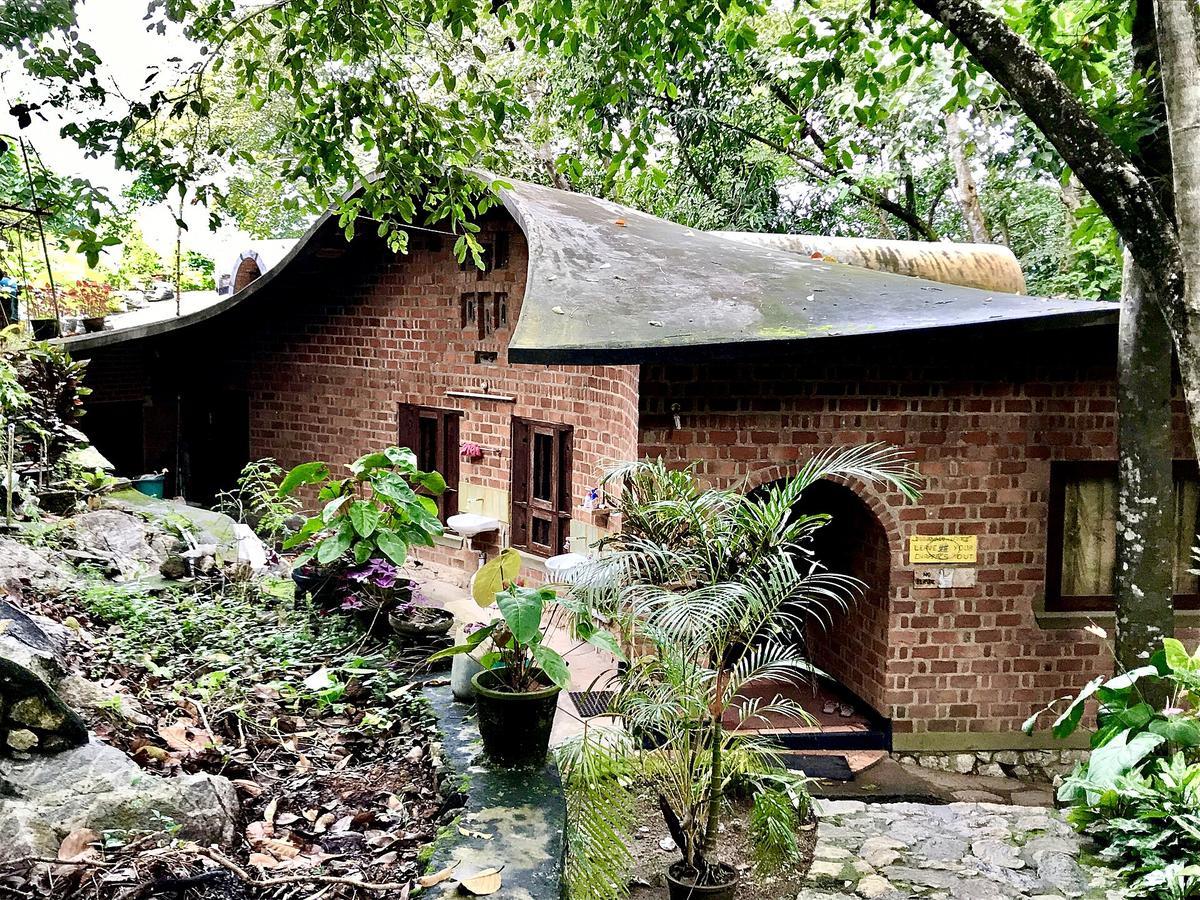
Vernacular Structures in Laurie Baker Workshop
| Photo Credit:
Photo: Wikimedia Commons
When she started working, there were almost no sustainable firms to join. So she left, stumbled onto YouTube, tried singing, realised it wasn’t her thing — and somewhere in that wandering, something clicked.
“The thing you keep coming back to, even across different careers and different phases of your life — that’s probably your real answer,” she says. For her, that thing was always sustainability.
Today, her entire life runs on that principle — from her bamboo toothbrush to what she eats for breakfast to how she gets around the city. None of it dramatic. All of it deliberate.
On fashion, she makes a point that’s hard to argue with.
“India has always had a culture of hand-me-downs. Thrifting is really just a hand-me-down from a stranger.” When you frame it that way, she says, it stops feeling like a sacrifice and starts feeling familiar.
And she’s optimistic about teenagers specifically — more than most people give them credit for.
“When you explain fast fashion’s actual impact, without lecturing, without the preachy tone — they get it. And once they get it, they’ll probably be louder about it than us.”
Her practical advice before any purchase: ask yourself three things. Do I actually need this, or do I just want it right now? Can I borrow it? Can I find it secondhand? Three questions. That’s the whole system.
“The goal isn’t to be perfect. It’s to be conscious. Once you shift from autopilot to actually thinking about your choices, even the imperfect ones feel different — because you made them on purpose.”
The device in your pocket is also the problem
Let’s talk about the one thing you’re probably holding right now: your phone.
Not because you use it too much—but because of what it takes to make it, and what happens when you replace it.
Most phones are upgraded every couple of years, often not because they’ve stopped working, but because something newer is available. A better camera, a new feature, a well-timed ad—and suddenly, what you have feels outdated.
But the real cost isn’t just financial. A single smartphone contains over 60 different elements, including rare minerals. Its production is energy-intensive, and globally, only about 20% of e-waste is formally recycled. The rest—old phones, earbuds, chargers—ends up as waste.
The slow consumption shift here is simple: use it longer. Even extending a device’s life by a year can significantly reduce its environmental impact.
The same applies across gadgets. Before replacing something, ask: is it actually broken—or does it just feel old?
Not just what you buy
Here’s the part we rarely talk about: digital consumption.
The same “more, faster, now” energy that fills your wardrobe with unworn clothes and your desk with gadgets you’ve forgotten about — it also runs your screen time. The endless scroll. The autoplay that decides you’re not done yet. The notification that pulls you back in before you’ve even processed the last thing you saw.
This isn’t about screen time being bad. It’s about the same mindless autopilot, the one Nayana talks about — playing out on your phone as much as in your shopping cart.
Slow consumption, at its core, is about choosing. Actively, on purpose, instead of just going along with whatever the algorithm serves next. That applies to what you watch, what you read, what you follow, just as much as what you buy.
Photo: Getty Images/iStockphoto
When you choose to watch one thing properly instead of half-watching six, when you follow accounts that make you feel like enough instead of like you’re missing out — that’s slow consumption too. Quieter. Less visible. But the same muscle.
Your unbothered era
So here’s where we land.
Slow consumption isn’t a personality type or an aesthetic. It’s not something you build an identity around. It’s just a small shift — from going along with everything to actually choosing.
It looks like waiting two days before buying something you suddenly want. Finishing the shampoo. Rewearing the outfit. Eating the mango before it goes bad. Keeping the phone a little longer. Watching something you actually picked.
None of these are sacrifices. They’re just decisions, small ones that quietly add up.
As Pankti puts it, sustainability is a mindset, not a shopping category. And Nayana says it simply: “The goal isn’t to be perfect. It’s to be conscious.”
That’s really all it is. Not checking out, not going off-grid, not becoming a different person. Just moving through your day a little more on purpose — and a little less on autopilot.