


Skip to content
  • Facebook
  • X
  • Linkedin
  • WhatsApp
  • YouTube
  • Associate Journalism
  • About Us
  • Privacy Policy
  • 033-46046046
  • editor@artifex.news
Artifex.News

Artifex.News

Stay Connected. Stay Informed.

  • Breaking News
  • World
  • Nation
  • Sports
  • Business
  • Science
  • Entertainment
  • Lifestyle
  • Toggle search form
  • Nervous about falling behind Republicans, Democrats are wrestling with how to use AI
    Nervous about falling behind Republicans, Democrats are wrestling with how to use AI World
  • Countdown to hostage release as Trump to host Gaza peace summit
    Countdown to hostage release as Trump to host Gaza peace summit World
  • Access Denied Sports
  • Donald Trump shakes up the global nuclear order
    Donald Trump shakes up the global nuclear order World
  • PCB Concerned Over Fast Bowler Ihsanullah’s Recovery From Injury
    PCB Concerned Over Fast Bowler Ihsanullah’s Recovery From Injury Sports
  • Attacker Finds Patient, Shoots Him At Delhi Hospital
    Attacker Finds Patient, Shoots Him At Delhi Hospital Nation
  • Access Denied Sports
  • Parle collaborates with IBM to drive digital transformation using cloud, AI
    Parle collaborates with IBM to drive digital transformation using cloud, AI Business
Where do the wild colours of domesticated silkworm cocoons come from?

Where do the wild colours of domesticated silkworm cocoons come from?

Posted on October 28, 2023 By admin


Silk, the queen of fibres, is drawn or reeled from cocoons of the silk moth (Bombyx mori). Humans domesticated it more than 5,000 years ago in China, from the wild moth (Bombyx mandarina). The ancestral moth is today found in China, the Korean Peninsula, Japan, and far eastern Russia, whereas the domesticated moth is reared all over the world, including in India.  In fact, India is the world’s second largest producer of raw silk after China.

Caterpillars, also known as silkworms, of both these species feed exclusively on leaves of mulberry plants (genus Morus). The domesticated moth is much larger than its wild progenitor, and thus extrudes a longer silk fibre to build its larger cocoon, up to 900 metres long. But it depends wholly on human care for its survival and reproduction. Since having been domesticated, it has lost the ability to fly, and since its need for camouflage no longer exists, it has also lost its caterpillar and adult-stage pigmentation.

Carotenoids and flavonoids

‘Wild’ silks – which include the muga, tasar, and eri silks – are obtained from other moth species: namely, Antheraea assama, Antheraea mylitta, and Samia cynthia ricini. These moths survive relatively independently of human care, and their caterpillars forage on a wider variety of trees. Non-mulberry silks comprise about 30% of all silk produced in India. These silks have shorter, coarser, and harder threads compared to the long, fine, and smooth threads of the mulberry silks.

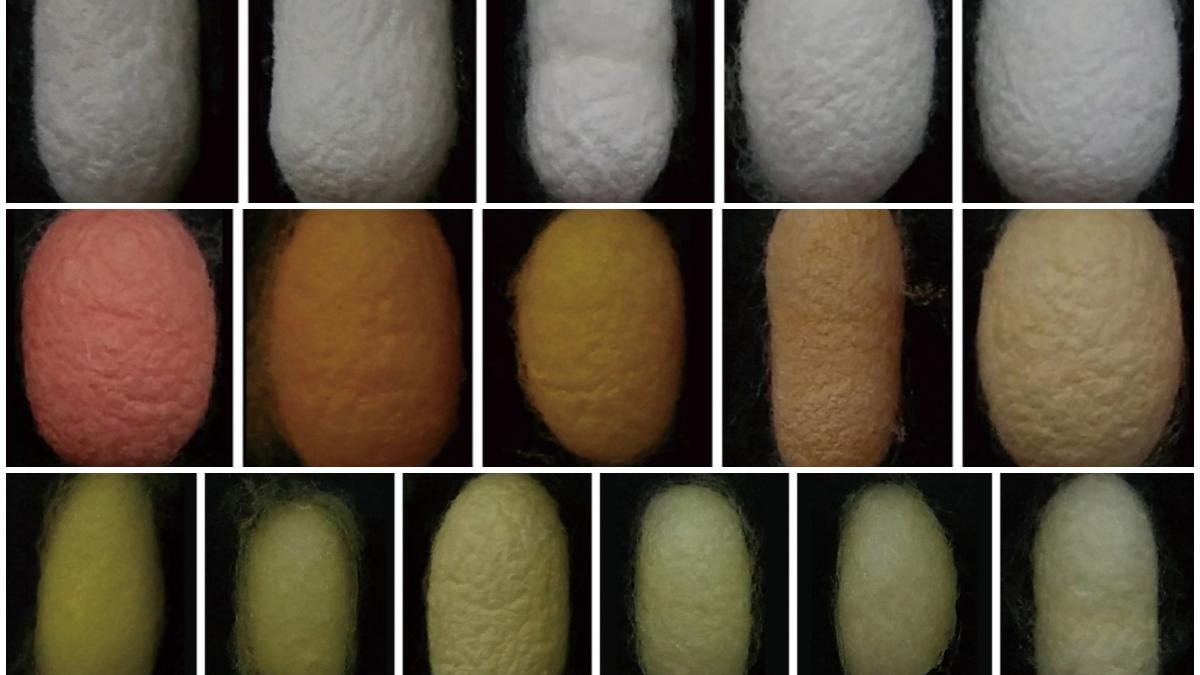
The ancestral mulberry moth makes (boringly uniform) brown-yellow cocoons. In contrast, domesticated silk moth cocoons come in an eye-catching palette of yellow-red, gold, flesh, pink, pale green, deep green or white.  Human handlers selected the differently coloured cocoons whenever they emerged, possibly in the hope of breeding for coloured silks. But they were disappointed: the pigments that coloured the cocoons are water-soluble, so they gradually fade away. The coloured silks we see in the market are instead produced by using acid dyes.

We know today that the cocoon’s pigments are derived from chemical compounds called carotenoids and flavonoids, which are made by the mulberry leaves. Silkworms feed voraciously on the leaves, absorb the chemicals in their midgut, transport them via the hemolymph – arthropods’ analogue of blood – to the silk glands, where they are taken up and bound to the silk protein. Mature caterpillars then spin out the silk proteins and associated pigment into a single fibre. The caterpillar wraps the fibre around itself to build the cocoon.

Mutant strains a valuable resource

The adult moth hatches (or ecloses) from the cocoon. In this process, the fibre is broken in many places. Superior quality silk however comes from an unbroken fibre, so unhatched cocoons are used for reeling. There is a contentious ‘economics versus ethics’ debate here about creating a species that depends wholly on humans (and whose unhatched cocoons we drown in hot water for better quality silk), but that is for another article.

The differently coloured cocoons arise from mutations in genes responsible for the uptake, transport, and modification of carotenoids and flavonoids. The mutant strains have become a valuable resource for scientists to study the molecular basis of how, in a relatively short span of 5,000 years, artificial selection generated such spectacular diversity.

Research on silk domestication has largely been conducted in China and Japan, although scientists from India (including from the Centre for DNA Fingerprinting and Diagnostics in Hyderabad, where this author worked), have also made some important contributions.

Combinations behind the colours

This said, earlier this year, researchers in Southwest University in Chongqing, China, proposed a model to explain how different combinations of mutations give rise to the different colours of the cocoons.

They found that the formation of a yellow-red cocoon requires the Y gene, which encodes a protein that transports the carotenoids from midgut to the silk glands. Other genes (C, F, Rc, and Pk) encode proteins that selectively absorb specific carotenoids. Mutations in one or more of these genes produce the yellow, flesh-coloured, rusty, and pink cocoons. If the Y gene is mutated, the flavonoids are absorbed but the carotenoids are not, resulting in green cocoons.

Further, whether the green is dark or light depends on whether genes for other proteins that enhance flavonoid uptake are normal or mutated. If both carotenoids and flavonoids are not taken up, the cocoons remain white. The researchers showed that a cluster of five closely related genes was responsible for the uptake of flavonoids.

The gene called apontic-like

Domesticated and ancestral mulberry silk moths can be interbred to produce hybrid offspring.  Last year, researchers in the University of Tokyo and Columbia University in New York created such hybrid moths and then specifically mutated either their B. mori– or B. mandarina-derived copy of a gene called apontic-like.

The hybrid caterpillars, like their wild parent, made the pigment called melanin. But when the B. mandarina-derived copy of apontic-like was mutated, the hybrid failed to make melanin. (This didn’t happen when the B. mori-derived copy was mutated, however.) The implication was that the domesticated silkworm’s apontic-like gene had lost the ability to support melanin production. 

Both versions of the apontic-like gene make the same protein. Therefore, the difference between them was attributable to differences in sequences that regulate when and where the gene was turned ‘on’ or ‘off’.

Gene by gene

Silk is an acme of domestication, comparable in its success to basmati rice, alphonso mangoes, and the golden retriever. Today, the tools are at hand for scientists to make and compare genetically identical hybrid silk moths that differ only in which of a gene’s two parental versions is inactivated: domesticated or ancestral.

This paves the way for scientists to work out – gene by gene – all the key steps that led to silk moth domestication. Hopefully, someday soon, similar techniques will become available for us to analyse domestication in rice, mangoes, and dogs.

D.P. Kasbekar is a retired scientist.


Source link

Science Tags:apontic-like gene, Bombyx mandarina, Bombyx mori, carotenoids, flavonoids, Indian silk, silk colours, silk moths

Post navigation

Previous Post: Fact check | The misinformation battle running parallel to Israel-Hamas war 
Next Post: Kim Kardashian Creates A Stir With New “Ultimate Nipple Bra” Ad

Related Posts

  • Two forerunners that set the stage for ISRO’s Gaganyaan test
    Two forerunners that set the stage for ISRO’s Gaganyaan test Science
  • The curious history of how quantum mechanics came to be ‘seen’ in an electrical circuit
    The curious history of how quantum mechanics came to be ‘seen’ in an electrical circuit Science
  • IISc launches product accelerator programme, Pravriddhi
    IISc launches product accelerator programme, Pravriddhi Science
  • Specific PET scan for TB for more effective treatment
    Specific PET scan for TB for more effective treatment Science
  • Scientist bottles smell of bones to help solve cold cases
    Scientist bottles smell of bones to help solve cold cases Science
  • Before and after satellite images of Wayanad landslip
    Before and after satellite images of Wayanad landslip Science

More Related Articles

Space Wrap: From Sriharikota to Leh, preparations for Gaganyaan mission in full swing Space Wrap: From Sriharikota to Leh, preparations for Gaganyaan mission in full swing Science
What is the legal framework for space missions like the Chandrayaan 3 and Aditya L-1? | Explained What is the legal framework for space missions like the Chandrayaan 3 and Aditya L-1? | Explained Science
Study by Indian researchers finds that body’s immune cells ‘betray’ it to help breast cancer spread Study by Indian researchers finds that body’s immune cells ‘betray’ it to help breast cancer spread Science
What is a wet dress rehearsal? What is a wet dress rehearsal? Science
Forgotten but not gone: Covid keeps killing, five years on Forgotten but not gone: Covid keeps killing, five years on Science
How much salt should you take every day? How much salt should you take every day? Science
SiteLock

Archives

  • May 2026
  • April 2026
  • March 2026
  • February 2026
  • January 2026
  • December 2025
  • November 2025
  • October 2025
  • September 2025
  • August 2025
  • July 2025
  • June 2025
  • May 2025
  • April 2025
  • March 2025
  • February 2025
  • January 2025
  • December 2024
  • November 2024
  • October 2024
  • September 2024
  • August 2024
  • July 2024
  • June 2024
  • May 2024
  • April 2024
  • March 2024
  • February 2024
  • January 2024
  • December 2023
  • November 2023
  • October 2023
  • September 2023
  • August 2023
  • July 2023
  • June 2023
  • May 2023
  • April 2023
  • March 2023
  • February 2023
  • January 2023
  • December 2022
  • November 2022
  • October 2022
  • September 2022
  • August 2022
  • July 2022
  • June 2022
  • May 2022

Categories

  • Business
  • Nation
  • Science
  • Sports
  • World

Recent Posts

  • Cuba has run out of diesel and fuel oil amid U.S. oil blockade
  • Karnataka’s Leader of Opposition R Ashok to reduce escort vehicles, travel by Namma Metro
  • China, U.S. should be ‘partners not rivals’, says Xi Jinping after meeting Donald Trump
  • UAE ‘denies reports’ of secret Netanyahu visit
  • Iran working on Hormuz ‘protocol’ to cover ‘costs’, says Deputy Foreign Minister Gharibabadi

Recent Comments

  1. OrvalMaync on UP Teacher Who Asked Students To Slap Muslim Classmate
  2. Jeffreyroure on UP Teacher Who Asked Students To Slap Muslim Classmate
  3. Stevemonge on UP Teacher Who Asked Students To Slap Muslim Classmate
  4. RichardClage on UP Teacher Who Asked Students To Slap Muslim Classmate
  5. StevenLek on UP Teacher Who Asked Students To Slap Muslim Classmate
  • “The Guys Who Know…”: Ravi Shastri Delivers Final Verdict On Rohit Sharma’s Struggles
    “The Guys Who Know…”: Ravi Shastri Delivers Final Verdict On Rohit Sharma’s Struggles Sports
  • Access Denied World
  • Access Denied Business
  • Justice Devendra Upadhyaya Sworn In As Chief Justice Of Delhi High Court
    Justice Devendra Upadhyaya Sworn In As Chief Justice Of Delhi High Court Nation
  • Access Denied Business
  • Tamil Nadu Assembly election 2026: Dairy farmers concerned over lack of attention to their core issues
    Tamil Nadu Assembly election 2026: Dairy farmers concerned over lack of attention to their core issues Nation
  • Bangladesh’s International Crimes Tribunal issues second arrest warrant against former PM Hasina
    Bangladesh’s International Crimes Tribunal issues second arrest warrant against former PM Hasina World
  • Putin to travel to Kyrgyzstan in first known trip abroad since ICC arrest warrant
    Putin to travel to Kyrgyzstan in first known trip abroad since ICC arrest warrant World

Editor-in-Chief:
Mohammad Ariff,
MSW, MAJMC, BSW, DTL, CTS, CNM, CCR, CAL, RSL, ASOC.
editor@artifex.news

Associate Editors:
1. Zenellis R. Tuba,
zenelis@artifex.news
2. Haris Daniyel
daniyel@artifex.news

Photograher:
Rohan Das
rohan@artifex.news

Artifex.News offers Online Paid Internships to college students from India and Abroad. Interns will get a PRESS CARD and other online offers.
Send your CV (Subjectline: Paid Internship) to internship@artifex.news

Links:
Associate Journalism
About Us
Privacy Policy

News Links:
Breaking News
World
Nation
Sports
Business
Entertainment
Lifestyle

Registered Office:
72/A, Elliot Road, Kolkata - 700016
Tel: 033-22277777, 033-22172217
Email: office@artifex.news

Editorial Office / News Desk:
No. 13, Mezzanine Floor, Esplanade Metro Rail Station,
12 J. L. Nehru Road, Kolkata - 700069.
(Entry from Gate No. 5)
Tel: 033-46011099, 033-46046046
Email: editor@artifex.news

Copyright © 2023 Artifex.News Newsportal designed by Artifex Infotech.