



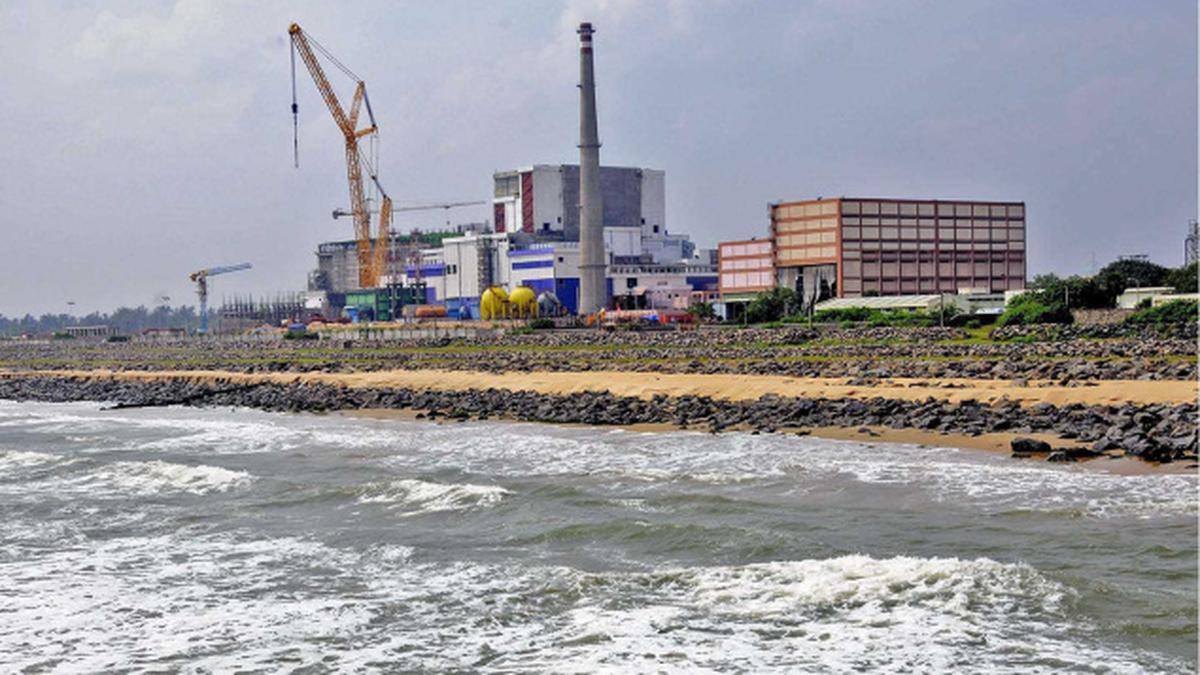
On March 4, Prime Minister Narendra Modi witnessed the start of the process of core-loading the indigenous prototype fast breeder reactor (PFBR) at the Madras Atomic Power Station in Kalpakkam, Tamil Nadu. A statement from his office called the occasion “a historic milestone in India’s nuclear power programme”.
What is the PFBR?
The PFBR is a machine that produces more nuclear fuel than it consumes. Its core-loading event is being hailed as a “milestone” because the operationalisation of the PFBR will mark the start of stage II of India’s three-stage nuclear power programme.
In the first, India used pressurised heavy water reactors (PHWRs) and natural uranium-238 (U-238), which contains minuscule amounts of U-235, as the fissile material.
In nuclear fission, the nucleus of an atom absorbs a neutron, destabilises, and breaks into two while releasing some energy. If the destabilised nucleus releases more neutrons, the reactor’s facilities will attempt to use them to instigate more fission reactions.
The heavy water in PHWR – water molecules containing the deuterium isotope of hydrogen – slows neutrons released by one fission reaction enough to be captured by other U-238 and U-235 nuclei and cause new fission. The heavy water is pressurised to keep it from boiling. The reactions produce plutonium-239 (Pu-239) and energy.
Only U-235, not U-238, can sustain a chain reaction but it is consumed fully in stage I. In stage II, India will use Pu-239 together with U-238 in the PFBR to produce energy, U-233, and more Pu-239. The Department of Atomic Energy (DAE) set up a special-purpose vehicle in 2003 called Bharatiya Nabhikiya Vidyut Nigam, Ltd. (BHAVINI) to implement stage II.
In stage III, Pu-239 will be combined with thorium-232 (Th-232) in reactors to produce energy and U-233. Homi J. Bhabha designed the three-stage programme because India hosts roughly a quarter of the world’s thorium. The three stages are expected to allow the country complete self-sufficiency in nuclear energy.
Why was the PFBR delayed?
The PFBR saga in India has been associated with numerous delays, cost overruns, and broken promises, and has accrued many critics.
The fast breeder test reactor (FBTR) at Kalpakkam is a testing ground for PFBR technologies. It was built by 1977 but sanctions against India’s ‘Smiling Buddha’ nuclear test forced the use of a mixed carbide fuel over enriched uranium (which France was to deliver). The former lowered the power output and changed operating conditions.
By the time the Indian government green-lit the PFBR in 2003, most people who worked on the FBTR were also nearing or had completed retirement.
The Indira Gandhi Centre for Atomic Research (IGCAR), Kalpakkam, designed the PFBR. Its original cost was Rs 3,492 crore and the original deadline, 2010. Six years later, the DAE sought more funds and an extended deadline, which the government granted in 2012: Rs 5,677 crore and commercial operations by March 2015.
Then the nuclear power establishment pushed the 2014 deadline to the next year, then the year after that, and so on until by March 2020, the new deadline to commercialise was October 2022. Even by 2019, its cost had also ballooned to Rs 6,800 crore.
In a 2014 audit, the Comptroller and Auditor General found BHAVINI had fumbled the procurement of some PFBR components by becoming inordinately dependent on the Nuclear Power Corporation of India, Ltd. The result: the placement of a hundred purchase orders had a “median delay” of 158 days per order.
Other causes of delay included technical difficulties with the reactor coolant.
How does the PFBR work?
PHWRs use natural or low-enriched U-238 as the fissile material and produce Pu-239 as a byproduct. This Pu-239 is combined with more U-238 into a mixed oxide and loaded into the core of a new reactor together with a blanket. This is a material the fission products in the core react with to produce more Pu-239.
A breeder reactor is a nuclear reactor that produces more fissile material than it consumes. In a ‘fast’ breeder reactor, the neutrons aren’t slowed, allowing them to trigger specific fission reactions.
The PFBR is designed to produce more Pu-239 than it consumes. It uses liquid sodium, a highly reactive substance, as coolant in two circuits. Coolant in the first circuit enters the reactor and leaves with (heat) energy and radioactivity. Via heat-exchangers, it transfers only the heat to the coolant in a secondary circuit. The latter transfers the heat to generators to produce electricity.
In a 2020 paper, former IGCAR scientist R.D. Kale wrote about several issues with getting this system to work as expected. For example, according to him, personnel working with the PFBR had expected the reactor vessel could be preheated to 150 degrees C in about a month based on theoretical calculations and tests with a mock-up. But the process took more than a year in reality.
What role can SMRs play?
The delays brooked another potential complication in the form of small modular reactors (SMRs). These reactor designs have a maximum capacity of 300 MW, require less land, and accommodate more safety features.
“Several countries are developing SMRs to complement conventional [facilities] since SMRs can be installed at reduced cost and time by repurposing … infrastructure in brownfield sites,” R. Srikanth, a professor at the National Institute of Advanced Studies, Bengaluru, told The Hindu. He added SMRs can work with low-enriched uranium, which India can import from the U.S. via its 123 Agreement.
According to him, increasing SMRs’ contribution would require, among other things, amendments to the Atomic Energy Act (1962) “and other related statutes” to allow private sector participation “under the oversight of the AERB, with both nuclear fuel and waste controlled by the DAE” according to international safeguards.
What is the value of stage II?
The PFBR has a capacity of 500 MWe. In 2019, the DAE proposed building four more fast breeder reactors (FBRs) of 600 MWe capacity each – two in Kalpakkam from 2021 and two from 2025, with sites to be selected. Experts have said the best way to moot work on stage II technologies is to press the reactors into commercial service.
The delays haven’t helped, however. In 2003, renewable sources of energy were a blip on the horizon. Today, the tariff for solar electricity is under Rs 2.5/kWh whereas nuclear electricity costs around Rs 4/kWh. The 2011 Fukushima Daiichi disaster also shifted public opinion worldwide against nuclear power, slowing work on new facilities.
Today nuclear power has a new lease of life thanks to the pressure on India to decarbonise, reduce its import of fossil fuels, and give its renewables sector some breathing space. In December 2023, NPCIL chairman B.C. Pathak told The Hindu the corporation plans to “commission a nuclear power reactor every year” from 2024.
What are the challenges of stage II?
On the flip side, bigger challenges await. FBRs are harder to handle than other reactor designs, whereas the DAE has acquired an unfavourable public reputation over its often heavy-handed response to safety concerns.
Further, the civilian nuclear programme’s nodal regulatory body, the Atomic Energy Regulatory Body (AERB), was set up by executive order and reports ultimately to the DAE secretary. In 2015, the International Atomic Energy Agency urged India to set up an independent statutory atomic regulator instead.
The DAE had responded to similar concerns with the Nuclear Safety Regulatory Authority (NSRA) Bill. It sought to replace the AERB with the NSRA. But it was criticised for allowing the Union government too much control over the NSRA’s composition.
Finally, among other products, the thorium fuel cycle produces caesium-137, actinium-227, radium-224, radium-228, and thorium-230, which are all radioactive in ways that complicate their handling and storage.