





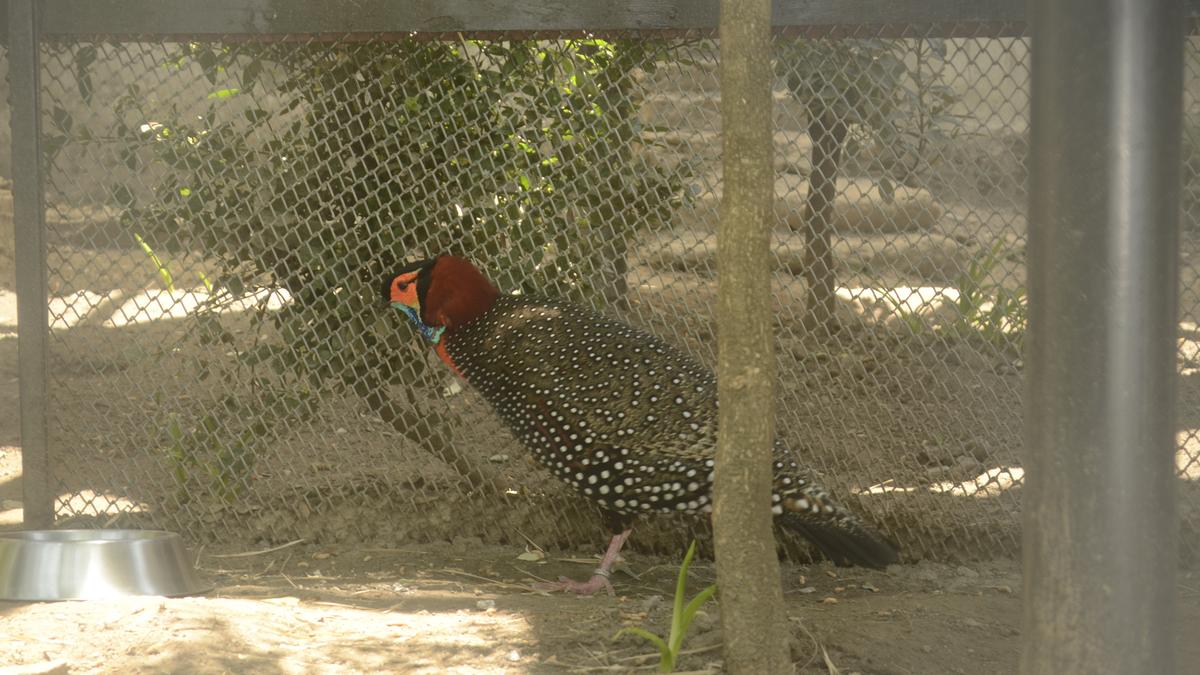
The western tragopan (Tragopan melanocephalus) is one of India’s rarest pheasants and the state bird of Himachal Pradesh. It was once found across parts of Jammu & Kashmir, Himachal Pradesh, and Uttarakhand, but now survives in small fragmented pockets.
Studies in the forests of Kazinag and Limber in Jammu & Kashmir have revealed that while habitats with suitable climates for the bird do exist, human disturbance and habitat fragmentation continue to endanger its future.
Conservationists at the International Union for the Conservation of Nature (IUCN) have estimated that only 3,000-9,500 mature tragopans remain and that all belong to a single subpopulation. Roughly a quarter lie across the western Himalayas and the northern parts of Pakistan.
Yet deep inside Himachal Pradesh’s Great Himalayan National Park, seasoned bird-watchers have said the tragopan still holds its ground.
The Sarahan Pheasentry
“Seeing one in the wild is rare and depends a lot on planning and luck where sightings are about 60% on well planned trips,” Panki Sood, a seasonal birdwatcher and a host at a travel company.
Wildlife Institute of India records say the first captive births took place in 1993. In 2005, the Himachal Pradesh Forest Department achieved a first when four western tragopan chicks hatched at the Sarahan Pheasantry, marking the world’s first successful captive breeding programme in the world. From 2007 to 2015, 43 captive-born individuals were recorded, although their survival rates fluctuated due to skewed sex ratios and mortality among older birds. Genetic analysis further revealed that the entire captive population had originated from only eight wild founders, retaining about 87% of their genetic diversity.
Sarahan Pheasantry staff recalled how inconsistent the early years were.
“In 2007-2008, there were none at all,” Keerthi (name changed on request), who has worked at the pheasantry for more than a decade, said. “There were no eggs, so no chicks. It was only after the biologists came that eggs and chicks finally began appearing.”
“When I joined as a research fellow in 2011, the Sarahan Pheasantry hosted about 15 birds,” Wildlife Institute of India senior fellow Lakshminarasimha R. recalled.
To stabilise the program, the experts began to redesign core husbandry systems. “The primary approach was to develop protocols for managing species in captivity. We referred to how it behaved in the wild,” Dr. Lakshminarasimha said.
Captive tragopans were very sensitive to stress, diseases, and the conditions in the artificial enclosure. Researchers thus recreated elements of their natural habitat, such as dense cover with specific nesting materials and incorporated seasonal dietary changes.
Everything from nesting material and vegetation to diet and feeding schedules were reworked to mimic the tragopan’s natural habitat as closely as possible.
“We have 46 tragopans now,” Ms. Keerthi added. “This year, seven or eight chicks hatched and five or six have survived.”
Climate variability, breeding
“Captive breeding emerged as a tool of insurance against major declines,” Rahul Kaul, chair of the Galliformes Specialist Group at the IUCN, said. “But it was always meant to complement, not replace, habitat protection. Unfortunately, much emphasis and resources were laid on protecting and breeding tragopans from outside the wild [ex-situ] while the conservation of species in their natural habitats [in-situ] was hugely undermined.”
Dr. Kaul has been closely involved with pheasant conservation across the Himalayas and also said the initiative was well-intentioned.
“The idea was to breed enough birds for release into identified habitats. Decades later and several crores of rupees spent, we are where we started in terms of conservation benefit. The forest department must be credited for their perseverance: they did produce birds, but without parallel habitat protection, the gains remain limited.”
Ex-situ programmes have tried to build population security but a greater threat today is the slow disruption of the tragopan’s timing system that synchronises breeding, insect availability, and seasonal changes in the wild.
“Climate variability affects species like the tragopan through warming at lower altitudes and disruption of food resources,” Dr. Kaul said. “If breeding no longer synchronises with insect availability, the chicks may starve. The forests themselves hold the species together, allowing the pheasants to persist. In some areas of Pakistan, communities identify breeding zones and voluntarily leave them untouched until the chicks can fly. Maybe such adaptive models can be tried [in India] too.”
Stalled rewilding attempt
At the Sarahan Pheasantry, where captive breeding continues, staff members said efforts to take the next step have wanted for support.
“The entire objective was to move towards reintroduction, specifically into forests surrounding Sarahan, and we were finally ready for it. In 2020-2021, we carried out experimental releases and results showed that the approach was viable,” Dr. Lakshminarasimha said.
Sources from the Himachal Pradesh Forest Department also acknowledged the ex-situ programme had reached a stable phase. They added that the Pheasantry now consistently maintains over 40 western tragopans, with six to eight eggs hatching and four to five chicks surviving every year, figures made possible by years of refinement and expert inputs.
Returning tragopans to the wild is also the most demanding phase of the programme. One forest guard said the Pheasantry had conducted reintroduction trials for two years, releasing birds deep into the forest and tracking them using radio collars. One individual survived in the wild for nearly a year — a highly encouraging sign for such an early-stage attempt — until its tag’s battery expired.
According to Forest Department sources (who wished to remain unnamed due to the sensitivity of commenting on reintroduction funding and programme status), reintroductions have been on hold since 2023 partly due to budgetary constraints linked to wider spending cuts by the State government. Some officials have also stressed that funding is only one part of the challenge.
“The real bottleneck,” one official noted, “is the research and protocol development needed before each new release.”
Before a tragopan can be returned to the wild, teams must check if release sites and food are available, monitor the birds’ predators, and make sure the captive-bred birds can adapt to natural conditions.
Dr. Narasimha said he’s more hopeful. Reintroduction, he explained, “cannot happen overnight”.
Like the decade-long effort that made captive breeding successful, reintroduction also demands patience, experimentation, and adaptive management: “You cannot draw conclusions from only a few attempts. This is a long-term commitment.”
Community support
Despite these challenges, those working closest to the species believe the western tragopan’s survival hinges on people as much as policy.
Mr. Sood said local stewardship had already shifted the trajectory: “Community-based tourism is one of the best ways to protect this rare bird.”
He added that tourism offered local families an alternative income source that didn’t depend on forest resources or grazing, giving them direct incentives to keep breeding areas undisturbed.
Since villagers stopped disrupting the forest, more tragopans have been, he said, citing examples from the Rakhundi and Shilt areas.
Aditya Ansh and Divyam Gautam are independent media writers based in India.