

Skip to content
  • Facebook
  • X
  • Linkedin
  • WhatsApp
  • Associate Journalism
  • About Us
  • Privacy Policy
  • 033-46046046
  • editor@artifex.news
Artifex.News

Artifex.News

Stay Connected. Stay Informed.

  • Breaking News
  • World
  • Nation
  • Sports
  • Business
  • Science
  • Entertainment
  • Lifestyle
  • Toggle search form
  • Keralite racket based in Tamil Nadu, Karnataka suspected to be behind recent major MDMA haul in Kochi Nation
  • Opener Abhishek Sharma Credits Skipper Pat Cummins, SRH Support Staff After Big Win vs LSG Sports
  • What Happened As KKR Fan Tried Stealing Match-Ball From IPL 2024 Match. Viral Video Sports
  • Pakistan sets up deportation centres to hold migrants who are in the country illegally World
  • Republican Mike Johnson Elected New US House Speaker World
  • “He Is The Next MS Dhoni”: Ex-India Star’s Massive Praise For Rohit Sharma Sports
  • LSG vs PBKS, IPL 2024 : KL Rahul-led Lucknow Super Giants eye all-round effort against Punjab Kings Sports
  • How Hamas Weaponised Palestinians’ Despair World

India set to transition to hyperlocal extreme weather forecasting

Posted on February 10, 2024 By admin


Weather forecasting plays a pivotal role in the country’s functioning. Accurately predicting rain, cyclones, heatwaves and drought are critical to inform decision making on disaster management. In India the Indian Meteorology Department (IMD) is the principal government agency in all matters relating to meteorology and it specialises in the incredibly complex science of predicting weather patterns by observing, modelling and interpreting a multitude of variables.

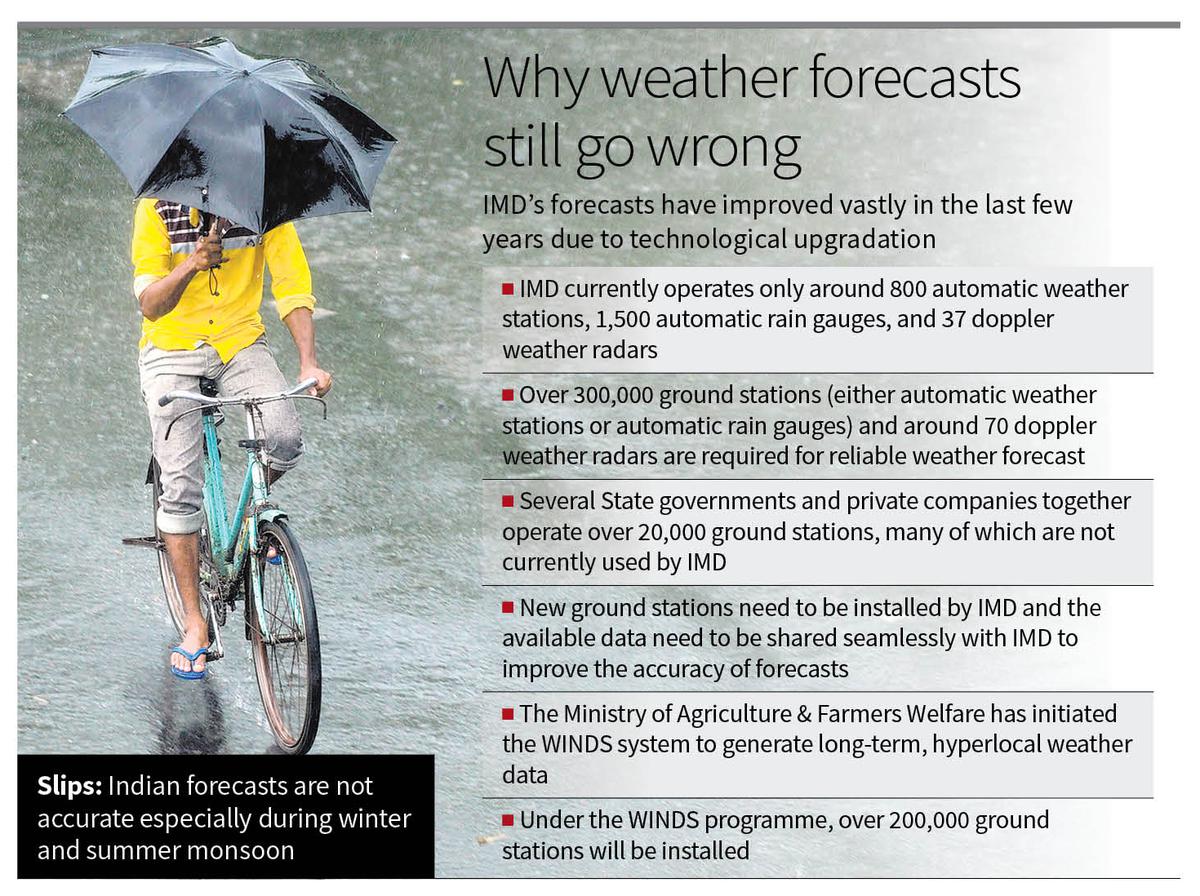
However, in tropical countries like India, weather variability is inherently higher. IMD’s forecasts have improved vastly in the last few years as it has upgraded to technologies similar to the ones used by the U.S., the U.K. and Japan, which are known to produce accurate forecasts. Yet, there are still many days and geographies for which Indian forecasts go wrong, especially during winter and summer monsoon.

One of the major hurdles is the lack of weather monitoring ground stations. Currently, IMD operates around 800 automatic weather stations (AWS), 1,500 automatic rain gauges (ARG) and 37 doppler weather radars (DWR). This is against the total requirements of more than 3,00,000 ground stations (AWS/ARG) and around 70 DWRs. It’s interesting to note that several Indian State governments and private companies operate a significant network of ground stations (more than 20,000), many of which are not currently used by IMD. The factors range from the inaccessibility of the data to their reliability.

Currently, most of the prediction software used in forecasting are based on the global forecasting system and weather research and forecasting models, both of which are not the most modern. In contrast, with the government’s focus on Make in India, its support to start-ups and the huge public and private investments in the sectors of agriculture and climate, many new age companies are switching to artificial intelligence/machine (AI/ML) learning for more predictions. At the same time though, these technologies are only as good and verifiable as the data they can access. Thus there is an urgent need for an integrated system to fill these data gaps. New ground stations will have to be installed and the available data have to be shared seamlessly.

A promising step forward was that recently, the Department of Agriculture & Farmers Welfare and the Ministry of Agriculture & Farmers Welfare have initiated the weather information network and data system (WINDS) to generate long-term, hyper-local weather data. The system will also promote the data for wider applications in agriculture and other sectors, it will help in creating a national-level data base, and it will assist in establishing the protocols required to access the country-wide data by the various public and private concerns. Under this programme, more than 200,000 ground stations (AWS and ARG) will be installed, which can help tremendously in enhancing weather data utilisation and thus in improving weather predictions and decision making.

Meanwhile, air pollution continues to be a challenge. In the last month large dense fog blanketed the NCR region, leading to near-zero visibility. This happens mainly because of the high particulate matter and smog in the atmosphere. Fog can trap the pollutants close to the ground, leading to an increase in respiratory and other health-related issues. Another cause for worry is that in foggy conditions, some pollutants like nitrogen  oxides  can  react  with  other  compounds  to  form  secondary pollutants, thus posing severe health risks, particularly to children and the elderly.

Air quality monitoring systems are currently very expensive and tend to be imported. Thanks to the Make in India initiatives, however, many Indian companies have started to manufacture low-cost and highly reliable sensor-based air quality monitoring systems. These are also easy to install and have low maintenance costs. Thus, it is now possible to install a large number of such instruments quickly, especially in the urban areas. The IITs are helping as well as they have started centres of excellence in this domain, with a mission to establish a nation-wide network of affordable air quality sensors. An integrated AI/ML-based model with data from the new air quality and weather sensors will be a major step forward to accurately predict fog as it will help in timely decision making around transportation and the health-related impacts of air pollution.

With the recent advances India is therefore poised towards establishing a world class, robust air quality and weather information network. What will bring everything together is a time-bound, inclusive approach by the various stakeholders to create this most important of national infrastructures. Once seamless data sharing and systems integration is achieved, India will have access to a new information gateway and one that is critical to addressing our climate and environmental challenges.

(Sachchida Nand Tripathi is Professor, Department of Civil Engineering, IIT Kanpur, and Ashish Agarwal is Founder & Chief Technology Officer, Ingen Technologies)



Source link

Science Tags:Disaster management, Weather forecasting, Weather forecasting in India, Weather information network

Post navigation

Previous Post: Manmohan Singh missed the reforms bus as PM: FM Nirmala Sitharaman
Next Post: What likely caused the extreme ice-age more than 700 million years ago?

Related Posts

  • ‘Fly me to the moon’ seems to be global ambition in 2023 Science
  • Two studies conducted by Bengaluru scientists explore how attention and eye movements are linked Science
  • If anxiety is in my brain, why is my heart pounding? A psychiatrist explains the neuroscience and physiology of fear Science
  • The Science Quiz | Exploring superfoods and beyond Science
  • Chandrayaan vs. Chang’e: How different are India’s and China’s lunar missions? Science
  • The animal that senses electrical boxes, tolerates snow, and has ‘mating trains’ Science

More Related Articles

People with two copies of a risk gene have genetic form of Alzheimer’s, scientists say Science
Summer 2023 was the hottest in 2,000 years, says study Science
With bad news from Cassini, is dark matter’s main rival theory dead? Science
ISRO may postpone soft landing on Moon to August 27 based on health of lander module: Official Science
With CRISPR poised to revolutionise therapy, a pause to consider ethical issues Science
Could tardigrades have colonised the Moon? Science
SiteLock

Archives

  • July 2024
  • June 2024
  • May 2024
  • April 2024
  • March 2024
  • February 2024
  • January 2024
  • December 2023
  • November 2023
  • October 2023
  • September 2023
  • August 2023
  • July 2023
  • June 2023
  • May 2023
  • April 2023
  • March 2023
  • February 2023
  • January 2023
  • December 2022
  • November 2022
  • October 2022
  • September 2022
  • August 2022
  • July 2022
  • June 2022
  • May 2022

Categories

  • Business
  • Nation
  • Science
  • Sports
  • World

Recent Posts

  • Myanmar’s ethnic rebels say they captured an airport in a new setback for the military government
  • Storm Beryl Kills 2, Knocks Out Power As It Churns Across Texas
  • Employment Growth Rate In India Was 6% Last Year, Says Reserve Bank Of India
  • Govt. reopens PLI scheme for white goods till October 12
  • Taylor Fritz Beats Alexander Zverev To Reach Wimbledon 2024 Last Eight

Recent Comments

  1. ywdVpqHiNZCtUDcl on UP Teacher Who Asked Students To Slap Muslim Classmate
  2. bRstIalYyjkCUJqm on UP Teacher Who Asked Students To Slap Muslim Classmate
  3. GkJwRWEAbS on UP Teacher Who Asked Students To Slap Muslim Classmate
  4. xreDavBVnbGqQA on UP Teacher Who Asked Students To Slap Muslim Classmate
  5. aANVRzfUdmyb on UP Teacher Who Asked Students To Slap Muslim Classmate
  • England vs Pakistan 1st T20I Live Score Updates: Will Rain Play Spoilsport? Sports
  • Search For 13 Miners Trapped For 2 Weeks In Russia Called Off World
  • T20 World Cup Group C Preview: West Indies Aim For Third Title, New Zealand And Afghanistan In The Mix Sports
  • Iran Flaunts “World’s Longest-Range Drone” On Iraq War Anniversary World
  • Rahul Gandhi Urges Yogi Adityanath To Increase Hathras Compensation Nation
  • India’s robust economic growth will continue, real GDP growth will accelerate: Moody’s Business
  • RBI Asks These 2 Banks To Stop Adding Customers To Co-Branded Credit Cards Nation
  • ‘Ukraine war dulled merchandise exports’ Business

Editor-in-Chief:
Mohammad Ariff,
MSW, MAJMC, BSW, DTL, CTS, CNM, CCR, CAL, RSL, ASOC.
editor@artifex.news

Associate Editors:
1. Zenellis R. Tuba,
zenelis@artifex.news
2. Haris Daniyel
daniyel@artifex.news

Photograher:
Rohan Das
rohan@artifex.news

Artifex.News offers Online Paid Internships to college students from India and Abroad. Interns will get a PRESS CARD and other online offers.
Send your CV (Subjectline: Paid Internship) to internship@artifex.news

Links:
Associate Journalism
About Us
Privacy Policy

News Links:
Breaking News
World
Nation
Sports
Business
Entertainment
Lifestyle

Registered Office:
72/A, Elliot Road, Kolkata - 700016
Tel: 033-22277777, 033-22172217
Email: office@artifex.news

Editorial Office / News Desk:
No. 13, Mezzanine Floor, Esplanade Metro Rail Station,
12 J. L. Nehru Road, Kolkata - 700069.
(Entry from Gate No. 5)
Tel: 033-46011099, 033-46046046
Email: editor@artifex.news

Copyright © 2023 Artifex.News Newsportal designed by Artifex Infotech.