



Skip to content
  • Facebook
  • X
  • Linkedin
  • WhatsApp
  • YouTube
  • Associate Journalism
  • About Us
  • Privacy Policy
  • 033-46046046
  • editor@artifex.news
Artifex.News

Artifex.News

Stay Connected. Stay Informed.

  • Breaking News
  • World
  • Nation
  • Sports
  • Business
  • Science
  • Entertainment
  • Lifestyle
  • Toggle search form
  • “Wrong That Rohit Sharma Has Insisted On Captaincy”: BCCI Breaks Silence On ‘Rubbish’
    “Wrong That Rohit Sharma Has Insisted On Captaincy”: BCCI Breaks Silence On ‘Rubbish’ Sports
  • Court On “Disturbing” Victim Impact Report In Case Linked To 2020 Delhi Riots
    Court On “Disturbing” Victim Impact Report In Case Linked To 2020 Delhi Riots Nation
  • Access Denied World
  • Aiden Markram scripts history, becomes fielder with most catches in Test
    Aiden Markram scripts history, becomes fielder with most catches in Test Sports
  • Supreme Court To NCR States
    Supreme Court To NCR States Nation
  • Access Denied Business
  • India vs Afghanistan live score over Match 9 ODI 31 35 updates
    India vs Afghanistan live score over Match 9 ODI 31 35 updates Sports
  • Access Denied
    Access Denied Nation
Could tardigrades have colonised the Moon?

Could tardigrades have colonised the Moon?

Posted on March 12, 2024 By admin


Just over five years ago, on 22 February 2019, an unmanned space probe was placed in orbit around the Moon. Named Beresheet and built by SpaceIL and Israel Aerospace Industries, it was intended to be the first private spacecraft to perform a soft landing. Among the probe’s payload were tardigrades, renowed for their ability to survive in even the harshest climates.
| Photo Credit: The Hindu

Just over five years ago, on 22 February 2019, an unmanned space probe was placed in orbit around the Moon. Named Beresheet and built by SpaceIL and Israel Aerospace Industries, it was intended to be the first private spacecraft to perform a soft landing. Among the probe’s payload were tardigrades, renowed for their ability to survive in even the harshest climates.

The mission ran into trouble from the start, with the failure of “star tracker” cameras intended to determine the spacecraft’s orientation and thus properly control its motors. Budgetary limitations had imposed a pared-down design, and while the command center was able to work around some problems, things got even trickier on 11 April, the day of the landing.

On the way to the Moon the spacecraft had been travelling at high speed, and it needed to be slowed way down to make a soft landing. Unfortunately during the braking manoeuvre a gyroscope failed, blocking the primary engine. At an altitude of 150 m, Beresheet was still moving at 500 km/h, far too fast to be stopped in time. The impact was violent – the probe shattered and its remains were scattered over a distance of around a hundred metres. We know this because the site was photographed by NASA’s LRO (Lunar Reconnaissance Orbiter) satellite on 22 April.

Animals that can withstand (almost) anything

So what happened to the tardigrades that were travelling on the probe? Given their remarkable abilities to survive situations that would kill pretty much any other animal, could they have contaminated the Moon? Worse, might they be able to reproduce and colonize it?

Tardigrades are microscopic animals that measure less than a millimetre in length. All have neurons, a mouth opening at the end of a retractable proboscis, an intestine containing a microbiota and four pairs of non-articulated legs ending in claws, and most have two eyes. As small as they are, they share a common ancestor with arthropods such as insects and arachnids.

Most tardigrades live in aquatic environments, but they can be found in any environment, even urban ones. Emmanuelle Delagoutte, a researcher at the CNRS, collects them in the mosses and lichens of the Jardin des Plantes in Paris. To be active, feed on microalgae such as chlorella, and move, grow and reproduce, tardigrades need to be surrounded by a film of water. They reproduce sexually or asexually via parthenogenesis (from an unfertilised egg) or even hermaphroditism, when an individual (which possesses both male and female gametes) self-fertilises. Once the egg has hatched, the active life of a tardigrade lasts from 3 to 30 months. A total of 1,265 species have been described, including two fossils.

Also Read | How water bears survive lethal UV radiation

Otherworldly powers

Tardigrades are famous for their resistance to conditions that exist neither on Earth nor on the Moon. They can shut down their metabolism by losing up to 95% of their body water. Some species synthesise a sugar, trehalose, that acts as an antifreeze, while others synthesise proteins that are thought to incorporate cellular constituents into an amorphous “glassy” network that offers resistance and protection to each cell.

During dehydration, the tardigrade’s body can shrink to half its normal size. The legs disappear, with only the claws still visible. This state, known as cryptobiosis, persists until conditions for active life become favourable again.

Depending on the species of tardigrade, individuals need more or less time to dehydrate and not all specimens of the same species manage to return to active life. Dehydrated adults survive for a few minutes at temperatures as low as -272°C or as high as 150°C, and over the long term at high doses of gamma rays of 1,000 or 4,400 Gray (Gy). By way of comparison, a dose of 10 Gy is fatal for humans, and 40-50,000 Gy sterilises all types of material. However, whatever the dose, radiation kills tardigrade eggs. What’s more, the protection afforded by cryptobiosis is not always clear-cut, as in the case of Milnesium tardigradum, where radiation affects both active and dehydrated animals in the same way.

Lunar life?

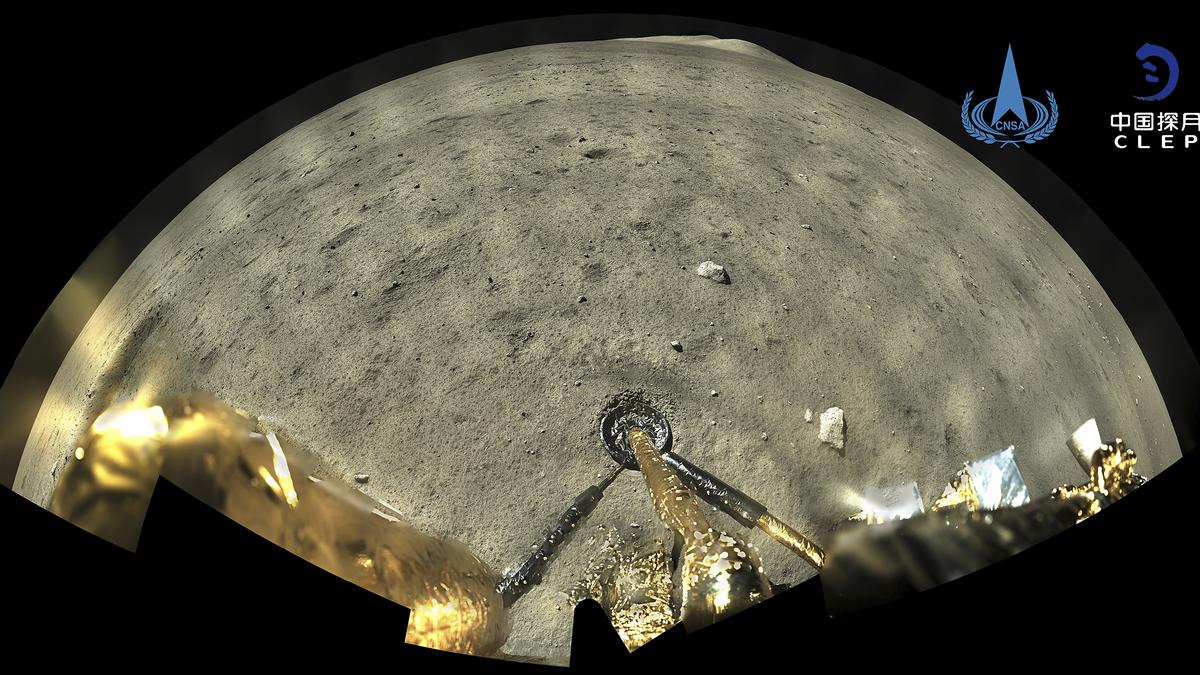
So what happened to the tardigrades after they crashed on the Moon? Are any of them still viable, buried under the moon’s regolith, the dust that varies in depth from a few metres to several dozen metres?

First of all, they have to have survived the impact. Laboratory tests have shown that frozen specimens of the Hypsibius dujardini species travelling at 3,000 km/h in a vacuum were fatally damaged when they smashed into sand. However, they survived impacts of 2,600 km/h or less – and their “hard landing” on the Moon, unwanted or not, was far slower.

The Moon’s surface is not protected from solar particles and cosmic rays, particularly gamma rays, but here too, the tardigrades would be able to resist. In fact, Robert Wimmer-Schweingruber, professor at the University of Kiel in Germany, and his team have shown that the doses of gamma rays hitting the lunar surface were permanent but low compared with the doses mentioned above – 10 years’ exposure to Lunar gamma rays would correspond to a total dose of around 1 Gy.

But then there’s the question of “life” on the Moon. The tardigrades would have to withstand a lack of water as well as temperatures ranging from -170 to -190°C during the lunar night and 100 to 120°C during the day. A lunar day or night lasts a long time, just under 15 Earth days. The probe itself wasn’t designed to withstand such extremes and even if it hadn’t crashed, it would have ceased all activity after just a few Earth days.

Unfortunately for the tardigrades, they can’t overcome the lack of liquid water, oxygen and microalgae – they would never be able to reactivate, much less reproduce. Their colonising the Moon is thus impossible. Still, inactive specimens are on lunar soil and their presence raises ethical questions, as Matthew Silk, an ecologist at the University of Edinburgh, points out. Moreover, at a time when space exploration is taking off in all directions, contaminating other planets could mean that we would lose the opportunity to detect extraterrestrial life.

The Conversation

Laurent Palka, Maître de conférences, Muséum national d’histoire naturelle (MNHN)

This article is republished from The Conversation under a Creative Commons license. Read the original article.

Source link

Science Tags:Could tardigrades have colonised the Moon?, life on moon, science, science news, Tardigrades on the moon

Post navigation

Previous Post: Russian military transport plane with 15 people on board crashed on takeoff, officials say
Next Post: Retail inflation eases marginally to 5.09% in February

Related Posts

  • Sci-Five | The Hindu Science Quiz: On Indian Institute of Astrophysics
    Sci-Five | The Hindu Science Quiz: On Indian Institute of Astrophysics Science
  • Microbe might spark first stages of ulcerative colitis: new study
    Microbe might spark first stages of ulcerative colitis: new study Science
  • 50,000-year-old magnetic fossils found in the Bay of Bengal
    50,000-year-old magnetic fossils found in the Bay of Bengal Science
  • Race to global eradication of Guinea worm disease nears finish line
    Race to global eradication of Guinea worm disease nears finish line Science
  • India to convey its plans to build a new research station in Antarctica at ATCM
    India to convey its plans to build a new research station in Antarctica at ATCM Science
  • Bengaluru scientists develop affordable fruit fly trap; seek global patents
    Bengaluru scientists develop affordable fruit fly trap; seek global patents Science

More Related Articles

When institutional reliability matters: the story of di-ethylene glycol When institutional reliability matters: the story of di-ethylene glycol Science
Gopichand Thotakura, India’s first civilian space tourist, recieves warm welcome in Delhi Gopichand Thotakura, India’s first civilian space tourist, recieves warm welcome in Delhi Science
Electrifying industrial heat as a path to India’s thermal independence Electrifying industrial heat as a path to India’s thermal independence Science
India must create ‘leading’ space firms, not just service companies: ISRO chief India must create ‘leading’ space firms, not just service companies: ISRO chief Science
Trump is pulling the US out of the UN FCCC. What does it mean? Trump is pulling the US out of the UN FCCC. What does it mean? Science
Ancient Egypt’s ‘screaming’ mummy woman may have died in agony Ancient Egypt’s ‘screaming’ mummy woman may have died in agony Science
SiteLock

Archives

  • May 2026
  • April 2026
  • March 2026
  • February 2026
  • January 2026
  • December 2025
  • November 2025
  • October 2025
  • September 2025
  • August 2025
  • July 2025
  • June 2025
  • May 2025
  • April 2025
  • March 2025
  • February 2025
  • January 2025
  • December 2024
  • November 2024
  • October 2024
  • September 2024
  • August 2024
  • July 2024
  • June 2024
  • May 2024
  • April 2024
  • March 2024
  • February 2024
  • January 2024
  • December 2023
  • November 2023
  • October 2023
  • September 2023
  • August 2023
  • July 2023
  • June 2023
  • May 2023
  • April 2023
  • March 2023
  • February 2023
  • January 2023
  • December 2022
  • November 2022
  • October 2022
  • September 2022
  • August 2022
  • July 2022
  • June 2022
  • May 2022

Categories

  • Business
  • Nation
  • Science
  • Sports
  • World

Recent Posts

  • BEST conductor dies in accident involving four buses in Mumbai
  • Nayar reckons KKR got a par total, rues missed chances
  • Pope Leo decries European military spending as ‘betrayal’ of diplomacy
  • Scent Of Rain, Shutterfly, Stud Poker and Starzella please
  • New factional battle lines emerge in Congress hours after nomination of Kerala CM

Recent Comments

  1. JamesHeR on UP Teacher Who Asked Students To Slap Muslim Classmate
  2. RafaelNar on UP Teacher Who Asked Students To Slap Muslim Classmate
  3. CarlosExorb on UP Teacher Who Asked Students To Slap Muslim Classmate
  4. Robertfloup on UP Teacher Who Asked Students To Slap Muslim Classmate
  5. Davidcag on UP Teacher Who Asked Students To Slap Muslim Classmate
  • Access Denied Business
  • What we know we don’t know is when and where our next disease outbreak will be: Kang
    What we know we don’t know is when and where our next disease outbreak will be: Kang Nation
  • Access Denied
    Access Denied Nation
  • Akali Dal Leader Surjit Singh Shot Dead In Punjab Hoshiarpur: Cops
    Akali Dal Leader Surjit Singh Shot Dead In Punjab Hoshiarpur: Cops Nation
  • Access Denied
    Access Denied Nation
  • Man Makes Threat Call About Blowing Up Taj Hotel In Mumbai, Arrested: Cops
    Man Makes Threat Call About Blowing Up Taj Hotel In Mumbai, Arrested: Cops Nation
  • Amnesty International says 21 killed in Nigeria economic hardship protests
    Amnesty International says 21 killed in Nigeria economic hardship protests World
  • Rail Fail. That’s The Headline: By Derek O’Brien
    Rail Fail. That’s The Headline: By Derek O’Brien Nation

Editor-in-Chief:
Mohammad Ariff,
MSW, MAJMC, BSW, DTL, CTS, CNM, CCR, CAL, RSL, ASOC.
editor@artifex.news

Associate Editors:
1. Zenellis R. Tuba,
zenelis@artifex.news
2. Haris Daniyel
daniyel@artifex.news

Photograher:
Rohan Das
rohan@artifex.news

Artifex.News offers Online Paid Internships to college students from India and Abroad. Interns will get a PRESS CARD and other online offers.
Send your CV (Subjectline: Paid Internship) to internship@artifex.news

Links:
Associate Journalism
About Us
Privacy Policy

News Links:
Breaking News
World
Nation
Sports
Business
Entertainment
Lifestyle

Registered Office:
72/A, Elliot Road, Kolkata - 700016
Tel: 033-22277777, 033-22172217
Email: office@artifex.news

Editorial Office / News Desk:
No. 13, Mezzanine Floor, Esplanade Metro Rail Station,
12 J. L. Nehru Road, Kolkata - 700069.
(Entry from Gate No. 5)
Tel: 033-46011099, 033-46046046
Email: editor@artifex.news

Copyright © 2023 Artifex.News Newsportal designed by Artifex Infotech.