Skip to content
  • Facebook
  • X
  • Linkedin
  • WhatsApp
  • Associate Journalism
  • About Us
  • Privacy Policy
  • 033-46046046
  • editor@artifex.news
Artifex.News

Artifex.News

Stay Connected. Stay Informed.

  • Breaking News
  • World
  • Nation
  • Sports
  • Business
  • Science
  • Entertainment
  • Lifestyle
  • Toggle search form
  • Access Denied
    Access Denied Nation
  • Trinamool Vs Women’s Commission Chief Over Candidate From Sandeshkhali
    Trinamool Vs Women’s Commission Chief Over Candidate From Sandeshkhali Nation
  • Access Denied
    Access Denied Nation
  • Customer Smashes Ola Scooter With Hammer, Video Goes Viral
    Customer Smashes Ola Scooter With Hammer, Video Goes Viral Nation
  • Ashneer Grover To Zerodha CEO Nithin Kamath Who Suffered A Mild Stroke
    Ashneer Grover To Zerodha CEO Nithin Kamath Who Suffered A Mild Stroke Nation
  • Widows Living In UP Shelter Homes Send Handmade Rakhis To PM Modi
    Widows Living In UP Shelter Homes Send Handmade Rakhis To PM Modi Nation
  • Access Denied
    Access Denied Nation
  • Police Officer Suspended For Mixing Ash In ‘Bhandara’ Food At Maha Kumbh
    Police Officer Suspended For Mixing Ash In ‘Bhandara’ Food At Maha Kumbh Nation
Study maps future glacial lakes

Study maps future glacial lakes

Posted on February 5, 2026 By admin


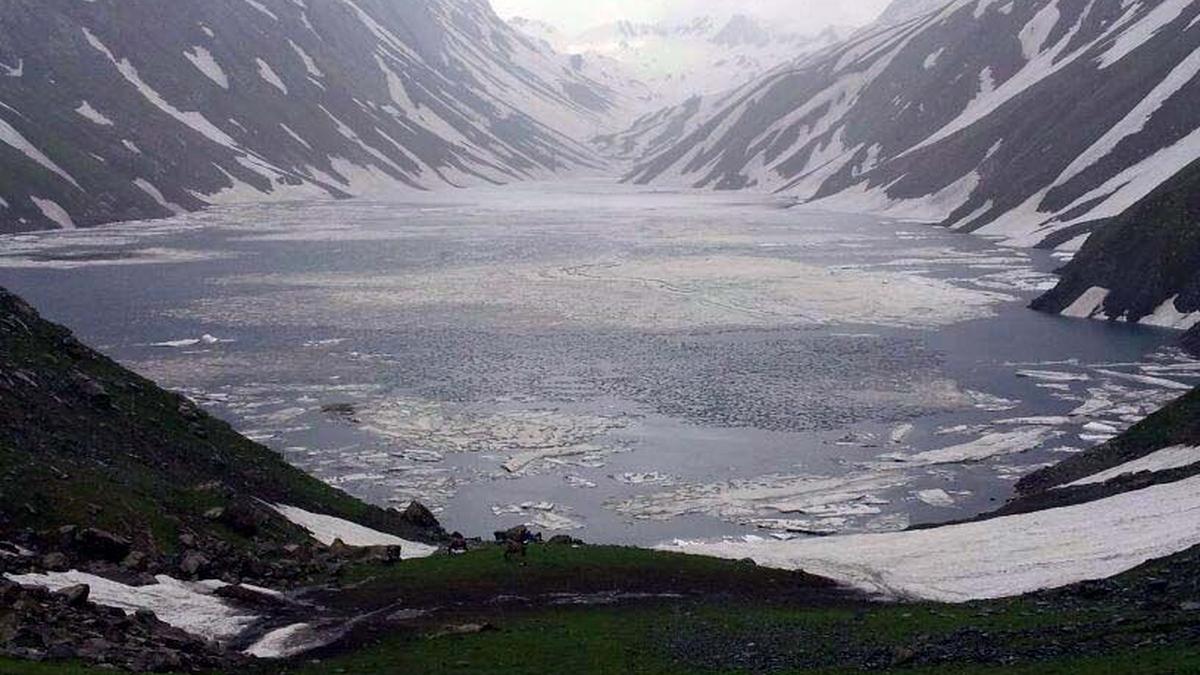
A glacial lake atop the Pir Panchal mountain range that divides Kashmir and Jammu provinces.
| Photo Credit: File photo

GUWAHATI: A team of researchers from the Indian Institute of Technology Guwahati (IIT-G) has developed a new way to identify where glacial lakes are likely to form in the Himalayas, offering a potential breakthrough in disaster preparedness for mountain regions facing rapid climate change.

Their study focuses on the Eastern Himalayas, which has recorded the highest frequency of glacial lake outburst floods, or GLOFs, in the entire mountain range. These sudden floods occur when natural dams holding back glacial lakes collapse, releasing vast volumes of water, debris and sediment downstream.

The findings of this research have been published in Nature Scientific Reports journal. The paper has been co-authored by Ajay Dashora of IIT-G’s Department of Civil Engineering, along with his research scholar Anushka Vashistha and Afroz Ahmad Shah of the Universiti of Brunei Darussalam.

GLOFs have caused extensive loss of life and damage to infrastructure in the past, including roads, bridges, hydropower projects, and agricultural land. The last major disaster caused by a GLOF was in October 2023 in Sikkim, which killed 94 people, damaged 1,835 houses, displaced 2,563 people, and swept a 1,200-megawatt dam away.

According to the researchers, the number and size of glacial lakes are increasing as glaciers retreat faster due to rising temperatures, heightening the risk to downstream communities.

While earlier studies largely relied on climate data to assess glacial lake hazards, the new research takes a different approach. It places geomorphology—the physical shape and structure of the land—at the centre of prediction.

The study examines how specific landforms influence where meltwater accumulates. These include cirques, which are bowl-shaped depressions carved by glaciers, U-shaped valleys, meltwater flow channels, retreating glacier fronts and neighbouring lakes. Together, these features determine whether a landscape can trap water long enough for a glacial lake to form.

Grid locations analysed

Using high-resolution satellite imagery and digital elevation models, the researchers analysed more than 12,000 grid locations across the Eastern Himalayas. They then applied machine learning techniques to estimate the probability of glacial lake formation at each site.

Among the tested models, a Bayesian neural network produced the most reliable results. Unlike conventional models, this approach not only predicts where lakes are likely to form but also quantifies uncertainty in those predictions. This is especially important in remote mountain regions, where field data are limited, and terrain conditions vary sharply over short distances.

The resulting probability maps highlight zones with a high likelihood of future lake formation. Many of these areas coincide with regions of active glacier retreat and gentle slopes that favour water accumulation. Some are located upstream of existing settlements and infrastructure, underscoring the potential risk.

“By pinpointing high-risk areas, the framework can guide early-warning systems for GLOFs, help plan safer locations for roads, hydropower projects, and settlements, and support long-term water-resource management,” Prof. Dashora said.

“Beyond hazard management, the method can help understand how water systems may change as glaciers continue to retreat. Importantly, the framework is adaptable to other glaciated mountain regions around the world, making it a valuable tool for climate-resilient planning and disaster-risk reduction globally,” he said.

The study also challenges the assumption that climate alone determines glacial lake formation. While temperature controls the meltwater supply, the research shows that landforms largely dictate where that water ultimately collects. EOM

Published – February 05, 2026 04:00 pm IST


Source link

Science

Post navigation

Previous Post: Access Denied
Next Post: At least 216 terrorists, 36 civilians and 22 personnel killed in Balochistan: Pakistan Army

Related Posts

  • 10,000 human genomes database launched
    10,000 human genomes database launched Science
  • A natural heater hidden in India’s ‘sacred lotus’ flowers
    A natural heater hidden in India’s ‘sacred lotus’ flowers Science
  • Asian cities are growing upwards more than outwards, satellite data show
    Asian cities are growing upwards more than outwards, satellite data show Science
  • First fossilised snake traces discovered in South Africa
    First fossilised snake traces discovered in South Africa Science
  • The Silent Killer: tackling hypertension in India
    The Silent Killer: tackling hypertension in India Science
  • Polluting shipwrecks are a ticking time-bomb at the bottom of our oceans
    Polluting shipwrecks are a ticking time-bomb at the bottom of our oceans Science

More Related Articles

76% of TB patients received payment for nutritional support 76% of TB patients received payment for nutritional support Science
Mitochondria keep your brain cells alive − helping them run smoothly may protect against Parkinson’s disease Mitochondria keep your brain cells alive − helping them run smoothly may protect against Parkinson’s disease Science
IACS scientists discover a new target for cancer treatment IACS scientists discover a new target for cancer treatment Science
Human DNA will have to be edited if humans are to settle on other planets Human DNA will have to be edited if humans are to settle on other planets Science
Read the rocks to improve India’s geological literacy Read the rocks to improve India’s geological literacy Science
Commercialisation of health services can be a recipe for disaster, says Sujatha Rao Commercialisation of health services can be a recipe for disaster, says Sujatha Rao Science
SiteLock

Archives

  • February 2026
  • January 2026
  • December 2025
  • November 2025
  • October 2025
  • September 2025
  • August 2025
  • July 2025
  • June 2025
  • May 2025
  • April 2025
  • March 2025
  • February 2025
  • January 2025
  • December 2024
  • November 2024
  • October 2024
  • September 2024
  • August 2024
  • July 2024
  • June 2024
  • May 2024
  • April 2024
  • March 2024
  • February 2024
  • January 2024
  • December 2023
  • November 2023
  • October 2023
  • September 2023
  • August 2023
  • July 2023
  • June 2023
  • May 2023
  • April 2023
  • March 2023
  • February 2023
  • January 2023
  • December 2022
  • November 2022
  • October 2022
  • September 2022
  • August 2022
  • July 2022
  • June 2022
  • May 2022

Categories

  • Business
  • Nation
  • Science
  • Sports
  • World

Recent Posts

  • U.S., India to work toward finalising Interim Agreement with view to concluding BTA: White House fact sheet
  • Access Denied
  • Indian space programme rooted in international cooperation rather than competition: ISRO chief
  • Access Denied
  • Access Denied

Recent Comments

  1. Samueloptip on UP Teacher Who Asked Students To Slap Muslim Classmate
  2. AustinThync on UP Teacher Who Asked Students To Slap Muslim Classmate
  3. WilliamHex on UP Teacher Who Asked Students To Slap Muslim Classmate
  4. AustinThync on UP Teacher Who Asked Students To Slap Muslim Classmate
  5. Leonardrah on UP Teacher Who Asked Students To Slap Muslim Classmate
  • Access Denied
    Access Denied Nation
  • Biden, Netanyahu To Stay In “Close Contact” As Israel Vows Iran Attack
    Biden, Netanyahu To Stay In “Close Contact” As Israel Vows Iran Attack World
  • Access Denied
    Access Denied Nation
  • 10 Grams Gold, Free Internet Likely In Congress Poll Manifesto In Telangana
    10 Grams Gold, Free Internet Likely In Congress Poll Manifesto In Telangana Nation
  • From Yashasvi Jaiswal To Nitish Reddy, 10 Emerging International Cricketers Who Enjoyed A Breakout 2024
    From Yashasvi Jaiswal To Nitish Reddy, 10 Emerging International Cricketers Who Enjoyed A Breakout 2024 Sports
  • Access Denied World
  • What will happen to Louvre jewellery after heist? There are two likely scenarios
    What will happen to Louvre jewellery after heist? There are two likely scenarios World
  • Access Denied Sports

Editor-in-Chief:
Mohammad Ariff,
MSW, MAJMC, BSW, DTL, CTS, CNM, CCR, CAL, RSL, ASOC.
editor@artifex.news

Associate Editors:
1. Zenellis R. Tuba,
zenelis@artifex.news
2. Haris Daniyel
daniyel@artifex.news

Photograher:
Rohan Das
rohan@artifex.news

Artifex.News offers Online Paid Internships to college students from India and Abroad. Interns will get a PRESS CARD and other online offers.
Send your CV (Subjectline: Paid Internship) to internship@artifex.news

Links:
Associate Journalism
About Us
Privacy Policy

News Links:
Breaking News
World
Nation
Sports
Business
Entertainment
Lifestyle

Registered Office:
72/A, Elliot Road, Kolkata - 700016
Tel: 033-22277777, 033-22172217
Email: office@artifex.news

Editorial Office / News Desk:
No. 13, Mezzanine Floor, Esplanade Metro Rail Station,
12 J. L. Nehru Road, Kolkata - 700069.
(Entry from Gate No. 5)
Tel: 033-46011099, 033-46046046
Email: editor@artifex.news

Copyright © 2023 Artifex.News Newsportal designed by Artifex Infotech.