





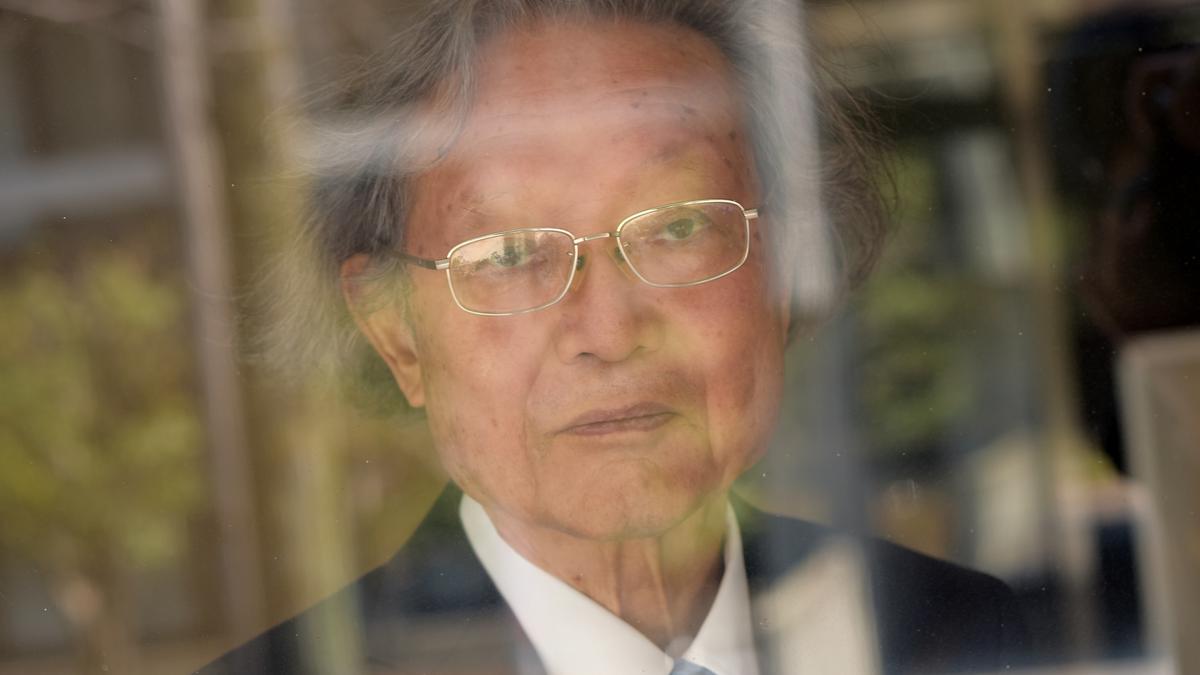
In March this year, the Japanese mathematician Masaki Kashiwara found out over a Zoom call that he had been awarded the Abel Prize, one of mathematics’ highest honours, for “his fundamental contributions to algebraic analysis and representation theory”.
Dr. Kashiwara had started developing parts of his Abel-winning work when he was 23. He is now 78.
At the time, enrolled as a postgraduate student at the University of Tokyo in Japan, he began working with D-modules — a way by which mathematicians can study a system of partial differential equations using the tools of algebra. These equations are commonly found across the sciences.
By 1980, Dr. Kashiwara had used his theory of D-modules to prove the Riemann-Hilbert correspondence — one of 23 famous problems posed by the German mathematician David Hilbert in 1900. (Three of Hilbert’s problems remain unsolved to this day.)
Such was the impact of this work that “Kashiwara could (even should) have won the Fields Medal already at the International Congress of Mathematicians … in 1982,” Dr. Pierre Schapira, a French mathematician who has collaborated with Kashiwara for over five decades, wrote in April this year. The Fields medal is another prestigious prize in mathematics but is reserved for those below the age of 40.
In 1982, the Medal went to Alain Connes, William Thurston, and Shing-Tung Yau. When Dr. Kashiwara did not win, Dr. Schapira speculated it was “because his work was too innovative to be understood at that time.”
And he was just getting started.
Riemann-Hilbert correspondence
Differential equations help us describe how one quantity changes with respect to another. For example, such an equation can be used to describe how a car’s speed changes vis-à-vis time. Solving this equation can help say whether the car is speeding up or slowing down at some point in time and by how much.
The Riemann-Hilbert correspondence is about a particular type of differential equations called linear partial differential equations.
Imagine you’re baking a cake. As the oven heats it from the outside, heat spreads inside the cake and different parts of the cake warm at different speeds. If you wanted to describe this, you’d need to know how temperature changes with time and how it changes at different points inside the cake. A partial differential equation is the mathematical way to keep track of all these changes at once.
When working on a mathematical equation, it is possible to encounter a solution that isn’t well defined. For example, the solution of the equation y = 1/x is not defined for x = 0. Such points are called singularities.
Partial differential equations have singularities, too.
![A graph depicting a singularity at [0, 0] for the function y^3 — x^2 = 0.](https://th-i.thgim.com/public/sci-tech/science/eyn90d/article70154466.ece/alternates/FREE_1200/output1.png "A graph depicting a singularity at [0, 0] for the function y^3 — x^2 = 0.")
A graph depicting a singularity at [0, 0] for the function y^3 — x^2 = 0.
| Photo Credit:
Image created with ChatGPT 5
And if you follow the solutions of a partial differential equation for points around a singularity, you encounter an effect called monodromy. Imagine a spiral staircase where each step is a point where the equation can be solved. At the centre of the spiral lies the singularity.
Because the solutions lie along a spiral staircase, taking one complete turn of the staircase won’t return you to the point where we started. Instead, you’ll have climbed a level higher or a level lower. This is like a monodromy. Specifically, a monodromy is when the solutions of a partial differential equation around a point behave differently when we return to it after having looped around a singularity.
When Hilbert proposed the Riemann-Hilbert correspondence, he knew that given a partial differential equation, one could identify its singularities and monodromies. He wondered if the opposite was true: that, given a singularity and a monodromy around it, would it be possible to determine the corresponding equation?
The Belgian mathematician Peter Deligne provided a proof of the Riemann-Hilbert correspondence in 1970. A decade later, two mathematicians — Zoghman Mebkhout and Dr. Kashiwara — independently proved it for settings more general than that considered by Deligne.
Dr. Kashiwara’s proof involved the theory of D-modules.

‘A new horizon’
Dr. Kashiwara’s work was a part of a larger project initiated by his advisor Mikio Sato, the Japanese mathematician credited with launching the field of algebraic analysis in 1959.
Algebra is the field of mathematics that deals with variables (e.g. x and y) and the relationships between them. Analysis is the field that tries to provide a theoretical foundation for calculus. Among other things, analysts are concerned with how to solve differential equations.
Even though they are common in the sciences, differential equations are known to be very hard to solve. In fact, barring some of the simplest cases, there exist no explicit formulae to crack them.
Sato’s algebraic analysis was an attempt to circumvent the need to solve individual differential equations. Instead, he wished to use the tools of algebra to study how certain kinds of partial differential equations behave.
This would help mathematicians study all solutions of a system of partial differential equations rather than individual solutions, Arvind Nair, a mathematician at the Tata Institute of Fundamental Research, Mumbai, said.
“Moving questions [of analysis] to algebra allows for the tools of algebra to be used” for studying partial differential equations, “which are often very powerful,” he added.
Algebraic analysis also sought to bridge two domains of mathematics — algebra and analysis — previously believed to be independent. As a result researchers could solve problems from one domain using the tools of the other.
In a 2024 paper, Schapira, Dr. Kashiwara’s collaborator, called this advance “a new horizon in mathematics”.
Dr. Kashiwara took Sato’s dream forward when he began working on D-modules as a student. According to Dr. Schapira, Dr. Kashiwara’s work on D-modules finally gave mathematicians “the tools to treat general systems of linear partial differential equations, as opposed to one equation with one unknown”.
That is, instead of trying to solve one partial differential equation in detail, D-modules allowed mathematicians to study how classes of such equations behaved in different conditions.
In his efforts, Dr. Kashiwara recast the Riemann-Hilbert correspondence as a correspondence between D-modules and mathematical objects called perverse sheaves. The latter is a way to represent systems of solutions of polynomial equations. A polynomial equation is an algebraic expression like x2 + y2 = 0.
“This can be thought of as a dictionary between two kinds of [mathematical] objects,” Dr. Nair said.
Hilbert’s version of this dictionary involved partial differential equations and a collection of singularities and monodromies around them.
Dr. Kashiwara’s reformulation also expanded the scope of the correspondence. According to Apoorva Khare, an associate professor of mathematics at the Indian Institute of Science, Bengaluru, “the original setting of the problem was far more restricted than the one Kashiwara solved the question in.”

Representation theory
About a decade after Dr. Kashiwara proved the Riemann-Hilbert correspondence, he made another big breakthrough, this time in a branch of mathematics called representation theory. Although it belongs to maths, representation theory is very important in physics too — especially quantum physics. In fact, physicists often use it as the language to describe the behaviour of basic particles like electrons and photons.
Representation theory takes complicated mathematical objects and expresses them in terms of simpler ones. A good example is groups. In maths, a group is the set of all the different ways you can change the position of an object — by rotating it, flipping it or moving it around. Each such change is called an element of the group.
Groups can be very hard to study because they carry so much information. To make them easier to handle, representation theory converts them into matrices, which are rectangular grids of numbers or symbols. The theory offers rules so that every element of the group corresponds to a specific matrix.
This idea of representing with matrices can be extended to other mathematical objects as well. One important example is the quantum group, created by mathematicians and physicists in the 1980s. This is where Dr. Kashiwara next made his mark.
Moving on a graph
In 1990, Dr. Kashiwara invented crystal bases, a new way to represent quantum groups. (MIT mathematics professor George Lusztig also independently invented crystal bases at the same time.)
Consider a two-dimensional space, like a graph with x- and y-axes. A point in this graph can be represented as a vector: an arrow that starts from the origin and ends at the point. These vectors can be expressed as a combination of movements along the x- and y-axes. For example, you can reach [5, 3] from [0, 0] by moving 5 units on the x-axis followed by 3 units on the y-axis.
Mathematicians call these unitary movements ‘bases’. According to Dr. Khare, Kashiwara turned the basis of quantum groups into graphs. It was a significant achievement because it created a “combinatorial tool that enabled the solution of many problems [of quantum groups] in representation theory,” per Kashiwara’s biography on the Abel Prize website.
Dr. Khare added that the technique made “computations on these objects easier” and that it yielded “more comprehensive information about quantum groups”.

Mathematicians around the world often use Dr. Kashiwara’s discoveries to push the boundaries of their disciplines. For example, Dr. Nair, the TIFR Mumbai mathematician, said he uses Dr. Kashiwara’s formulation of “the Riemann-Hilbert correspondence every day” in his work. Dr. Nair works on representation theory and algebraic geometry; the latter uses algebraic techniques to solve problems in geometry.
Perhaps Dr. Kashiwara’s biggest contribution is building bridges between different domains of mathematics. His work on D-modules, for example, bridges the study of differential equations with algebra and topology, the study of spaces that are not changed under certain kinds of deformations.
In doing so, it allows mathematicians to tackle problems in one domain with tools borrowed from a different domain — somewhat like how using Teflon coatings, originally made to protect aircraft, gave rise to diets with less cooking oil.
At 78, Dr. Kashiwara is still building these bridges for mathematics.
Sayantan Datta is a faculty member at Krea University and an independent science journalist. The author thanks Pierre Schapira (Sorbonne University) and K.N. Raghavan, Rishi Vyas, and Vivek Tewary (all at Krea University) for their inputs.