


Skip to content
  • Facebook
  • X
  • Linkedin
  • WhatsApp
  • YouTube
  • Associate Journalism
  • About Us
  • Privacy Policy
  • 033-46046046
  • editor@artifex.news
Artifex.News

Artifex.News

Stay Connected. Stay Informed.

  • Breaking News
  • World
  • Nation
  • Sports
  • Business
  • Science
  • Entertainment
  • Lifestyle
  • Toggle search form
  • He Conned Over 50 Women On Pretext Of Marriage, Including A Judge
    He Conned Over 50 Women On Pretext Of Marriage, Including A Judge Nation
  • Tabla Maestro Zakir Hussain, Legend With “Dancing Fingers”, Dies At 73
    Tabla Maestro Zakir Hussain, Legend With “Dancing Fingers”, Dies At 73 Nation
  • 192 Farmers Charged For Stubble Burning In Haryana
    192 Farmers Charged For Stubble Burning In Haryana Nation
  • Ambitious Ahmedabad eyes sporting history
    Ambitious Ahmedabad eyes sporting history Sports
  • Libya central bank ‘suspends all operations’ after official abduction
    Libya central bank ‘suspends all operations’ after official abduction World
  • In His Fifth Olympics, Sharath Kamal Feels His Best Is Yet To Come
    In His Fifth Olympics, Sharath Kamal Feels His Best Is Yet To Come Sports
  • Watch: Trump administration to defend H-1B visa changes in court
    Watch: Trump administration to defend H-1B visa changes in court World
  • US Supports Elon Musk’s Remarks On India’s Permanent UNSC Seat
    US Supports Elon Musk’s Remarks On India’s Permanent UNSC Seat Nation
Scientists turn E. coli bacteria into a mercury sensor

Scientists turn E. coli bacteria into a mercury sensor

Posted on August 17, 2025 By admin


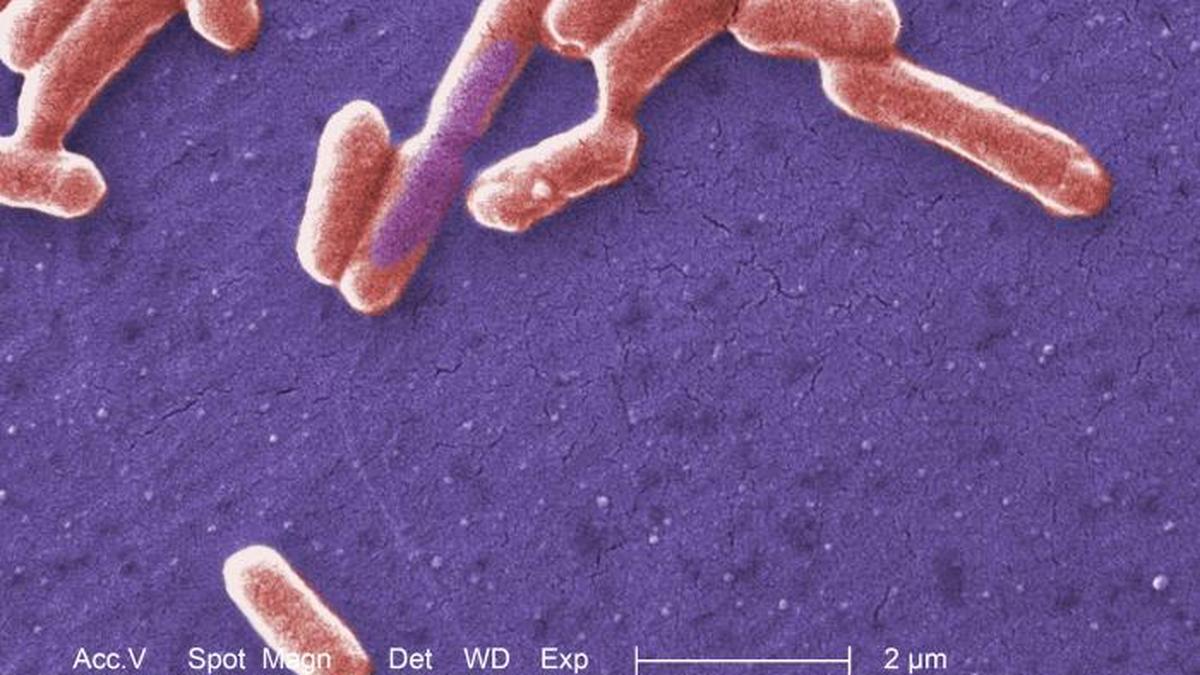
A scanning electron micrograph of Escherichia coli bacteria.
| Photo Credit: US CDC

In a step towards building cheap and programmable bioelectronic devices, Imperial College London and Zhejiang University researchers have shown in a new study that genetically engineered bacteria can be turned into self-powered chemical sensors that interface directly with electronics.

According to the authors, these new platforms are possible today thanks to advances in synthetic biology and bioelectrochemistry.

Traditional biosensors, such as those based on enzymes, are often fragile, costly and/or have a slow response time in complex environments. Whole-cell biosensors, which use living microorganisms, can maintain and repair themselves and operate inside contaminated samples. However, in most conventional designs, these biosensors’ output signals are in the optical range, which is harder to integrate into portable or field-deployable electronics.

In their study, the researchers built a modular biosensor that could sense the presence of specific compounds and convert that into an electrical signal, which is compatible with low-cost electronics.

The team used genetically engineered Escherichia coli bacteria as ‘containers’. The microbes hosted three biosensor modules. The sensing module detected a target chemical through specific molecular regulators. The information processing module amplified or processed the signal. And the output module produced phenazines, nitrogen-containing organic molecules that can be measured using an electrochemical technique called voltammetry.

This way, the researchers built two biosensors. The first one could detect arabinose, a simple plant sugar often used in lab media. When a sample containing the sugar came in contact with the bacteria, the cells started producing phenazine-1-carboxylic acid. When this molecule touched the electrode, the latter produced a current that rose with sugar level. The signal appeared in roughly two hours.

The second sensor detected mercury ions in water. Because these ions are present only in trace quantities in real-world water, the researchers added a genetic amplifier to the E. coli. When the mercury bound with a protein called MerR, the meeting triggered the production of a polymerase that pushed the phenazine production pathway into overdrive. As a result, just 25 nanomoles of mercury — below the WHO safety limit — produced a readable current within three hours.

The team also demonstrated an ‘AND’ logic gate inside E. coli, so that it produced a signal only when two specific molecules were present together.

The team thus established a proof of concept of a living, electronically integrated biosensor capable of detecting compounds in its surroundings, processing the signals, and supplying data.

Published – August 17, 2025 05:45 am IST


Source link

Science

Post navigation

Previous Post: Connexin proteins rally arteries to nourish brain on demand
Next Post: In letter to Putin, U.S. First Lady asks him to consider the children in push to end war in Ukraine

Related Posts

  • The mysterious fate of the Neanderthal Y chromosome
    The mysterious fate of the Neanderthal Y chromosome Science
  • Thanks to two special genes, a single atom can change the colour of a bird
    Thanks to two special genes, a single atom can change the colour of a bird Science
  • In pictures | Rare blue supermoon dazzles stargazers around the globe
    In pictures | Rare blue supermoon dazzles stargazers around the globe Science
  • The Science Quiz | Today is the 30th death anniversary of Karl Popper
    The Science Quiz | Today is the 30th death anniversary of Karl Popper Science
  • Space Wrap: Historic Vikram-1 launch puts Indian spaceflight back on track
    Space Wrap: Historic Vikram-1 launch puts Indian spaceflight back on track Science
  • How are hydrocarbons extracted from under the ground? | Explained
    How are hydrocarbons extracted from under the ground? | Explained Science

More Related Articles

What is the technology behind manufacturing a semiconductor chip? | Explained What is the technology behind manufacturing a semiconductor chip? | Explained Science
The Hindu Quiz on Space Shuttle disaster The Hindu Quiz on Space Shuttle disaster Science
How is global warming affecting sea breeze? How is global warming affecting sea breeze? Science
Model by Chennai, Pune team predicts birth weight from routine scans Model by Chennai, Pune team predicts birth weight from routine scans Science
Social relationships help vampire bats facilitate their unusual blood diets Social relationships help vampire bats facilitate their unusual blood diets Science
TB patients must also be screened for prediabetes  TB patients must also be screened for prediabetes  Science
SiteLock

Archives

  • October 2026
  • September 2026
  • August 2026
  • July 2026
  • June 2026
  • May 2026
  • April 2026
  • March 2026
  • February 2026
  • January 2026
  • December 2025
  • November 2025
  • October 2025
  • September 2025
  • August 2025
  • July 2025
  • June 2025
  • May 2025
  • April 2025
  • March 2025
  • February 2025
  • January 2025
  • December 2024
  • November 2024
  • October 2024
  • September 2024
  • August 2024
  • July 2024
  • June 2024
  • May 2024
  • April 2024
  • March 2024
  • February 2024
  • January 2024
  • December 2023
  • November 2023
  • October 2023
  • September 2023
  • August 2023
  • July 2023
  • June 2023
  • May 2023
  • April 2023
  • March 2023
  • February 2023
  • January 2023
  • December 2022
  • November 2022
  • October 2022
  • September 2022
  • August 2022
  • July 2022
  • June 2022
  • May 2022

Categories

  • Business
  • Nation
  • Science
  • Sports
  • World

Recent Posts

  • Saudi Supreme Court sets aside Sri Lankan migrant worker’s death penalty
  • Nedumbassery accident: CPI(M) stages protest march to police station over ‘indifference’ in handling of case
  • Why CJI Surya Kant said ‘no’ to Rahul Gandhi’s request to meet | Explained
  • September WPI Inflation rises to 11.39% as food, fuel and manufactured goods prices increase
  • Frankfurt-Delhi Air India flight diverted to Jaipur following bomb threat

Recent Comments

  1. RobertTes on UP Teacher Who Asked Students To Slap Muslim Classmate
  2. Manuelret on UP Teacher Who Asked Students To Slap Muslim Classmate
  3. RobertTes on UP Teacher Who Asked Students To Slap Muslim Classmate
  4. RobertTes on UP Teacher Who Asked Students To Slap Muslim Classmate
  5. BrentWes on UP Teacher Who Asked Students To Slap Muslim Classmate
  • Rajnath Singh Visits Maha Kumbh, Takes Holy Dip At Triveni Sangam
    Rajnath Singh Visits Maha Kumbh, Takes Holy Dip At Triveni Sangam Nation
  • Access Denied
    Access Denied Nation
  • Cricket World Cup – “Right At The Bottom…”: Afghanistan Coach Jonathan Trott Blasts Team’s Fielding After Loss To New Zealand
    Cricket World Cup – “Right At The Bottom…”: Afghanistan Coach Jonathan Trott Blasts Team’s Fielding After Loss To New Zealand Sports
  • Before refrigeration, how did seafarers preserve food on long voyages?
    Before refrigeration, how did seafarers preserve food on long voyages? Science
  • Pollution Curbs Under GRAP-3 Revoked In Delhi Amid Dip In Air Pollution Levels
    Pollution Curbs Under GRAP-3 Revoked In Delhi Amid Dip In Air Pollution Levels Nation
  • India is going ‘beyond advocacy’ on the Russia-Ukraine conflict: Jaishankar
    India is going ‘beyond advocacy’ on the Russia-Ukraine conflict: Jaishankar World
  • Access Denied
    Access Denied Nation
  • Access Denied World

Editor-in-Chief:
Mohammad Ariff,
MSW, MAJMC, BSW, DTL, CTS, CNM, CCR, CAL, RSL, ASOC.
editor@artifex.news

Associate Editors:
1. Zenellis R. Tuba,
zenelis@artifex.news
2. Haris Daniyel
daniyel@artifex.news

Photograher:
Rohan Das
rohan@artifex.news

Associate Journalists
1. Subrata Paul - AN/2020/01
2. Quamruz Zaman - AN/2021/22
3. Ahmed Sha - AN/2021/035
4. Ajay Kumar Shaw - AN/2021/39
5. Tahqiqul Hoda - AN/2021/21

Artifex.News offers Online Paid Internships to college students from India and Abroad. Interns will get a PRESS CARD and other online offers.
Send your CV (Subjectline: Paid Internship) to internship@artifex.news

Links:
Associate Journalism
About Us
Privacy Policy

News Links:
Breaking News
World
Nation
Sports
Business
Entertainment
Lifestyle

Registered Office:
72/A, Elliot Road, Kolkata - 700016
Tel: 033-22277777, 033-22172217
Email: office@artifex.news

Editorial Office / News Desk:
No. 13, Mezzanine Floor, Esplanade Metro Rail Station,
12 J. L. Nehru Road, Kolkata - 700069.
(Entry from Gate No. 5)
Tel: 033-46011099, 033-46046046
Email: editor@artifex.news

Copyright © 2023 Artifex.News Newsportal designed by Artifex Infotech.