


Skip to content
  • Facebook
  • X
  • Linkedin
  • WhatsApp
  • YouTube
  • Associate Journalism
  • About Us
  • Privacy Policy
  • 033-46046046
  • editor@artifex.news
Artifex.News

Artifex.News

Stay Connected. Stay Informed.

  • Breaking News
  • World
  • Nation
  • Sports
  • Business
  • Science
  • Entertainment
  • Lifestyle
  • Toggle search form
  • Access Denied
    Access Denied Nation
  • Caterpillars may sense threats using electric fields
    Caterpillars may sense threats using electric fields Science
  • Dry weather threatens Ivory Coast cocoa crop, farmers say
    Dry weather threatens Ivory Coast cocoa crop, farmers say Science
  • Cracks On Atal Setu, Alleges Mumbai Congress Chief. BJP Hits Back
    Cracks On Atal Setu, Alleges Mumbai Congress Chief. BJP Hits Back Nation
  • Avinash Sable Finishes Ninth In His Maiden Diamond League Final
    Avinash Sable Finishes Ninth In His Maiden Diamond League Final Sports
  • Israeli strike on hospital tent camp in Gaza kills 4 and ignites a fire that burns dozens
    Israeli strike on hospital tent camp in Gaza kills 4 and ignites a fire that burns dozens World
  • “Mumbai Cha Yoddha”: Rohit Sharma, Sachin Tendulkar’s Praise For Dhawal Kulkarni After Ranji Trophy Win
    “Mumbai Cha Yoddha”: Rohit Sharma, Sachin Tendulkar’s Praise For Dhawal Kulkarni After Ranji Trophy Win Sports
  • Access Denied World
Scientists turn E. coli bacteria into a mercury sensor

Scientists turn E. coli bacteria into a mercury sensor

Posted on August 17, 2025 By admin


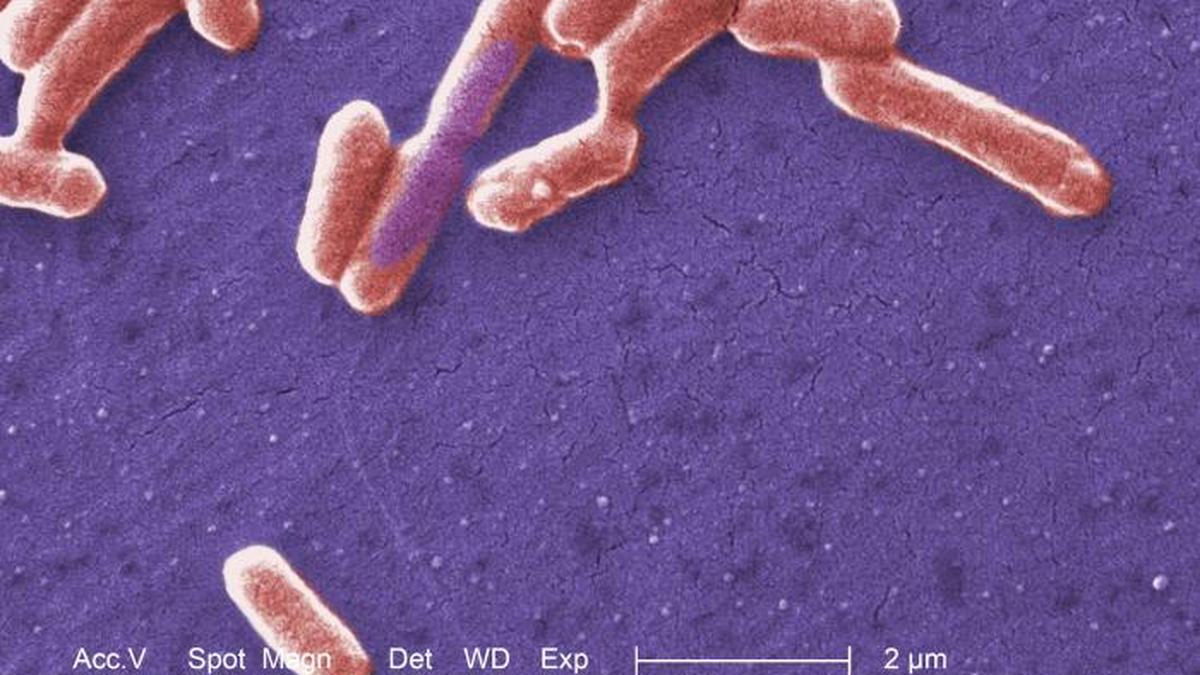
A scanning electron micrograph of Escherichia coli bacteria.
| Photo Credit: US CDC

In a step towards building cheap and programmable bioelectronic devices, Imperial College London and Zhejiang University researchers have shown in a new study that genetically engineered bacteria can be turned into self-powered chemical sensors that interface directly with electronics.

According to the authors, these new platforms are possible today thanks to advances in synthetic biology and bioelectrochemistry.

Traditional biosensors, such as those based on enzymes, are often fragile, costly and/or have a slow response time in complex environments. Whole-cell biosensors, which use living microorganisms, can maintain and repair themselves and operate inside contaminated samples. However, in most conventional designs, these biosensors’ output signals are in the optical range, which is harder to integrate into portable or field-deployable electronics.

In their study, the researchers built a modular biosensor that could sense the presence of specific compounds and convert that into an electrical signal, which is compatible with low-cost electronics.

The team used genetically engineered Escherichia coli bacteria as ‘containers’. The microbes hosted three biosensor modules. The sensing module detected a target chemical through specific molecular regulators. The information processing module amplified or processed the signal. And the output module produced phenazines, nitrogen-containing organic molecules that can be measured using an electrochemical technique called voltammetry.

This way, the researchers built two biosensors. The first one could detect arabinose, a simple plant sugar often used in lab media. When a sample containing the sugar came in contact with the bacteria, the cells started producing phenazine-1-carboxylic acid. When this molecule touched the electrode, the latter produced a current that rose with sugar level. The signal appeared in roughly two hours.

The second sensor detected mercury ions in water. Because these ions are present only in trace quantities in real-world water, the researchers added a genetic amplifier to the E. coli. When the mercury bound with a protein called MerR, the meeting triggered the production of a polymerase that pushed the phenazine production pathway into overdrive. As a result, just 25 nanomoles of mercury — below the WHO safety limit — produced a readable current within three hours.

The team also demonstrated an ‘AND’ logic gate inside E. coli, so that it produced a signal only when two specific molecules were present together.

The team thus established a proof of concept of a living, electronically integrated biosensor capable of detecting compounds in its surroundings, processing the signals, and supplying data.

Published – August 17, 2025 05:45 am IST


Source link

Science

Post navigation

Previous Post: Connexin proteins rally arteries to nourish brain on demand
Next Post: In letter to Putin, U.S. First Lady asks him to consider the children in push to end war in Ukraine

Related Posts

  • New research traces how Africa’s wildcats became today’s house cats
    New research traces how Africa’s wildcats became today’s house cats Science
  • Tropical birds show signs of mercury contamination, due to artisanal gold mining operations: Study
    Tropical birds show signs of mercury contamination, due to artisanal gold mining operations: Study Science
  • An energy transition driven by ethics
    An energy transition driven by ethics Science
  • How deep in the ocean does life exist?
    How deep in the ocean does life exist? Science
  • ISRO signs implementing agreement with Australian Space Agency for Gaganyaan mission
    ISRO signs implementing agreement with Australian Space Agency for Gaganyaan mission Science
  • Optical biosensor rapidly detects monkeypox virus
    Optical biosensor rapidly detects monkeypox virus Science

More Related Articles

Why is India on the U.S. blacklist on fentanyl? | Explained Why is India on the U.S. blacklist on fentanyl? | Explained Science
Why can we recycle only some kinds of plastics? Why can we recycle only some kinds of plastics? Science
Diversity, social impact open gates for non-scientists in venerable science academy Diversity, social impact open gates for non-scientists in venerable science academy Science
Rampant development, not climate, pushing Himalaya to the edge Rampant development, not climate, pushing Himalaya to the edge Science
Bengaluru scientists develop affordable fruit fly trap; seek global patents Bengaluru scientists develop affordable fruit fly trap; seek global patents Science
Indian scientists build breakthrough gene-editor, aim for patent Indian scientists build breakthrough gene-editor, aim for patent Science
SiteLock

Archives

  • May 2026
  • April 2026
  • March 2026
  • February 2026
  • January 2026
  • December 2025
  • November 2025
  • October 2025
  • September 2025
  • August 2025
  • July 2025
  • June 2025
  • May 2025
  • April 2025
  • March 2025
  • February 2025
  • January 2025
  • December 2024
  • November 2024
  • October 2024
  • September 2024
  • August 2024
  • July 2024
  • June 2024
  • May 2024
  • April 2024
  • March 2024
  • February 2024
  • January 2024
  • December 2023
  • November 2023
  • October 2023
  • September 2023
  • August 2023
  • July 2023
  • June 2023
  • May 2023
  • April 2023
  • March 2023
  • February 2023
  • January 2023
  • December 2022
  • November 2022
  • October 2022
  • September 2022
  • August 2022
  • July 2022
  • June 2022
  • May 2022

Categories

  • Business
  • Nation
  • Science
  • Sports
  • World

Recent Posts

  • Donald Trump lands in Beijing for vital talks with Xi Jinping
  • Shrimp feed manufacturers put on hold price hike following govt.’s intervention
  • Refurbished Bharat Scouts and Guides Training Centre inaugurated at Papanasam
  • King’s Speech outlines U.K. govt. agenda as Starmer’s future hangs in the balance
  • Shots heard at Philippine Senate as lawmaker wanted by ICC holds out; no casualties reported

Recent Comments

  1. NathanJobre on UP Teacher Who Asked Students To Slap Muslim Classmate
  2. DavidNup on UP Teacher Who Asked Students To Slap Muslim Classmate
  3. JeffryFok on UP Teacher Who Asked Students To Slap Muslim Classmate
  4. Jesusetexy on UP Teacher Who Asked Students To Slap Muslim Classmate
  5. WilliamGoT on UP Teacher Who Asked Students To Slap Muslim Classmate
  • Byelection: BJP defeat has again exposed party’s lack of focus on strengthening cadre
    Byelection: BJP defeat has again exposed party’s lack of focus on strengthening cadre Nation
  • Access Denied World
  • Former Iraq President named U.N. refugee chief
    Former Iraq President named U.N. refugee chief World
  • Delhi to host 2026 Commonwealth Table Tennis Championship
    Delhi to host 2026 Commonwealth Table Tennis Championship Nation
  • KTR’s Arrest Dare To Telangana Chief Minister
    KTR’s Arrest Dare To Telangana Chief Minister Nation
  • Vedanta to proceed with dollar bond sale in first post-Adani India credit test
    Vedanta to proceed with dollar bond sale in first post-Adani India credit test Business
  • No accord on plastic pollution deal, more time needed: chair
    No accord on plastic pollution deal, more time needed: chair World
  • Kenya starvation cult leader goes on trial on terrorism charges
    Kenya starvation cult leader goes on trial on terrorism charges World

Editor-in-Chief:
Mohammad Ariff,
MSW, MAJMC, BSW, DTL, CTS, CNM, CCR, CAL, RSL, ASOC.
editor@artifex.news

Associate Editors:
1. Zenellis R. Tuba,
zenelis@artifex.news
2. Haris Daniyel
daniyel@artifex.news

Photograher:
Rohan Das
rohan@artifex.news

Artifex.News offers Online Paid Internships to college students from India and Abroad. Interns will get a PRESS CARD and other online offers.
Send your CV (Subjectline: Paid Internship) to internship@artifex.news

Links:
Associate Journalism
About Us
Privacy Policy

News Links:
Breaking News
World
Nation
Sports
Business
Entertainment
Lifestyle

Registered Office:
72/A, Elliot Road, Kolkata - 700016
Tel: 033-22277777, 033-22172217
Email: office@artifex.news

Editorial Office / News Desk:
No. 13, Mezzanine Floor, Esplanade Metro Rail Station,
12 J. L. Nehru Road, Kolkata - 700069.
(Entry from Gate No. 5)
Tel: 033-46011099, 033-46046046
Email: editor@artifex.news

Copyright © 2023 Artifex.News Newsportal designed by Artifex Infotech.