


Skip to content
  • Facebook
  • X
  • Linkedin
  • WhatsApp
  • YouTube
  • Associate Journalism
  • About Us
  • Privacy Policy
  • 033-46046046
  • editor@artifex.news
Artifex.News

Artifex.News

Stay Connected. Stay Informed.

  • Breaking News
  • World
  • Nation
  • Sports
  • Business
  • Science
  • Entertainment
  • Lifestyle
  • Toggle search form
  • Access Denied World
  • Arvind Kejriwal Hits Out At Ashok Gehlot
    Arvind Kejriwal Hits Out At Ashok Gehlot Nation
  • As Assam floodwaters recede, focus on relief for animals
    As Assam floodwaters recede, focus on relief for animals Nation
  • French President Emmanuel Macron Says He Was Not Aware Of Telegram Chief Pavel Durov’s Arrival In France
    French President Emmanuel Macron Says He Was Not Aware Of Telegram Chief Pavel Durov’s Arrival In France World
  • Myanmar fighters agree China-brokered pullout from ruby town
    Myanmar fighters agree China-brokered pullout from ruby town World
  • Access Denied Sports
  • Access Denied Business
  • Sukirt and Rathva engineer Baroda’s recovery against Tamil Nadu
    Sukirt and Rathva engineer Baroda’s recovery against Tamil Nadu Sports
NASA’s Voyager 1 reaches one light-day from Earth on November 18: What does it mean?

NASA’s Voyager 1 reaches one light-day from Earth on November 18: What does it mean?

Posted on November 18, 2026 By admin


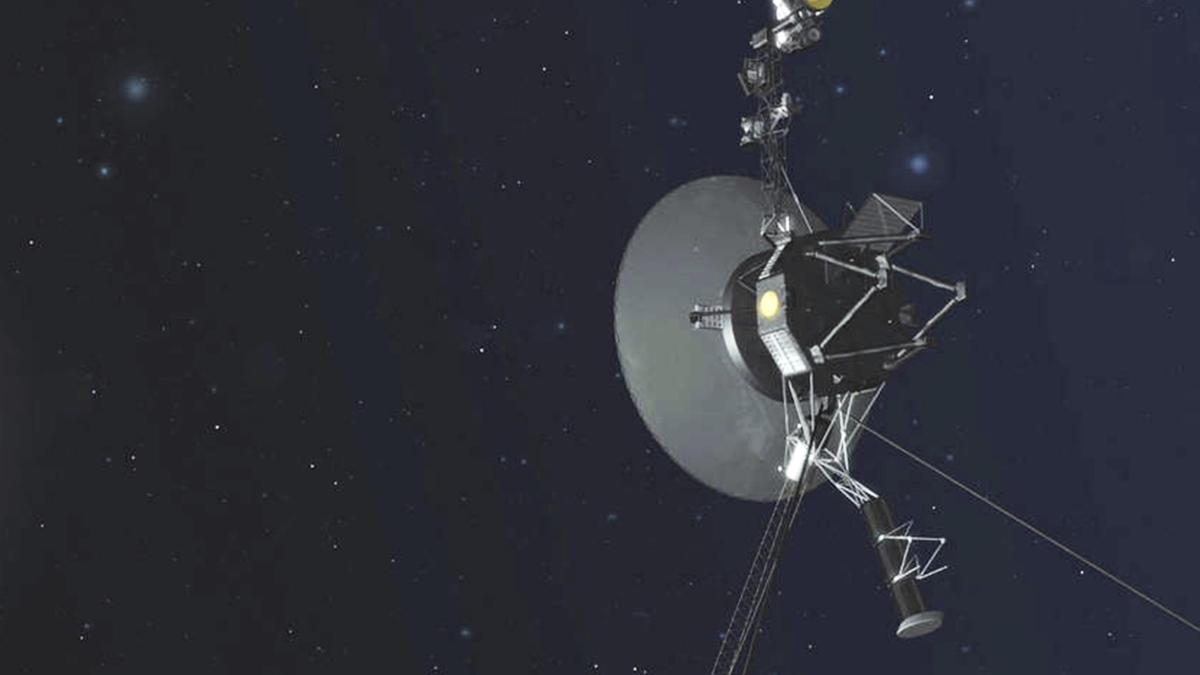
NASA’s Voyager 1 is set to cross a historic threshold in space exploration as it is about to become humanity’s first object to reach one light-day from Earth. The iconic probe, which has travelled farther from Earth than any other human-made object since its launch in 1977, is expected to cross the landmark on Wednesday (November 18, 2026) at 5:16:07 a.m. EST (3:46:07 p.m. IST), according to NASA.

Infographics: Voyager I’s 49-year journey into the void

Having spent 49 years, two months and 11 days hurtling through the cosmos, Voyager 1 continues to push the boundaries of human space exploration.

What does one light-day mean?

One light-day is a staggering measure of distance, rather than a measure of time. It represents the exact space that light, which travels at roughly 186,000 miles (300,000 kilometres) per second, covers in a full 24-hour period.

For Voyager 1, this is equivalent to more than 16 billion miles away from Earth.

When Voyager 1 reaches that incredible milestone on November 18, its radio signals will take precisely 24 hours travelling at the speed of light to reach Earth — in other words, one light-day.

Sunlight takes just over eight minutes to reach Earth, and over four hours and 10 minutes to reach Neptune. From November 18, any radio command sent from NASA’s Deep Space Network to Voyager 1 will take a full 24 hours to arrive, requiring another 24 hours for the spacecraft’s response to return.

Humanity’s farthest aircraft

Launched on September 2, 1977, Voyager 1 was originally designed for a four-year mission to study Jupiter and Saturn. Its trajectory eventually allowed it to overtake its twin, Voyager 2, which was launched 16 days earlier. According to NASA, Voyager 2 is expected to reach the one-light-day distance from Earth in November 2035.

The two spacecrafts were launched to explore the outer planets, with Voyager 1 taking a trajectory that eventually carried it towards interstellar space. It became the first spacecraft that entered the interstellar space in August 2012 and has continued transmitting information from beyond the solar system. Today, it speeds onward at roughly 38,000 miles per hour.

In 1990, Voyager 1 captured the most distant image of Earth, known as the iconic “Pale Blue Dot,” while venturing farther than any other human-made object beyond Neptune.

NASA said Voyager 1 is currently travelling in the direction of a star known as AC +79 3888, or Gliese 445, located more than 17 light-years from Earth in the constellation Ursa Minor.

How NASA is keeping the ageing spacecraft alive?

Powered by decaying plutonium generators, Voyager 1 loses a small amount of electrical power every year. With this plutonium supply continually depleting, both probes lose about 4 watts of power each year.

To extend its lifespan, engineers at NASA’s Jet Propulsion Laboratory have systematically shut down non-essential heaters and science instruments, including turning off another instrument earlier this year to conserve energy.

The mission team, now a small crew assisted by retired original engineers, sends commands once a week. Despite age-related glitches, such as the recent communication disruption in October 2026, Voyager 1 continues to be resilient.

As John Casani, the mission’s original project manager, put it, “We didn’t design them to last 30 years or 40 years, we designed them not to fail.”

NASA’s global celebration

To mark the historic moment, NASA has invited people worldwide to participate in “Shine Bright for Voyager’s Light-Day.”

NASA urged people from all corners to grab their phones or a flashlight to create a wave of golden light after sunset on Tuesday (November 17), using Morse code to spell the letters V-G-R, Voyager’s call sign, into the night sky.

Published – November 18, 2026 07:00 am IST


Source link

Science

Post navigation

Previous Post: फांसी की सजा पर रस्साकशी : मृत्युदंड पर रोक के खिलाफ भारत का मतदान
Next Post: World needs peace, stability, predictability: Modi in Manila

Related Posts

  • Sci-Five | The Hindu Science Quiz: On Gharials
    Sci-Five | The Hindu Science Quiz: On Gharials Science
  • Quantum shift: On private industry and national research spending
    Quantum shift: On private industry and national research spending Science
  • Inadequate sleep increases the risk of fatty liver disease
    Inadequate sleep increases the risk of fatty liver disease Science
  • In Japan, a third of today’s 18-year-old women may not have children: Study
    In Japan, a third of today’s 18-year-old women may not have children: Study Science
  • SpaceX took oxygen leak before Axiom-4 launch ‘lightly’: ISRO Chairman
    SpaceX took oxygen leak before Axiom-4 launch ‘lightly’: ISRO Chairman Science
  • 1998 Pokhran nuclear tests reflected India’s scientific excellence: PM on National Technology Day
    1998 Pokhran nuclear tests reflected India’s scientific excellence: PM on National Technology Day Science

More Related Articles

What is post-stroke depression and how can we address it? | Explained What is post-stroke depression and how can we address it? | Explained Science
Stealing behaviour influenced by emotional instability: NIMHANS study Stealing behaviour influenced by emotional instability: NIMHANS study Science
As in Kerala, local climate processes can worsen climate extremes | Analysis As in Kerala, local climate processes can worsen climate extremes | Analysis Science
Inside a scientific experiment that transformed skin cells into embryo-forming eggs Inside a scientific experiment that transformed skin cells into embryo-forming eggs Science
Rapid Himalayan erosion triggers hidden source of CO2: study Rapid Himalayan erosion triggers hidden source of CO2: study Science
Kids exposed to Zika in the womb show development delays Kids exposed to Zika in the womb show development delays Science
SiteLock

Archives

  • November 2026
  • October 2026
  • September 2026
  • August 2026
  • July 2026
  • June 2026
  • May 2026
  • April 2026
  • March 2026
  • February 2026
  • January 2026
  • December 2025
  • November 2025
  • October 2025
  • September 2025
  • August 2025
  • July 2025
  • June 2025
  • May 2025
  • April 2025
  • March 2025
  • February 2025
  • January 2025
  • December 2024
  • November 2024
  • October 2024
  • September 2024
  • August 2024
  • July 2024
  • June 2024
  • May 2024
  • April 2024
  • March 2024
  • February 2024
  • January 2024
  • December 2023
  • November 2023
  • October 2023
  • September 2023
  • August 2023
  • July 2023
  • June 2023
  • May 2023
  • April 2023
  • March 2023
  • February 2023
  • January 2023
  • December 2022
  • November 2022
  • October 2022
  • September 2022
  • August 2022
  • July 2022
  • June 2022
  • May 2022

Categories

  • Business
  • Nation
  • Science
  • Sports
  • World

Recent Posts

  • Cyclone ‘Akvan’ LIVE: Landfall process begins; coastal Odisha districts receive heavy rain
  • U.S. religious freedom panel says India is targeting minorities in voter roll revisions
  • IND vs NZ, 1st Test: New Zealand 317-6 at lunch on day 2 after Phillips century against India
  • Cyclone Akvan: Landfall process begins
  • Mahua Moitra alleges attack on her convoy by BJP supporters

Recent Comments

  1. BrainSlusy on UP Teacher Who Asked Students To Slap Muslim Classmate
  2. BrainSlusy on UP Teacher Who Asked Students To Slap Muslim Classmate
  3. BrainSlusy on UP Teacher Who Asked Students To Slap Muslim Classmate
  4. JasonkaK on UP Teacher Who Asked Students To Slap Muslim Classmate
  5. Robertchoib on UP Teacher Who Asked Students To Slap Muslim Classmate
  • The hidden polluter in your wardrobe: How fast fashion is fuelling the next pollution crisis
    The hidden polluter in your wardrobe: How fast fashion is fuelling the next pollution crisis Science
  • CIEL HR Services mops up ₹30 crore from Zoho, Pegasus, others in pre-IPO round
    CIEL HR Services mops up ₹30 crore from Zoho, Pegasus, others in pre-IPO round Business
  • Access Denied World
  • Malaysian Doubles Coach Tan Kim Her Returns For Second Stint
    Malaysian Doubles Coach Tan Kim Her Returns For Second Stint Sports
  • Access Denied
    Access Denied Nation
  • Trump’s ‘Monaco’ Vision For Gaza Is As Tone-Deaf As It Can Get
    Trump’s ‘Monaco’ Vision For Gaza Is As Tone-Deaf As It Can Get World
  • Access Denied World
  • Access Denied Sports

Editor-in-Chief:
Mohammad Ariff,
MSW, MAJMC, BSW, DTL, CTS, CNM, CCR, CAL, RSL, ASOC.
editor@artifex.news

Associate Editors:
1. Zenellis R. Tuba,
zenelis@artifex.news
2. Haris Daniyel
daniyel@artifex.news

Photograher:
Rohan Das
rohan@artifex.news

Associate Journalists
1. Subrata Paul - AN/2020/01
2. Quamruz Zaman - AN/2021/22
3. Ahmed Sha - AN/2021/035
4. Ajay Kumar Shaw - AN/2021/39
5. Tahqiqul Hoda - AN/2021/21

Artifex.News offers Online Paid Internships to college students from India and Abroad. Interns will get a PRESS CARD and other online offers.
Send your CV (Subjectline: Paid Internship) to internship@artifex.news

Links:
Associate Journalism
About Us
Privacy Policy

News Links:
Breaking News
World
Nation
Sports
Business
Entertainment
Lifestyle

Registered Office:
72/A, Elliot Road, Kolkata - 700016
Tel: 033-22277777, 033-22172217
Email: office@artifex.news

Editorial Office / News Desk:
No. 13, Mezzanine Floor, Esplanade Metro Rail Station,
12 J. L. Nehru Road, Kolkata - 700069.
(Entry from Gate No. 5)
Tel: 033-46011099, 033-46046046
Email: editor@artifex.news

Copyright © 2023 Artifex.News Newsportal designed by Artifex Infotech.