



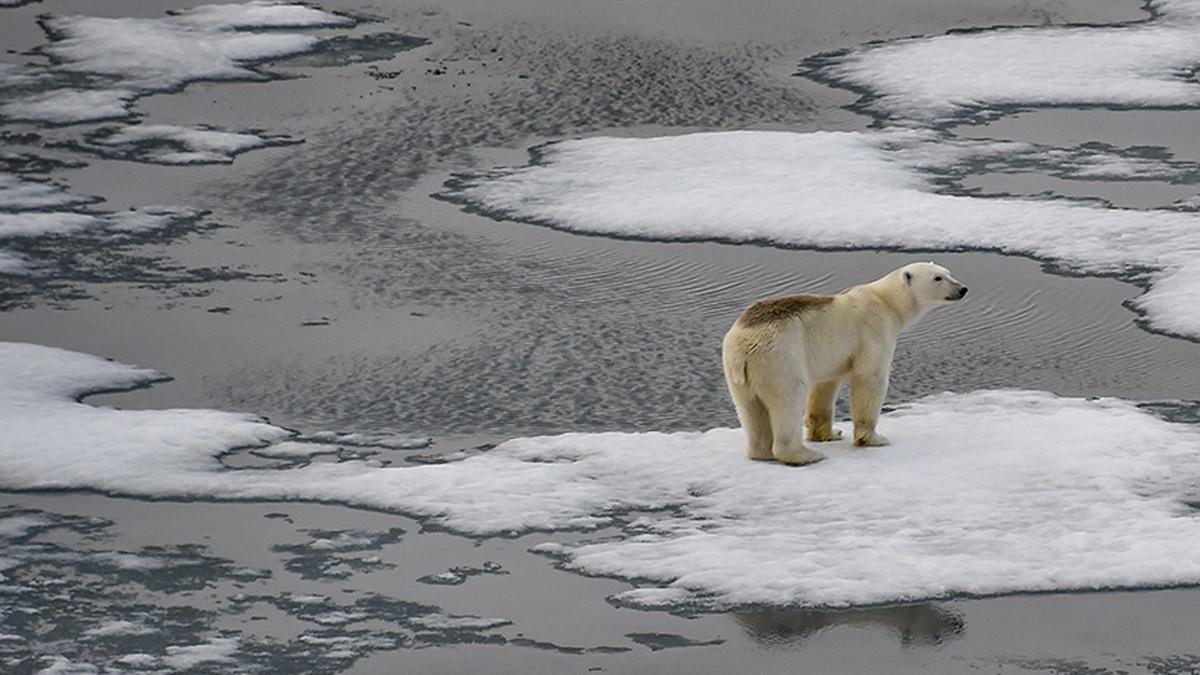
In this photo taken on August 17, 2021, a polar bear is seen on ice floes in the British Channel in the Franz Josef Land archipelago.
| Photo Credit: AFP
The decision was expected to take minutes. But after nearly three years of debate, members of the world’s leading authority on climate change still can’t agree on a timeline to publish its next review of the latest science on the warming planet.
Such assessments from the Intergovernmental Panel on Climate Change (IPCC) have informed every major United Nations climate agreement for three decades. But the impasse over publication dates could leave countries to decide the next phase of action without consensus on critical issues – including the extent to which some global warming might be reversible – according to interviews with more than a dozen current and former IPCC scientists, government negotiators and meeting observers.
On October 12, representatives from the IPCC’s 195 member states are expected to have convened in Addis Ababa, Ethiopia’s capital, for a plenary meeting many see as the last chance to agree publication dates falling before UN climate talks in November 2028. That’s when governments are due to assess progress toward goals set out in the landmark agreement reached in Paris in 2015.
The possibility the IPCC’s reports might not be ready in time for the 2028 talks has alarmed a coalition of countries pushing for more robust action. Those discussions are intended to guide decisions on climate financing and national targets to bring down greenhouse gas emissions.
Countries including India, Kenya, Saudi Arabia, Russia, and China are pressing for more time to prepare the IPCC’s next reports to ensure scientists from less-resourced countries can make meaningful contributions. Some struggle to publish new research in time to be included or to take time off from their regular jobs for unpaid IPCC work, they say.
The deadlock – unprecedented in the IPCC’s history – comes as the organisation faces increasing pressure from governments critical of climate policies they say hurt industrial competitiveness or restrict the ability of emerging economies to use cheaper, more polluting fuels to meet development needs. The United States, the IPCC’s biggest funder, quit the organisation in January.
The IPCC will publish three key reports: one on the extent and causes of climate change, another on vulnerabilities and how countries can adapt, and a third on options to avoid warming getting worse. Scientists chairing groups preparing the reports have proposed a work plan that would see all three approved by September 2028.
Robert Vautard, a French co-chair, said the proposal was based on the anticipated workload rather than the timing of the 2028 UN summit. Report timelines are typically approved in “a matter of minutes,” he added.
Opponents of the chairs’ proposal want the second and third reports pushed into 2029.
Thiagarajan Jayaraman, a scientist who represents India at the IPCC, said it was “short-sighted” to suggest the value of the body’s work rests solely on contributing to the 2028 UN talks.
Developing countries have long argued their perspectives are not sufficiently reflected in IPCC reports because they do not have enough experts involved and because their researchers have fewer resources to publish peer-reviewed studies.
The result, Thiagarajan said, is that issues of “equity and inclusivity” are in some instances “simply ducked.”
Published – October 12, 2026 03:32 pm IST