




Well after a few months of a hectic summer, rains are here. The campus is green and nature is once again abundant. With rains, however, has also come a usual game of hide and seek. Every time I take my umbrella out, the rain is nowhere to be seen. But when I forget it, I am greeted by sudden bouts of rain spoiling my ambition to reach my class dry and tidy.
Umbrellas, however, have something amazing about them. You press a button and it automatically opens up, stretches itself, and unfolds into a shade, growing much larger than it was. Like a magical genie.
Have you wondered how an umbrella works? You only applied a small amount of energy to push the button. Where did it get all this energy to open up so big?
As always, we are on the cusp of some beautiful physics.
Spring forth
If you have ever broken up an umbrella, you will have seen a spring inside the main rod. That is the most crucial piece.
Springs are usually metal wires winded in a spiral, giving it a remarkable mechanical property: it becomes a ‘mechanical battery’. Just like batteries allow us to store electrical energy, springs allow us to store mechanical energy. Once pressed, the springs try to come back to their original size and exert a force on its end.
How much force? That depends on how much you have compressed it. The more you compress, the greater the force. The British physicist Robert Hooke discovered this 350 years ago; the relationship between the compression and the force is today called Hooke’s law.
Incidentally, you must have seen batteries and springs together. Where? Well, everytime you try to fit a battery in the sockets in a remote control. The spring keeps the battery snug and tight, and the fact that it is made of metal allows for electrons to easily flow into a circuit from the battery through the spring.
The strength of springs are often quoted in newtons per millimetre, or N/mm. Here, ‘newton’ is the unit of force and ‘metres’ is the unit of distance. A newton is about the force a medium-sized apple exerts on your hand. You can easily see a millimetre on a regular stationery scale. Now, a usual spring you may have seen in a battery socket faces about 1 N/mm. So when you try to tuck a battery in, that battery compresses the spring and the spring in turn pushes on the battery by about one newton of force, to keep it in its place, so that it doesn’t fall, and keeps the circuit connected.
But that’s just one spring you see. You are in fact surrounded by springs, just that they are hidden. The sofa you sit on while entertaining a guest, the mattress you collapse on after a day of office work, and even your car or your scooter where you spend hours managing rainy-season potholes — all of them have several springs to make sure you are comfortable.
If you have ever paid close attention to our trains or metro rails, you might have noticed large springs under the coaches or hanging on the top. These springs help stabilise the train as it moves over uneven terrain. And they can reach up to strengths of hundreds of N/mm.
Now, even though you may have noticed the spring, the real physics question is why it stores any energy at all. And what type of force does it exert?
Forces in nature
In physics, we think of four fundamental forces. One is the electromagnetic force, which decides how electric charges move and magnets attract. The second is the gravitational force, due to which we don’t fly off and remain stuck to the ground. The two other forces are called strong and weak forces: they work at very small distances, like inside the nucleus of an atom.
The force created by springs doesn’t seem to be any of these four options. So what is it?
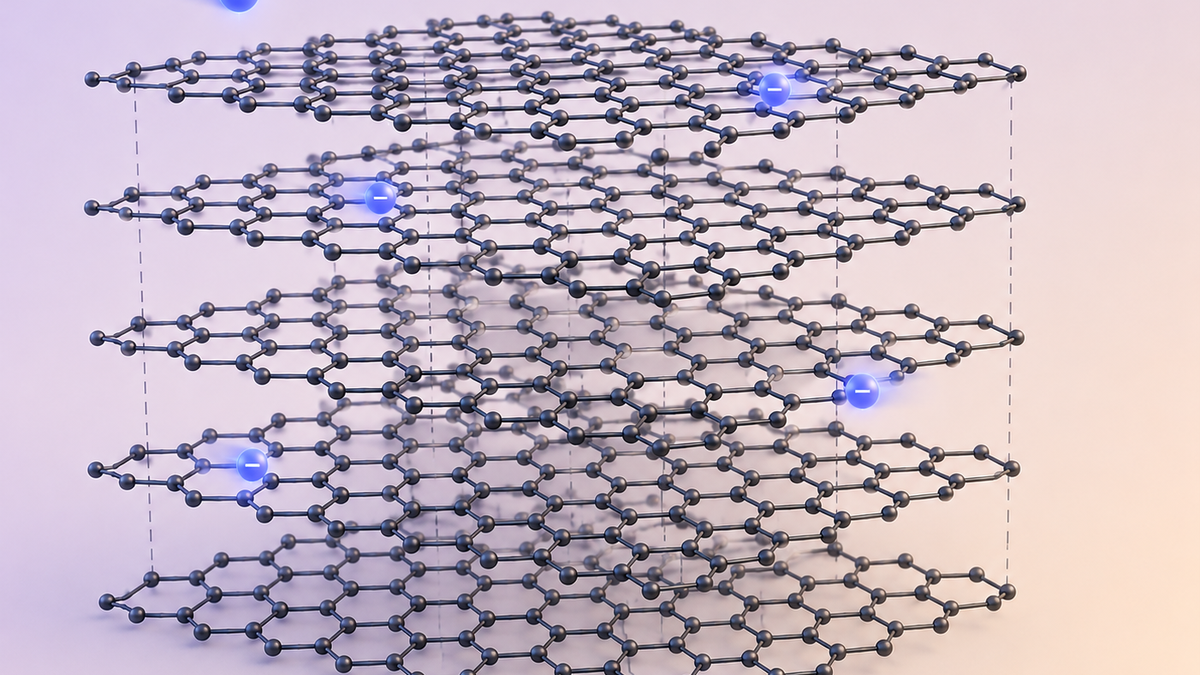
Turns out even the spring’s force is secretly an electromagnetic force. Think of any metal, say aluminium. It has billions of aluminium atoms arranged like oranges on fruit carts. These atoms have a massive positively charged nucleus and negatively charged electrons that are very light. Electromagnetism teaches us that positively charged particles repel each other while positives and negatives attract. Now, in a metal, even though the atoms stay in their places, the electrons move around, spending their time near whichever atom they like.
The atoms are like residents in a colony who don’t get along with each other. But then all of them have kids (the electrons), which form a group and love to hangout at all the houses in the neighborhood. And the kids are loved by all and everyone takes care of them. So the kids hold the whole neighborhood together.
But remember: the nucleus of the two atoms still repel each other since they are both positively charged. So the atoms strike a deal. The two nuclei of atoms decide to build homes at some convenient distance where they can tolerate each other even while their electrons can happily move between the houses.
Now, when you try to push any material from one side, the distances between these atoms become squished. The positively charged nuclei come closer than they want to, and since positive charges repel each other, they now push back. This is how the elastic force of any material arises.
Vibrations and sound
Now, while one spring can push back, a lot of them arranged together in a material can do something more: they can vibrate together.
Think of a sofa with many springs beneath. When you jump at one end (of course you need to ignore the possibility of damaging it permanently), you can feel the whole bed vibrating even at the other end. The same thing happens in water when you drop a stone at one point. Water molecules vibrate and push and pull on nearby molecules as well, leading to a ripple.
Even in a solid material like iron or aluminum, when we strike one end, we make small changes to the position of atoms at that point. These atoms push and pull nearby atoms using those elastic forces. These vibrations can move at very high speed throughout the material. They are called sound waves. If a steel plate falls from your hand on the floor, the vibrations and sound you hear moves through the plate at a speed of about 20,000 km/hr and reaches you over air molecules at about 1,000 km/hr.
Sound and superconductivity
It may seem that the vibrations of positively charged atoms and the movement of negatively charged electrons do not bother each other much. And they do not, at least not significantly, when they are at room temperature. This is why metals behave like metals when we see them. But when the temperature drops, atoms and electrons can do funny things. For instance, atoms can conspire to generate attraction between two negatively charged electrons.
Imagine two atoms (neighbours) that move closer together using the spring that connects them, to attract a few kids to their garden for a moment. Now, once one electron (Bunty) moves towards them, another electron (Bubly) notices and also approaches the same neighborhood. Now as they move, another set of neighbours on a different road do the same thing. So Bunty and Bubly will continue following each other and form like a pair even though they did not mean to move together.
This pair of electrons is now called a Cooper pair, named after Leon Cooper, a U.S. physicist who won a Nobel Prize in 1972 for discovering this mechanism.
So what if two electrons start attracting each other? Turns out this formation of Cooper pairs leads to superconductivity. This is an extraordinary phenomenon: where a metal decides to completely change its character and start conducting electric currents without any resistance. Your electricity bills would nosedive if such materials could exist at room temperature.
Most metals become superconductors but at very low temperatures. Aluminum, often used to make your pressure cookers, becomes a superconductor at –271.9 C. Even though scientists discovered superconductivity more than a century ago, even today they don’t understand all aspects of it. It really requires quantum mechanics to understand, and is one of the most active areas of research in quantum condensed matter physics — which is the study of quantum materials around us.
Back to umbrellas
Finally, our most important question: why does an umbrella need that big spring?
The umbrella’s rod consists of multiple cylinders one around the other, and the spring opens them up in succession. When you close an umbrella, you compress the spring and store energy in it — essentially squishing billions of atoms slightly closer together than they want to be. This gets locked by a hook. When you press the umbrella button, the hook releases to let the spring push out again.
Next time, when you open an umbrella and walk in the rain, don’t forget to thank the billions of atoms and their small inter-atomic springs, which are also breathing a sigh of relief.
Adhip Agarwala is an assistant professor of physics at IIT Kanpur.