


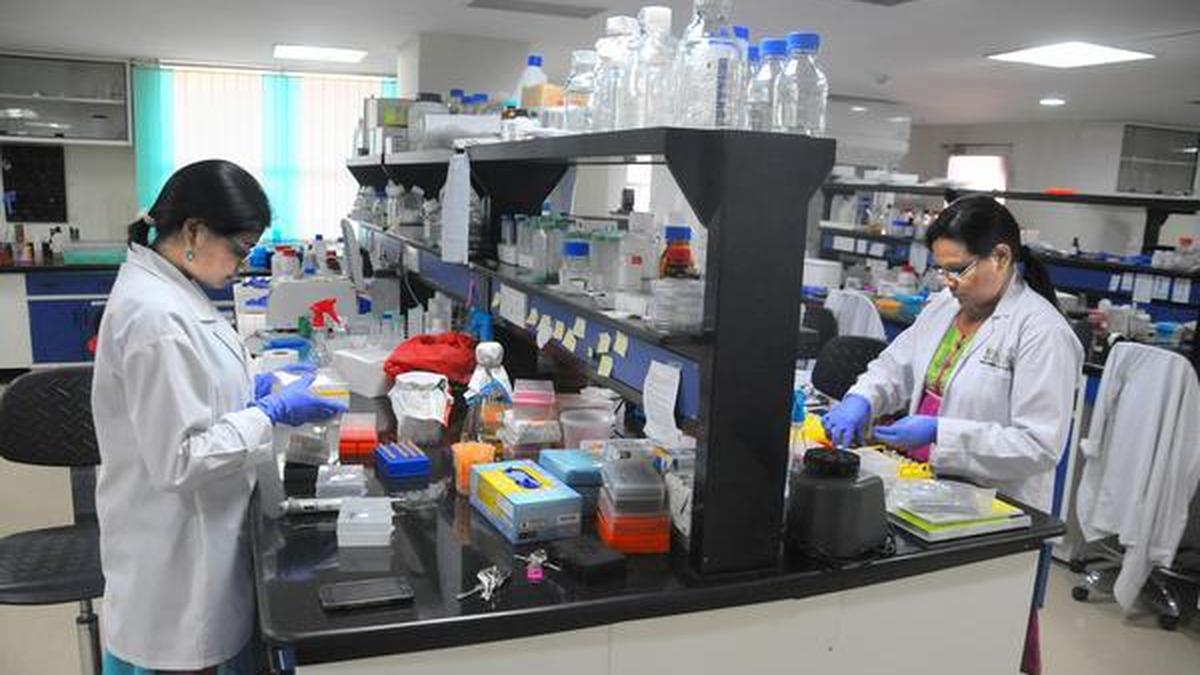
Walk into MIT, Stanford, Caltech, or Bell Labs, and you will find Indian-origin scientists driving quantum computing, mRNA therapeutics, agentic AI, and graphics processor design. They run corporate research divisions, win Nobel Prizes, and turn lab prototypes into trillion-dollar companies. Their schooling, their instincts, their work ethic—all of them trace back to India.
(Sign up for THEdge, The Hindu’s weekly education newsletter.)
So why does the same talent pool, often from the very same graduating batch, hit an invisible wall the moment it walks into a research lab back home?
It isn’t talent. It isn’t ambition. It’s the ecosystem.
In the U.S., a young researcher gets multi-year grants that don’t vanish overnight, an administration that trusts rather than audits every rupee, freedom to move between university and start-up, and a culture that actually celebrates the risky bet. In India, the same researcher gets trapped in a paper fortress — lacking a financial budget, scholarships that show up five months late, struggling over procedures just to buy test tubes, and the annual March 31 guillotine when unspent funds simply disappear.
We are trapping our sharpest minds in mundane concerns instead of letting them pursue scientific revolutions.
This isn’t just an Indian complaint, either.
Elsevier’s 2025 study, Researcher of the Future, which surveyed over 3,200 scientists across 113 countries, found 68% grappling with rising publish-or-perish pressure, barely 45% with any protected research time, and only a third expecting funding to grow.
And yet Indian researchers stand apart in one heartening way: 81% insist their work must produce real societal benefit, and 68% are optimistic about funding — the highest of any country surveyed.
The funding barrier
For over two decades, India’s gross expenditure on R&D has stagnated at 0.64–0.65% of GDP. China spends 2.4–2.6%, the U.S. 3.5%, and South Korea over 5%. Per person, India puts in about $13 a year on research; China spends $250, the U.S. over $2,100. And we have just 262 full-time-equivalent researchers per million people, against 1,585 in China and 4,821 in the U.S.
In developed economies, private industry funds 65–77% of national R&D—77% in China, 75% in the U.S. In India, the government still carries roughly 64% of the load, while private industry chips in barely the remaining 36%. And the grants that exist are wildly lopsided: of the roughly ₹4,000 crore spread across some 40,000 extramural projects a year, the IITs alone gobble the lion’s share — over 80% of major competitive grants — while State universities, which enroll more than 85% of India’s students, fight over less than 10%.
NITI Aayog’s audit of public R&D institutions found that of India’s 1,815 public labs, more than half focus on agriculture alone, leaving manufacturing, materials, and digital technology chronically under-resourced. Over a third of these institutes are clustered in the south; the Northeast gets under 2%. And our apex labs for electronics, petroleum, and chemicals were built near government capitals instead of industrial hubs like Pune, Jamnagar, or Dahej—cutting off exactly the kind of proximity that built Silicon Valley and Cambridge.
Then there’s the paperwork. NITI Aayog’s report on the Ease of Doing Research & Development in India (August 2026) lays it all out: the government procedures that delay grant releases by three to six months, and the traditional financial year-ending 31st March “use it or lose it” sweep that puts undue pressure on spending timelines.
Grooming researchers, not just awarding degrees
Producing a doctorate and producing a good researcher are not the same thing, and Indian universities have gotten very good at the former while badly neglecting the latter.
According to All India Survey on Higher Education (AISHE) records, Ph.D. enrollment in India has grown by 70% in four years, from about 2.03 lakh in 2019-20 to 3.44 lakh in 2023-24 — by far the fastest-growing level of higher education, and a near-tripling since 2014-15. Yet the number of Ph.Ds actually awarded each year has not kept pace; instead, it has slipped from close to 38,986 degrees conferred in 2019-20 to around 32,588 in 2021-22, the most recent years for which comparable figures exist. China awarded roughly 87,000 doctorates in 2023, about double that of India.
Ph.D. graduations range from 10% of enrollments in State universities to 30% in premier centrally funded institutions. India is filling the doctoral pipeline far faster than it is clearing it—which means either scholars are taking longer to finish, or a growing share are discontinuing midway.
As experts put it, the real question facing India “is not whether to produce more PhDs, but whether those PhDs will matter.”
The problem deepened when the University Grants Commission (UGC) made the Ph.D. a mandatory minimum qualification for college assistant professor recruitments and promotions under the API (Academic Performance Indicators) system. Overnight, hundreds of under-resourced State and private universities launched doctoral programs without qualified guides or basic laboratory facilities. A lack of rigour in doctoral coursework and an informal supervisor-examiner nexus that rubber-stamps repetitive dissertations have diluted program quality.
Paradoxically, the UGC’s 2022 Ph.D. regulations, meant to implement NEP 2020, opened a “direct entry” route straight from a four-year undergraduate degree into a doctorate for students scoring 75%. Seasoned researchers warn this drops eighteen-year-olds with zero research training into Ph.D. programmes designed for those with deep domain knowledge and a research-heavy master’s degree.
Here is a silver lining: The IITs and premier private institutions such as BITS Pilani have re-engineered their Ph.D. programmes, enabling working professional scholars to address live industry problems as their thesis rather than shelf-bound theory. The All India Council for Technical Education (AICTE) has launched a ₹245 crore doctoral fellowship scheme explicitly built to fund Ph.Ds that translate into products and policy, competing with a dedicated innovation grant on top of the monthly stipend. Each of these is a genuine improvement on the old publish-and-pray model.
The story gets worse after the award of the degree.
India currently funds only around 2,500 postdoctoral positions nationally—so few that an estimated 95% of Indian postdocs leave for the U.S., U.K., or Germany, where fellowships pay multiples of what’s on offer at home. Uptake of the Anusandhan National Research Foundation’s (ANRF) National Post-Doctoral Fellowship scheme has been discouraging due to short tenures, slow and manual grant disbursal, and the career risk of stepping off the tenure track for a fellowship with no guaranteed landing spot afterward.
A government roadmap aims to expand this to 10,000 positions soon and 25,000 within a decade, with pay closer to global benchmarks—necessary, since no country builds a research culture around a doctorate that dead-ends the moment it is awarded.
The mission question: should the government drive academic research?
This brings us to a genuinely hard question India needs to consider seriously: should the government identify specific national missions—semiconductors, quantum computing, clean energy, vaccines—and align research funding, timelines, and institutional incentives around hitting concrete milestone targets?
Purists argue passionately for unconstrained academic freedom. When the state forces every university department to align strictly with immediate industrial or societal deliverables, critics warn, fundamental mathematics, theoretical physics, and deep humanistic inquiry wither away.
Yet, the opposing reality is equally sobering. For decades, India’s academic establishment operated on an unguided, supply-push model. Academic researchers, shielded behind ivory tower walls, pursued esoteric micro-problems chosen primarily because they offered a smooth path to an easy publication in a Western-indexed journal. Meanwhile, the Indian state poured billions of scarce public funds into importing jet engines, specialised semiconductor chips, medical imaging sensors, and industrial catalysts.
The solution is dynamic bifurcation, borrowing from Donald Stokes’ idea of Pasteur’s Quadrant. India should ring-fence 30–40% of public research funding for pure, curiosity-driven inquiry, while organising the rest ruthlessly around national strategic missions. In line with NITI Aayog’s sectoral thinking, mission funding should concentrate on key sovereign priorities: semiconductors and microelectronics; quantum technologies and cryptography; clean energy and green hydrogen; artificial intelligence and autonomous systems; advanced bio-manufacturing and therapeutics; and advanced aerospace materials.
How global superpowers strike a balance
This is where America’s National Science Foundation (NSF) offers a useful lesson, having spent eighty years wrestling with this tension. More so, as ANRF is broadly modeled after NSF.
The NSF historically left scientists free to follow their curiosity, funding them purely on merit through peer review. However, in 2022, the NSF created its Technology, Innovation and Partnerships (TIP) directorate to fund research on key technology areas, publishing a formal three-year investment roadmap. Running in parallel is the legendary Defense Advanced Research Projects Agency (DARPA), which appoints visionary program managers who formulate radical technological goals and issue competitive challenge contracts to consortia of universities and startups.
Meanwhile, the European Union approaches mission-driven research through structured multilateral consensus. Under its €95.5-billion framework, Horizon Europe (2021–2027), it established five high-profile EU missions tackling cancer, climate adaptation, healthy oceans, climate-neutral smart cities, and soil health. The U.K. pioneered a societal outcomes-based system via the Research Excellence Framework (REF), where block grant funding is determined by independently audited impact case studies.
Chinese policy explicitly mandates prioritisation of national strategic contribution over institutional evaluation of research projects.
From lab bench to market
The real bridge across what is known as the Technology Readiness Level 3–7 “Valley of Death” is the university incubator. In global knowledge economies, Stanford, MIT, and Cambridge have effectively created thriving industrial corridors.
India already has proof that this model works. The IIT Madras Research Park has incubated over 200 deep-tech start-ups across 13 sectors, filed more than 1,300 patents, partnered with 70-plus corporates, and produced unicorns. Other IITs and BITS Pilani’s Technology Business Incubators have done similar work, turning doctoral research into real ventures.
However, outside these elite technical islands, most universities lack a dedicated Technology Transfer Office, have IP policies stuck in another era, and show little real faculty entrepreneurship. NITI Aayog’s report recommends professionally staffed R&D offices with dedicated units for sponsored projects, consultancy, and technology transfer, backed by generous revenue-sharing rules.
The transformative mandate of ANRF
Three years after the ANRF was enacted by Parliament in 2023 with a five-year outlay of ₹50,000 crore, it is designed to be the central orchestrator of India’s scientific future.
ANRF must take the role of a single-point co-ordinator of all research activities and sponsored projects across universities, government departments, and funding agencies. It must design an Indian equivalent of an NSF-TIP-style mission layer: a small, clearly ring-fenced, time-bound pool of money for a handful of named national priorities, reassessed every few years on a fixed public schedule.
To fulfill its transformative promise and overcome the procedural rigidities documented in NITI Aayog’s report, ANRF must streamline complex application processes across multiple funding portals, eliminate long delays in proposal evaluation and fund release, and relax rigid financial rules that limit flexibility during project execution. Crucially, it must dismantle the elite monopoly where top IITs absorb over 80% of competitive extramural funding while state universities starve.
What our young researchers lack isn’t spark; it’s an ecosystem that trusts them enough to let it catch fire. Dismantle the paper fortress, provide adequate and predictable resources, and build a genuine bridge from campus incubators to sovereign manufacturing—and India won’t just catch up with the world’s research superpowers. It will ignite a scientific renaissance and enable our brightest minds to build the future in India, for the entire world.
(Prof. O. R. S. Rao is the Chancellor of the ICFAI University, Sikkim. Views are personal)