
Skip to content
  • Facebook
  • X
  • Linkedin
  • WhatsApp
  • YouTube
  • Associate Journalism
  • About Us
  • Privacy Policy
  • 033-46046046
  • editor@artifex.news
Artifex.News

Artifex.News

Stay Connected. Stay Informed.

  • Breaking News
  • World
  • Nation
  • Sports
  • Business
  • Science
  • Entertainment
  • Lifestyle
  • Toggle search form
  • Access Denied
    Access Denied Nation
  • Kolkata Knight Riders To Not Play All IPL 2025 Home Games At Eden Gardens. Reason Is…
    Kolkata Knight Riders To Not Play All IPL 2025 Home Games At Eden Gardens. Reason Is… Sports
  • Access Denied
    Access Denied Nation
  • MDH On Presence Of Ethylene Oxide In Its Spices
    MDH On Presence Of Ethylene Oxide In Its Spices Nation
  • “Neeraj Chopra Not Someone Who Makes You Feel Junior”: Kishore Jena
    “Neeraj Chopra Not Someone Who Makes You Feel Junior”: Kishore Jena Sports
  • FIFA World Cup Round of 32 LIVE: USA vs Bosnia-Herzegovina knockout clash under way
    FIFA World Cup Round of 32 LIVE: USA vs Bosnia-Herzegovina knockout clash under way Sports
  • IRCTC Website, Mobile App Down Due To “Maintenance Activity”
    IRCTC Website, Mobile App Down Due To “Maintenance Activity” Nation
  • North Korea says Kim Jong-un supervised tests of rocket launchers targeting Seoul
    North Korea says Kim Jong-un supervised tests of rocket launchers targeting Seoul World
Sperm whale ‘clicks’ have complex patterns similar to human speech

Sperm whale ‘clicks’ have complex patterns similar to human speech

Posted on May 15, 2026 By admin


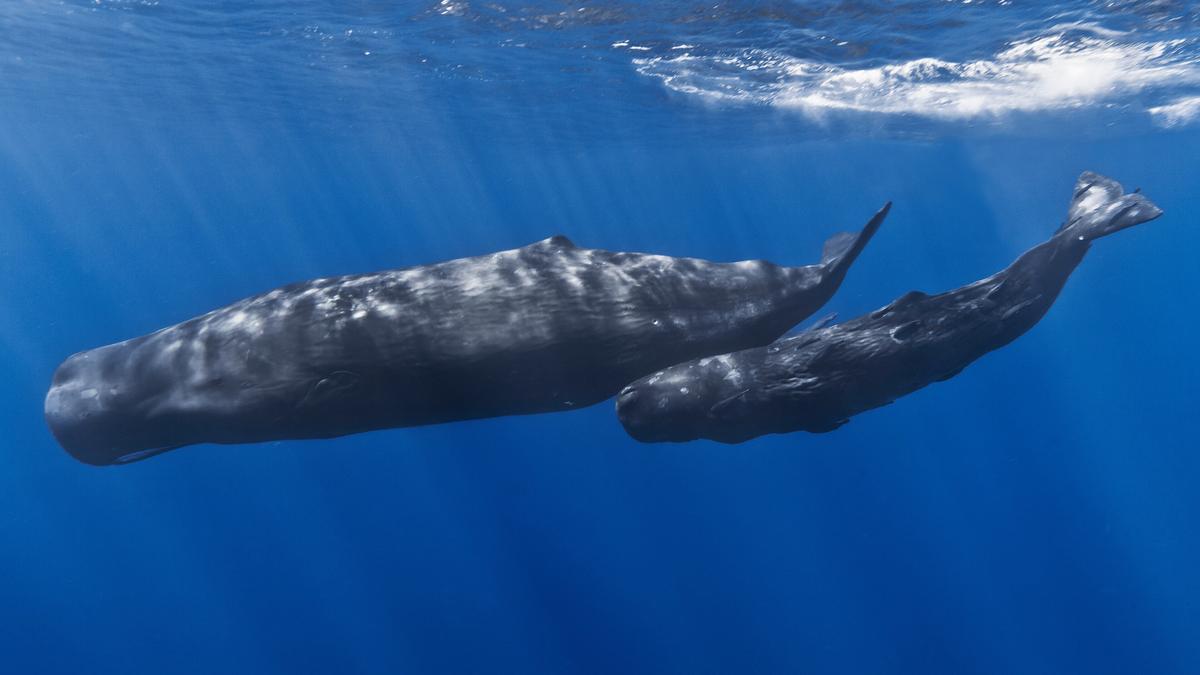
Sperm whales communicate using short sequences of clicks known as codas, which they exchange while coordinating within their groups. Scientists have long classified these sequences using the number of clicks and the timing between them.

A study published on April 15 in Proceedings of the Royal Society B has however reported that there’s more to it than meets the ears: the codas also vary in their acoustic structure in ways that resemble patterns found in human speech.

“Before this work, sperm whale vocalisations were often treated as a kind of Morse code — simply patterns defined mainly by timing,” Gasper Beguš, associate professor of linguistics at University of California, Berkeley, and senior author of the study, said. “What we’re showing here is that there’s another layer of structure within the clicks themselves.”

A learnt structure

Until now, classification relied on two measurable features: the number of clicks in a sequence and the spacing between them, known as inter-click intervals. These patterns produce distinct coda types. For example, a 1+1+3 coda consists of two clicks separated by pauses, followed by three clicks in rapid succession, while a 5R coda contains five evenly spaced clicks. Because different whale groups use different sets of these patterns, the system is unlikely to be entirely inborn. Instead, scientists think at least part of it is learnt within groups.

When the researchers broke each click down into its frequency components, they found that the sounds fall into two distinct categories: some have a single dominant frequency peak, while others have two. In human linguistics, such peaks are known as formants—the resonant frequencies that allow us to distinguish an “ah” sound from an “ee.” Consequently, the authors label these whale categories “a” and “i.” These two types are clearly distinct, and the same pattern of clicks—for example, a 1+1+3 coda—can be produced using either the “a” click or “i” click.

A histogram of the raw coda durations (in seconds) of 1+1+3 coda for four whales named ‘Atwood’, ‘Ford’, ‘Pinchy’, and ‘TBB’.
| Photo Credit:
Beguš et al. 2026 The phonology of sperm whale coda vowels. Proc. R. Soc. B 293: 20252994

Calling it a “fascinating finding,” Mason Youngblood, a behavioural scientist at Stony Brook University, said the study shows that sperm whale communication “varies not just in timing but also in tonal quality,” in ways similar to human vowels, suggesting the “signals may be able to convey more information than previously thought.”

Two layers, then three

The two click types are not used in the same way across all codas. In some, such as the 1+1+3 pattern, both appear in roughly equal numbers. In others, one dominates, and in a few it is almost absent. If click type were simply a side effect of sound production, this variation would be random. Instead, the patterns are consistent, suggesting that sperm whales control not just when they click, but also what kind of click they produce—treating timing and type as two separate features of their signals.

The researchers also identified several additional layers of variation in how codas are produced.

Codas in the two click types differ in length. Even when the pattern of spacing between clicks is the same, “a” codas are typically longer than “i” codas. In addition, the “i” category splits into two groups—some codas are short, while others are long—whereas the “a” category does not. This is similar to how the length of a sound can matter in human speech, where longer and shorter vowels can serve different functions.

They also found consistent differences between individual sperm whales. Even within the same coda pattern and click type, some whales produce longer sequences than others. For example, the length of an “a” coda can differ by about 170 milliseconds between individuals. Despite this, “a” codas are still longer than “i” codas across all sperm whales, showing that while whales may sound different from one another, they follow the same underlying patterns.

Finally, they found that one coda can influence the next. Most codas consist of a single click type, but in a few cases, the first click is different from the rest—for example, a coda made up of “i”-type clicks may begin with a single “a”-type click. These mismatches occur most often when whales switch from one type of coda to another. This suggests that the first click of a coda is affected by the coda that came before it, showing that codas aren’t produced in isolation—the previous one can shape how the next begins.

What it means, what we don’t know

The results show that sperm whale vocalisations show clear parallels with human phonology—the system of rules that organises sound patterns in human language through combinations of discrete sound categories, timing, and position. Prof. Beguš, provides a hypothesis of convergent evolution playing out over grand timescales to explain the observations. “Humans and whales diverged tens of millions of years ago, but both evolved complex vocal systems that show striking structural parallels.” 

Dr. Youngblood added that the rich social and cultural lives of sperm whales relies heavily on communication withing their family and clan groups. He believes this might support such a complexity in whale phonology. At the same time, he cautioned that one must not be quick to call it a language just yet.

“There are clear similarities, but also important differences,” Dr. Youngblood said. “The fundamentally rhythmic nature of sperm whale codas, for example, sets them apart from human speech.”

What these patterns mean remains unknown. The study does not identify what information codas convey or whether different patterns correspond to specific contexts. What it does show is that sperm whale communication is built from multiple features that can vary independently and in relation to one another—a level of organisation that is uncommon in animal communication systems.

“Determining whether these patterns map onto specific meanings will require much more work,” said Dr. Youngblood. “I know these are the goals of Project CETI, and I’m really looking forward to seeing what comes next.”

Anirban Mukhopadhyay is a geneticist by training and science communicator from New Delhi.

Published – May 21, 2026 07:30 am IST



Source link

Science

Post navigation

Previous Post: India ready to extend all possible support for peace in West Asia: PM Modi in UAE
Next Post: Petrol and diesel prices hike LIVE: ‘Take votes first, then raise prices’: Congress attacks Modi

Related Posts

  • Black holes in Webb data allay threat to cosmology’s standard model
    Black holes in Webb data allay threat to cosmology’s standard model Science
  • What scientists make of R&D allocations in the 2025 Union Budget
    What scientists make of R&D allocations in the 2025 Union Budget Science
  • Sci-Five | The Hindu Science Quiz: On Amoeba
    Sci-Five | The Hindu Science Quiz: On Amoeba Science
  • What role does CSTT play in standardising technical terms?
    What role does CSTT play in standardising technical terms? Science
  • Sunflowers ‘dance’ to get more sunlight, scientists find
    Sunflowers ‘dance’ to get more sunlight, scientists find Science
  • Droughts can drive antibiotic resistance in soil bacteria, research finds
    Droughts can drive antibiotic resistance in soil bacteria, research finds Science

More Related Articles

In search of the elusive and threatened fishing cat In search of the elusive and threatened fishing cat Science
Does seeking social proximity improve flight routes among pigeons? Does seeking social proximity improve flight routes among pigeons? Science
Is a heatwave really a wave of heat? Is a heatwave really a wave of heat? Science
RRI technique yields certified randomness with one qubit RRI technique yields certified randomness with one qubit Science
Heavy metals in Cauvery fish, study warns against regular intake Heavy metals in Cauvery fish, study warns against regular intake Science
How does glue work: the physics of what makes glue so sticky How does glue work: the physics of what makes glue so sticky Science
SiteLock

Archives

  • October 2026
  • September 2026
  • August 2026
  • July 2026
  • June 2026
  • May 2026
  • April 2026
  • March 2026
  • February 2026
  • January 2026
  • December 2025
  • November 2025
  • October 2025
  • September 2025
  • August 2025
  • July 2025
  • June 2025
  • May 2025
  • April 2025
  • March 2025
  • February 2025
  • January 2025
  • December 2024
  • November 2024
  • October 2024
  • September 2024
  • August 2024
  • July 2024
  • June 2024
  • May 2024
  • April 2024
  • March 2024
  • February 2024
  • January 2024
  • December 2023
  • November 2023
  • October 2023
  • September 2023
  • August 2023
  • July 2023
  • June 2023
  • May 2023
  • April 2023
  • March 2023
  • February 2023
  • January 2023
  • December 2022
  • November 2022
  • October 2022
  • September 2022
  • August 2022
  • July 2022
  • June 2022
  • May 2022

Categories

  • Business
  • Nation
  • Science
  • Sports
  • World

Recent Posts

  • AIADMK, BJP leaders slam TVK-led Tamil Nadu government over electricity purchase at high rate
  • Women stage silent demonstration at Kathipara against police action on anti-CEC protesters in Delhi
  • DGCA bans specific power banks on flights
  • Saudi Supreme Court sets aside Sri Lankan migrant worker’s death penalty
  • Nedumbassery accident: CPI(M) stages protest march to police station over ‘indifference’ in handling of case

Recent Comments

  1. RobertTes on UP Teacher Who Asked Students To Slap Muslim Classmate
  2. Manuelret on UP Teacher Who Asked Students To Slap Muslim Classmate
  3. RobertTes on UP Teacher Who Asked Students To Slap Muslim Classmate
  4. RobertTes on UP Teacher Who Asked Students To Slap Muslim Classmate
  5. BrentWes on UP Teacher Who Asked Students To Slap Muslim Classmate
  • Team Akhilesh Yadav Party MLA’s Son Arrested After Girl Dies By Suicide: Cops
    Team Akhilesh Yadav Party MLA’s Son Arrested After Girl Dies By Suicide: Cops Nation
  • Access Denied
    Access Denied Nation
  • Chennai gets respite from searing heat as cloud cover, sea breeze cool city
    Chennai gets respite from searing heat as cloud cover, sea breeze cool city Nation
  • Rebel Samajwadi Party MLA’s Manoj Pandey Praise For PM Modi After Meeting Amit Shah
    Rebel Samajwadi Party MLA’s Manoj Pandey Praise For PM Modi After Meeting Amit Shah Nation
  • FPIs withdraw close to ₹18,000 crore from equities in August on trade tension, disappointing earnings
    FPIs withdraw close to ₹18,000 crore from equities in August on trade tension, disappointing earnings Business
  • Effective policing must as cybercriminals target vulnerable groups, says Keralam Minister
    Effective policing must as cybercriminals target vulnerable groups, says Keralam Minister Nation
  • Access Denied
    Access Denied Nation
  • Access Denied
    Access Denied Nation

Editor-in-Chief:
Mohammad Ariff,
MSW, MAJMC, BSW, DTL, CTS, CNM, CCR, CAL, RSL, ASOC.
editor@artifex.news

Associate Editors:
1. Zenellis R. Tuba,
zenelis@artifex.news
2. Haris Daniyel
daniyel@artifex.news

Photograher:
Rohan Das
rohan@artifex.news

Associate Journalists
1. Subrata Paul - AN/2020/01
2. Quamruz Zaman - AN/2021/22
3. Ahmed Sha - AN/2021/035
4. Ajay Kumar Shaw - AN/2021/39
5. Tahqiqul Hoda - AN/2021/21

Artifex.News offers Online Paid Internships to college students from India and Abroad. Interns will get a PRESS CARD and other online offers.
Send your CV (Subjectline: Paid Internship) to internship@artifex.news

Links:
Associate Journalism
About Us
Privacy Policy

News Links:
Breaking News
World
Nation
Sports
Business
Entertainment
Lifestyle

Registered Office:
72/A, Elliot Road, Kolkata - 700016
Tel: 033-22277777, 033-22172217
Email: office@artifex.news

Editorial Office / News Desk:
No. 13, Mezzanine Floor, Esplanade Metro Rail Station,
12 J. L. Nehru Road, Kolkata - 700069.
(Entry from Gate No. 5)
Tel: 033-46011099, 033-46046046
Email: editor@artifex.news

Copyright © 2023 Artifex.News Newsportal designed by Artifex Infotech.