




Since NASA launched the James Webb Space Telescope (JWST) almost three years ago, astronomers have been actively searching for clues about how galaxies grew in the early universe. This universe was a dark place: there is no light from this period to tell us how the first stars and galaxies formed, yet uncovering these processes could help answer key questions like the role of dark matter in the early universe.
So when astronomers recently pored through JWST, they were surprised to find monstrous structures when the universe was only a few hundred million years old, instead of infant galaxies.
The universe began with a Big Bang about 13.8 billion years ago as a hot, dense mixture of gases and subatomic particles. Over time, the universe expanded and cooled, allowing the particles to separate from the mixture and become independent clumps of matter. The gradual and continuous cooling of the universe eventually created larger structures such as stars, galaxies, and galaxy clusters.
According to the standard model of cosmology, which attempts to explain the universe’s origins and evolution, the first stars formed around 100-200 million years after the Big Bang and the first galaxies within the first billion years.
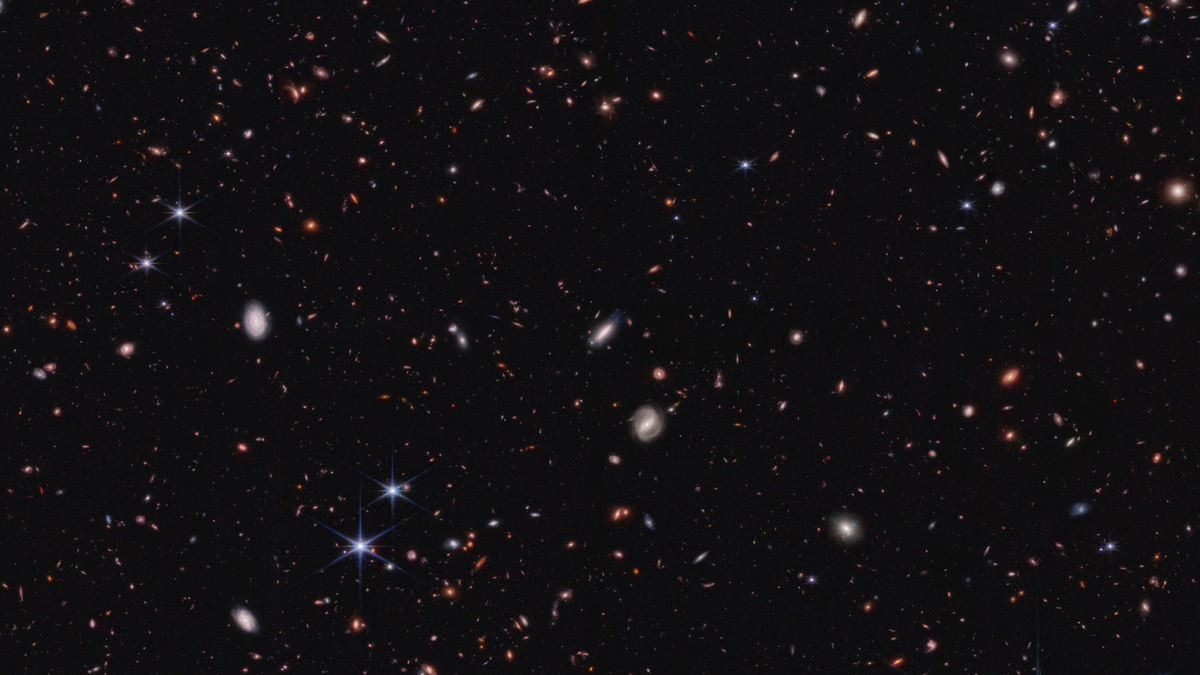
But JWST was revealing massive, fully-developed galaxies, that too in greater numbers than expected, only around 400-650 million years after the Big Bang. This mismatch became a source of intrigue among researchers, who had to figure out what was wrong with their standard model.
Now, a study published on August 26 in the Astrophysical Journal by an international team, led by Katherine Chworowsky and Steven Finkelstein at the University of Texas at Austin, offers a promising explanation.
Deep into the universe
Distant galaxies are faint and detecting them requires advanced telescopes, Prerana Biswas, a postdoctoral researcher at the Indian Institute of Astrophysics, Bengaluru, explained. (She wasn’t involved in the new study.)
This means, first, a telescope with a large primary mirror. The Hubble Space Telescope has a 2.4-m-wide primary mirror while JWST’s mirror is 6.5 m wide. Second, the telescope will have to be very sensitive, which relates to its ability to record data at different wavelengths. The Hubble operates in the optical, ultraviolet, and some infrared wavelengths, while JWST is specifically designed for infrared observations with a focus on studying the early universe. This is because visible and ultraviolet light from distant galaxies shift to the infrared wavelengths as the universe expands.
In the new study, researchers analysed data from the JWST’s Cosmic Evolution Early Release Science (CEERS) Survey, which Finkelstein leads. They focused on galaxies that existed when the universe was 650-1,500 million years old.
According to the team, one possible explanation for a larger number of massive galaxies in the early universe is that these galaxies manufactured stars more efficiently than the galaxies of today.
Biman Nath, a professor of astronomy and astrophysics at the Raman Research Institute, Bengaluru, said the higher efficiency of star formation “wouldn’t affect the large-scale structure” of the universe “because the bulk of these large-scale structures is produced by dark matter, so what happens to a tiny fraction of normal matter (whether or not they produce stars at a faster rate) wouldn’t affect it.”
He added that the specifics of whether the modified efficiency contradicts the current understanding of galaxy formation needs to be worked out. Biswas agreed, saying that if this value is found to have been higher in the early universe, existing models of galaxy growth and evolution may need to be reworked.

A secret ingredient
The researchers also examined the black holes at the centres of these ancient galaxies. These objects are also called “little red dots” because of what the light from their direction looks like. These black holes rapidly consume the galaxies’ gas, causing the latter to emit heat and light.
“The fact that massive black holes contribute to the total light emitted by their host galaxies has been known for some time, and there has been research and work done to disentangle light coming from black holes from the light coming from stars to accurately measure” the masses of stars in galaxies, Chworowsky said.
“However, before JWST, we had not seen galaxies that looked specifically like little red dots, therefore it was not known that they often hosted black holes until they had been independently studied,” she added.
In other words, the star mass of galaxies may have been overstated in previous studies thanks to the additional light emitted by their black holes. When the researchers in the new study removed these little red dots from their data for analysis, they found that the galaxies weren’t as massive as previously estimated, thus sparing the standard model of cosmology from revision.
The bottom line
The researchers wrote in their paper that the standard model could explain more efficient star formation in the early universe in the form of the extreme physical conditions and abundant gas. Catastrophic events like supernovae and stellar winds were also less effective then at disrupting star formation.
“The standard model of cosmology remains the most successful framework for describing our universe,” Biswas said. “There are only a handful of studies that contradict this model. It is not surprising that JWST observations align with its predictions. It would be far more surprising if these observations challenged this model.”
Previous JWST observations of massive, well-developed galaxies in the early universe had questioned the standard model, including the universe’s age, the timeline for the formation of the first galaxies, and galaxy formation theories. For example, a recent study used JWST data to say spiral galaxies could have emerged in the universe within 1.5 billion years, much earlier than previously expected. As evidence the researchers pointed to an exceptional star formation rate and larger galaxy sizes — but these conclusions could be overturned now. The authors of this study declined to comment.

Nath, who wasn’t involved with the new study, added that the problem of observations not matching the standard model’s predictions “become acute when the JWST observations of even earlier galaxies are considered, going back to when the universe was around 400 million years old.”
Chworowsky said the team is working on including more data from JWST in addition to CEERS. “This will give us the ability both to push this analysis to higher redshifts and higher masses, as those galaxies are rarer and we’re more likely to be able to find them in larger sets of data.”
Expanding the data set will help researchers get a better sense of the current results and develop a more comprehensive understanding of the formation of massive galaxies in the early universe.
“I am happy to see that astronomers are working towards these problems,” Nath said. “Maybe it is possible, after all, to find some explanation within the current models.”
Shreejaya Karantha is a freelance science writer and a content writer and research specialist at The Secrets of The Universe.
Published – October 22, 2024 05:30 am IST