



Skip to content
  • Facebook
  • X
  • Linkedin
  • WhatsApp
  • YouTube
  • Associate Journalism
  • About Us
  • Privacy Policy
  • 033-46046046
  • editor@artifex.news
Artifex.News

Artifex.News

Stay Connected. Stay Informed.

  • Breaking News
  • World
  • Nation
  • Sports
  • Business
  • Science
  • Entertainment
  • Lifestyle
  • Toggle search form
  • UN nuclear watchdog board reports Iran to UN Security Council for the first time in 20 years
    UN nuclear watchdog board reports Iran to UN Security Council for the first time in 20 years World
  • India Sends 1,400 kg Anti-Cancer Drugs To Syria In Humanitarian Assistance
    India Sends 1,400 kg Anti-Cancer Drugs To Syria In Humanitarian Assistance Nation
  • Daily Quiz | On FIFA Women’s World Cup
    Daily Quiz | On FIFA Women’s World Cup Sports
  • Access Denied
    Access Denied Nation
  • Iran warns Gulf countries against helping U.S. after UAE cuts trade ties
    Iran warns Gulf countries against helping U.S. after UAE cuts trade ties World
  • Access Denied Sports
  • Sensex, Nifty rebound after days of downtrend
    Sensex, Nifty rebound after days of downtrend Business
  • ‘Declare Kerala Backward If You Want Funds’: Row Over Minister’s Remark
    ‘Declare Kerala Backward If You Want Funds’: Row Over Minister’s Remark Nation
Moon Base | India’s lunar future

Moon Base | India’s lunar future

Posted on August 15, 2026 By admin


“The past is a foreign country; they do things differently there,” the English novelist L.P. Hartley wrote famously in his 1953 novel The Go-Between. In a peculiar twist, the same cannot be said of the Moon. It is not a foreign country, or even a foreign world: the U.S.’s manoeuvring to beat China to the satellite has increasingly meant the Moon is an extension of the Earth’s geopolitics and political culture.

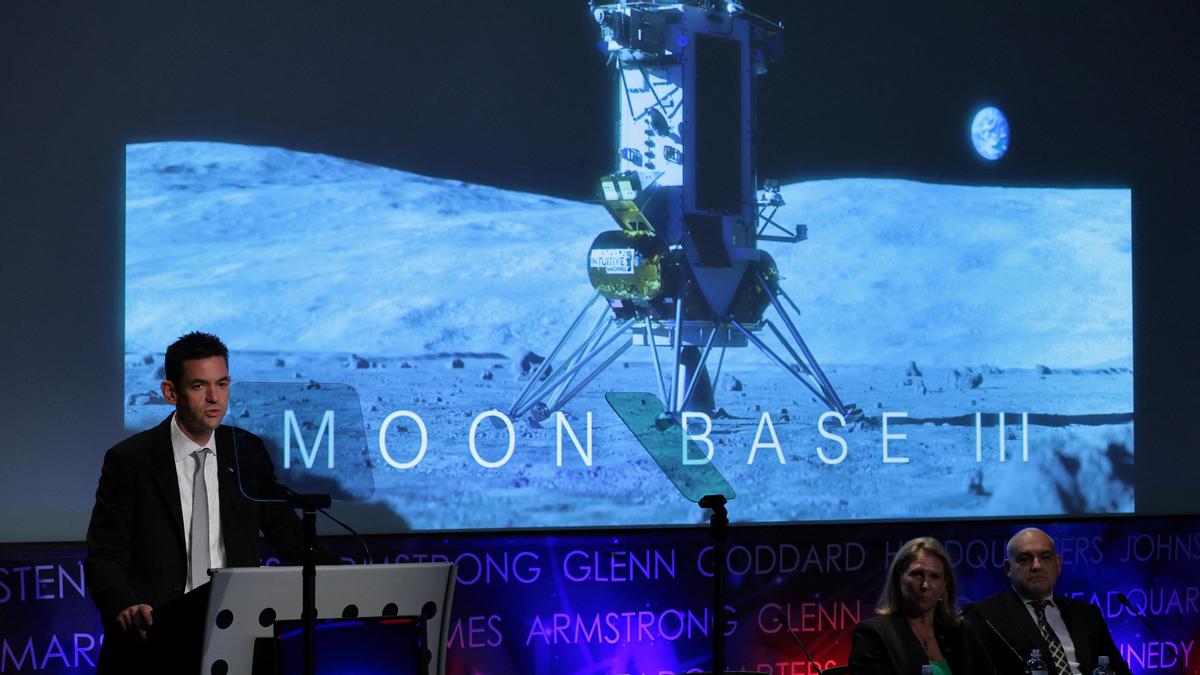
At the ninth India-U.S. Civil Space Joint Working Group meeting at Indian Space Research Organisation (ISRO) headquarters last week, NASA invited the organisation to participate in its ‘Moon Base’ programme, ostensibly as part of the two countries’ Artemis Accords partnership. According to NASA, the facility will be built piece by piece near the Moon’s south pole, where sunlight is available for longer durations and where permanently shadowed craters hold significant water-ice deposits. The target is for it to be humankind’s first outpost on a new celestial body, taking shape around 2030.

NASA is leaning heavily on private industry for this, having already awarded contracts to Astrolab (worth $219 million) and Lunar Outpost ($220 million) for lunar terrain vehicles, Blue Origin ($188 million) for delivery task orders, and Astrobotic, Firefly Aerospace, and Intuitive Machines ($600 million) for four robotic missions to the Moon to deliver equipment. Intuitive is also developing a relay satellite under a separate contract.

Further, as part of NASA chief Jared Isaacman’s overhaul of the Artemis programme earlier this year, in no small part responding to the Trump administration’s December 2025 space policy calling for securing U.S. interests in cislunar space, the profiles of the Artemis III and IV Missions changed. Now, Mission III will be a crewed test flight in Earth orbit in 2027 and Mission IV will attempt the first lunar landing under the programme in 2028. Taken together, the ‘Moon Base’ is effectively the next phase of the new Artemis programme, tasked with keeping — intermittently at first, and eventually continuously — Artemis astronauts on the Moon.

Deepening partnership

Since India signed the Artemis Accords in 2023, NASA and ISRO have engaged regularly across several areas. NASA has trained India’s astronaut candidates for the ‘Gaganyaan’ human spaceflight mission. In 2025, Prime Minister Narendra Modi and U.S. President Donald Trump jointly announced a broader strategic technologies framework, including spaceflight.

ISRO also launched the NASA-ISRO Synthetic Aperture Radar, a major scientific mission that has been a decade in the making. NASA instruments are slated to fly on forthcoming Chandrayaan missions just as they did on the first three.

While it seems almost facile to suggest the U.S. also engage with China considering the latter’s formidable spaceflight capabilities — many industry experts agree the age of U.S. dominance in spaceflight is in its twilight years — the two countries’ actions mean that the lines they have drawn on the Earth are set to be extended to the Moon, and that will pose new challenges for India.

In 2021, China and Russia announced plans to cooperate on an ‘International Lunar Research Station’ (ILRS), which China described as a long-term lunar science and technology facility, also to be built near the south pole and with a targeted deadline of 2035. Like the Artemis Accords, the ILRS is an international effort, currently involving 17 countries and organisations and more than 50 research institutions worldwide.

Earlier this year, when NASA solicited proposals for payloads to send to the Moon, it said it welcomed foreign entities “except those with bilateral ties to China”. NASA’s FY2027 budget request has also described the ‘Moon Base’ as a means to establish U.S. “superiority on the Moon” and to preserve U.S. leadership in space — language with more strategic overtones relative to the agency’s pre-Trump rhetoric.

Given how much of U.S. policy is shaped by out-competing China, India’s gains or losses will not be restricted to its space programme either. For instance, ISRO’s engagement with NASA has arguably become more politicised thanks to NASA’s own politicisation by virtue of having to respond to China’s ILRS plans. Contrary to the focus areas of these bodies through much of their histories, future discussions would be poorly served by treating their engagement on the Moon as purely exploratory.

For example, the Artemis Accords do not say a signatory cannot cooperate with non-signatory countries. (In June, ISRO also hosted the BRICS Heads of Space Agencies meeting in Bengaluru with China among the participants). However, the Artemis programme itself is increasingly concerned with infrastructure, and building one’s components, equipment, tools, etc. to be interoperable with that infrastructure will thus extend geopolitical alignments on the Earth to the Moon.

Suppose China invites India to join the ILRS in 2035. (In fact, the Moon could become one of the few domains in which India and China may have a practical incentive to cooperate on the Moon even while competing on the Earth, and India should endeavour to preserve rather than foreclose that possibility.) The government can say ‘yes’, but if China uses different communication protocols, data formats or operational procedures, India will face a tough choice: to build a second, expensive set of capabilities with China or to persuade China to change its systems to be interoperable with American designs.

Different ecosystems

That is, the U.S.-China competition means India’s increasing embedding in one technological ecosystem will also increase the cost of engaging with the other in future. At the same time, India will be mistaken to avoid deepening ISRO’s relationship with NASA. The U.S.-led ecosystem is much larger and more technologically diverse than the one led by China. But India may nonetheless have to reconsider its strategic autonomy in the spaceflight domain — particularly if the U.S.-China rivalry changes substantially over the next two or three decades. It should certainly steer clear of any dependencies that could hold back its own space programme because of U.S. objections.

In fact, one useful way to achieve this that also presents yet another opportunity for Indian leadership in space is to push for open international standards that allow nations to retain sovereign control over specific hardware and software components without hampering collaborations in space. Such diplomacy could foster interoperability between the lunar blocs and allow India to retain its strategic autonomy.

If it does not, the Moon may cease to be a foreign world but India may find itself a foreigner there.

Published – August 16, 2026 03:00 am IST



Source link

Science Tags:chandrayaan, gaganyaan, india moon mission, india space diplomacy, india space program, india us space partnership, space race

Post navigation

Previous Post: Bishnoi comes out in support of Rao Inderjit, says ignoring seniors will weaken BJP
Next Post: Moon Base | India’s lunar future

Related Posts

  • Donald Trump praises Artemis astronauts: ‘You’ve made history’
    Donald Trump praises Artemis astronauts: ‘You’ve made history’ Science
  • Gaganyaan’s expected launch by end of 2025, says ISRO chief
    Gaganyaan’s expected launch by end of 2025, says ISRO chief Science
  • AstroSat unravels mysteries surrounding Black Hole X-ray Binary MAXI J1820+070
    AstroSat unravels mysteries surrounding Black Hole X-ray Binary MAXI J1820+070 Science
  • Brains that don’t see in greyscale first over-rely on colours: Project Prakash study
    Brains that don’t see in greyscale first over-rely on colours: Project Prakash study Science
  • NASA spacecraft ‘safe’ after closest-ever approach to Sun
    NASA spacecraft ‘safe’ after closest-ever approach to Sun Science
  • All eyes on PSLV-C60 mission as ISRO looks to end 2024 on a high
    All eyes on PSLV-C60 mission as ISRO looks to end 2024 on a high Science

More Related Articles

NASA astronaut Butch Wilmore retires less than five months after extended Starliner spaceflight NASA astronaut Butch Wilmore retires less than five months after extended Starliner spaceflight Science
A comprehensive immunisation schedule for adult women is now ready A comprehensive immunisation schedule for adult women is now ready Science
How the science Nikolai Vavilov built changed how we save crops How the science Nikolai Vavilov built changed how we save crops Science
Realisation about fragility of earth common among astronauts upon return: Rakesh Sharma Realisation about fragility of earth common among astronauts upon return: Rakesh Sharma Science
The Rohini Godbole way of teaching, talking and engaging with students The Rohini Godbole way of teaching, talking and engaging with students Science
IIT Madras researchers on a mission to develop technologies for space exploration IIT Madras researchers on a mission to develop technologies for space exploration Science
SiteLock

Archives

  • October 2026
  • September 2026
  • August 2026
  • July 2026
  • June 2026
  • May 2026
  • April 2026
  • March 2026
  • February 2026
  • January 2026
  • December 2025
  • November 2025
  • October 2025
  • September 2025
  • August 2025
  • July 2025
  • June 2025
  • May 2025
  • April 2025
  • March 2025
  • February 2025
  • January 2025
  • December 2024
  • November 2024
  • October 2024
  • September 2024
  • August 2024
  • July 2024
  • June 2024
  • May 2024
  • April 2024
  • March 2024
  • February 2024
  • January 2024
  • December 2023
  • November 2023
  • October 2023
  • September 2023
  • August 2023
  • July 2023
  • June 2023
  • May 2023
  • April 2023
  • March 2023
  • February 2023
  • January 2023
  • December 2022
  • November 2022
  • October 2022
  • September 2022
  • August 2022
  • July 2022
  • June 2022
  • May 2022

Categories

  • Business
  • Nation
  • Science
  • Sports
  • World

Recent Posts

  • Delhi journalist who accused ACP of sexual harassment slapped with SC/ST Act over ‘casteist remarks’
  • Three Indians killed in Germany building fire: reports
  • Govt. to roll out National Electricity Data Sharing framework in October: Power Secretary
  • BCCI steps in to prevent further forfeitures by Arunachal Pradesh
  • TCCI seeks review of steep parking, access charges at Thiruvananthapuram airport

Recent Comments

  1. RobertTes on UP Teacher Who Asked Students To Slap Muslim Classmate
  2. Manuelret on UP Teacher Who Asked Students To Slap Muslim Classmate
  3. RobertTes on UP Teacher Who Asked Students To Slap Muslim Classmate
  4. RobertTes on UP Teacher Who Asked Students To Slap Muslim Classmate
  5. BrentWes on UP Teacher Who Asked Students To Slap Muslim Classmate
  • Rahul Gandhi obstructing MPs from serving people, says Capt. Chowta
    Rahul Gandhi obstructing MPs from serving people, says Capt. Chowta Nation
  • Access Denied World
  • Traffic police arrest 25 persons involved in bike racing in various parts of Chennai
    Traffic police arrest 25 persons involved in bike racing in various parts of Chennai Nation
  • Access Denied Sports
  • US Makes Bridging Proposal In Gaza Truce Talks, Israeli Official Says
    US Makes Bridging Proposal In Gaza Truce Talks, Israeli Official Says World
  • India-EFTA trade pact to be implemented from October 1: Piyush Goyal
    India-EFTA trade pact to be implemented from October 1: Piyush Goyal Business
  • Virat Kohli Lands In Australia Ahead Of Border-Gavaskar Trophy
    Virat Kohli Lands In Australia Ahead Of Border-Gavaskar Trophy Sports
  • Access Denied
    Access Denied Nation

Editor-in-Chief:
Mohammad Ariff,
MSW, MAJMC, BSW, DTL, CTS, CNM, CCR, CAL, RSL, ASOC.
editor@artifex.news

Associate Editors:
1. Zenellis R. Tuba,
zenelis@artifex.news
2. Haris Daniyel
daniyel@artifex.news

Photograher:
Rohan Das
rohan@artifex.news

Associate Journalists
1. Subrata Paul - AN/2020/01
2. Quamruz Zaman - AN/2021/22
3. Ahmed Sha - AN/2021/035
4. Ajay Kumar Shaw - AN/2021/39
5. Tahqiqul Hoda - AN/2021/21

Artifex.News offers Online Paid Internships to college students from India and Abroad. Interns will get a PRESS CARD and other online offers.
Send your CV (Subjectline: Paid Internship) to internship@artifex.news

Links:
Associate Journalism
About Us
Privacy Policy

News Links:
Breaking News
World
Nation
Sports
Business
Entertainment
Lifestyle

Registered Office:
72/A, Elliot Road, Kolkata - 700016
Tel: 033-22277777, 033-22172217
Email: office@artifex.news

Editorial Office / News Desk:
No. 13, Mezzanine Floor, Esplanade Metro Rail Station,
12 J. L. Nehru Road, Kolkata - 700069.
(Entry from Gate No. 5)
Tel: 033-46011099, 033-46046046
Email: editor@artifex.news

Copyright © 2023 Artifex.News Newsportal designed by Artifex Infotech.