

Skip to content
  • Facebook
  • X
  • Linkedin
  • WhatsApp
  • YouTube
  • Associate Journalism
  • About Us
  • Privacy Policy
  • 033-46046046
  • editor@artifex.news
Artifex.News

Artifex.News

Stay Connected. Stay Informed.

  • Breaking News
  • World
  • Nation
  • Sports
  • Business
  • Science
  • Entertainment
  • Lifestyle
  • Toggle search form
  • ACA chief Kesineni Sivanath meets BCCI president Roger Binny
    ACA chief Kesineni Sivanath meets BCCI president Roger Binny Nation
  • Access Denied Sports
  • Supreme Court Irked At Lawyer Over ‘Scurrilous’ Remark
    Supreme Court Irked At Lawyer Over ‘Scurrilous’ Remark Nation
  • Secondary tariffs on India ‘aggressive economic leverage’ to force Russia to stop war: Vance
    Secondary tariffs on India ‘aggressive economic leverage’ to force Russia to stop war: Vance World
  • Access Denied World
  • Bodies of 15 Indian tourists killed in Vietnam boat accident flown home
    Bodies of 15 Indian tourists killed in Vietnam boat accident flown home World
  • Access Denied Sports
  • Who is Heman Bekele? 5 Points On US Teen Who Invented Soap To Treat Skin Cancer
    Who is Heman Bekele? 5 Points On US Teen Who Invented Soap To Treat Skin Cancer World
To fix unemployment, fix the economy first

To fix unemployment, fix the economy first

Posted on July 27, 2026 By admin


The Cockroach Janta Party’s movement has highlighted the political urgency for reforming the economy to create more employment for India’s youth. Fixing the education system alone will not solve the unemployment problem. The basic structure of the economy must be reformed.

China and India, the only two countries in the world with populations exceeding one billion, have the greatest need for meaningful employment. If citizens are not fully employed, and incomes of masses do not rise, their economies cannot grow. China has done much better than India in this regard; the per capita income of Chinese citizens has risen roughly eight times faster than Indians’ in the last 30 years.

India’s leaders find themselves in the middle of conflicting trends. First, they are pushing ahead with reforms for ‘ease of doing business’; diluting the rights of workers to organise; and weakening environmental protection. Second, they are promoting the wide-spread application of Artificial Intelligence (AI) to improve ‘productivity’ (and other benefits) in agriculture, industry, health and education, with productivity defined, purely in economic terms, as more output with less human input. Third, they also see the need to change the pattern of growth and increase employment elasticity. Employment elasticity is the amount of meaningful employment created with each unit of GDP growth, in which India has been a laggard since the liberal market economic reforms of the 1990s.

Since India has the largest population of youth in the world, its economic growth should have the highest employment elasticity. However, the increased adoption of AI will only make it worse.

The China model

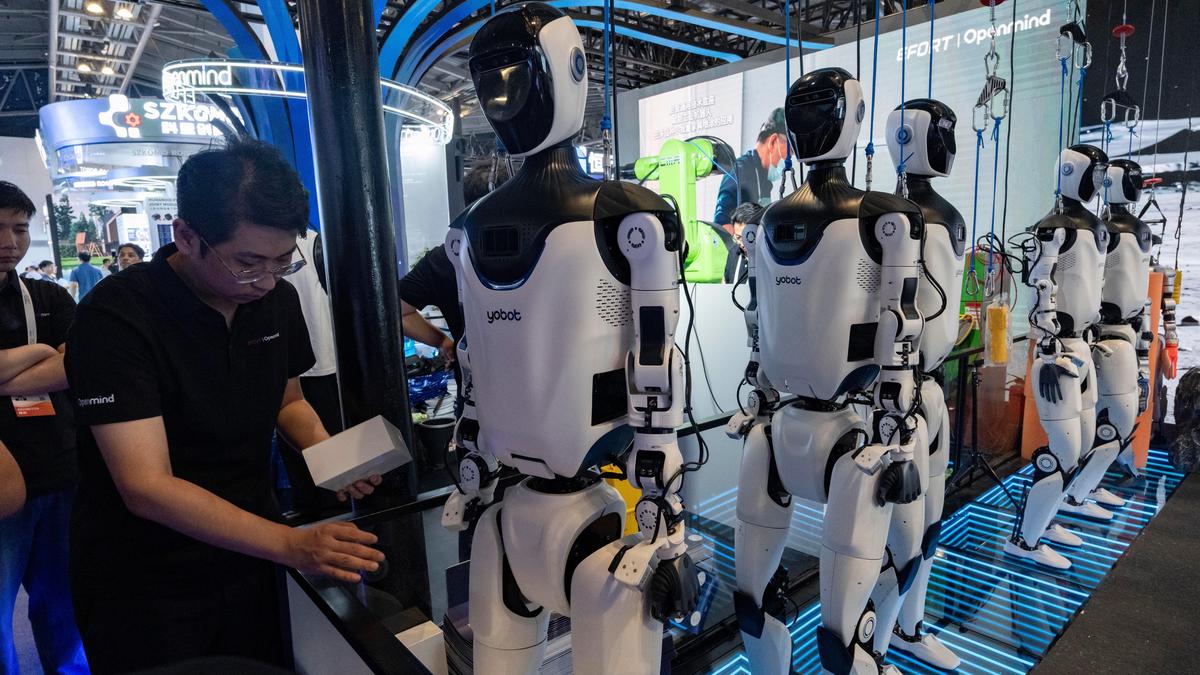
China has invested billions to become an AI superpower and has raced to integrate the technology across a range of industries. By 2024, more than two million robots were already working in Chinese factories. And in Beijing, Shanghai and Shenzhen, Meituan, the nation’s largest food delivery service, has experimented with using small autonomous robots to deliver food. But China’s advances in AI have run headlong into a growing problem: anxiety over the workers who could be displaced.

China’s political and economic history reveals that, despite being an authoritarian country, the Chinese government is very attentive to what people are thinking and saying on the Internet. History has taught them that another revolution will form if disenchanted and educated youth rise along with the disgruntled workers and peasants. They know they must respond.

Unemployment has been increasing in China. The unemployment rate for migrant workers rose to 5.7% in March this year, which has been the highest in nearly three years for China, while youth unemployment stood at 16.3% in April. Moreover, 70% of unemployed young people are university graduates, with older laid-off workers facing prolonged periods of joblessness.

However, Chinese courts have been swift to act. A court ruled in May that a tech company had illegally laid-off a worker after replacing him with AI software. Another ruled that, “the development of artificial intelligence technology should be applied to liberating labour, promoting employment and improving people’s livelihood”. And yet another ruled that “companies that benefit from technology must, at the same time, adopt social responsibilities and protect worker rights”.

China’s Ministry of Human Resources and Social Security announced in January that it would roll out policies to address the impact of AI on jobs, including targeted support for key industries. In June, the State Council issued a plan on implementing an “employment-first” strategy for the 2026-2030 period. Party officials have proposed sweeping government interventions such as requiring employers to offer training to help workers adapt to an AI-centric job market.

The Chinese government’s ‘people-first’ ideology has served China’s economy and its people well. China’s leaders have remained socialists; they have always put the needs of common citizens, and the stability of China’s society, above economists’ demands for deregulation of markets and prices, especially with respect to labour, food, education, health, and housing.

The road ahead for India

Indian income levels must rise rapidly — in agriculture, manufacturing, and services. The government has added ‘ease of living’ to ‘ease of doing business’ as the purpose of the reforms required for India to become ‘Viksit Bharat’ by 2047. To make it a reality, it will have to put more teeth into its policies to increase employment and incomes, and stave off the negative impacts that AI will have on employment. Policies must require that employers take more responsibility for training their own workers; they must be restrained from laying them off.

New policies must put workers’ rights ahead of capitalists’ rights, as China has done. India’s labour market reforms, with the four labour codes, are directed to improve ‘ease of doing business’, which is undoubtedly necessary. However, the ‘ease of doing business’ must now become subordinate to the ease of living and earning for all citizens.

India’s leaders would do well to learn from China’s leaders on how to navigate this moment in history. The rights of all workers must be firmly protected. While the views of financial investors must be heard, the views of workers and small-time entrepreneurs must be heard much more.

Arun Maira is Author of Reimagining India’s Economy: The Road to a More Equitable Society.

Published – July 28, 2026 01:24 am IST


Source link

Business Tags:Basic structure of economy, Cockroach Janta Party student movement, Employment for India’s youth, India unemployment problem

Post navigation

Previous Post: The woman reimagining Kattaikoothu for a warming world
Next Post: Delhi Police step up drive to take down posts on protests

Related Posts

  • Turning threads
    Turning threads Business
  • Gold declines ₹612 on strong dollar, weak global cues after Fed move
    Gold declines ₹612 on strong dollar, weak global cues after Fed move Business
  • Sensex, Nifty rebound in early trade on firm global cues, foreign fund inflows
    Sensex, Nifty rebound in early trade on firm global cues, foreign fund inflows Business
  • India, Israel likely to sign bilateral investment treaty next week
    India, Israel likely to sign bilateral investment treaty next week Business
  • Access Denied Business
  • CII wants Centre to push land, labour, agriculture reforms to boost growth
    CII wants Centre to push land, labour, agriculture reforms to boost growth Business

More Related Articles

Access Denied Business
Sensex, Nifty climb in early trade after 7-day decline Sensex, Nifty climb in early trade after 7-day decline Business
NHAI’s road assets monetisation can fetch up to ₹60,000 crore for government this fiscal: Report NHAI’s road assets monetisation can fetch up to ₹60,000 crore for government this fiscal: Report Business
Rate cuts transmission moderated in May 2026: RBI Rate cuts transmission moderated in May 2026: RBI Business
Sensex, Nifty tumble amid weak global peers, foreign fund outflows Sensex, Nifty tumble amid weak global peers, foreign fund outflows Business
Access Denied Business
SiteLock

Archives

  • July 2026
  • June 2026
  • May 2026
  • April 2026
  • March 2026
  • February 2026
  • January 2026
  • December 2025
  • November 2025
  • October 2025
  • September 2025
  • August 2025
  • July 2025
  • June 2025
  • May 2025
  • April 2025
  • March 2025
  • February 2025
  • January 2025
  • December 2024
  • November 2024
  • October 2024
  • September 2024
  • August 2024
  • July 2024
  • June 2024
  • May 2024
  • April 2024
  • March 2024
  • February 2024
  • January 2024
  • December 2023
  • November 2023
  • October 2023
  • September 2023
  • August 2023
  • July 2023
  • June 2023
  • May 2023
  • April 2023
  • March 2023
  • February 2023
  • January 2023
  • December 2022
  • November 2022
  • October 2022
  • September 2022
  • August 2022
  • July 2022
  • June 2022
  • May 2022

Categories

  • Business
  • Nation
  • Science
  • Sports
  • World

Recent Posts

  • Follow example of Dharmendra Pradhan, resign from post, Naveen to Odisha Education Minister
  • Rajya Sabha adjourned again; Opposition MPs seek apology from Amit Shah
  • Delhi Police step up drive to take down posts on protests
  • To fix unemployment, fix the economy first
  • The woman reimagining Kattaikoothu for a warming world

Recent Comments

  1. Jamesdix on UP Teacher Who Asked Students To Slap Muslim Classmate
  2. Brandonrok on UP Teacher Who Asked Students To Slap Muslim Classmate
  3. AlbertBloft on UP Teacher Who Asked Students To Slap Muslim Classmate
  4. Phillipjonee on UP Teacher Who Asked Students To Slap Muslim Classmate
  5. Patrickchemy on UP Teacher Who Asked Students To Slap Muslim Classmate
  • Chief Justice DY Chandrachud Shares He Was Caned In Class 5 And Why He Can’t Forget It
    Chief Justice DY Chandrachud Shares He Was Caned In Class 5 And Why He Can’t Forget It Nation
  • Shakib Al Hasan Undecided On Playing In Bangladesh’s Tour Of India
    Shakib Al Hasan Undecided On Playing In Bangladesh’s Tour Of India Sports
  • Sci-Five | The Hindu Science Quiz: On Amoeba
    Sci-Five | The Hindu Science Quiz: On Amoeba Science
  • Rupee falls 16 paise to 83.10 against US dollar in early trade
    Rupee falls 16 paise to 83.10 against US dollar in early trade Business
  • Solar projects inaugurated at Vizag hospitals to promote green healthcare
    Solar projects inaugurated at Vizag hospitals to promote green healthcare Nation
  • Access Denied Business
  • Access Denied
    Access Denied World
  • Access Denied Sports

Editor-in-Chief:
Mohammad Ariff,
MSW, MAJMC, BSW, DTL, CTS, CNM, CCR, CAL, RSL, ASOC.
editor@artifex.news

Associate Editors:
1. Zenellis R. Tuba,
zenelis@artifex.news
2. Haris Daniyel
daniyel@artifex.news

Photograher:
Rohan Das
rohan@artifex.news

Artifex.News offers Online Paid Internships to college students from India and Abroad. Interns will get a PRESS CARD and other online offers.
Send your CV (Subjectline: Paid Internship) to internship@artifex.news

Links:
Associate Journalism
About Us
Privacy Policy

News Links:
Breaking News
World
Nation
Sports
Business
Entertainment
Lifestyle

Registered Office:
72/A, Elliot Road, Kolkata - 700016
Tel: 033-22277777, 033-22172217
Email: office@artifex.news

Editorial Office / News Desk:
No. 13, Mezzanine Floor, Esplanade Metro Rail Station,
12 J. L. Nehru Road, Kolkata - 700069.
(Entry from Gate No. 5)
Tel: 033-46011099, 033-46046046
Email: editor@artifex.news

Copyright © 2023 Artifex.News Newsportal designed by Artifex Infotech.